Unknown's avatar

About B Gourley

Bernie Gourley is a writer living in Bangalore, India. His poetry collection, Poems of the Introverted Yogi is now available on Amazon. He teaches yoga, with a specialization in pranayama, and holds a RYT500 certification. For most of his adult life, he practiced martial arts, including: Kobudo, Muay Thai, Kalaripayattu, and Taiji. He is a world traveler, having visited more than 40 countries around the globe.

BOOK REVIEW: The Perfect Nine by Ngũgĩ wa Thiong’o

The Perfect Nine: The Epic of Gikuyu and MumbiThe Perfect Nine: The Epic of Gikuyu and Mumbi by Ngũgĩ wa Thiong’o
My rating: 5 of 5 stars

Amazon.in page

Out: October 6, 2020


As Homer did for the Greeks, Ngũgĩ wa Thiong’o does for the Gĩkũyũ people, using epic poetry to convey morals by way of gripping stories that are rich in both action and symbolism. The story revolves around a slew of suitors who travel from near and far with interest in the gorgeous and talented daughters of Gĩkũyũ and Mũmbi – the daughters being the titular “perfect nine.” [Lest one take the allusion to Homer too far, the problem faced in this story is not how to be rid of the suitors, but how to find the best of them and have the daughters each have a husband she desires. Also, in the case of this myth, the answer to the question of how to deal with the suitors is not to murder them all — on the contrary, discouraging the use of violence as a problem-solving tool is among the major morals taught throughout this work.]

I’ve long been meaning to read works by Ngũgĩ wa Thiong’o. I have a policy of reading literature from each country I visit, and when one looks into literature from Kenya his name stands above all others. He’s not merely one of the major figures in Kenyan literature, but of African and global literature as well. However, before I got around to reading one of his novels, I was lucky to have the opportunity to read his latest work, which is due out in the fall of 2020.

The story takes the Nine and their prospective suitors on a journey of adventure that will test their mettle as they carry out a mission, traveling through perilous territory that Gĩkũyũ and Mũmbi once traversed, themselves. As in Greek and Norse Mythology, the enemies are often supernatural, as is necessary given how capable the Nine are shown to be. Most of the suitors – certainly the ones that live through the early adventures — are no slouches themselves.

The morals that are conveyed through the story are non-violence (whenever possible), opposition to misogyny and patriarchal norms, a variety of virtuous attitudes and actions, and a kind of tribal attitude. By tribal attitude, I don’t mean tribalistic in the sense that that they suggest attacking or even denigrating those of other tribes, but Gĩkũyũ and Mũmbi insist that all the suitors and daughters live nearby — with none allowed to return to the homeland of the suitors. However, as this plays out in the latter part of the story in a way that I’ll leave to the reader to discover, there is an opportunity for learning that modifies the strong tribal norm. [It also leads to the teaching of another important virtue which is to avoid the “you’re dead to me” attitude that one often sees in stories when two parties are at loggerheads.]

I was fascinated by this work. Because — in the manner of mythology — it has some preliminaries to get through at the start, it felt a little slow out of the gates. [Though it was much quicker to delve into the adventure than were the early chapters of “The Odyssey” in which Telemachus goes out looking for his father.] So, don’t worry, the story gets into a taught journey of heroes in no time.

I highly recommend this book for readers of fiction and mythology.

View all my reviews

BOOK REVIEW: Shakespeare’s Comedies: A Very Short Introduction by Bart van Es

Shakespeare's Comedies: A Very Short Introduction (Very Short Introductions)Shakespeare’s Comedies: A Very Short Introduction by Bart van Es
My rating: 5 of 5 stars

Amazon.in


I picked up this guide because I recently finished reading through a superset of Shakespearean comedies. By a superset I mean all the plays that are unambiguously classed as comedies (e.g. “The Comedy of Errors,” “The Taming of the Shrew,” “The Merry Wives of Winsor,” etc.,) but also the ones called “problem plays” (i.e. “Troilus and Cressida,” “Measure for Measure,” and “All’s Well That Ends Well”) and some late plays that are sometimes called “romances” (e.g. “Pericles,” “Cymbeline,” “The Winter’s Tale,” and “The Two Noble Kinsmen.”) Having read 18 plays [in some cases] called Shakespeare’s comedies, I had questions that I hoped the book would help to answer.

The first such question is “what’s a comedy?” I was somewhat familiar with various literary definitions, but still plays like “Measure for Measure,” “The Winter’s Tale,” and even [in ways] “The Merchant of Venice” seem a bit dark – regardless of how things worked out for the lead character in the end. I was pleased to learn that I’m not the only one befuddled by this question. It turns out there is a great deal of debate among scholars on the topic. This topic is discussed in the introduction, in an epilogue, and at various points in between. The epilogue looks at one variation on the question, which is “When did Shakespeare stop writing comedies?” The reason is that his latter plays that are classed as comedies (on folios, playbills, and by scholars) tend be much more mixtures of tragedy and comedy.

The book is organized into five chapters, each of which takes on a different characteristic of the plays. I liked this arrangement as it allowed the author to compare and contrast Shakespeare’s work with his contemporaries on crucial aspects of a play. A recurring theme throughout the book is to consider what the norm was for comedies during that period and then to look at how Shakespeare followed, bent, or blew up the rules.

Though I liked the organization, I found some of the chapters more intriguing than others. The first, entitled “World,” explores setting. One major distinction between Shakespeare’s comedies and those of his peers is discussed in depth. While it was common to set comedies in urban environs, Shakespeare wrote a lot of forest scenes, and while he employed even more urban settings, van Es argues that the urban settings are forest-like in terms of expansiveness.

Chapter two examines wit in the works of Shakespeare. In doing so, it differentiates humor and wit and suggests the latter was more Shakespeare’s forte. The author also considers where Shakespeare’s wit is most clever and where it is ham-handed or even out-done by his contemporaries. One thing that I wish there was more of would have been elucidation of peculiarities of humor and wit of the day. There is some of this, and I did learn some new things. Still, when one is reading Shakespeare, no matter how much one is engaged by the story, there are references that one doesn’t know what to make of because while they must have made perfect sense in the lexicon of the time, they are meaningless (or divergently meaning) in today’s language. Some of these can readily be Googled, but not all. I have seen books that systematically explain such terms and phrases, but this one only offers a few examples.

Chapter three is about the theme of love. There is a lot that seems strange to modern sensibilities in Shakespeare’s work as pertains to love and relationships. Take “All’s Well That Ends Well,” Helena can have anything she wants from the King of France (who she cured of a fistula) but she insists on marrying Bertram — a man who despises her, resents her for what he views as having tricked her, thinks he is vastly better than her, and (worst of all) is not. How tricking a disgruntled jerk – Count or no – into moving back to live with one is considered a happy ending is hard to fathom. This was another area in which I was reassured to find that I’m not the only one who found some of the relationship matters bizarre.

Chapter four is about the element of time. During Shakespeare’s era it was normal for a comedy to take place over the course of a day – i.e. a short period. A couple of Shakespeare’s early comedies comply with this norm, but that is less and less the case as his works progress. “Pericles” and “The Winter’s Tale” both see infants grow into marriageable age (granted that was like 12 in back in those days, but still) over the course of a play. [Granted, not everyone would class those works as comedies.]

Chapter five was by far the most interesting to me. It discusses the idea of characters, and it does so largely by employing E.M. Forester’s conception of flat versus round characters. Comedies of the day relied heavily – if not exclusively – on flat characters. Characters that were like caricatures, having simple motivations and little of the depth that might make them relatable or sympathetic. The author argues that Shakespeare increasingly wrote characters that were – to a person — round. Shakespeare was often able to gain comedic effect by making characters seem flat at times for which it was called. However, it’s also considered that this need for roundness might explain why Shakespeare’s late “comedic” plays are far less clearly comedic than one might expect.

The book has graphics, references, and a further reading section.

Chapter five and the epilogue really improved my view of this guide. I was not displeased with it prior to that point, but didn’t think it offered any great value-added to my understanding of the topic. However, in the end I found the book highly informative and useful. If you’re looking for a concise, no-nonsense guide to Shakespeare’s comedies, it’s worth having a look.

View all my reviews

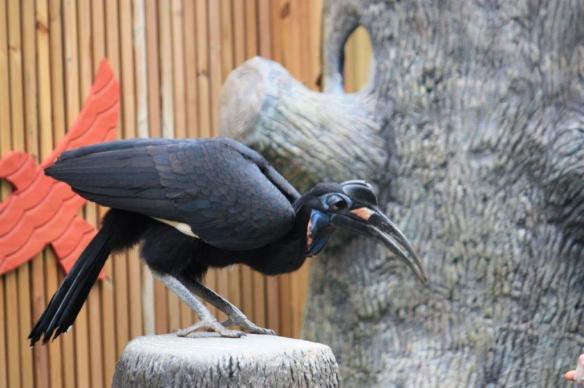
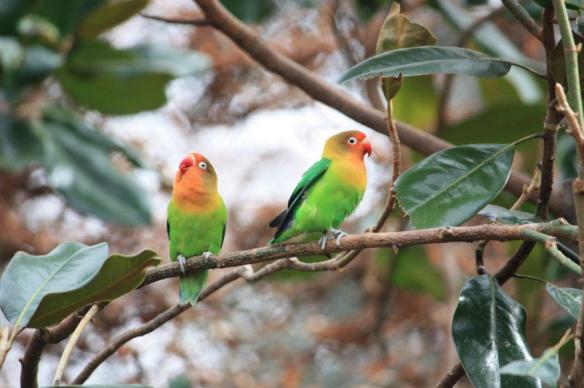
DAILY PHOTO: Scenes from the Zoo

Taken in December of 2012 in Zoo Atlanta.

POEM: Hate by Wire

Hate scuttles down a wire.
It was sent hatefully,
and received angrily.

But wire knows neither hate nor love —
nor does circuitry.
Electrons don’t.
Hardware doesn’t,
software doesn’t —
only wetware.


What passes down that line?

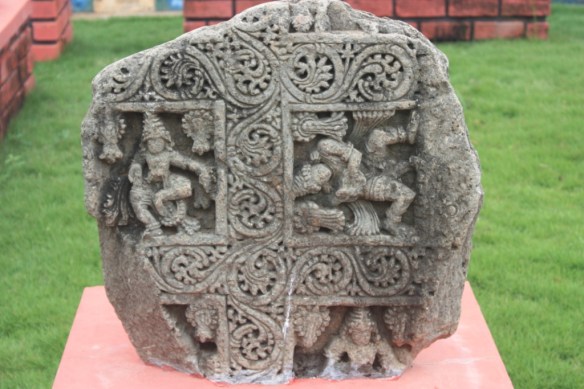
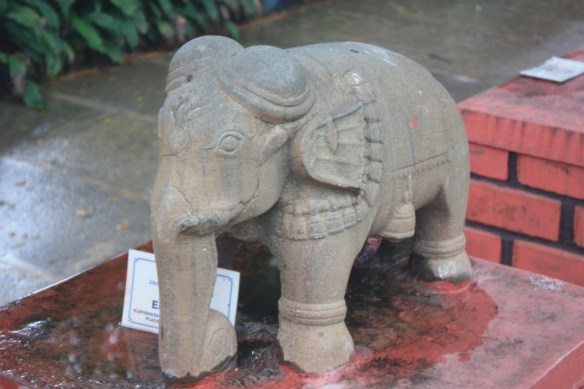
DAILY PHOTO: Carvings at The Government Museum

Taken at the Government Museum in Bangalore

Haiku that Move

a little rain
on a little slope
races seaward


the world blurs,
my brain strains to track
its motion


in stillness
one loses the world’s
steady spin


i throw myself
to silly dance — joyous
that i can


the perched raven
still swivels its eye
in stone mode

DAILY PHOTO: Sunrise in Bai Tu Long Bay

Taken in Bai Tu Long Bay in December of 2015.

POEM: Lost @ Sea

rum-dumb sailor,

bobbing in the horse latitudes —

dying dryly —

parched, in a fluid universe

he prays to the holy mother of Time —

prays that she have the courtesy to exist,

but she’s as silent as the wind,

and as invisible as the shore

DAILY PHOTO: Mountains, Near & Far

Taken near Pisaq, Peru in around 2010.

POEM: Questions of The Night Watch

What creates more and bigger monsters…

fear or drink?
boredom or loneliness?
Hell or High Water?

And when the Captain points the way…

How does one know that one has put the monster to the fore?
What lurks in the shadowed archway, behind?

Who charges forward to the tune of,

“Lead onward, oh ye of the pointy stick!”


And why does yonder illuminated woman carry a chicken?

It’s a snack too raw for the Night Watch,
but too small to distract a monster.