 The muddy cotton clouds
that shouted threats of rain —
packed in shouldering crowds,
oh, will they, won’t they drain?
I blinked and they had ripped,
growing a gap of blue.
How quickly fates were flipped,
and sun was shining through.


The muddy cotton clouds
that shouted threats of rain —
packed in shouldering crowds,
oh, will they, won’t they drain?
I blinked and they had ripped,
growing a gap of blue.
How quickly fates were flipped,
and sun was shining through.

Taken in August of 2016 in Nubra Valley
 Each step through the scree field must be judged on: angle, stability, slipperiness — but the flat, dry, and robust rock is the one that will roll on you — heaving you headlong, rolling over brick and boulder.
Crossing the glacier, each step is taken both like it won’t fail and like it inevitably will.
The former because one can’t fear one’s hips will slip out from under one, but the latter because one needs to be ready to stab an axe into the snowpack without the other end puncturing one’s ribs.
When you reach the altitude at which stepping is a series of singular activities — not a seamless sequence — you will love breathing like you haven’t since that time you were dangling upside-down outside the womb being smacked on the bottom by a masked man.

Taken in November of 2018 near Udaipur
 They call it the Veil —
an invisible world scaffolded against our own.
The thin space between is as a two-way mirror —
from the Veil we can be seen with crystal clarity,
but, from here, the Veil is obscured
by our own reflection.
Everyone wants a ticket to the Veil,
but it’s a dimensionless dimension
so your meat vehicle can’t be folded inside.
Veil-dwellers could come here,
but our world makes them agoraphobic —
tormented by the feeling one gets in a sci-fi movie
when the astronaut’s tether is severed,
and you imagine what it would be like to float
in a vast void until one’s oxygen runs out —
or one’s high-tech diaper catastrophically fails —
whichever comes first.
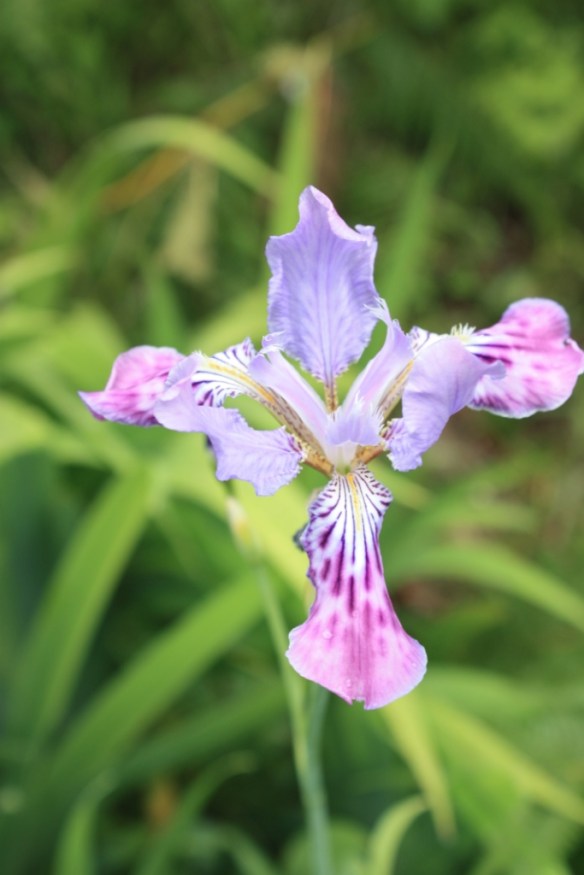
Taken in Himachal Pradesh in the Summer of 2015.
 If you can keep a heavy head high,
and facing that bright sun —
you’ll be able to lose, but still
feel, in a way, you’ve won.
Sunny, still, when the clouds crawl in;
gay though the day is done —
And in the dark hours you’ll have the
time to become unspun.
In a field of festive flowers
there’s one that’s lost its line.
Its face droops down, shyly twisted —
its sun refused to shine.
But its sun is surely the same
sun as is yours or mine,
though its coy stance speaks its own truth,
and follows its own sign.

It was an alien landscape,
in red-brown Martian hues,
but built of boulders older than
the skies have known the blues —
or so the locals always said.
But no man knew those views.
They date to days primordial —
before artist or muse.

Taken in February of 2012 at Zoo Atlanta.
 Dracula: Son of the Dragon by Mark Sable
My rating: 5 of 5 stars
There is a vast amount of vampiric fiction available today, and no small amount of it focuses on the character of Dracula. This graphic novel sets itself apart by building the story on real world events (such as they are known, and with dramatic license to make the story exciting and the imagery evocative.) At the risk of turning people off (but not intending to,) I would go as far as to say this book leads with history, and makes the supernatural secondary. I actually liked that about it. When I say the supernatural is secondary, it’s not like its eliminated from existence or that it’s purely garnish. There are dragons and vampires, but a story exists with or without those elements.
A story of war and political intrigue in what is now Romania is bookended by the depiction of a meeting between Vlad Dracula and three clergymen. In the opening, Vlad is telling the priests that he is about to let them in on the truth of his story, which they have no doubt heard in mythologized form. At the end, he asks the clergymen to tell him whether he will be allowed into heaven. The body of the story is a flashback from the meeting with the priests. It splits focus between Vlad’s father, who is working to keep his domain under his control by playing the ends against the middle vis-à-vis his Roman Catholic neighbors (notably Hungary) and the Ottoman Empire, and the story oft Vlad, himself. Vlad is a young man. He and his brother are sent to Scholomance (a kind of Slavic Dark Arts Hogwarts) and later become prisoners of the Ottomans.
I thought the artwork was easy to follow and stylistically appealing enough. Some of the frames in the ancillary material at the back were truly beautiful. I often disregard the back-matter in comics because it usually amounts to little more than discussion of how the drafts changed over time – i.e. offering insight into the sausage-making of the book. However, this book had an extensive Notes section that I found fascinating and useful because it explained how points in the book compared with known history. Some of the points that I assumed were pure fiction had a factual basis. Sable also related points to Bram Stoker’s “Dracula.” The creators tried to be consistent with Stoker’s book, as well as with history, when they could. The former wasn’t so hard because readers of Bram Stoker’s will recognize that the titular character is kept largely a mystery, particularly with regard to his backstory.
If you are interested at all in the historical and mythological basis of the Dracula vampire, I’d recommend this book. As I said, the notes will give you a good idea of what was known to be true, what is complete fiction, and what is a kernel of truth enveloped in story sensationalism. Obviously, all the supernatural elements are pure fiction, and also there is a lot that remains unknown, but this graphic novel provides an interesting take on the origins of Vlad Dracula.


