BOOK REVIEW: Global Catastrophes: A Very Short Introduction by Bill McGuire

Global Catastrophes: A Very Short IntroductionGlobal Catastrophes: A Very Short Introduction by Bill McGuire
My rating: 4 of 5 stars

Amazon.in Page

This book explores a select set climatological, geological, and extraterrestrial impact disasters and their potential planet-wide repercussions. About half of the book deals with climate: global warming and the next ice age. [Those sound like completely unrelated topics, given global climate disruption is largely about a rise in average temperatures (which has been caused by human activities) and the coming ice age is about cooling (which is mostly because of factors outside our control — e.g. our orbital path and axial tilt — but there’s a discussion about how global warming might hasten (rather than stave off) the ice age.]

The other half of the book is about the more dramatic geological and extraterrestrial threats. There’s a chapter (ch.4) about volcanos, earthquakes, and the tsunamis they cause, and the last chapter (ch. 5) is about comet and asteroid impacts.

The book contains a great deal of thought-provoking information. There are two major criticisms to be leveled. First, it leaves some important items undiscussed – e.g. there’s nothing about the solar storms that I’ve heard constitute a planetary risk. (I do understand that technologically induced catastrophes are another book entirely.) Also, there’s little mention of the mitigative activities that are in place and what impact they might have. For example, I know NASA and others have developed technologies to not only monitor but also destroy impactors. (The author mentions monitoring but says nothing of mitigative activities.) I can’t condemn these omissions severely because this is a “very short” guide. The second criticism is potentially more concerning and that is that the tone isn’t the completely objective one we’re used to hearing on scientific subjects. I don’t fault the author for having some angst about climate change or super-volcanoes, but I am left to wonder degree of confirmation bias crept into the selection of research presented. (All “sky is falling” with no discussion of possible mitigative events or best-case scenarios sets my Spidey-sense a tingling.)

This is a fascinating look at catastrophes, though the complete doom and gloom tone of the author made me wonder whether confirmation bias might be at play (or maybe there was a presumption about what people who would read such a guide may want to hear.)


View all my reviews

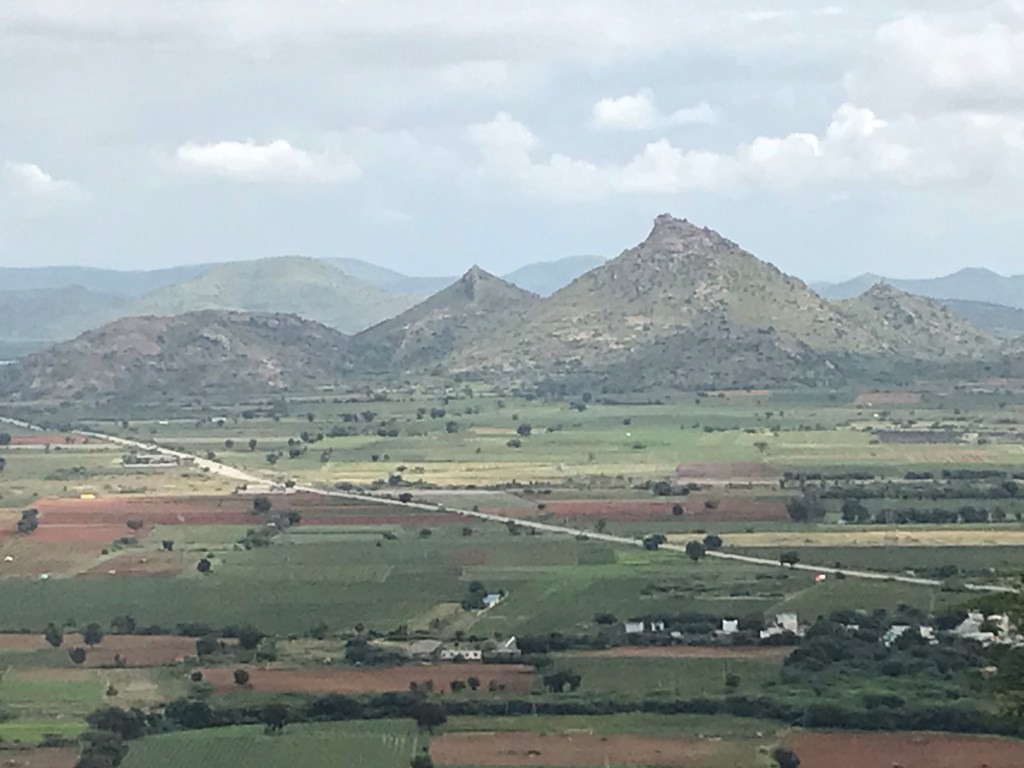
Faux Tsunami [Haiku]

the hills break
like tsunami waves
on a postcard

POEM: Tsunami

She flips a sheet over the line,

smoothing it by pulling the ends wide.

Looking out to a vague and distant rumble,

she sees a wall of water climb from the sea.

A crazy person would smile at the idea of

putting laundry out to dry in a tsunami.

But, sanely, she runs for high ground.

Everything she owns is soon to be debris,

unclaimable, indistinguishable, and unsanitary.

But she doesn’t think about that.

She can’t think about anything.

Zen mind is her saving grace.

 If she thought about how

tripping, struggling to her feet,

and resuming a limpy run

would spell her doom,

She’d trip, fall, sprawl

and be pummeled

by flotsam–

that chunky stew of humanity’s refuse.


[National Poetry Month: Poem #21]

The Force of Nature

This video begins on the peaceful banks of a river in a nondescript Japanese town. The first minutes of footage is unremarkable except that the water level is quite low, but as it might be in dry season or low tide. Then there is a shrill siren and an urgent warning by loudspeaker–events that will replay periodically throughout the video. Twenty-five minutes later, the camera is fixed on throngs of people trapped on a rooftop across the river. Dawn slinked in and it would be too dark to see these rooftop refugees, but they are silhouetted by the glow of the fires that rage in the background. In the footage in between, one sees houses and ships being carried by the water as if they were a child’s toys washed away by an overturned bucket of water–but brown, debris-laden water that is roiling and churning. Eventually, we see the river reverse its flow.

Someone posted this on Facebook yesterday. I watched all 25 minutes of it. Who watches 25 minutes of shaky, hand-shot home movie? Not me, normally, but I was compelled by the force of nature. They say that one of the things that differentiates humans from even our closest primate brethren is that humans routinely achieve the identical physiological state emotionally from remembering tragedy as from experiencing it first hand–or sometimes even through being exposed to them remotely.

I thought about this force of nature, at first in the literal sense–a pedestrian bridge swept away and freighters swept up a normally unnavigable river. Then I wrote the first 1,000 words or so on a short story entitled The Ghost Ship Onryō that was inspired by watching the tsunami and remembering the news stories it triggered. The story is quite dark, as matched my mood for much of yesterday. Such is the force of nature, to compel me to change my plans and to morph my emotional state through ripples that continue to expand years after the event.

Was the Fukushima-Daiichi Incident the Final Nail in Nuclear Energy’s Coffin?

Today is the two-year anniversary of the tsunami that swamped parts of eastern Japan. Among the ongoing effects of this event was a re-chilling of attitudes toward nuclear energy–undoing a thaw that some swore was imminent. The tsunami hit the Fukushima-Daiichi plants and knocked out generators that were needed to run the coolant pumps with the power lines down. In the days after the disaster, the release of radioactivity and explosions of built up hydrogen presented some of the most prominent news stories.

Japan obtained about a third of its energy from nuclear prior to the event. All reactors were shut down in subsequent months, at no small cost to their economy. Eventually, a couple of plants were brought back on-line, providing only a fraction of the electricity of the country’s full fleet of 50+ nuclear plants.The Japanese had plans to add another 15 plants to their reactor fleet at that time, plans that have since vanished.

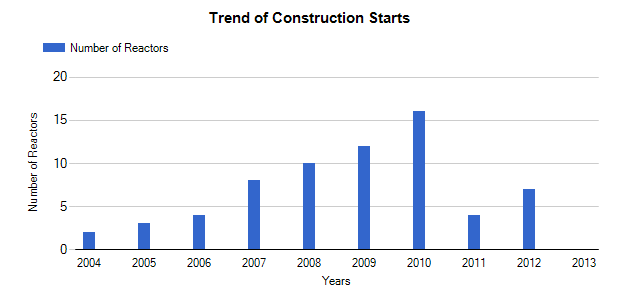
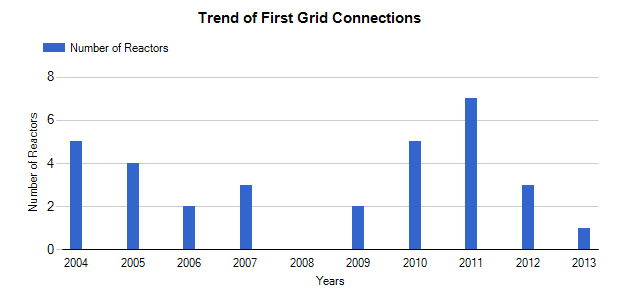
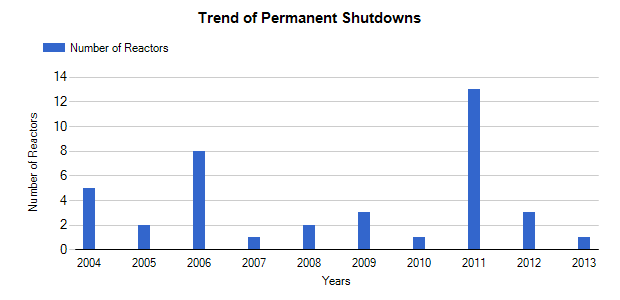
Even China, the world’s most prolific builder of nuclear plants as of late, had a brief moratorium on nuclear power plant (NPP) construction. However, China seems to have regained its ardor for nuclear power. France, of course, won’t be dissuaded either. However, for much of the rest of the world, doubts remain.

Pictures may be worth a thousand words.

Source: International Atomic Energy Agency (IAEA) Power Reactor Information System (PRIS)

Source: International Atomic Energy Agency (IAEA) Power Reactor Information System (PRIS)

Source: IAEA PRIS

Source: IAEA PRIS

Source: IAEA PRIS

Source: IAEA PRIS


The Nuclear Renaissance and International Security

Edited by Adam N. Stulberg and Matthew Fuhrmann

2013, Available Now

Buy this book

ONLINE RESOURCES
Contents

Contributors

Introduction