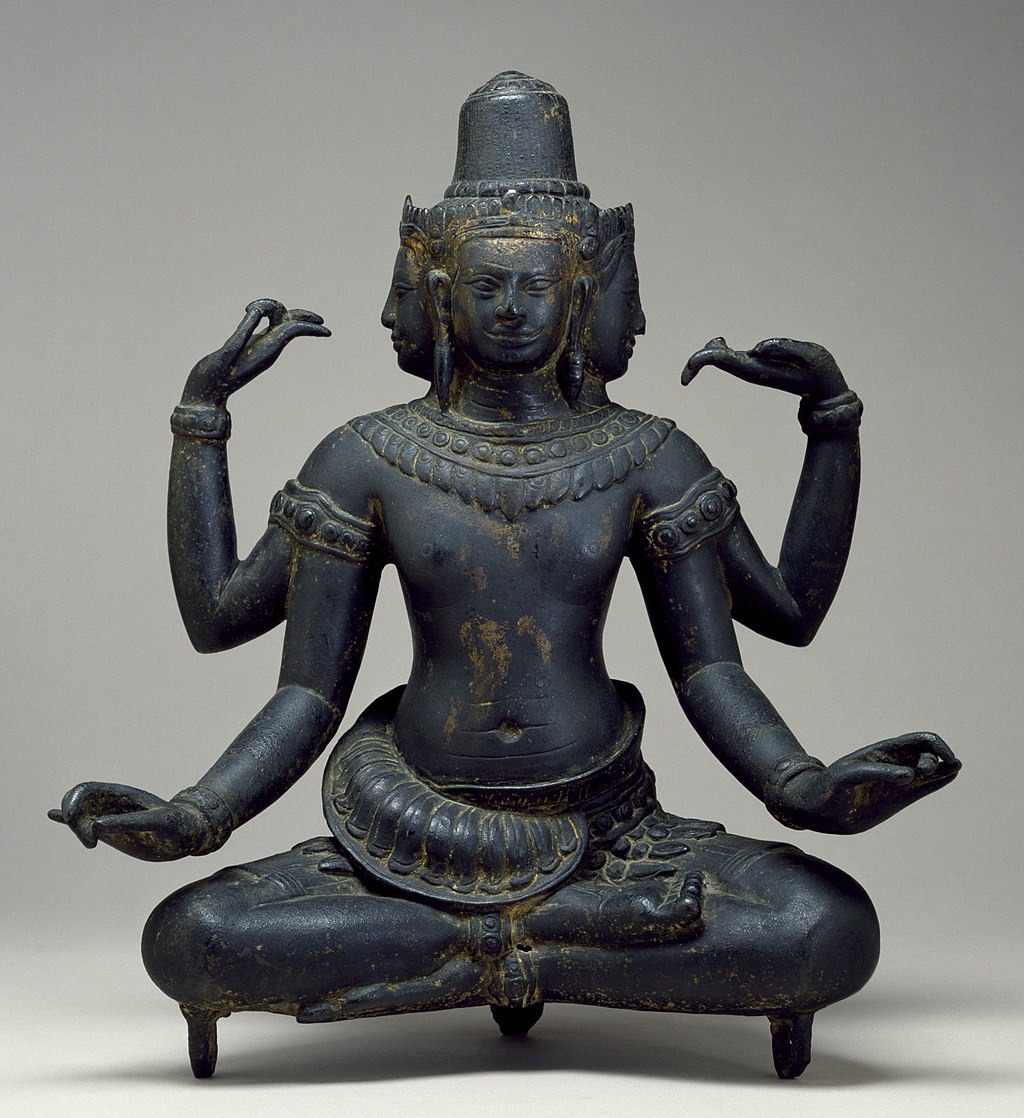
If the red slayer think he slays,
   Or if the slain think he is slain,
 They know not well the subtle ways
   I keep, and pass, and turn again.

Far or forgot to me is near;
   Shadow and sunlight are the same;
 The vanished gods to me appear;
   And one to me are shame and fame.

They reckon ill who leave me out;
   When me they fly, I am the wings;
 I am the doubter and the doubt,
   I am the hymn the Brahmin sings.

The strong gods pine for my abode,
   And pine in vain the sacred Seven;
 But thou, meek lover of the good!
   Find me, and turn thy back on heaven.
You're my Analects,
           my Gita,
           my Dao De Jing,
           my sutras,
           my Meditations,
           and my Republic
 all rolled into one.

You are the scripture by which I live.

You present a path to that rare place:
            extreme confidence
            which tears no one down,

            but, rather, lifts all.

You achieve this by crushing
            the ordinary.

Nothing is common.

Everything is a miracle.
            (Even those leaves of grass
                      you repeatedly reference.)

No one is so rough
             or promiscuous
             or simple
as to be lowly.

Your author's unbridled enthusiasm
             glowed with the insane confidence
             of an adolescent boy,
but his awesomeness was never gained
             by subtracting from others.
Rather by seeing the bright, beautiful spark
             in each body,
             mind,
             pair of hands,
             & burdened shoulder.

You are America,
             the America we want to be.

The America that labors,
             but which takes time to see
             its natural wonders.

The America that heard what Jesus said,
             and became less excelled at stone-throwing,
             and more at cheek-turning.

The America that could see beyond dogma
             and hard-edged tribalism,
             and could learn from all the
             grand & glorious people
             who reached its shores --

So that we could be the best version of ourselves
            through the strengths of all of us,
            and not be stymied by missing
            the great beauty & knowledge
           among us.

You pair away the extraneous burdens
            which tax the mind,
and show us what the world looks like
             unfiltered.

You teach one to see a beauty
            that is so well hidden
            that its own possessor doesn't
                      recognize it.

You are the song of a life well lived.
“I desire that there may be as many different persons in the world as possible”
Henry david thoreau, Walden
Too many people wish that the world consisted
of those who held the same views as they -

who loved what they loved,
who believed what they believed,
who would do what they would do.

I can't imagine a more boring world than that.

If there aren't those with different:

ideas,
desires,
beliefs,
and values,

then who will show me something new:
something that -- for good or for ill --
will change my world
and advance my understanding.

If truth be told,
I'd just as soon spend time
among the crazy sages who --
having rejected all programming --
will not be made prisoner to a train schedule,
let alone to a norm or convention or protocol.

The madmen who shaman one
out of all mental conventions.

But such as they are hand forged,
each vibrating at his or her own wavelength --
hard to see and
 not easily found.
Amazon.in Page
Free Online: Emersoncentral.com
In this short essay (about ten pages,) Emerson lays out an argument for Idealism over Materialism, and then contends that it’s reasonable to excuse oneself from the economic and civic aspects of society in favor of a simple life of introspection. [e.g. As Thoreau did in his years at Walden Pond.]
Emerson opens by suggesting that Transcendentalism is just Idealism by a different name. Idealism being a philosophical stance which puts consciousness at the fore while proposing that there is something beyond [that transcends] our experience of sensory information. The arguments put forth in favor of Idealism include the fact that sensory illusions exist and the Kantian critique of Locke’s view that there’s no more to the intellect than that which is or was sensory experience; Kant argues that there’s intuition. Kant’s influence is considerable, and Emerson explains that even the term “Transcendentalism” is derived from Kant’s use of the term “transcendental.”
The latter part of the essay echoes Emerson’s masterwork, the essay “Self-Reliance.” It proposes that it’s perfectly laudable to take advantage of the greatest gift one has, one’s consciousness, to introspect and indulge one’s need to better understand.
I may have mixed views on Emerson’s ideas, but one can’t say he doesn’t use language and reason and passion to make compelling claims. I found this brief essay to be both thought-provoking and inspirational, and I’d highly recommend it.






 Tiger Riding for Beginners