POEM: Rush

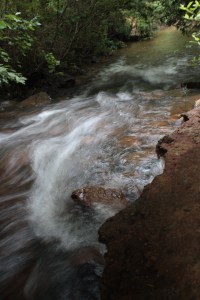
Rushing water carves rock and clay away,
gouging out a statement in nature’s hand.
Water spatter creates a misty spray,
stinging sharply as pelted with wet sand.

A foamy ridge takes a serpentine form
on the glassy warp field glazing brook stones.
This wild water isn’t born of savage storm;
it’s the effortless effort of Zen koans.

My camera fails to capture the calm scene,
but blurs it into a tiny tempest,
transforming a mundane forest stream
into a world scarring menace.

In these rapids I see a tsunami
washing over isles of Izanami.

BOOK REVIEW: Erotic Poems ed. Peter Washington

Erotic PoemsErotic Poems by Peter Washington
My rating: 5 of 5 stars

Amazon page


This collection stands as one volume in a series entitled “Everyman’s Library Pocket Poets.” Other volumes in the series feature the work of a particular author, a regional or national poetic tradition, a type of poem (e.g. sonnets,) or – like this one – a central theme (e.g. friendship, love, animals, war, etc.)

It’s a broad ranging collection. It covers a period from before Christ (e.g. the Roman poet Catullus) to twentieth century poets such as Sylvia Plath and Joseph Brodsky. The poetry also spans the globe including not only English language poets of Britain and America, but also translated poetry from India, the Middle East, China, Japan, and elsewhere. The poem’s lengths range from the brevity of a Bashō haiku to long poems such as Keats’s “The Eve of St. Agnes.” Epically long poems aren’t included, though there are excerpts such as that of Shakespeare’s “The Rape of Lucrece.” There is a favoring of classical English forms (e.g. iambic pentameter) even among many translated poems, but that doesn’t mean that the collection lacks diversity of form.

One nice thing about the diversity of poems is that one gets to see how various cultures and time periods dealt with erotic content. It should be noted that readers who are expecting poems that are erotic in the sense of being pornographic or bawdy by today’s standards are likely to be disappointed. That said, while many of the erotic elements are veiled in symbolism, that isn’t the case throughout. There is some explicitly erotic content among the collected poems. (Though, not as explicit as one sees in the works of Allen Ginsberg, for example.) It was interesting to see that it isn’t necessarily that the further back one goes in time the more repressed or veiled the writing is. On the contrary, some of the Latin and old Indian poems were among the most explicit. Of course, decoding the meaning of poets, and the savoring of reading that requires, is part of the joy of reading poetry.

I enjoyed this collection. I thought it was nice gathering of poems that explored sensuality, romance, and eroticism.

View all my reviews

POEM: The Curious Tower [a Sonnet]


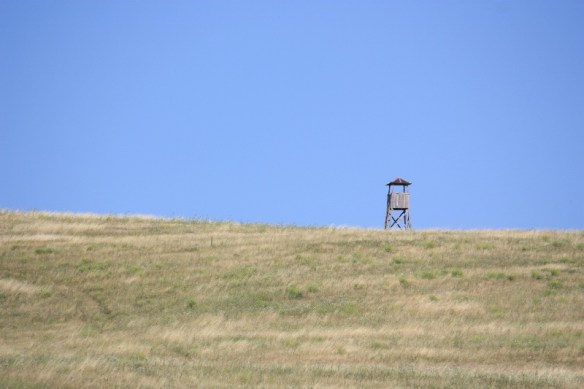
And in my dream I saw a vast expanse.
To the horizon tawny hills did roll.
Stood nothing but a tower in stout stance,
to burden the barrenness of this knoll.

Such an anomaly must draw one near.
So I began to march with all my might.
Hours down, feet sore, with vanishing good cheer,
as the tower retreated from my sight.

What devil played these tricks inside my mind,
and thieved that wonder under the blue dome
that suggests the existence of mankind
in this slumber simulacrum of home.

When I awoke the world seemed right again,
a world where all resides beyond my ken.

POEM: Literary Allusions

Captain Ahab, go chase your whale!
Better obsession end in death than jail.
Though Thoreau’s case for the latter
takes task with escapees like Hatter.
But then again everyone needs a head.
Perhaps, just let them think one dead?
Ask Tom and Huck what could go wrong
when found out by an aggrieved throng.


Should one tilt at windmills and take beatings,
or pass upon the heroic moment fleeting?
La Mancha versus Fleming, which one is penned
to know what’s true in the end?

POEM: Lonely Oak


I
lonesome oak on a hill


having outlived your peers


your progeny denied the light
by scythe and mower blade alike


II
it’s said you speak by pheromone
but no whiff is caught when alone
your words disperse unsmelt
lost across a manmade veldt


III
if it’s any consolation
you have our unflagging admiration
you’re the model of stately poise
to all the little girls and boys


who swing about your stout limbs

BOOK REVIEW: Chicago Poems by Carl Sandburg

Chicago PoemsChicago Poems by Carl Sandburg
My rating: 5 of 5 stars

This collection put Sandburg on the map as a literary figure. It opens with one of his most famous poems “Chicago” (i.e. “HOG Butcher for the World, Tool Maker, Stacker of Wheat…”) and – as the title suggests – the windy city is a recurring theme throughout the collection, and not just within the first of seven parts of the volume, which is eponymously named. Sandburg takes on the gritty and the glorious of Chicago. The collection includes about 140 poems of various lengths and styles.

The first part of this collection is by far the largest, consisting of about fifty poems, most of which are free verse or prose poems of short to intermediate length (a few lines to few pages per poem.) In addition to one of the most famous of Sandburg’s poems, “Chicago,” which opens the collection, there are a number of lesser known personal favorites in this part including: “Fish Crier,” “Happiness,” “Mag,” and “Mamie.”

The second part is called “Handfuls,” and – as the name suggests – it features short poems. This section begins with another of Sandburg’s most famous poems, “Fog” (i.e. The fog comes on little cat feet.”) The third part is entitled “War Poems” and it gathers together a few poems written during the First World War. My favorite is probably “Statistics” which takes an expectedly grim view of the nature of modern warfare with a bit of gallows humor. The other sections of the book are: “The Road and the End,” “Fogs and Fires,” “Shadows,” and “Other Poems (1900 – 1910.)”

Those who are familiar with Chicago will recognize the frequent references to streets and neighborhoods, but one needn’t be a Chicagoan to benefit from reading this collection. At times, the collection presents an edge of angry protest as Sandburg rails against Chicago as a place that grew opulently wealthy in the making of the modern world, but in which so many struggle to survive. However, it’s not all grim. Sandburg also dotes admiringly on the magnificence of the city. In fact, the theme presented in “Chicago” – a defense of the mixed nature of the city – can be seen exploded across the collection.

I enjoyed reading these poems. Sandburg uses both sound and imagery to evoke emotion. While he writes without rhyme and often without meter, he doesn’t abandon the sound quality (one need read no further than “Chicago” to hear this.) I’d recommend this book for all poetry readers.

View all my reviews

POEM: Man Glued to Phone Spends Eternity on Elevator

A man joined me on the elevator.
He pressed no button, but rode along.
When I got off, I said, “See you later.”
The doors closed and reopened with a “bong.”


I turned to see if the elevator’s chiding
would wake the man from his phone-fueled languor.
And put him on the path of proper riding.
Or whether it’d take a more persistent clangor.


The elevator gave up, shut, and ascended
To this day, I can not help but wonder
whether the man’s reverie ever ended,
or whether the phone’s spell he’s still under.


And does he still spend his days in futile elevating?

POEM: Missed Mark

engine whine, in a dive

pray to god to be alive

when the bombs missed their mark

hit some pristine city park

turf and rubble, an ugly mess

wild-eyed people in distress

and trembling lips do confess

a fugue state born of savage stress

 as dreams of a peaceful past glide by

POEM: Revolving Exile

He was an exile.
Shoved through a turnstile.
Kicked to the burn pile.


One day he walked back.
Followed the train track.
He’d no need for hijack.


Then, sitting on a park bench.
Life threw him a monkey wrench.
And he couldn’t entrench


So he got caught by the eddy.
When he wasn’t ready.
“Not again!” said he.


As he swung around again.

POEM: Speak True

Oh, speak true and from the heart,

did you hear my tiny fart?

I tried to keep it pent inside,

but sometimes farts, too, swell with pride.