No. Snow and ice can’t rectify my mind.
Don’t pray I’ll flash fire it into a boil.
I’ll seize, sullen, frozen, as a gargoyle.
Frost will form on my eye, and I’ll be blind.
A thaw comes only in the state entwined.
If only I were gifted at that toil.
I watch Trussed Wonder’s melt begin to roil,
wondering how they knew which way to wind.
But nature graces those lacking talent.
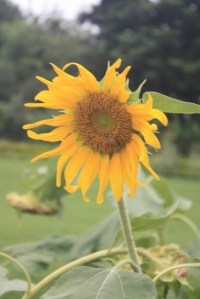
A sunflower’s wisdom is all one needs.
Making turning to the sun look gallant,
is the lazy thaw path to being freed.
There is no flash fried wisdom you shouldn’t shun,
but, perhaps, just revolve to face the sun.
Tag Archives: poetry
POEM: Decay
People fear death,
but beyond death lies decay,
and one can rejoice in decay.
For to decay is
to be Santa handing out piles of gifts,
building blocks badly needed to make
stalks and sternums.
Becoming the dark, rich loam,
the color of coffee grounds,
from which shoots and leaves
sprout to chase the light.
Your gifts will keep giving
despite the people grieving
because you are a pile of
recyclables.
POEM: Surrender

The arrogance, shoving words into rows,
try to describe someplace only god knows.
A cube of rock, turned edge skywards,
loftily defying each, and all, of my words.
Jolie laide in its craggy perfection,
free from all vanity and dejection.
When it shrouds itself in cloudy veils,
it doesn’t do so because it quails.
It demands no awe and yet has mine.
It is the sacred, sans the shrine,
and, before it, I bow.
POEM: My Theory on the Long Shadow of Hitler’s Mustache
People once saw in it great panache,
but Hitler killed the toothbrush mustache.
Now no one would dare to wear it.
Except that groundskeeper from Magnum P.I.
who turned out to be the mysterious millionaire.
Maybe, his wealth was Nazi gold?
But that isn’t my theory of the long shadow of Hitler’s mustache.
My theory is that when the short mustache comes back in fashion,
great evil will sit upon our doorstep.
For it is more than a choice of facial hair,
it’s a barometer of remembrance
that lacks an indicator of the half-life
of evil’s stain upon our collective consciousness.
Or, maybe, it just looks stupid on your face.
As if you made a dreadful razor error
and tried to play it off as a plan
through use of symmetry.
In which case, someone should be charting
the rate of application for name change by
Hitlers, Himmlers, Goebbels, and Görings.
BOOK REVIEW: Aimless Love by Billy Collins
Aimless Love: New and Selected Poems by Billy Collins
My rating: 5 of 5 stars
I hope this isn’t taken the wrong way, but Collins is to poetry what J.K. Rowling is to the novel. By that, I only mean that his poems are as popular as poetry can be these days because they are readable, avoid needless complications, give challenge to pretentiousness, and are just plain entertaining. Collins combines dry humor, surreal elements, and profound observations to make poems that readers can either readily relate to or find hilarity in. While he does touch on traditional poetic topics like love and nature, he spends more time on language, quirkiness in everyday life, and poetry itself.
This book combines a collection of 51 new poems with “greatest hits” selections from Collins’s previous four collections: NINE HORSES (22 poems), THE TROUBLE WITH POETRY (16 poems), BALLISTICS (29 poems), and HOROSCOPES FOR THE DEAD (24 poems.)
The opening poem, from NINE HORSES and entitled “The Country,” displays typical Collins humor as it takes a parent’s warning to not leave strike-anywhere matches out and about because mice might start a fire, and brings it to its absurd conclusion by showing it. Odd little thoughts that flicker into and out of consciousness are a mainstay for Collins, and he wrings the full wit from them. “Litany” may be my favorite poem from the NINE HORSES selection. It takes the standard poetic tool of metaphor and shows the silliness that can result when it’s employed without context.
The selections from THE TROUBLE WITH POETRY include intriguing reflections on particular words. Examining the personal meanings of words as well as the meanings words migrate into is a common subject for Collins. This can be seen in poems like “Lanyard” and “Genius.” However, while those poems — as well as the titular poem — are enjoyable, the most hilarious is “The Revenant.” This poem turns the sanctity of the mutual bond of man and man’s best friend on its head as it imagines if a dog could tell its master its true feelings.
In BALLISTICS we see several examples of another recurring approach used by Collins and that is the use of a quote as the premise of a poem. “Tension” is among the funniest of these in which some advice to writers about the risks of using the word “suddenly” is put to the test. My favorite from this section may have been “Old Man Eating Alone in a Chinese Restaurant” in which Collins admits he’s glad that he avoided that old chestnut as a young poet because now he’s said old man.
In HOROSCOPES FOR THE DEAD we see a few poems (in addition to the titular one) that concern themselves with mortality, including a whimsical ride through a cemetery on a bike – “Cemetery Ride.” However, “Table Talk” is among my favorites for the joy it takes in mocking pretentiousness. In the poem, an individual brings up Zeno’s most famous paradox, suggesting no arrow should ever hit its target because it always has to halve the remaining distance – and, thus, should remain forever at bay.
Among the new poems, “To My Favorite 17-Year-Old High School Girl,” is among the funniest and is most certainly the one with the most general appeal to readers. In it, we see a father celebrate his daughter, but with no shortage of backhanded compliments as he compares her to other teenagers who were more productive, brilliant, or at least more helpful around the house.
I found this collection to be immensely enjoyable and I’d recommend it for anyone. Even if you aren’t a poetry reader, you may find this collection makes you one.
An Introvert’s Poem
Please don’t take this the wrong way,
but I wish you existed fewer hours per day.
It’s not that I don’t like your company.
It’s just that I wish your dosage were smaller.
It’s not like I wish you thinner, prettier, or taller,
I just wish there were less of you — temporally speaking.
POEM: Joker, or: Disruptive Forces
Among the brick rubble, down a side street from the temples encased in spiky, cuboid scaffolds, next to a bulging wall bolstered by beams knocked in at a slant, someone painted this graffiti of Heath Ledger’s Joker.
I stare at the maniacal face and can’t help but wonder whether someone painted it in the seven years between Ledger’s portrayal and the 2015 earthquake that broke Bhaktapur, or whether it’s a commentary on disruptive forces.
POEM: Dad’s Strange Lexicon
My father had a strange lexicon.
In second grade, we were playing a word-guessing game like the game show Password (if it were in a classroom of spastic 2nd graders.)
The word was: “BARN.”
I offered the clue: “HAYMOW.”
You can imagine the puzzlement in a classroom of mostly “city” kids raised on Richard Scarry vocabularies. I almost got beat up when my team — the losing team — decrypted my clue into “hayloft,” a clue that would’ve easily won the game.
Our house had a DOG-TROT. I know it was toward the middle of the house, but have no idea what its defining characteristic might have been. I do know that I never saw a single dog trot through the middle of our house because of the policy of “Outside for Animals – Inside for Humans” that reined in our household, except when a wily field mouse snuck in through the basement or a wood duck — distinctly lacking wiles — snuck its way down the chimney and into the wood stove.
I was told, with great conviction, that a “HAN-YAK” was second cousin to a “POT-LICKER.” As a child, I missed that these were terms of derision, and — I fear — I may have hung a slander upon my cousins by licking some marinara off the lip of a piece of cookware once upon a time.
POEM: Park in Motion
Three sights seen on my run in the park:
1.) a pup trotting in yaw as its nose and spine aligned on another dog while its neck followed the vector of the leash
2.) a slim-wristed, kurta-clad woman marching with such vigor of arm swing as to make it appear that her arms were rubber from the elbows down
3.) pairs playing net-less badminton such that making one’s “opponent” take a step would be considered bad form
BOOK REVIEW: Beowulf Translated by Seamus Heaney
Beowulf by Unknown
My rating: 5 of 5 stars
“Beowulf” is a narrative poem, originally composed in Old English (Anglo-Saxon), telling the story of the hero, Beowulf, and his battles against monsters. In a sense, it’s an early superhero story. Mere mortal men are no match for the warrior Beowulf; he battles the monster Grendel who’s been terrorizing the banquet hall of a Danish king, that monster’s mother, and – later in life, back in his homeland – a dragon. While the poem isn’t formally broken up into subparts, these three battles and the events leading up to each can be thought of as the three sections of the poem. It reads as the highlights of a warrior-hero’s life.
Heaney’s verse follows a form reminiscent of the Anglo-Saxon approach to verse without sticking to the form it so rigidly that it becomes difficult to read. The Anglo-Saxon lines consist of two halves balanced with two stressed syllables each and alliteration across the caesura (the line’s midpoint break.) Heaney often alliterates across a line’s mid-point, but sometimes the alliteration is packed into one half, and sometimes it’s non-existent. That’s not a criticism. It’s actually beneficial because it’s incredibly easy for the reader to follow Heaney’s translation. The more dogmatic one is about form, the more hoops one makes a reader jump through to understand. Heaney also doesn’t restrict himself to a single approach to meter, and his lines tend to be longer than the original. This translation doesn’t require complex decryption of cryptic or archaic language. Besides, for those who want to read to hear the meter and precise proper alliteration, the Anglo-Saxon version is included. (As is typically of bilingual editions, the original is on the left-hand page and the translation is on the right. This also makes it a short work as half of the 200-ish pages are the Anglo-Saxon version.)
It’s a straightforward book. There’s an introduction in which Heaney explains how he got involved with this project as well as providing some translation notes, there’s brief exposition on how names work in the story, and there are family trees to help keep the characters straight (the latter is important because of the nature of naming addressed in front matter.) Otherwise, it’s just the poem and its translation.
I enjoyed reading this translation. It is easy to follow while offering some beautiful use of language. I’d recommend this book for just about anyone, whether a reader of poetry, heroic tales, or historical fiction.