POEM: Faces & Places of My Dreams

I once read that one never dreams:
-a place one hasn’t been, or
-a face one hasn’t seen.

This is either false, or
I’ve been a lot of places:
-of which I’ve no waking recollection,
-which don’t exist in my photos, and
-which no one ever asks me,
“Do your remember that place…”

I’m less confident that my mind generates faces —
except that I’ve dreamt featureless faces, and
I’ve sure never seen one of those while awake.

But, given that a blonde wig on a brunette actress is
— apparently —
enough to keep me from identifying her,
I can’t be certain that I dream faces,
faces I’ve never seen in the real world —
and there have been oh so many faces.

BOOK REVIEW: An Incomplete List of Names by Michael Torres

An Incomplete List of Names: PoemsAn Incomplete List of Names: Poems by Michael Torres
My rating: 5 of 5 stars

Amazon.in page


This collection consists of autobiographical free verse poetry. About forty poems describe Torres’s youth as a Latino graffiti artist, his adolescent experiences with his friends, and his adult years as he teaches in a prison. Questions of identity are a central theme in these poems. Having numerous group identities: ethnic minority, artist, scholar, and teacher, Torres explores how these facets fit together, and how they sometimes don’t.

Much of the work is simple prose, a direct telling of events, but frequent poetic flourishes shine through. The depth of insight into the author is the strength of this collection. He reveals his worldview with plain clarity. The collection offers touches of philosophical insight. It’s sometimes angry, but more often reflective.

This book is one of the five poetic works put out under the rubric of the National Poetry Series in 2019.

I enjoyed reading this collection and found the insights it offered to be interesting and evocatively framed.

View all my reviews

BOOK REVIEW: Poems to Night by Rainer Maria Rilke [Trans. Will Stone]

Poems to NightPoems to Night by Rainer Maria Rilke
My rating: 5 of 5 stars

Amazon.in page

Out: March 2, 2021

This is a new English translation of Rilke’s 1916 collection of poems themed around the night. It includes the twenty-two poems of the “Poems to Night” collection, as well as seven draft poems from the same collection and another fifteen poems and fragments on the theme of night. Most of the poems were written during the same period as “Duino Elegies,” which is one of Rilke’s most beloved collections.

The period in which the collection was being composed was a tragic one for Rilke. He was trapped by the war in Germany (while he was born in Prague, he’d been living in France at the time) and all his possessions [in France] were disposed of by his landlord. He had a bit of military service, and — though it was a desk job — he wasn’t cut out for it. And he had an intense affair with a French artist.

The poems mix imagery with a heavy dose of strategic ambiguity — leaving the possibility for the poems to be interpreted in various ways. One might suspect a collection themed around the nighttime and written by a German in the midst of life crises would be deadly morose, but I felt that Rilke balanced the more somber elements with beauty and vibrancy. The poems felt more like a reach for catharsis than a wallowing in suffering (a fault of many poets, in my opinion.)

I found this collection to be evocative and mind-expanding. I’d highly recommend it for readers of poetry.

View all my reviews

POEM: The Flood [a Triolet]

The pounding rain will ease,
but still the flood follows.
The gale becomes a breeze.
That pounding rain will ease!
And stillness tames the trees
while runoff swamps the hollows.
That pounding rain will ease,
but still that flood follows.

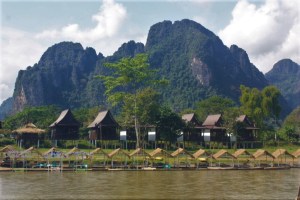
A Sad Limerick of Laos

There was a cautious family from Laos
who decided not to live in a house.
“Old bombs make us quiver;
it’s safer on the river,”
said the boathouse-living family of Laos.

POEM: Creeping Colonization

The tender end of a creeper —
whip thin, light-green, and curling —
cantilevers itself across a chasm,
reaching toward our balustrade.

It pretends to be blown by wind,
but it’s just using the gusts
to lazily set its hook.

It will colonize our balcony,
if it’s given half a chance;
it will weave out our windows —
blocking out the sun
by the time we return from holiday.

It may work slowly,
but it’s more clever than you know.

People are intrigued by those shows &
books about the world “after humans.”
We show amazement at the projections
of how quickly nature will reclaim “our space,”
but shouldn’t we be the last to be surprised?

POEM: An Angelic Take on Time

“We, who move through this world, have varied gifts,” said the angelic figure who saw the world without time.

She could hold infinite temporal cross-sections in her mind at once. Though she usually focused on one time at a time as you and i might focus our vision on a bird sitting on a lamp post — knowing that one can shift one’s visual attention at will.

Her mind snaps from mundane moments to the nearest frenetic second —  be it tragic or festive. Just as your eye would snap from the bird on the lamp post to a furry canine shape, trotting into one’s periphery; her mind snapped to the “good part” of the story.

While you may think yourself either alive or dead, to her you are a Schrödinger’s cat of both alive and dead, but her mind always wants to snap to the second of transformation.

A Limerick of Kenya

There was a Professor from Kenya
who was hoping to soon make ten-ya.
He studied the past,
but, there, things move fast —
always outrunning that scholar from Kenya.

POEM: The Cut Worm

Blake said, “The cut worm forgives the plow.”

This might make me wonder whether the plowman gains the same grace,
but I don’t think one can comprehend forgiveness
if one isn’t already prone to grudge-holding.

The cut worm doesn’t forgive, because no alternative exists.

Before we reach the point at which worms need to learn forgiveness
they will have gone on strike from their soil-churning duties —

crops will wither and fail
&
we’ll already be wondering whether we can ever forgive
the worms for their impudence.

POEM: EXPLORE! [a Rubāʿī]

Go seek the ill-trodden pathway,
the well-sheltered cove, strait, or bay —
the inn where few have known to stay,
&
isles known only to castaways.