POEM: Dancing Shadows

I found a world in an old book
so darkly like my own.
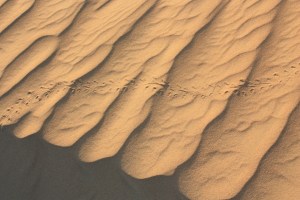
But built on sands I’d never seen,
their marbled grains were blown
across the land and through the door
to an abandoned house
where lived not one single soul —
nor dog, nor cat, nor mouse.

Just a flock of lively shadows
that danced on floor and wall,
in a dread silent cotillion —
a shadow monster’s ball.
And though I was not invited,
my shade was welcomed in.
I was, to my own shadow, a
second-rate citizen.

But I am just a cruel slaver;
for when it’d broken free,
my shadow moved with such swift grace
as in ‘t I’d never seen.
And standing like a stone statue,
I watched these twirling forms,
and wondered whether they’d blown in
upon the desert storms?

POEM: Last Sunflower Standing

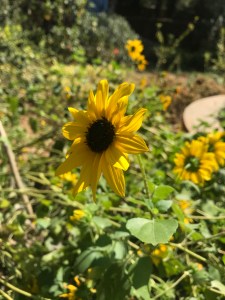
I saw a field — once sunflowers —

now reaped at harvest time.

Just stiffened stalks and wrinkled leaves,

and one head past its prime.

Those glorious yellow petals,

drooping — facing the ground,

were the only way I knew the

crop that’d been mowed down.

How sad to be a survivor

who lives by a bowed head

once the ones that faced the sun

have joined the newly dead.

Five Hampi Haiku

I
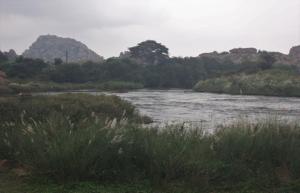
flat waters
glide wide at the bend,
their might mute


II
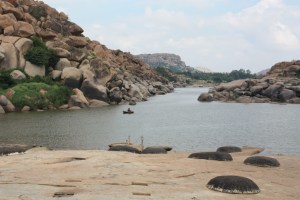
boulders stacked
in precarious piles —
yet they stand


III
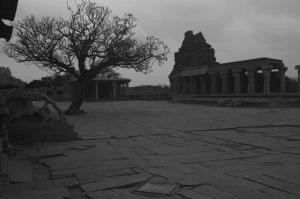
the palm trees
stand over stone ruins —
upright sentries


IV
a leaning tree
reaches its gnarled, bent trunk
to shade pilgrims


V
strange landscape —
rubble swept into piles
by what hand?

POEM: River Drift

Coracles spin the river’s route
like dervishes in dance,
whisked around frenetically
as minds spill into trance.

POEM: Ancients

They chiseled temples out of mountains —
all removed but what they found sacred,
featuring figures svelte and naked.
Those stones know chants loud and resounding.

But now grass grows on the stone roof,
some cracks have spread under blazing rays
and rubble topples on monsoon days.
Still come those whose faith is weatherproof.

Clerihew of American Literary Greats

I
Edgar Allan Poe
always lacked for dough.
Still, he always strived
to not be buried alive.


II
Emily Dickinson
lived a bit like a nun,
but her verse was insightful —
even sans an earthly eyeful.


III
Samuel Clemens, or Mark Twain,
wrote personas known to speak plain.
His nom de plume
means “fathoms, two!”


IV
The poet Walt Whitman
had a startled milkman.
Never one to be subdued,
if you just dropped by, he might be nude

POEM: Crisscrossed by Roads [Sestina]

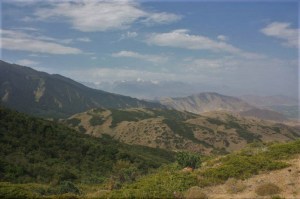
I walked beyond the world of roads —
out where the mountains meet the sky.
The time moves slowly in those parts,
where miles are trod to gain meters,
but no one cares when the sun is high
’cause getting somewhere ain’t the goal.

But who can say what is the goal
in those lands that lie beyond roads?
Some listen for the voice on high —
thundered instructions from the sky,
counting out each exact meter,
though without a listing of parts.

Not everything is made of parts.
Not every walk requires a goal,
or counting of kilometers.
This world is crisscrossed in roads;
though seen only from high in sky,
but the trap is felt at no great height.

The surface etch shows: low or high —
those lines: the earth-scarred parts,
cut clean, like contrails through the sky.
Arrows converging on a goal,
the goal of longer, wider roads,
stretching out each kilometer.

Who’ll save the walked kilometers?
When roads are low, who’ll take the high?
Who’ll not ask to extend those roads
into distant, dangerous parts
when workers need their next new goal
and flyers see no lights from the sky?

We measure miles across the sky
and judge all sprints on the meter.
There’s no escaping precise goals;
there’s jumping long, pole-vaulting high,
making sums greater than the parts,
and building new (and longer) roads.

Now our old nodes have blown sky high.
We’ve teetered meters, taking part
in goals far bolder than new roads.

POEM: The World According to a Reader

I’ve built cities in my brain,
cities that no one would recognize.

I’ve danced around Dublin with Dedalus and Bloom,
but no Dubliner would recognize his fair city
from my mental projection.

It doesn’t matter how masterful Joyce is in his description.
I’ve only visited the version that I tossed up in my mind
as I tore through his poetry,
and which was torn down in the wake of my reading.

And yet I treasure that false metropolis.

It’ll do — for now.

Kyrgyzstan Limerick

There was an old woman from Kyrgyzstan
who went to the lake daily, feeding swans,
but it’s not a swan lake —
just plovers, gulls, and crakes
learned the woman who’d been badly conned.

Five Tiny Haiku

I
the forest,
seen from a child’s height,
shares secrets


II
lifting leaves,
I find a pale, sad sprout
ready to rise


III
sunflower seed:
carried across the floor
by dogged ants


IV
floating leaf,
twisting as it glides
down river


V
a spider,
dangling by its web,
feels each breeze