POEM: Literary Journeys

I’ve taken journeys by the page,
sitting before the Globe’s great stage,
trolling a knight’s tilt at windmills,
and seen where Grendel made his kills
to kick off a much greater rage.


I learned why birds sing in their cage,
and why the caged go on rampage,
while knights and knaves go quest for thrills.
I’ve read of roads…


I’ve spanned the Stone through the Space Age
while living too briefly to be sage,
I’ve moved by dogsled through the chill,
and opulently, with all the frills.
I’ve read of roads…

BOOK REVIEW: Cephalopography 2.0 by Rasiqra Revulva

Cephalopography 2.0Cephalopography 2.0 by Rasiqra Revulva
My rating: 4 of 5 stars

Amazon.in page


This poetry collection is unique in a couple of ways. First, its running theme is based on the animal class Cephalopoda (i.e. octopi and squid) and how human life likens to that of those many-limbed creatures. It also features ancillary material such as artistic works and interactive exercises – e.g. build your own octi-poem, “squidoku,” etc. The collection consists of free-verse and prose poetry.

The book uses a unique blend of artistic and scientific language. That characteristic creates a niche for the work, but it’s also the source of its greatest weakness, a weakness that lies in the fact that a few of the poems send any reader who’s not a marine biologist running for their dictionaries. That’s a fine quality in a non-fiction book, but can make poetry difficult to absorb — given the importance of the sonic / musical quality of the medium and the need for emotional resonance.

I enjoyed the concept and found it to be clever. While most of the poems were not so laden with scientific jargon to make them incomprehensible for a general reader, a few were. That said, I don’t know how niche an audience the book is targeting. I suspect it will have trouble reaching a general audience of poetry readers, though it may resonate more with oceanographers and biologists.

View all my reviews

BOOK REVIEW: The Art of Description by Mark Doty

The Art of Description: World into WordThe Art of Description: World into Word by Mark Doty
My rating: 5 of 5 stars

Amazon.in page


Usually, when a book isn’t what one expected, a feeling of disappointment accompanies that mismatch between expectation and experience. For me, this was the rare exception to that situation. I expected more of a how-to manual and less of a collection of essays. [I also expected a book that was less poetry-dominant and which touched upon prose writing to a greater extent. But that was entirely my oversight.] Anyhow, I think I got far more out of this book than I would have if it had been the book I expected. It encouraged me to revamp my thought process about writing description — be it poetic or prose.

The book is short, consisting of six chapters that take varied approaches to the subject. The first few chapters build on an idea that the art of description requires insight both into perception and into the nature of that which we become conscious. That is, one is not trying to perfectly describe the full extent of the world that lies before one. If one did that: a.) one would fail; b.) the reader would not be granted insight into what captures the writer’s eye – i.e. insight into the mind of the artist; c.) one’s writing would become drudgery to read. [I recently started Yukio Mishima’s “The Temple of Dawn” and he begins the first chapter with dense, wall-to-wall description of the story’s Bangkok environs, and I found the thicket of description was losing me. It should be noted that after that opening, the readability becomes excellent – i.e. very story- and character-centric.] There are certainly other issues discussed in the first four chapters. One idea that resonated with me was Chapter two’s discussion of the importance of how we perceive time (as opposed to the orderly pace at which it unfolds,) and the role of temporal perception in description.

The penultimate and final chapters are quite distinct, both different from each other and from the preceding chapters. Chapter five, entitled “Four Sunflowers,” presents four poems that feature sunflowers to show how various poetic masters take on a given subject. The four poems are by William Blake, Alan Shapiro, Allan Ginsberg, and Tracy Jo Barnwell. The final chapter follows a glossary format, and is entitled, “Descriptions Alphabet.” This section actually makes up about half of the book, and it considers a range of relevant topics in an ABC format. Some of these topics are discussed in more detail than others, and are of greater importance than others. Discussions that particularly resonated with me were one on “Economy” versus “Excess,” one about metaphors, similes, and Figures of speech, and those on Qualifiers, Sonic quality, and Verbs. In this chapter, the author delves into the value of common advice that is often (unfortunately) delivered in Biblical – i.e. “thou shall” / “thou shalt not” form. The point being that it’s often bad practice to follow such advice so dogmatically.

As I said, I got a lot out of this book. It’s a quick read, but loaded with food-for-thought. I’d highly recommend it both for poets and for prose writers. (Though, as I mentioned, it’s very much directed toward poets, e.g. all of the examples come from poetry. That said, the approach to thinking about description can be of value to any writer.)

View all my reviews

POEM: Lesson Learned

If I’ve learned anything,

if the years of schooling and the degrees have done me any good,

if the stacks of books that have passed before my eyes shed any light,

it’s the recognition of the ubiquity of darkness,

&

of the fact

that it’s better to learn to cautiously navigate the cave

than to pretend there’s no darkness.

Limerick of Mexico


There was a great wrestler from Mexico
who went by the name “el Comando.”
His mask was quite garish.
His tactics nightmarish.
He’s the least stealthy soldier of Mexico.

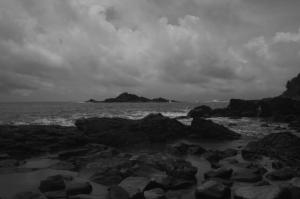
Stormy Shore Tanka


I
seas churn
under darkened skies
raindrops arrive
pelting the sandy shore
with wind-blown violence


II
the rocky shore
becomes a fierce fountain
as wave water
hits and shoots skyward
to be blown sideways


III
this storm lingers
as metaphorical storms
are known to do
natural storms are
always in motion

POEM: Mental Catacombs [a Villanelle]

I found the catacombs, below
my mind’s deepest basement level,
searching for secrets in shadows.


Up top, my tracks were writ in snow,
and wet prints through keeps, medieval,
’til I found the catacombs below.


What would I find down there, who knows?
Let’s hope not some home-grown devil.
Searching for secrets in the shadows


isn’t work for weak and weary souls.
Don’t know how I ‘massed the mettle
to find the catacombs, below.


I felt the torment and the throes
of one who’s become bedeviled,
searching for secrets in shadows.


I saw highs and lows — thorns and rose,
but never had time to revel.
I found the catacombs below,
searching out secrets in shadows.

Limerick of Malaysia

There was an Orangutan from Malaysia
who dreamed of leaving Southeast Asia.
“Sure, I’d love to linger,
but it’s hard being ginger
when you live deep in the heart of Asia.”

POEM: Ancient Agonies

Ancient Agonies
abound

Written boldly
on our
souls

Cold chiseled
into the architecture
of one’s mind,

a mind rife with
desire
for things that
it does not know.

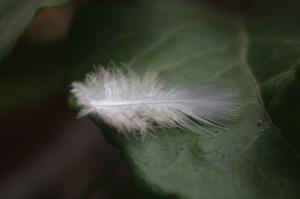
POEM: Floating Feather

A downy, white feather twists languidly, drifting downward.

I spot it as I stand on my balcony.
I’m transfixed,
compelled to follow the feather to its final resting place,
be it inside or outside the rail.

I’m transfixed because it moves impossibly slowly;
gravity’s hold on it is tenuous,
a puppy’s breath could put it on another course —
changing its fate.

And in those moments of lazy falling,
I, too, feel fateless.