BOOK REVIEW: Body Heat by Mark S. Blumberg

Body Heat: Temperature and Life on EarthBody Heat: Temperature and Life on Earth by Mark S. Blumberg
My rating: 4 of 5 stars

Amazon page


I picked up this book for an odd–and potentially disconcerting–reason. I sweat when I work out. I know that everyone sweats while active, but for me it’s preternatural. It’s at a level that has the potential to be a superpower, if I had any control of it. I’ve finished muaythai sessions with the ring floor looking like it’d rained inside—granted Thailand takes humidity to its heights, but still. I was hoping to gain some insight into what this anomaly was all about. After reading the book, I can’t say I have any greater insight on the issue. However, having lived in the tropics for over three years now, I’ve recently begun to notice that my level of sweating seems normal—at least within a range acceptable for our species.

There are nine chapters. The first examines the basics of heat. While the examples are zoological, the substance is largely what one would study in an introductory physics class—sans the math. Chapter 2 dips more into the biology, considering the various ways in which organisms achieve an ideal temperature. The third chapter explores the role that temperature plays in impregnation, gestation, and genetic information transfer.

Chapter 4 explains how various creatures work internally to create a comfortable temperature. It’s related to chapter 2, but the second chapter deals more with external regulation, i.e. animals’ interaction with their environments. Besides explaining the human need to control the brain’s temperature, chapter 4 explores how birds who keep their feet in chilly water manage to keep from getting hypothermia. In the next chapter, Blumberg considers various ways in which animals fight the cold. There’s an extended discussion of Brown Adipose Tissue (BAT)–a fat that is particularly useful in generating heat–that was interesting.

Chapter 6 raises an intriguing question: should one take fever reducer when one develops a fever? Obviously, a fever can become so high that one needs to combat it, but here we’re talking about a fever of a level that won’t cause any long-term harm. Chapter 7 discusses a range of heat related topics including the connection between spiciness and the feeling of heat and the evolution of language related to heat, but the chapter is mostly about the thermal dimension of sex.

Chapter 8 is about how our body regulates fat so that it can be used both as an energy reserve and as insulation, and what can go wrong with the process. The final chapter addresses the thermal dimension of sleep. If you’ve ever woken up soaked in sweat or chilled, it may have occurred to you that our thermal regulation doesn’t work as usual through sleep.

There is a point in the Introduction that reads as though the author is calling Tibetan Buddhists monks charlatans, and that seems both harsh and offensive. However, I’m willing to give him the benefit of the doubt that he used an example in unfortunate juxtaposition to his charlatan comment—which is well taken. He’s referring to monks who wrap themselves in wet sheets in subfreezing conditions. His point is that it’s not a suspension of the laws of physics that the monks don’t end up with hypothermia—true enough. The monks’ point is likely that it’s a tremendous challenge to be able to maintain a tranquil mind under such conditions, which I would argue is true as well.

There are only a few graphics, and they consist of tables, line drawings, and photos. There is an extensive bibliography that is organized by chapter.

The Kindle version of the book that I have has some formatting irregularities. However, they didn’t really detract from the reading experience, and will probably be corrected in newer editions. [But it wasn’t an ARC, so the formatting should have been finalized.]

I found this book to be interesting, and I learned a lot from reading it. It’s an important topic, but for many it won’t be a subject that one thinks of learning about in isolation. If you are interested in finding out more about the many ways in which animals (humans included) are influenced by temperature, I’d recommend you give this book a look.

View all my reviews

BOOK REVIEW: The Brain: A Very Short Introduction by Michael O’Shea

The Brain: A Very Short IntroductionThe Brain: A Very Short Introduction by Michael O’Shea
My rating: 4 of 5 stars

Amazon page


The human brain in 120-ish pages, it’s an ambitious goal considering that the brain is widely considered to be the most complex object in the known universe. Still, this is one of Oxford University Press’s “A Very Short Introduction” (AVSI) series, so the only promise is to give one a concise overview of the subject for beginners. In that task, the book succeeds. In fact, the book takes on some subjects that one might think beyond its scope, such as the historical progression of our understanding of the brain and how technology might be used to repair damaged brains.

The book consists of seven chapters and an epilogue. The first chapter introduces the brain, and it makes this monumental subject manageable by considering reading—a skill that we take for granted but for which the brain conducts miraculous feats from rapid accurate eye movement to turning abstract symbols into meaning. The second chapter takes the reader on a tour of the changing understanding of the brain leading up to the discovery of the neuron—the brain’s basic unit. Chapter three explores how those neurons transmit signals, the fundamental action of the brain. Chapter four examines the evolution of the human brain, both from the perspective of how it could become so complex, and of why it needed to become so. Chapter five is about how the brain receives information and uses this information to conduct activities. A majority of this chapter is devoted to how patterns of light are recognized and turned into the meaningful basis upon which to make decisions or perform actions. Chapter six offers a basic understanding of memory, one of the roles we most closely associate with the brain. Chapter seven considers whether we’ll be able to fix damaged brains, and, if so, using what technologies. A brief epilogue tells us where the future of brain research will go–having gained much understanding since the invention of functional Magnetic Resonance Imaging (fMRI), neuroscience must find new approaches to take itself into the future.

The book uses line drawings to depict concepts that are hard to convey via text. While the graphics are simple black-and-white drawings, they are immensely beneficial. Like other AVSI books, there are no citations or notes, just a couple of pages of “further readings.” That’s not a criticism; it’s perfectly acceptable for this type of book.

I found “The Brain: AVSI” to be informative and interesting. The author uses some illuminating examples and cases to cover a lot of ground in a small package. I’d recommend the book for anyone who wants a neophyte’s introduction into the human brain.

View all my reviews

BOOK REVIEW: Hormones: A Very Short Introduction by Martin Luck

Hormones: A Very Short IntroductionHormones: A Very Short Introduction by Martin Luck
My rating: 4 of 5 stars

Amazon page

Let’s face it; the word “hormone” is usually reserved for questions of why a male is so horny (e.g. “His hormones were raging.”) or why a female is so moody (e.g. “She’s hormonal.”) Yet, the endocrine system is about much more than horniness and moodiness. It’s the body’s lesser known communication system, transmitting signals more slowly than the nervous system, but over a broader area and with longer-lasting results. Yes, it’s instrumental in sex, but it’s also involved in regulation of almost everything else the body does. Though we associate hormones with sex, when it comes to mass appeal it’s clearly not the sexiest of systems.

Dr. Luck’s book allows one to rectify one’s ignorance of hormones without a major investment of time or money. This is one volume in a series put out by Oxford University Press that’s designed to convey the fundamentals of a subject in about 100 pages or so (in this case it’s more like 130pgs.) I’ve done several reviews of books in this series, and will likely do more. These “Very Short Introductions” are a good way to get the gist of a topic quickly and painlessly, and they are reasonably priced on Amazon Kindle and in hard-copy at my local discount bookseller. (FYI: Your results may vary. i.e. Hard-copies at some bookstores may be pricey for what these books are—i.e. subject summaries that are optimized for concision and not for entertaining reading.)

The book has nine chapters. The first is a history of the science related to hormones and the endocrine system. (It took a while to figure out that there even was a system because of the nature of hormonal action.) The second chapter hits the basics, such as what hormones are and how they work. Chapter three tells us about the role hormones play in reproduction. The next chapter is about how hormones regulate the body’s levels of water and salt (and the effects on blood pressure.) Next, there is a discussion of the calcium cycle and how calcium is banked in bone and borrowed for the purposes of other cells. There’s a chapter that educates one about diabetes and how hormones (notably insulin) regulate blood sugar. Chapter seven is devoted to the thyroid. Chapter eight describes the role of hormones in circadian rhythms and the cycles of the body. The final chapter is about where science is going with its knowledge of hormones and the advances that are being pursued.

There are few graphics in this book. Most of them are chemical diagrams in dialogue boxes that many readers will skip because of their ominous appearance. The lack of graphics isn’t a problem. Luck does use a narrative approach on occasion (such as his telling of the story of the giant William Rice of Sutton Bonington.) This enhances the book’s readability, and is noteworthy because it’s a rarity among books in this series, which—again—are written to shotgun information and not to be entertaining reads.

I’d recommend this book for those who want to learn (or brush up on) the basics of the endocrine system. It does what it’s supposed to do, and does it quickly.

View all my reviews

BOOK REVIEWS: Gut by Giulia Enders

Gut: The Inside Story of Our Body's Most Underrated OrganGut: The Inside Story of Our Body’s Most Underrated Organ by Giulia Enders
My rating: 5 of 5 stars

Amazon page

[I recently posted a review of Mary Roach’s GULP. I mention this because that book is likely to be the primary competitor if you’re looking for a tour of the alimentary canal in book form. While I’d recommend both books and point out that the two have different thrusts, if you’re set on reading just one book on poop and farts this year, the two reviews should help you determine which work is more up your alley.]

In this highly readable and humorous book, medical student Giulia Enders teaches us how to poop, what to do when we can’t, how our bodies extract resources from the stuff we shove in our pie holes, and what the bacteria that outnumber our body’s cells by an order of magnitude do for (and against) us. The book is in part a work of popular science, but it’s also a guidebook to the digestive tract. In other words, Enders not only tells readers about the wondrous job their digestive system does, but she also offers advice as to how to keep it running efficiently.

The book is divided into three parts. The first part lays out what the gut consists of and how it does its job. The second part introduces the reader to the enteric nervous system, which is the part of the nervous system that governs the digestive tract and determines when we vomit, poop, and—to some degree–experience emotional turmoil. The final part addresses the body as an ecosystem. The human body consists of 10 trillion cells and another 100 trillion microbes—cells that could theoretically live independently of your body provided the right conditions.

The strength of this book lies in Enders’s ability to put the complex physiological actions of our body into simple, understandable, and whimsical terms. This may mean anthropomorphizing a colon, but so be it—you’ll still get the drift. A prime example is the “Salmonella in Hats” section that equates antibodies with big floppy sombreros that interfere with the germ’s mobility and virulence. The author’s enthusiasm for this “under-rated” organ is infectious.

The book employs amusing, off-beat line drawings to help convey relevant ideas and to support the stories that the author uses to clarify the complex actions of the gut. The art is well matched to the tone of the text, which makes sense given they were drawn by the author’s sister.

As I mentioned in my GULP review, GUT is a very different book despite all they have in common. Enders spends the bulk of her time in the middle of the alimentary canal, where Roach spends most of her time talking about what happens at the two ends. Enders’s book is about the typical Joe’s digestive system, where Roach specializes in extreme cases and narrow (but fascinating) questions. Enders’s book is more of a tour of the digestive system rather than a series of tales of interesting things that happen in and around it. While Roach’s book deals in bizarre cases, Enders’s book is actually more light-hearted and informal in tone. (Whimsical is a good descriptor for GUT.)

I’d recommend this book for anyone who wants to learn more about how their digestive system works and what they can do to keep it working at its best. It’s funny and packed with fun facts.

View all my reviews

BOOK REVIEW: Gulp by Mary Roach

Gulp: Adventures on the Alimentary CanalGulp: Adventures on the Alimentary Canal by Mary Roach
My rating: 5 of 5 stars

Amazon page


This week I’m [improbably] doing two book reviews about works devoted to the human digestive tract. (Before you conclude that I’ve got a colon fetish, let me explain that I was spurred to this research by life events. I did some advanced yoga cleansing practices and wanted to learn more about the science of what was going on down below.) In addition to this book, Mary Roach’s “GULP,” I’ll be soon posting a review of Giulia Enders’s “GUT.” The two books have more in common than their monosyllabic titles beginning in “gu” and the fact that they each came out within the past couple years. They’re both light-hearted romps down your digestive tract. However, they’re also different in several key ways. GULP is quirkier; GUT is perkier, but more importantly the two books have different thrusts (yes, there’s just that much interesting stuff to learn about digestion (and the lack thereof)—which make the two books complementary. Cutting to the chase, I’d recommend both books, but if you only read one book about your alimentary canal this year, I hope my reviews will help you determine which one is for you.

Explaining how Roach’s book is “quirkier” will tell one a lot about Roach’s book and how it differs from Ender’s work. (And since Ender’s writing style could be described as quirky itself, it’ll help clarify that as well.) By “quirky,” I mean that Roach’s book is built around a set of narrow questions that address topics of a bizarre or strange nature. In GULP one will read about whether your pet really wants “paté in beef gravy” [spoiler: it does not], whether the story of Jonah and the whale is BS, how smugglers use their digestive tracts illicitly, what are the benefits of Fletcherizing (chewing your food more thoroughly—much more thoroughly), whether Thanksgiving dinner can split one’s stomach open (like it feels it does), and what’s the worst case flatulence scenario.

This isn’t to say that one doesn’t learn something about the basic science of digestion as one is reading about extreme cases of tasting skill, stomach fistulas, flatulence, constipation, and overeating. One does, but this book isn’t organized to educate one about the alimentary canal systematically and generally. It’s a work of creative nonfiction designed to make the reader keep saying “huh, I never would have thought” and it does an outstanding job of it. You may not have given much thought to some of these topics, but you’ll be craving answers by the time you get past the chapter heading. There’s a reason that Roach’s works top the charts of pop science books. She finds the interesting questions and the most fascinating examples.

There are 17 chapters in GULP, and while they collectively take one on a tour of the alimentary canal, Roach devotes more space to some parts than others. She spends more time on what goes at the head end (smelling, tasting, chewing, and salivating) than does Enders. Also, please don’t think the book is low brow or that it appeals to the lowest common denominator (8-year-old boys?) when I tell you that there are three chapters on various dimensions of flatulence.

As I said, you may not have thought much about some of these questions, but you’ll learn something nonetheless. A prime example can be seen in the chapter on smuggling via the digestive tract. I’d read stories of cocaine mules dying when a condom burst in their stomach, but I had no idea about the extent to which items and materials are smuggled down there. It’s not just drugs. One guy was explaining how he smuggled knives. Really. Knives. Plural.

There are a few topics that are well covered by both books. Take, for example, constipation. Roach elucidates the topic using the case of Elvis Presley and others who’ve been literally terminally constipated. (Ender’s—on the other hand—considers the everyman’s constipation, though with amusing drawings and commentary.)

I’d recommend this book for readers interested in learning more about how their food makes its way through—particularly if you like learning about the strange cases.

View all my reviews

BOOK REVIEW: Zen and the Brain by James H. Austin

Zen and the BrainZen and the Brain by James H. Austin
My rating: 4 of 5 stars

Amazon page

Dr. Austin’s 900-page book looks at what the brain does during (and as a result of) the practice of Zen, and is a great resource for those interested in the science of meditative practices. It’s easy to sum up the strength and weakness of this book. With respect to the book’s greatest strength, it’s that the author—like the book—straddles two widely divergent worlds. He is at once a scientist and a practitioner of Zen. This gives him rare insight into both halves of the equation. This isn’t one of those books written by a spiritual seeker who uses the word “science” and “scientific” very loosely (and in a manner that shows a lack of understanding of the central premise of science.) On the other hand, it’s not one of those books by a scientist who got all of his understanding of meditation from other books.

As for the weakness, it’s that the book was written in the late 1990’s. Ordinarily, I would say that wouldn’t matter much, but concerning our understanding of the brain, it might as well have been the Stone Age—hyperbole duly noted. One doesn’t put together a book of almost 1000 pages overnight, and so much of the references for “Zen and the Brain” are actually from papers from the 1980’s and earlier. The fMRI (functional Magnetic Resonance Imaging) machine didn’t even come out until the early 1990’s, but—of course—it took a while for the studies featuring this powerful technology to reach publication.

The book is arranged into a whopping 158 chapters divided amongst 8 parts. Some of the chapters are pure neuroscience, and there are detailed descriptions of the brain and the functions of its various parts. Other chapters are designed to give one an insight into the practice of Zen and aren’t technical at all. The author has a reasonably engaging writing style when he’s not conveying the minutiae of brain science. He tells stories of his experience as a practitioner of Zen, and passes on the wisdom of past Zen masters.

I have an unconventional recommendation for this book, which I got so much out of. I recommend you first check out the book “Zen-Brain Horizons” put out by the same author and press (MIT Press) in 2014. While I haven’t yet read that book, it seems to hold three advantages. First, it’s only one-third as long and seems to cover similar material. Obviously, it goes into far less detail. (But you may find that a plus.) Second, the 2014 book is reasonably priced. “Zen and the Brain” is one of the most expensive books I’ve bought in recent years. I’m not saying I regret paying as much as I did, because it was a useful book, but cheaper would be better. Finally, the 2014 has the benefit of access to a lot of great research from the past couple decades. If you read the 2014 book and think you need more detail about the brain, then—by all means—get this book.

View all my reviews

BOOK REVIEW: Adventures in Human Being by Gavin Francis

Adventures in Human Being: A Grand Tour from the Cranium to the CalcaneumAdventures in Human Being: A Grand Tour from the Cranium to the Calcaneum by Gavin Francis
My rating: 5 of 5 stars

Amazon page

Dr. Francis’s book of essays takes one on a fascinating anatomical cook’s tour—literally from head to toe. The book uses patient case histories, tales from med school, great moments in medical history, and even references to art and pop culture to intrigue the reader with the awesome nature of the human body. This isn’t the kind of book that tries to tell one everything there is to know on a subject. Rather it drills deep on specific subjects, but with humor and readability. While the book examines specific issues pertaining to the body part under consideration, it gives the layman reader the necessary background to comprehend even the most complex topics, often through interesting factoids.

In 18 chapters divided into seven parts by regions of the body, one will learn about topics such as: electroconvulsive therapy (ECT), the almost ancient art of cataract surgery, botoxing of Bell’s Palsy patients, how the Epley manoeuver is used to seemingly miraculously cure vertigo through snappy head movements, why Renaissance thinkers thought the soul resided in the lips, why having one’s blood circulated pulselessly causes problems, how a “Brachial stun” immobilizes an arm, why suicidal wrist slashers rarely succeed, where the nail goes in a proper crucifixion, how kidneys became the gift that keeps giving, how a scratch on the hand almost cost a gardener her life and what her liver did to save her, why your bowel movements matter, how fetoliths (i.e. “stone babies”) come to reside in the abdomens of older women, why–in some cultures–it’s necessary to eat the afterbirth while others insist on burying it under the house, why the hip’s blood supply is lacking, and how the foot is really more specialized and consequential to human existence than our hands and their well-publicized opposable thumbs.

My wife got me this book after seeing it on the list of the best books of 2015 put out by “The Economist” magazine. It was an excellent choice and it moved it quickly to the front of my reading list. I’d highly recommend it for anyone interested in science, medicine, anatomy, physiology, or the human body.

View all my reviews

BOOK REVIEW: Wired for Story by Lisa Cron

Wired for Story: The Writer's Guide to Using Brain Science to Hook Readers from the Very First SentenceWired for Story: The Writer’s Guide to Using Brain Science to Hook Readers from the Very First Sentence by Lisa Cron

My rating: 5 of 5 stars

Amazon page

There are countless books offering advice to writers. Some are good. Some are not. Good, bad, or ugly, few of these books offer anything new beyond particularly artful (e.g. humorous or poetic) explanations or superior examples. In other words, if you’ve read five writer’s guides you’ve read five thousand. Cron’s book is the rare guide worth a read even if you’ve read a hundred other such books. It’s not that Wired for Story offers radical or novel advice on story building (its writer’s tips are orthodox.) It’s the way this book couches the arguments for what can admittedly be hackneyed advice. As the title suggests, Cron’s book is about how our brains are wired to love stories–as long as said stories contain certain attributes that the brain finds appealing. (Conversely, there’s a reason why books that go wildly off the reservation with “experimentalism” are doomed.)

While I’ve read many a book on writing, I picked up Wired for Story more out of an interest in the subject of the neuroscience of story. The book doesn’t delve deeply into the science, but it does cite leading thinkers in the field as well as providing a good layman’s overview of the neuroscientific principles that inform the book’s tips. Cron’s background is in publishing and her bona fides to write this book are as someone who came from a career reading and rejecting / accepting manuscripts. However, I believe she did a good job of laying out science.

The central idea is that humans love stories because the narrative structure allows people to simulate a nasty chain of problems without suffering the real world consequences. The brain loathes uncertainty and randomness, and loves whenever it can learn about how to face a problem or make sense of the world. This is why we love conflict, tension, and an unrelenting unfolding of worst case scenarios in our stories even though we tend to hate those characteristics in our own lives. This results in both the tried advice to keep putting the protagonist through the wringer, and the qualifications that a writer should do so in a way that is believable (our brain’s BS-detector is ever on) and which will eventually force the protagonist to change. Cron offers a definition of story that has the usual elements: “A story is how what happens affects someone who is trying to achieve what turns out to be a difficult goal, and how he or she changes as a result.” As with many guides, the definitions of plot, the protagonist’s issue / goal, theme, and tone are elaborated at length—as well as being differentiated because these topics tend to be confused by neophytes—often resulting in a failure to clarify one or more of them.

Stories also give us an opportunity to anticipate what others will do, and forecasting the behavior of others gives one a nice little dopamine dump. The ability to foresee what others will do has always been a powerful evolutionary advantage, and those who did it better passed on their genes more than their oblivious counterparts. Owing to this idea, there is a great deal of advice about what should be in the book (only what is relevant), and how it should be revealed (in a way that eschews attempts to play “gotcha” with your readers.)

One may wonder why I’m so pleased with a writer’s guide that gives common advice about writing–just because it explains said tips in terms of evolutionary biology. The answer is that it’s far easier to keep these lessons in mind when they’re held together by a logic rooted in what all readers have in common (e.g. conscious and unconscious minds, emotions, instinctual drives, etc.) For example, knowing why readers hate an overly simple resolution for a problem that’s presented as insoluble (i.e. robbing them of dopamine reward for figuring it out) helps one better recognize this pitfall in all its forms and to avoid it. Such an approach allows for a deductive approach and is far more useful than having memorized “avoid deus ex machina” as a disparate tip that’s attached to a specific example. In short, it’s both easier to remember and broadly implement these ideas when one understands the rationale from the ground up.

Beyond the reason in the last paragraph, I enjoyed this book for reasons that have little to do with its advice to writers. While I now know that there are other books on the evolutionary biology of story that deal with the subject more from a scientific perspective (while I haven’t read it yet, you might try this book), this was the first book that I stumbled across on that topic. And, it’s a topic that’s well worth understanding whether you’re a writer or not. No matter what one does, understanding the universal appeal of a story can be beneficial, whether it’s in the context of teaching, parenting, or business.

I’d recommend this book for writers—particularly those who think about the world in scientific terms. Beyond writers, if you have cause to construct or use stories in your life—or suspect you should—you can benefit from this book.

View all my reviews

The Science of Inversions: or, Why and How to Get Off the Wall

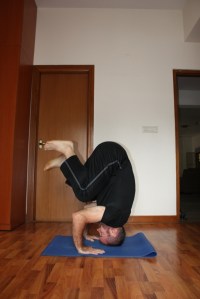
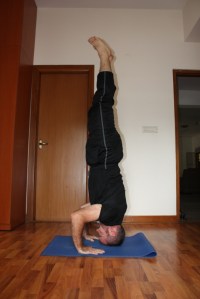
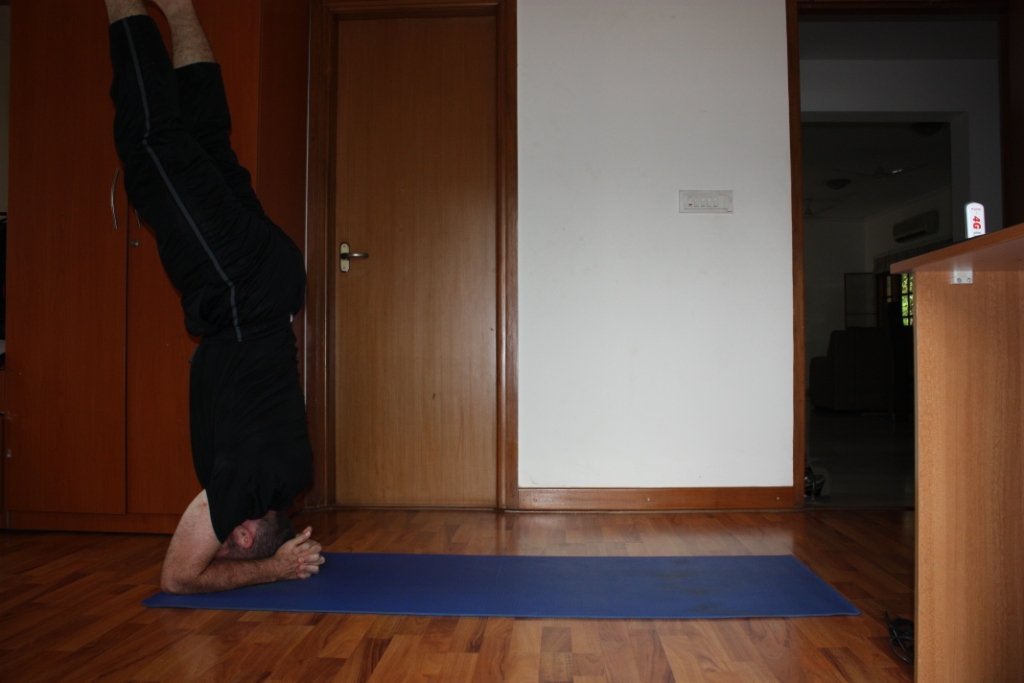
IMG_0835Inversions are a class of postures (asana) in which part or all of the body / limbs are raised above the head. The classic inversions are: headstand [shirshasana], shoulder-stand [sarvangasana], plow pose [halasana], forearm-stand [pinchamayurasana], and handstand [adho mukha vrksasana], but there are many more–some of which are easier and others of which are more challenging than these basics. Other than a few partial inversions (e.g. down-dog [adho mukha svanasana] and leg-up-the-wall pose), inversions tend to be daunting for beginners (and even intermediate students) at a mental as well as a physical level.

In this post I’ll focus on headstands. Most students seem to achieve shoulder-stands and plow pose relatively easily because it feels more stable. I’ll note that those two asana require as much or more care and caution as any inversion given the flexed state of the neck. On the other hand, by the time one is perfecting one’s handstand, one will likely be over the issues that I’m addressing in this post. I’ll save those poses for a later post with a different thrust.

Let’s first consider the effect inversions are supposed to have (and then the effect they tend to have in reality.)

What inversions are supposed to do:  The story is supposed to go like this: 1.) The body inverts. 2.) Our body’s sensors recognize that the blood flow to the brain is far beyond its needs.  3.) The body quiets our vital signs.

What inversions (too often) actually do: It may surprise some readers that inversions are supposed to have a calming effect because the chain of events is often as follows: 1.) The body inverts. 2.) The amygdala fires, triggering the physiological responses associated with fear. 3.) One’s conscious mind imagines the pain and suffering of falling. 4.) The amygdala fires some more. One is in “fight or flight” mode, and the flight the body wants to make is to a right-side-up position.

While I’ve had to work hard to improve my inversions, I had a much easier time with this issue than many. Before you dismiss me as a narcissist, let me state unequivocally that I have no special gift for inversions . I’m not claiming to be a yoga prodigy by any stretch. Why was it easier for me? I’ve practiced a martial art for many years that required training in breakfalls (ukemi.) Therefore, I had no particular fear of falling over onto my back, because my body is trained to tuck and roll. [My only fear when I first started doing headstands in studio sessions was that someone, e.g. the teacher, would walk into my blind spot. Note to all: don’t walk behind someone’s back when they’re inverted unless you’re sure you’re out of the “timber” zone.]

Why are breakfalls so beneficial to the development of one’s inversions?  Because it allows one to get off the wall. A lot of practitioners get addicted to the wall. “Addicted” may sound like a harsh term, but like addicts they think they can quit anytime and that they will quit at some undesignated point in the future–sometimes they do, but often they don’t. Reliance on the wall is reinforced by the fact that one may find one can only spend a couple anxiety-filled seconds inverted without the wall, but one can spend minutes comfortably against the wall. There’s a reason for this great disparity, and understanding this reason is crucial for knowing why doing 2 or 3 seconds unsupported (at first) is better for one’s long-term development than staying for three minutes leaning on the wall.

Here’s the deal. When you invert, your body needs to make subtle corrections to keep you on balance–at least until you reach the level of yoga genius. If you stand up with your feet together, your eyes closed, and you pay attention to your feet and legs, you’ll see that this is true when you’re upright as well. It’s just that your body is used to being upright. It knows how to make all these micro-corrections without conscious thought. The good news is that one’s nervous system rapidly learns to do the same thing when one is upside-down. When I say “rapidly” I’m not talking about the first, second, or even the twelfth time you try to do an inversion. [Trust me, despite what your mother may have told you about her darling genius, you didn’t achieve stability upright on your first few tries either.] The first several times, you’ll fall down almost immediately. However, if you keep trying, your body will learn and you’ll achieve progressively longer inverted stays. You can’t make these corrections at the speed of conscious thought. But the beauty part is that your body will learn to achieve stability solely through practice without any intellectual activity whatsoever.

Why doesn’t your body learn this when you use the wall? The cornerstone biological principle for those interested in fitness, movement, and sports is: Your brain and body are lazy; they will not develop any capability that you don’t force them to by challenging activity. Your muscles don’t get bigger without overloading them and causing little micro-tears in them that they must heal up better than before. Your bones don’t get more dense unless you put more load on them (see: Wolff’s Law.) And your nervous system will not wire itself to keep you upright in an inversion if you’re propped up against a wall. You can invert against a wall for a thousand years and not get the same benefits as from an hour of struggling to get off the wall. This principle is reflected in nature from Darwinian evolution onward.  Gazelles don’t learn to run 500 miles an hour. Once it can accelerate (on average) fast enough to survive the cheetahs that prey on it, it passes on genetic material and the evolutionary pressure is off. Gazelles don’t keep getting increasingly faster than their predators for shits and giggles.

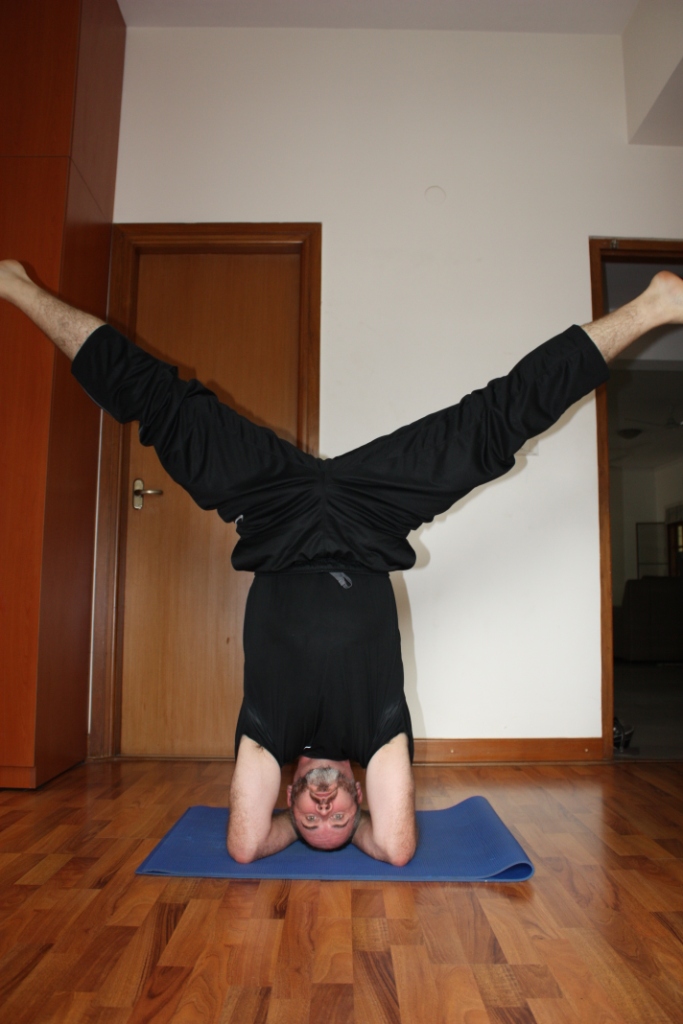
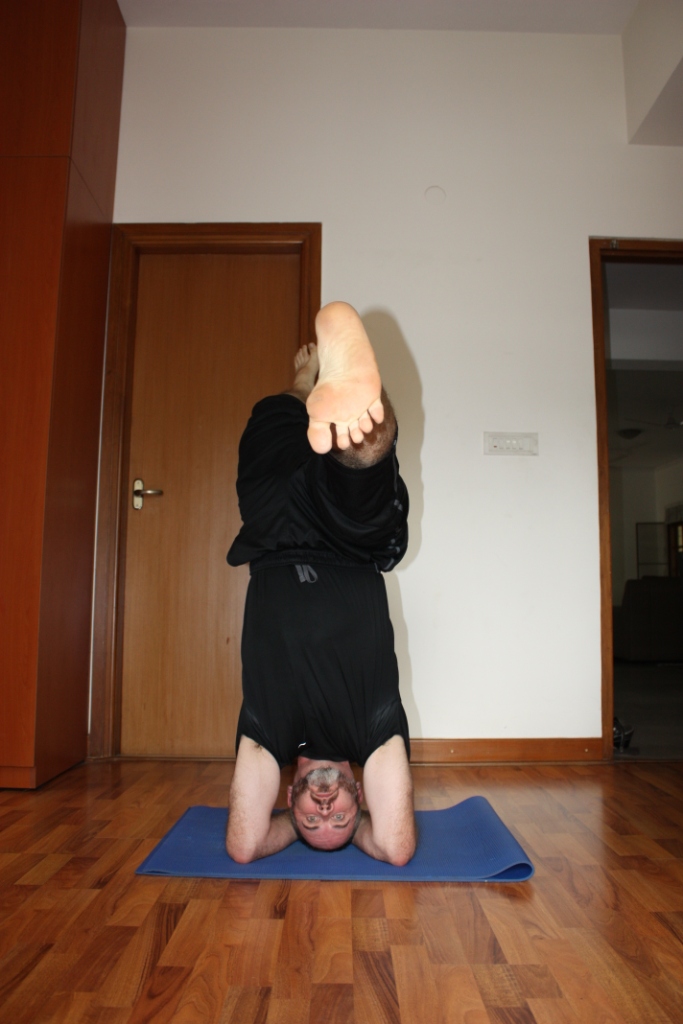
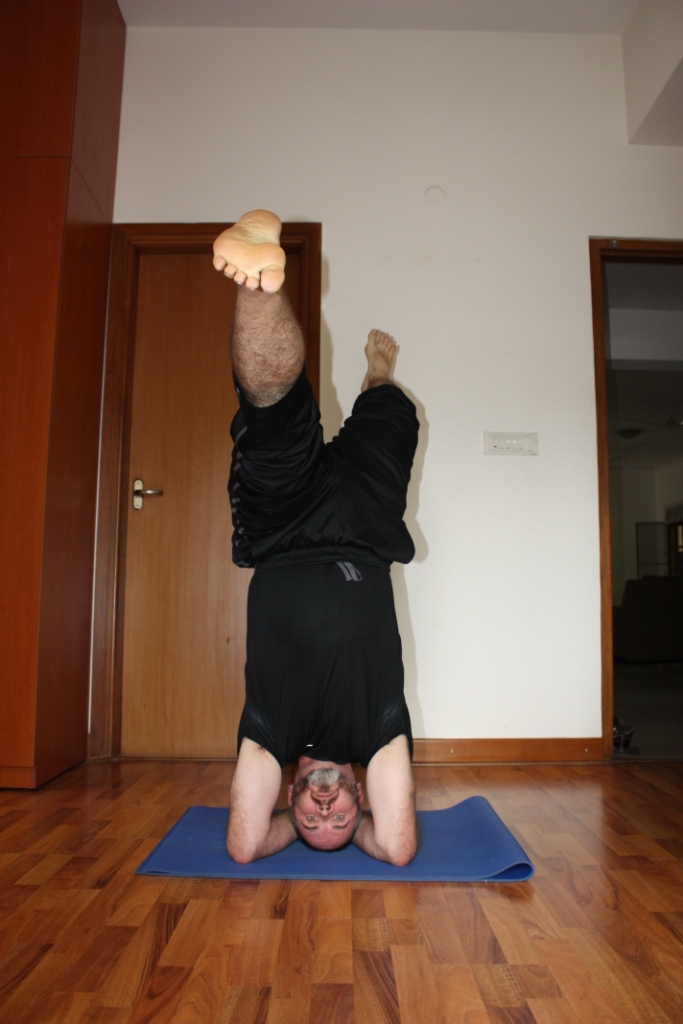
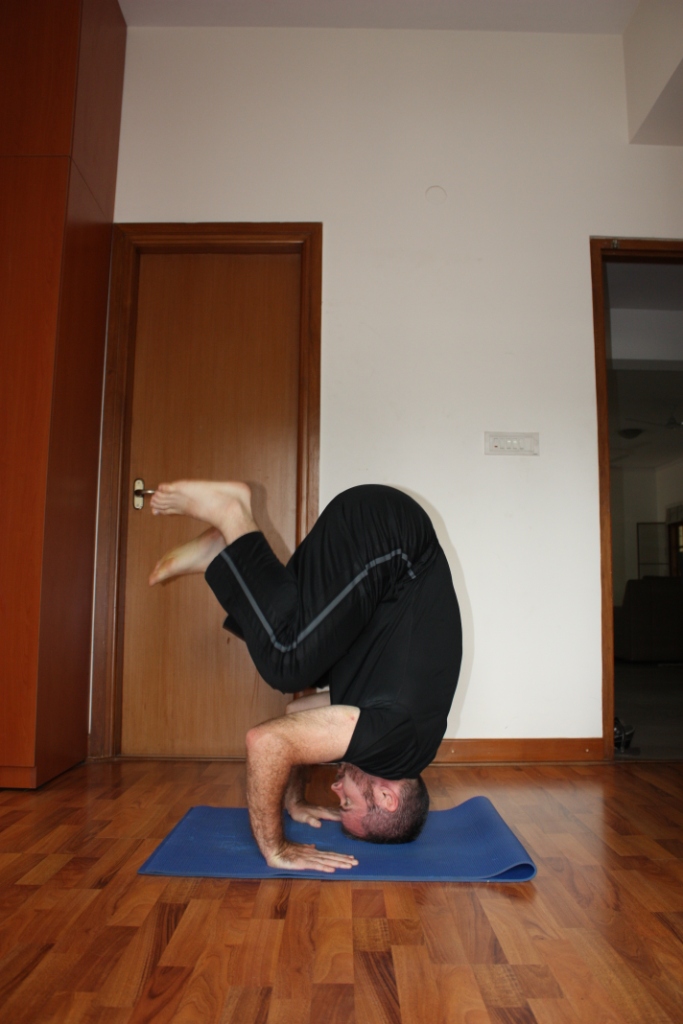
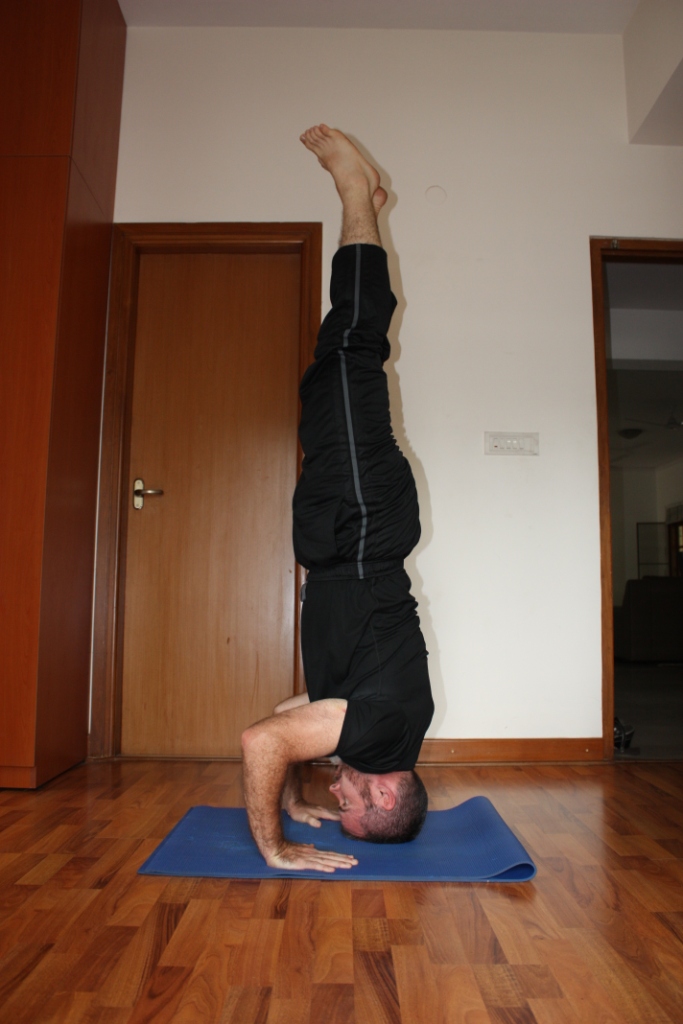
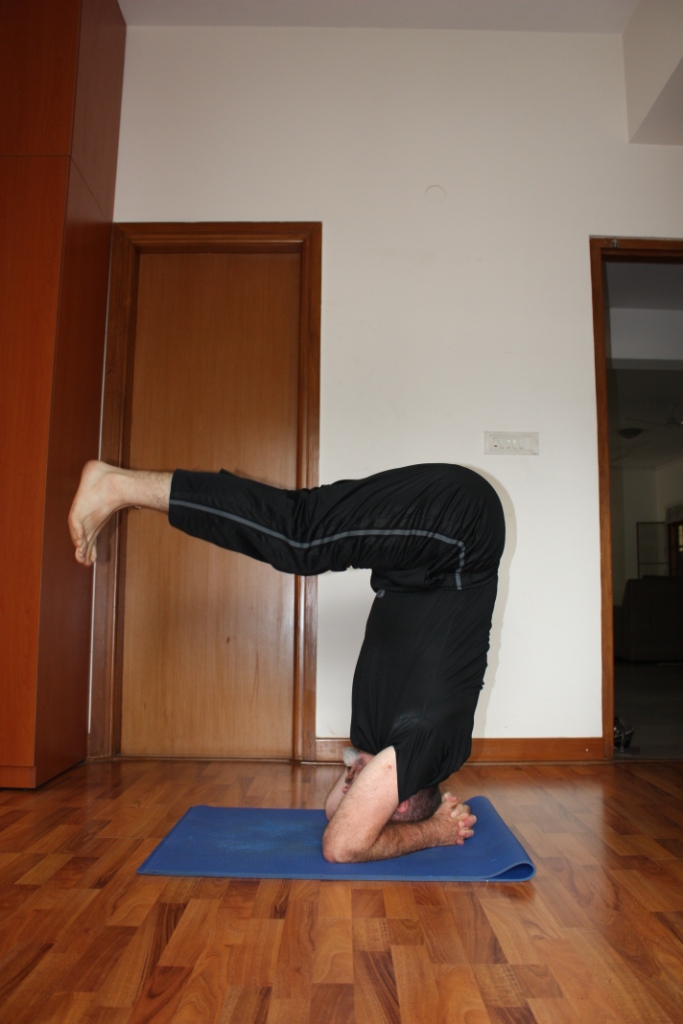
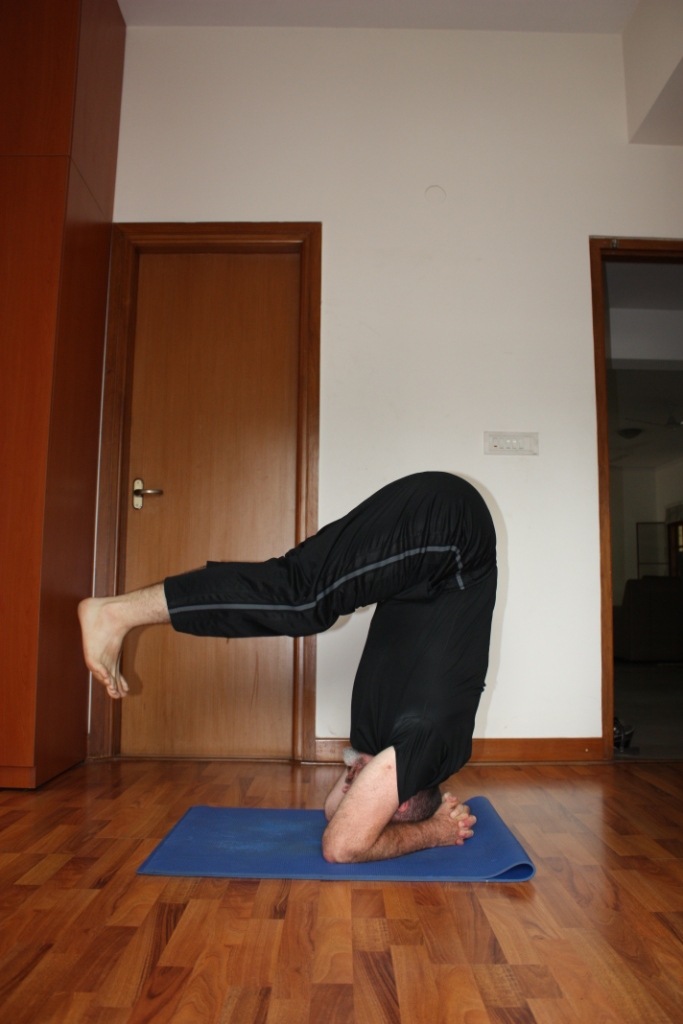
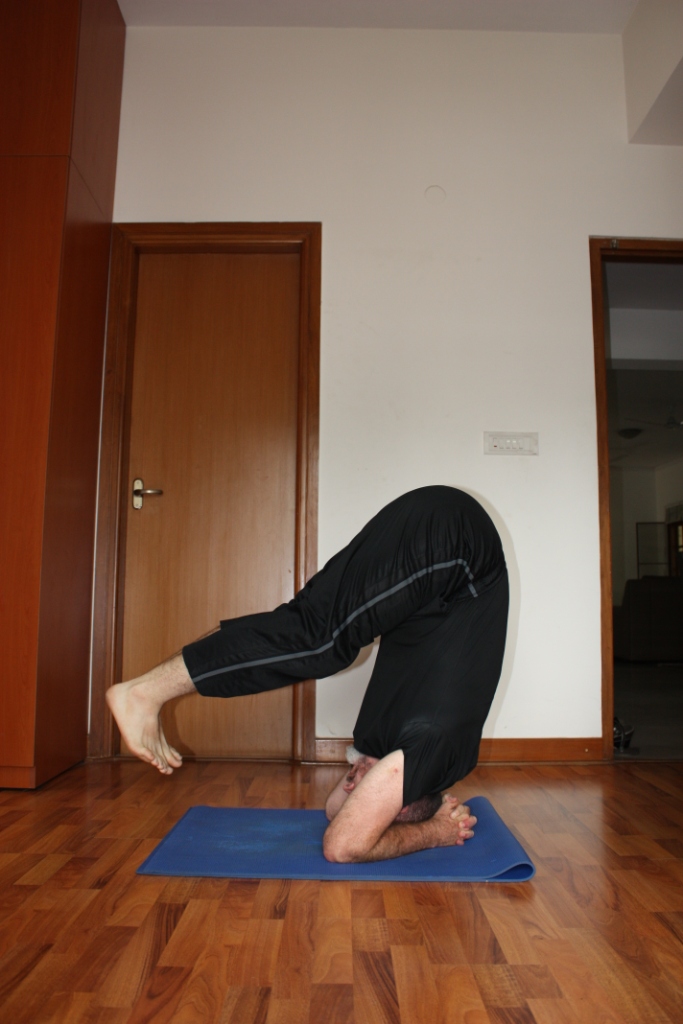
Incidentally, this is also why you should keep challenging yourself, and not rest with getting the basic form. There’s always somewhere new to take it. For example, one can look at moving between splits like so:
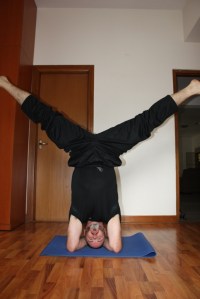
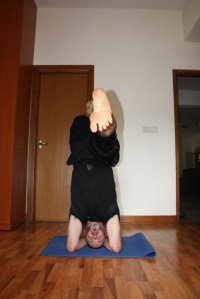
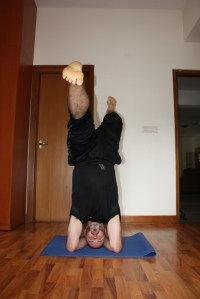
IMG_0834IMG_0836IMG_0837


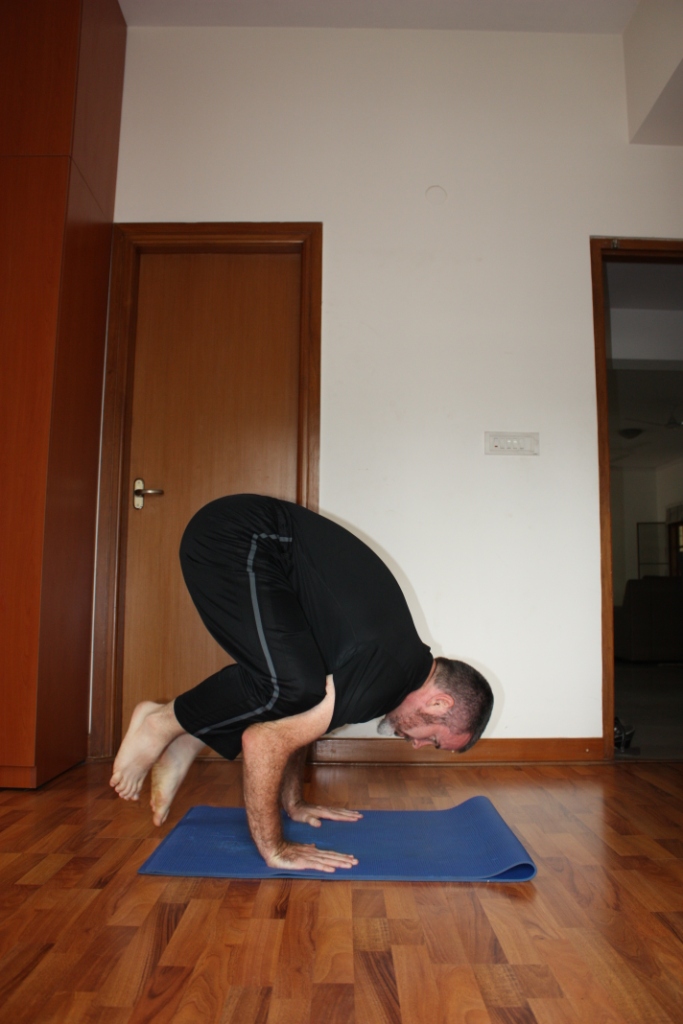
Alternatively, one can work on a different form of the pose, such as the tripod headstand. Transitioning from crow pose [kakasana] to tripod headstand is a good way to start to learn the bodily control that will serve one well in intermediate and advanced practice.
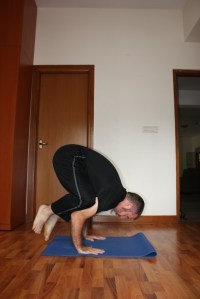


IMG_0851IMG_0853IMG_0859


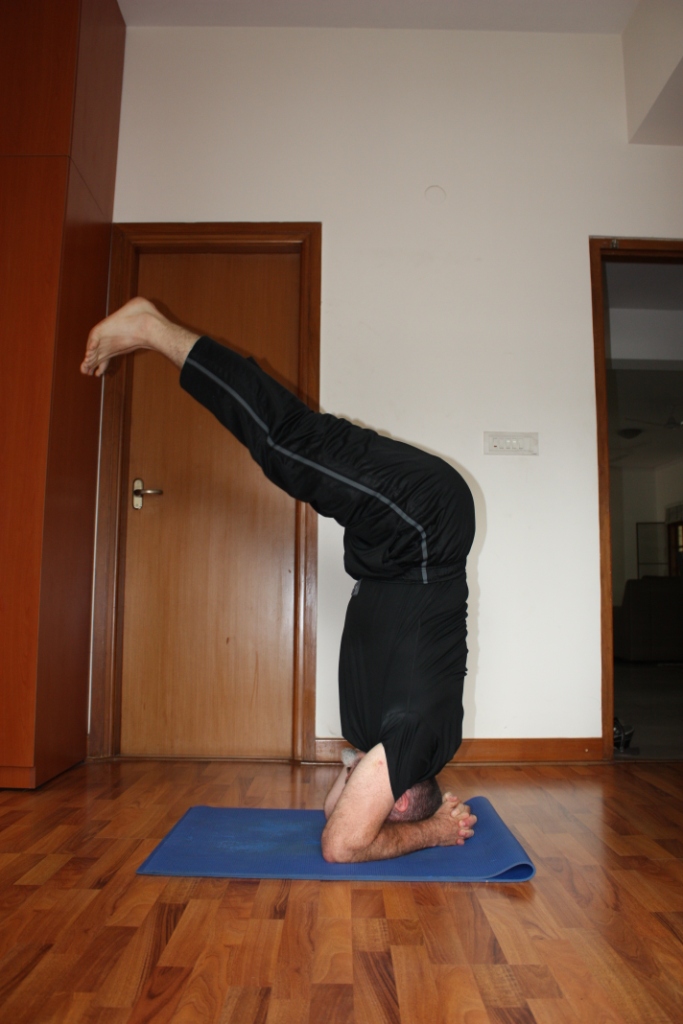
Yet another option is to practice a controlled descent. The inverted “L” is quite a challenge. Not as one might think because it requires tremendous core strength, but because it requires gradually leaning into the direction of falling backwards in order to counterbalance the weight of your legs.
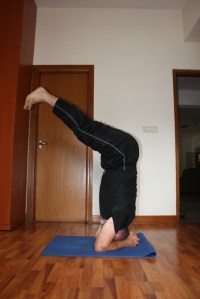
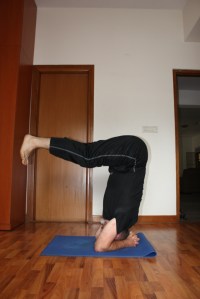
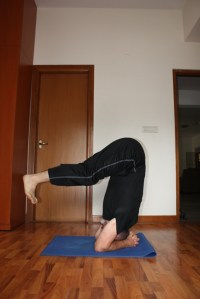
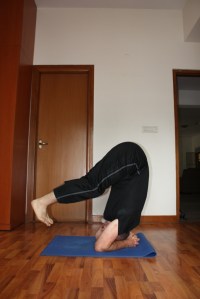
IMG_0844IMG_0846IMG_0847IMG_0849


A few notes on headstand breakfalls:

– Make sure you have room in all directions to fall without crashing into anything or anyone. While it would be nice to always fall back onto one’s feet, it’s neither realistic nor beneficial to your development. Why not? If you’re always distributing your weight to fall onto your feet, you will be keeping muscles tense and will have trouble finding a relaxed state of balance. Furthermore, there is a tendency toward panicked motion if one starts to lose balance in the wrong direction, and speed is your enemy in inversions.  (One wants to do everything from entering the inversion to falling in as slow and controlled a manner as one can possibly manage.) If you get your feet up high enough to be on balance, you need to accept the fact that you’re as likely to roll onto your back as on to your feet.

– If one is doing the basic forearm-supported headstand, don’t tightly interlock one’s fingers. “Tightly” is the key word here. It’s alright to interlock your fingers, but one doesn’t want to create ridged hands such that one’s neck rolls over a 3 to 4 inch (7 to 10 cm) ledge if one falls backwards.  One wants the hands to collapse.

– Tuck and roll. Don’t reach back with your foot / feet and try to arrest your fall. If you have enough strength, flexibility, and timing to make that work you probably don’t need my advice and haven’t read this far. (i.e. you have advanced gymnastic skill.) If you’re the more typical yoga practitioner, you’re more likely to injure your back, toes, feet, or some combination thereof by arching into a back-bend to arrest your fall.

– Counter-intuitively, you probably don’t want to put anything behind you to soften your fall. You don’t want your spine rolling over surfaces that are at different levels–even if one them is relatively soft. It’s usually best to roll over a level surface, even if that surface may be a bit hard. Furthermore, if you think you’re going to save yourself by working entirely on a softer surface, you’ll probably find yourself falling more often and for a longer period. Softer surfaces are harder to maintain balance on. That’s why one of the primary ways that we make an exercise more challenging is to do it on a softer (more rolly) surface.

– Don’t let your neck crumple. On a related aside, never look around while you’re in a headstand. If you need to see something, e.g. the teacher’s demonstration, come out of the headstand.

– However you come out of an inversion, don’t neglect the counter-pose. For the headstand, child’s pose is a common counter posture, and you should spend some time there upon exiting the pose.

– It’s best to begin one’s practice of inversions under the supervision of a qualified teacher. As one develops confidence and one’s body begins to learn how to maintain stability, one can make these postures an increasing part of one’s practice.

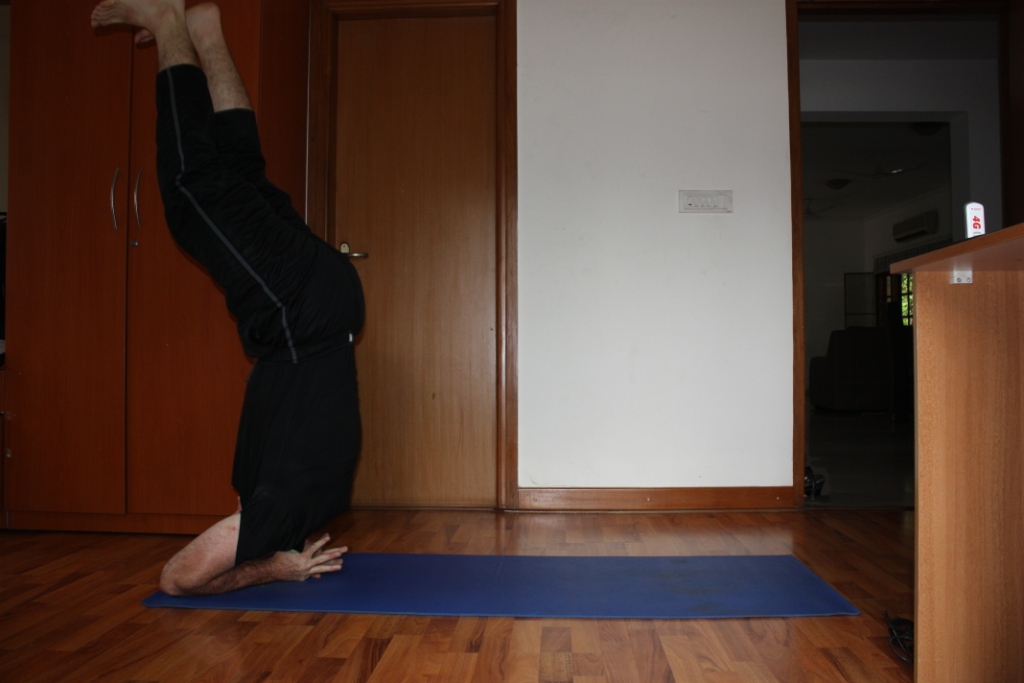
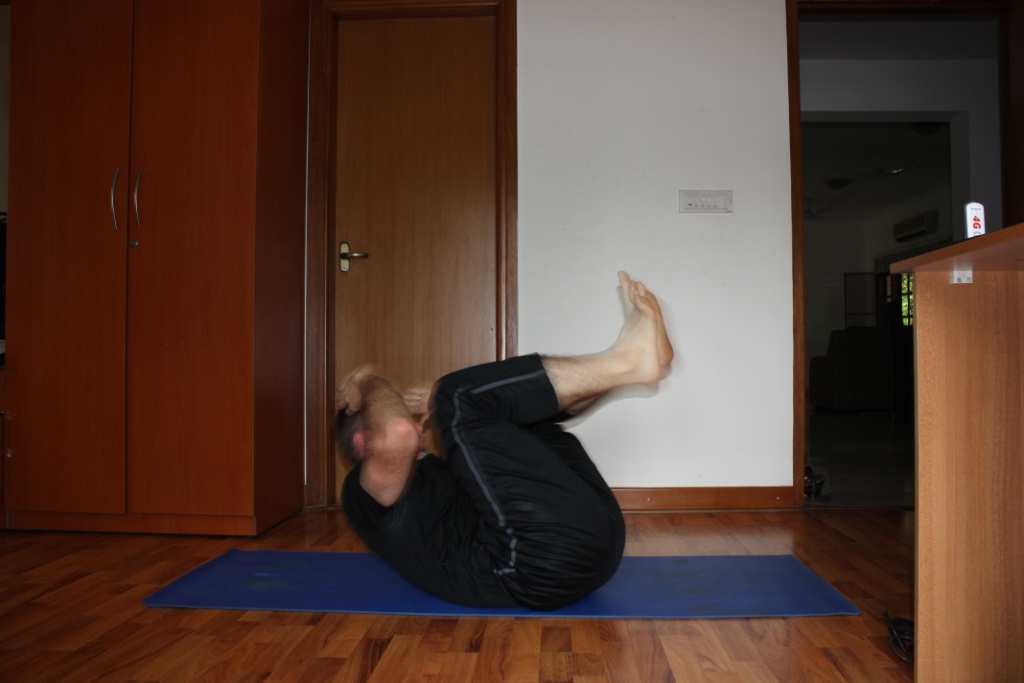
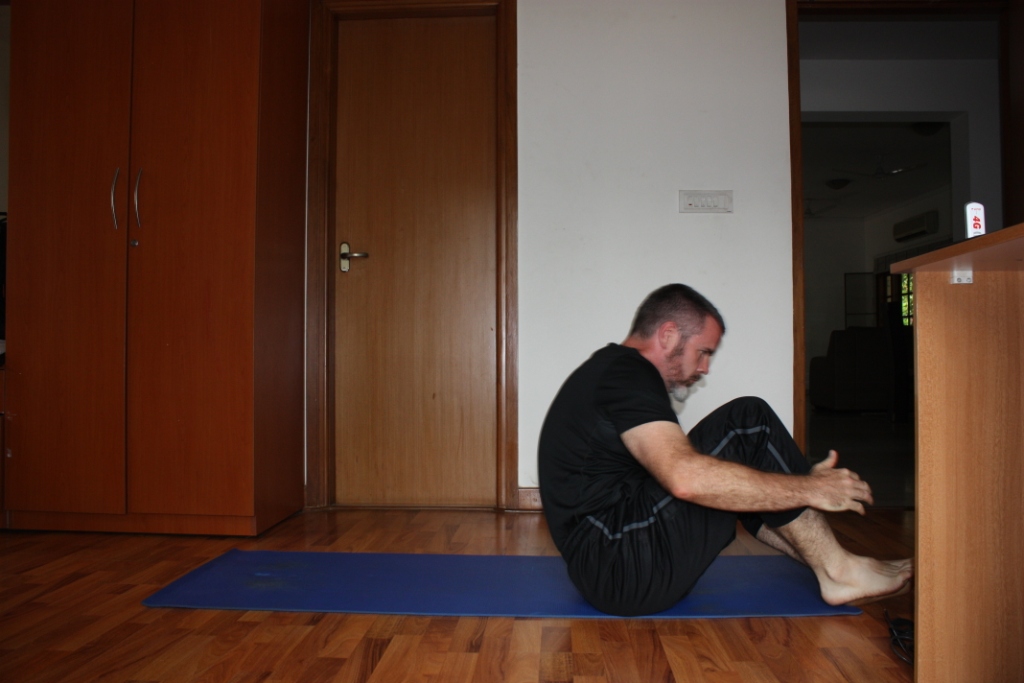
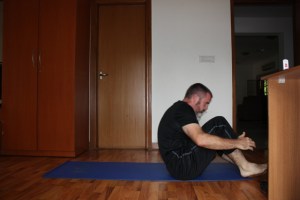
It’s hard to get get a good sequence of pics to show how to breakfall–given my limited photography skills, that is. But here’s my attempt.

So it begins with crumpling balance
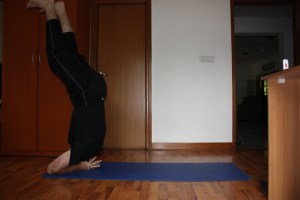
So it begins with crumpling balance

Get those fingers open so your neck doesn't flow over an interlocked fist

Get those fingers open so your neck doesn’t flow over an interlocked fist
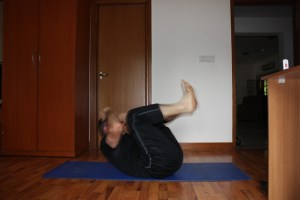
Tuck and roll
Tuck and roll

Don't arrest your roll.  Let momentum carry you forward. Gradually dissipate the energy.

Don’t arrest your roll. Let momentum carry you forward. Gradually dissipate the energy.

Happy inverting.

BOOK REVIEW: Becoming Batman by E. Paul Zehr

Becoming Batman: The Possibility of a SuperheroBecoming Batman: The Possibility of a Superhero by E. Paul Zehr

My rating: 5 of 5 stars

Amazon page

[Note: This book is about sport and exercise science, particularly as they pertain to the martial arts. If you’re a martial artist or are interested in fitness and movement arts at the extremes of human capacity, you’re in the right place. If you’re interested in the comics and an overview of topics including how many billions Bruce Wayne needs and what technologies Batman must master, those aren’t questions addressed in this book. Such readers may find the book delving into depths they aren’t interested in on biological science. There are articles on the web that deal with topics like the “Cost of being Batman.”]

Next summer an eagerly awaited movie entitled Batman v Superman: Dawn of Justice hits theaters. Who knows how much screen time will involve the fight between the titular characters, but the same battle has played out a number of times in the comics, and its appeal is clear. What are the limits of human capability given training, technology, and sufficient smarts? Can a man really defeat an alien that’s faster than a bullet and more powerful than a locomotive? A popular fanboy mantra is, “I like Batman, because I could be Batman. Batman has no superpowers.” So, yes, if you were a billionaire, genius, with the physique of a Greek god, and knew 127 martial arts, you too could be Batman. Or could you? That question is at the heart of Zehr’s book.

Becoming Batman is arranged into sixteen chapters divided among five parts. It begins logically with the question of whether Bruce Wayne needs to begin at any particular point to achieve success in transforming himself into Batman? (At the extreme, one probably can’t imagine Bruce Wayne becoming Batman if he was born with one leg a foot longer than the other and with a Quasimodo hump, but given a Bruce who is starting out “average,” what are his limitations.) In other words, how much does genetics come into play. In the first part, Zehr introduces a character, Bob Wayne, who doesn’t appear in the comics. Bob is Bruce’s twin, and is used throughout the book for comparison purposes, i.e. to convey what Bruce Wayne would look like if he didn’t train fanatically to be Batman. The question of how much of Batman is innate and how much is painstaking built by exercise and training is critical to determining how many of those fanboys really could be Batman.

There a series of chapters explaining the mechanism by which stressors result in a stronger, faster, more powerful, and more resilient Batman. The idea is that Mother Nature doesn’t over-engineer. The only way one gets stronger muscles is by overloading them, which triggers a process of rebuilding them bigger and better than before. Wolff’s Law defines the same concept for bones, i.e. bone density increases in response to increased loading. (Incidentally, the same is true of the mind. A more agile mind is achieved only by working it, and zoning out in front of the television results in a dumbening.)

The next section shifts from generic exercise science to questions of Batman’s martial arts training. What kind of martial arts (or arts) would Batman practice? There is an often quoted statement in the comics to the effect that Batman had mastered 127 martial arts. (This is ridiculous, but it does spur the intriguing question of how many systems does Batman need to learn to have a well-rounded skill-base without being a dabbler? Many will say one art—the right one–is enough, others will say that–given the varied cast of villains he must defeat–Batman needs a broader skill-set than any existing art provides.) More to the point, how many hours does one need to practice a technique to ingrain the movements into one (e.g. neurologically it takes repetition to optimize efficiency.) This is among the questions discussed in this book.

The fourth section deals with the ravages of being Batman, and how much any human could be expected to endure. In this section, one will learn about the cumulative toll of concussions, the likelihood of Batman avoiding broken bones and other injuries that would necessarily sideline his crime fighting, and the effect that working the night shift would have. (The latter might seem trivial in comparison to the former two topics, but—in fact—it’s not. It’s well established that night workers have higher incidence of some cancers and other ailments. Furthermore, as Bruce Wayne has to keep appearances up, it means not only fighting circadian rhythm issues, but also frequent sleep deprivation—the hazards of which are even clearer and occur in short order.)

There are a number of interesting topic that aren’t don’t pertain to the core question per se, but which are interesting for fans of the Batman canon and the character’s mythos. Famously, Batman doesn’t use guns or lethal force. This raises the question of how realistic it is to regularly fight hardened knaves and miscreants without killing them. One can only knock out so many of Gotham’s baddies before one doesn’t get up.

There’s a chapter about what a fight between Batman and Batgirl would be like. While strength would definitely be to Batman’s advantage, there are advantages that an equally skilled female fighter might bring to the fight? How would Batgirl (or Catwoman) need to fight to put those advantages to use? Finally, for those of us who are no longer spring chicks, there are chapters about how Batman could expect to age, and how long he could keep performing at a level at which he could defeat his enemies.

I enjoyed this book and found it both educational and interesting. It should be clear that Batman is just a teaching tool used to explore the limitations of the human body and its ability to endure a life of fighting. That said, references to the Batman comic books and movies makes for a readable text. Perhaps what I like most about this book is that most of the books that address these subjects are textbooks that are sold on the textbook pricing model (i.e. we have a limited but captive audience so let’s make them pay top dollar.) This is one of the few books that takes on these topics at the readability and pricing model of a popular science book.

I recommend it for those interested in the science of performance, martial arts, and injury.

View all my reviews