I ran into a seeker from far lands,
 and asked him what he sought in my hometown.
  He said he sought what's true and beautiful.
  I asked him if it was here, more than his home?

"Sometimes you have to walk a thousand miles
  to find that which resides beneath your nose.
   To unlock truth, the tumblers must align
    from the shake of experience and time."
Uh, we are all seeking both. That is the fundamental strain of being human — the struggle between a need for novelty and a need for familiarity. We are all both tribesman and traveler — though in varied proportion. I love the traveler more in my own particular self.
As far as life experiences, I find just about everything gets better with age. It’s probably to do with the dawning realization that most of the shit one has gotten worked up about over the years wasn’t worth it (as well as the realization that one has fewer years ahead than behind and so one had better get on with it in an aware kind of way.) As icing on the cake, I’m virtually certain to be long gone before the oceans boil or the robots rise up and massacre humanity.
If the question is what kind of things get better with age… certainly not french fries.
What strategies do you use to increase comfort in your daily life?
I don’t, but I have a lot of strategies for being more content in the face of various situations and environments — including uncomfortable ones. These include the yogic practice of dispassionate witnessing, minimalism, travel (and specifically minimalist travel to places – the less familiar the better,) and intense physical activity.
I think comfort as a major objective in life is overrated, and virtually insures a discontented life. A life in which one can be content, whatever may come along, is a happy life.
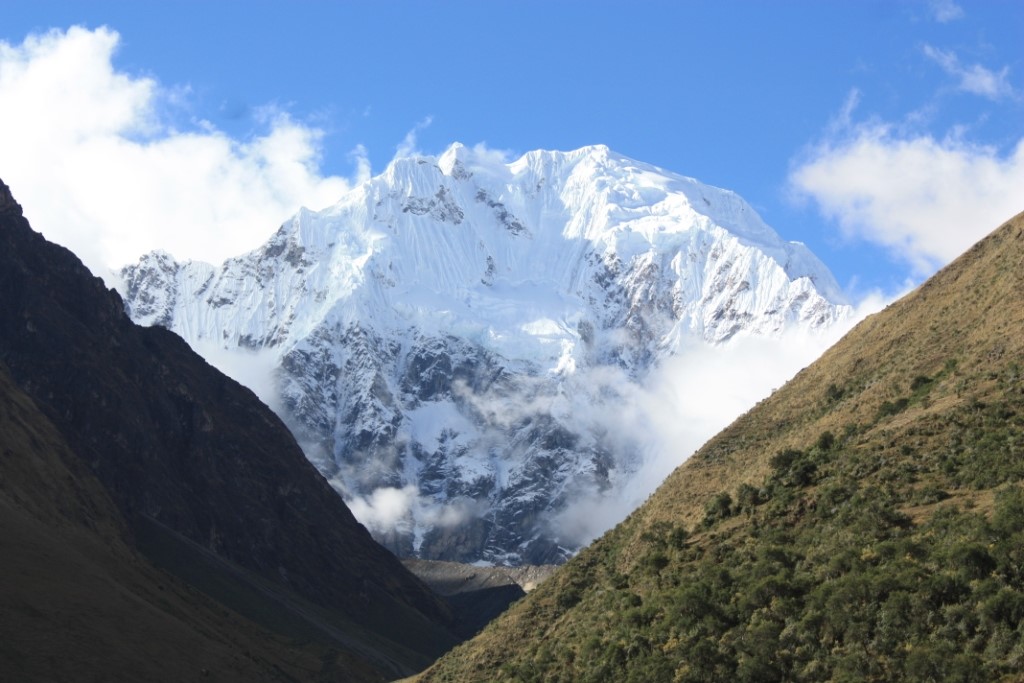
That’s a tough one, but I have to go with a trip to the Peruvian Andes about twelve-ish years ago. As a person from Northwest Indiana (where anthills appear on topographic maps,) it was my first time in the Very High Altitude range. We hiked through the Salkantay Pass (15,000+ft / 4500+m) on the second day of a trek with me vomiting (water, as my stomach was long devoid of other contents) every couple switch-backs. I’m told I was literally green, but can’t confirm for lack of mirrors. But I trudged through, one glacial step at a time.
At the end of our trip, we were in Arequipa and needed to get back to Cuzco for our flight out. After buying bus tickets, we discovered that the road from Arequipa to Cuzco would be shut down by a transportation strike, and that everyone was honoring the strike as they sometimes turned violent. After a day of frustration, we surrendered to the situation, traded in our Arequipa-Cuzco tickets for Arequipa-Lima tickets, and we got into Lima (where we had a layover) early enough to arrange to join the flight there.
The reason this stands out as such a wonderful trip (besides all the beautiful sights: Titicaca, Machu Picchu, the Andes, all the Incan ruins and old Spanish churches; not to mention the delicious food) is the powerful life lessons it taught me. First, I’ve never felt closer to death than crossing through Salkantay Pass, and yet one step at a time got me through. Second, I learned not to butt heads with changing circumstance, but rather flow over, around, or under. Lastly, trips where things go wrong produce the dividend of great stories. Nobody cares about your trip to Paris where everything went smoothly, but they can’t get enough about the trip to Zaire where you got Malaria and were caught up in an insurrection or the cruise where passengers started turning to zombies.
1.) Move my body often and with vigor. 2.) Eat my veggies. 3.) Rest as though it’s an essential part of the process of living (i.e. not as though it’s goofing off between “doing stuff.”) 4.) Drop anything without value, making personal development as much a process of stripping away as it is of adding to.
My days are out of joint and shuffled up,
 and memories are pictures cast upon
  the floor, and rummaged through 'til chaos reigns,
 and I pick random recollections out
  of all the events ever to transpire.

They seem no more my life than another's:
 a glance, a glimpse, a blank firing of mind,
 a wicked hope that truth will come to me.

But all I see are monochrome mindscapes
 that could've been wrenched out of another mind,
  or made from AI's collage artistry
 to serve some distant master's deep wish to
  learn what hot-injected time does to a soul,
  and if shuffled scene stacks can make one whole?
A Psych teacher told us a story of what he called “a gestalt of expectations.” A man from a city in the East is driving out West, and he passes a gas station – despite being low on fuel. (He’s used to gas stations being everywhere.) Anyhow, he runs out of fuel. He can’t see anything around except desolate desert bisected by a line of asphalt. He decides to walk back to the gas station he passed ten miles back. There is no one traveling on this remote stretch of desert road. As he’s walking in the intense heat, it comes to his mind that the employee at the service station is really going to gouge him on the price of gas and a jerry can. As he walks and walks, skin prickling with the heat, he keeps thinking about how he’s going to get screwed by the gas station attendant and also how he’ll be chided and ridiculed for running out of gas in the middle of the desert. He imagines it in great detail. Finally, bedraggled and with heaving breaths, he arrives at the station. The gas station attendant rushes out to help this poor man, and the man punches the attendant square in the nose (for all the offenses taking place solely in the man’s mind.)
In a broader formulation, I think this is the most important lesson any human can learn. Our personal perception of what we experience is not equal to what it is that we experience (the exterior world.) This is why some people dealt a crappy hand can turn it into a wonderful life, and also why some people who seem to have it all commit suicide in the prime of life.
I could be angered or dismayed that the single most important lesson I learned in secondary school was via off-curriculum ramblings during an elective class, but I choose not to. Instead, I’ve been trying all my life to make that bit of knowledge into wisdom.