 Hamlet by William Shakespeare
My rating: 5 of 5 stars
Amazon.in page
Get Speechify to make any book an audiobook
This is probably Shakespeare’s most popular work. If it’s not, it has to be in the top three. One reason for its popularity relates to language. There’s probably a higher density of widely-quoted lines, and phrases that are part of common speech, in this play than in any other work of literature. From Polonius’s warnings to his son (e.g. “Neither a borrower nor a lender be”), to Hamlet’s soliloquized attempts to think through a course of action (“To be, or not to be: That is the question:”), to Hamlet’s wisdom in moments of lucidity (”There is nothing either good or bad, but thinking makes it so.” or “There is more in Heaven and Earth, Horatio, than is dreamt of in your philosophy.”) to the many other quotes from various characters that appear across pop culture and everyday speech. “Methinks she doth protest too much,” “Something is rotten in the state of Denmark,” “Brevity is the soul of wit,” and “Sweets to the sweet” [or variations thereof] all derive from this play.
But quotability isn’t the sole basis for the play’s popularity. While it’s certainly not the most action-packed of Shakespeare’s plays, that is actually part of what makes it unique and makes its lead character relatable. Shakespeare’s works are full of tragedy resulting from rash conclusions that – in turn — result in ill-considered actions. How many times have we seen the case of a man who is too quick to believe his wife or girlfriend has been unfaithful, and – after the cataclysmic fallout – he then discovers that it was never true in the first place. Hamlet turns the convention on its head, showing us what can go wrong with a character who – in true scholarly fashion – is prone to paralysis by analysis. Hamlet is prone to drawn out contemplation that results in missed opportunities – not to mention, tragic neglect of his love interest, Ophelia. [Such over-analysis is exemplified by the famous “To be or not to be” soliloquy as Hamlet considers suicide.] It might seem like inaction would make for a boring play, but the tragedy unfolds never-the-less. [And in the instances in which there is fast-action, it proves flawed as when Hamlet mistakenly kills Polonius.]
Another element of the play’s success hinges on a technique for which Shakespeare was a pioneer and an early master, strategic ambiguity. We don’t know the degree to which Hamlet is insane versus pretending, regardless of hints in the form of moments of lucidity. At least until the final act, we don’t know the degree to which Hamlet’s mother is in on Claudius’s plotting. We also don’t know if Ophelia is a lunatic when she is handing out flowers, or if she’s cunningly delivering a masterful series of passive-aggressive bitch-slaps. Shakespeare is careful with his reveals, and sometimes chooses to not offer any at all.
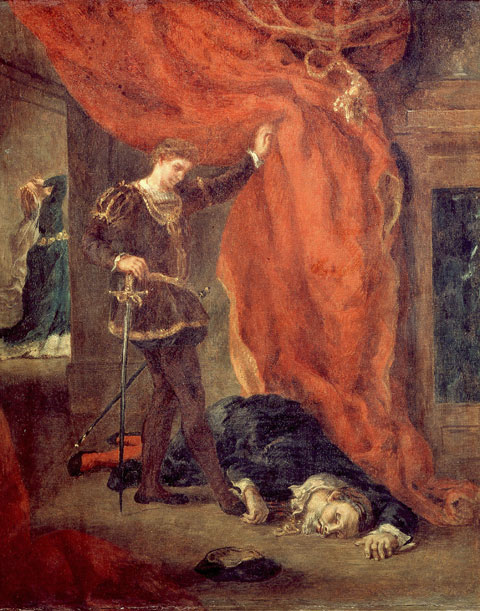
As most people are at least vaguely acquainted with the story, I’ll offer only a brief description. [But if you don’t want the story spoiled any more than it has been, call it quits here.] Hamlet, Prince of Denmark, returns home from college. He’s bummed because, not only did his father recently die, but his mother has remarried his uncle. Hamlet might be able to cope with this apparent disrespect [arguably to him as well as his father because young Hamlet was next in line of succession], but then his father’s ghost appears to Hamlet. The ghost tells him that he (Hamlet’s father) was murdered by Claudius, and the ghost insists upon revenge. Hamlet doesn’t want to be punked by a malevolent spirit, so he has a group of actors modify their play so that it depicts the assassination as the ghost described it. When Claudius is shaken up by the scene and leaves the theater, Hamlet feels certain that the ghost spoke true. When Hamlet goes to visit his mother, he believes that Claudius [or a real rat] is spying on him and stabs out at a rustling curtain, but he actually kills Polonius (father to Hamlet’s love interest, Ophelia, and a guy who doesn’t deserve to die – despite being a bit of an irritating know-it-all.) Polonius’s killing triggers a sequence of events that ultimately results in Hamlet being sent to England, Ophelia committing suicide, and her brother, Laertes, coming home intent on getting revenge for Polonius’s murder.
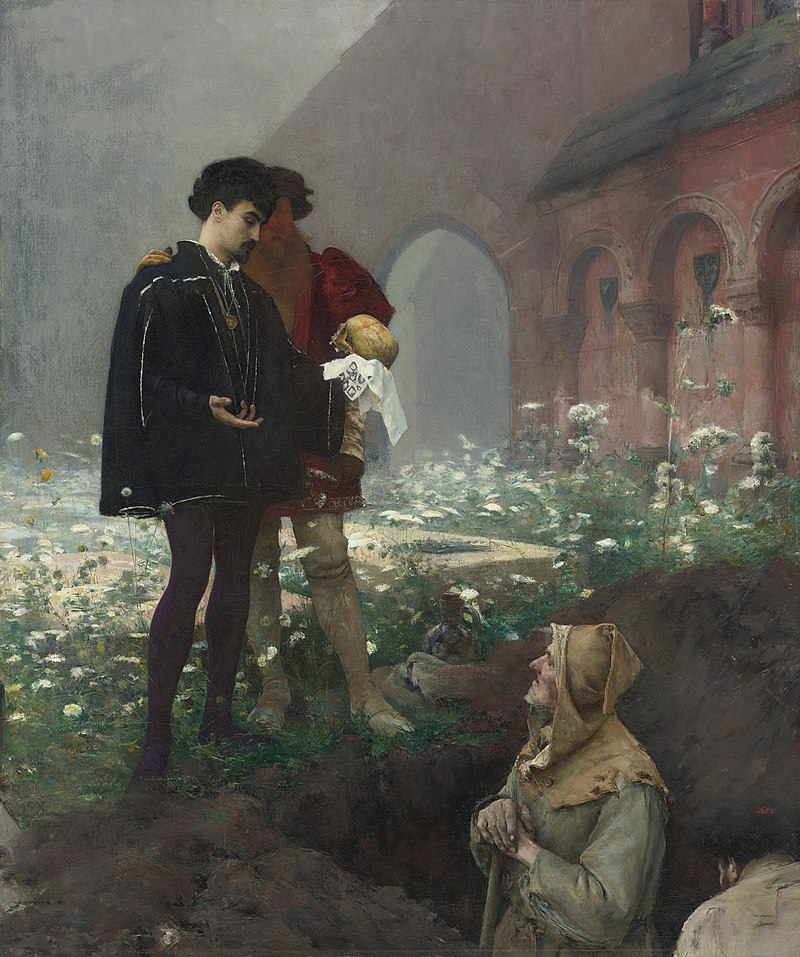
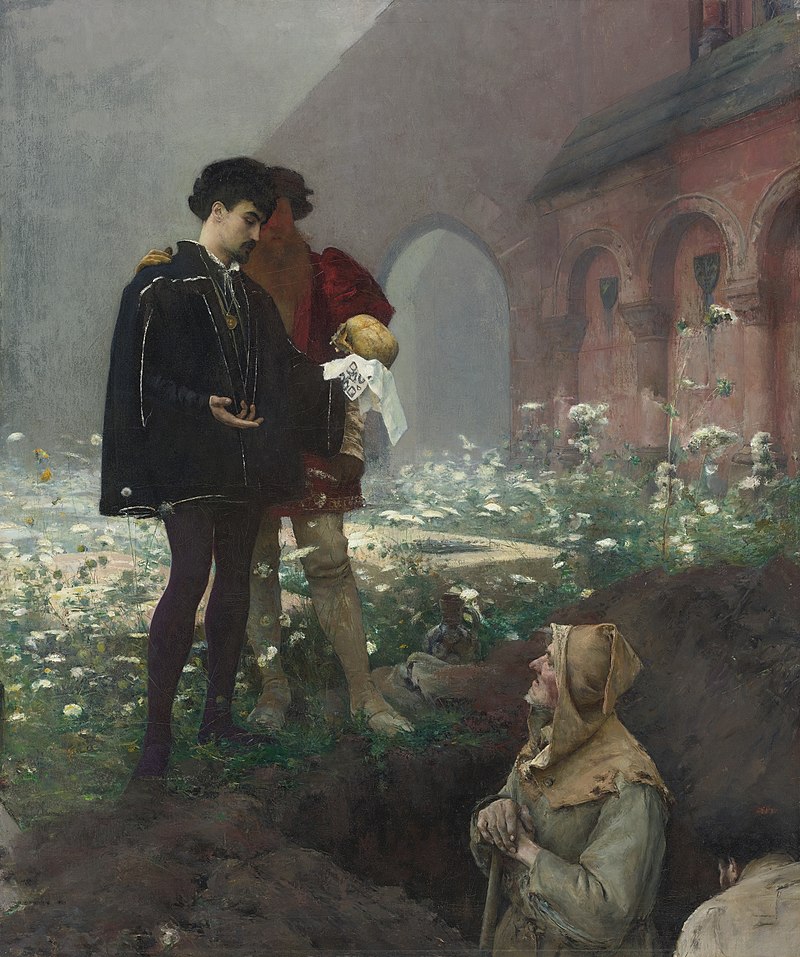
Hamlet discovers that Claudius sent him off with a “Please kill this man” note, but Hamlet manages to replace the King’s order and escape. He returns to Denmark in time to happen upon Ophelia’s funeral. He’s distraught about Ophelia’s death, despite having been a complete jerk to the girl whenever he wasn’t completely ignoring her. Laertes is angry at Hamlet for killing Polonius and giving his sister a lethal case of heartbreak, and there is a tussle. This is broken up and an agreement is made to have a gentleman’s duel later. Unbeknownst to Hamlet, this is part of a plot engineered by Claudius and Laertes. [To be fair, Laertes doesn’t know what a treacherous villain Claudius is, and how much the King’s previous plot – killing Hamlet’s father – is the cause all the play’s unfortunate events – as opposed to them resulting from Hamlet being part crazy and part jackass.] Claudius and Laertes poison the tip of Laertes’ rapier, and Claudius doubles down by pouring some more poison into Hamlet’s cup [which Hamlet’s mother ultimately drinks, followed by forced consumption by Claudius at the hands of Hamlet.] In true tragic form, the end is an orgy of death.
This is a must read (or see) for everyone – both for the language and the complex and interesting characters.
View all my reviews
Share on Facebook, Twitter, Email, etc.








 Tiger Riding for Beginners