BOOK REVIEW: Extreme Fear by Jeff Wise

Extreme Fear: The Science of Your Mind in DangerExtreme Fear: The Science of Your Mind in Danger by Jeff Wise
My rating: 4 of 5 stars

Amazon page

Extreme Fear examines the science behind fear—particularly the fear of life and death situations. In doing so, the author presents findings from scientific research as well as cases that demonstrate the concepts behind those findings. People are often so close to their fears that they take them for granted, and feel that there’s nothing to be done about them. However, there’s a great deal to be learned about how fear operates and how one can improve one’s performance in fearful situations. By replacing the lens of shame with one of science, one can see what fear is objectively, and make the emotion more of a help and less of a hindrance.

A central idea in the book is that fear evolved to maximize one’s chance of survival against the age-old threats facing mankind. These pre-historic threats were relatively straightforward: saber-tooth tiger attacks, clubbing by members of warring tribes, fire, famine, flood, etc. Ancient threats often called for hauling ass, freezing in place, or getting stabby. The problem is that our present-day threats often call less for gross motor skills (run, kick, or throw) and more for creative or nuanced solutions to technological problems (i.e. sliding cars, falling planes, or malfunctioning assault rifles.)

Motor learning is one means by which this mismatch between what our brain tells our body to do in a stressful situation and what is called for in our modern world. Take the case of the infantryman with the jammed rifle. Without training, he might pick up the rifle like a club, intending to use it to unleash blunt force trauma. That is, if he’s still alive then the enemy gets into cudgeling range. Alternatively, the soldier may drop the rifle and run for his life. However, because he had a drill sergeant who made him practice clearing his weapon over and over, his body can go to that behavior while his conscious mind is blinking out.

Still, motor learning only takes us so far. Sometimes creativity is called for, and that’s a tall order in the face of where our body / brain want to put limited resources. In fact, Wise begins the book with the story of a pilot who was flying an old plane when the wing support broke and the wing flipped up, threatening to rip off. Somehow the pilot figured out—based on a vague memory and lots of experience—that he could flip the plane over and fly it upside-down and the wing would snap back into place. Then he had to figure out how to land: a.) upside-down crash, or b.) try to flip the plane over at the last second. The brain systems that this pilot smoothly accessed are among those that one doesn’t expect to be operating in life or death situations—e.g. those involved with long-term conscious memory and abstract problem solving.

The question of how some people can keep their wits about them, as the above pilot did, while others crash and die is the one that Wise really wants to answer. It turns out that it’s not such and easy question. During World War II, the military conducted studies to try to determine which soldiers could be counted on under life and death stress. The answer didn’t readily present itself. Among the problems in finding an answer is that courage and fearfulness aren’t as unitary or straightforward characteristics as one might think. Wise presents the case of Audie Murphy as a prime example. Murphy was at once one of the most decorated American soldiers in World War II—a man who’d taken on a company of Germans single-handedly—and a man of great social anxiety.

The book’s 13 chapters are divided into three parts. The first part presents fear and its effects. The middle section deals with various forms, aspects, and facets of fear, including: social v. life-and-death fear, choking behavior in sports, and fear of fear v. fear of an outcome. In the last part of the book, Wise suggests how one might achieve better performance in the face of fear.

I found this book to be informative and interesting. Wise did a good job of picking cases to illustrate the concepts discussed in the scientific literature. I’d recommend this book for individuals who are interested in the science of the brain and the ways to achieve ultimate human performance.


View all my reviews

How to Kill a “Cereal Killer” and Restore Halloween

cereal killerI know what you’re going to say. Why would I want to murder a cereal killer, a taco belle, a holy cow, a pig in a blanket, a deviled egg, or any of the other bearers of bad Halloween punnery? First, you want to kill someone.  You don’t have to admit it to me and I’d advise against admitting it to the District Attorney, but at least admit it to yourself. Second, if you kill the person you really want to kill (e.g. your boss, the tax man, your personal trainer, or your hairdresser—sorry, low blow) you’ll be the lead suspect. Therefore, you need to find a way to vent your homicidal rage into productive outlets, and I’d argue that the killing of punsters is community service. You shouldn’t even think of it as murder. It’s more like culling the Halloween herd. Forest fires kill, but the next year the forest is more lush and beautiful than ever before.


Now let’s get down to the real reason to conduct your own Halloween killing spree. Because it’s the perfect time for the perfect crime. Think about it.

  • Anonymity: Except for the lazy people who wear a T-shirt with “Halloween Costume” printed in unimaginative block letters, everybody is in makeup or has their head stuffed in some stinking mask that five people have thrown up in within the last three years. This makes it almost impossible to identify suspects. The lazy bastards would be eliminated immediately anyway because it takes commitment to be a homicidal maniac.
  • Relative Inconspicuousness: You won’t be the only one who’s apparently blood spattered. Besides Marti Gras and full moons, what other nights can one say that. There will be large numbers of people wielding weapons and looking creepy. What better time to blend in?
  • Distraction: If I might be granted a brief diatribe. Halloween used to be the holiday of terror, but no more. Valentine’s Day may be the holiday of romance (or florists), but Halloween is the holiday of sex. However, you can use this trend to your advantage. There’s a great deal of distraction to be garnered from the proliferation of sexy nurses, sexy waitresses, and sexy actuarials. When the girl whose costume is painted on rather than worn walks through the room to get a single potato chip, that’s a good time to jab the hypodermic into the neck of the nearest drunk pun and get the hell out of dodge.


So how will you choose your target? First, as indicated, it’s best to pick someone who’s inebriated because no one will realize they’re dead–and not just passed out–until they begin to stink. Don’t worry, finding a drunk won’t be hard. At a given Halloween party there will be four designated drivers for the 150 people in attendance—so 148 people will be completely hammered. [No, my math is not that bad. Two of those designated drivers are cheating bastards. If you kill a pun who’s a cheating designated driver you’ve hit the trifecta—OK, maybe my math is that bad. At any rate, you get bonus points. ]


Next comes the question of determining whether the costume is a pun or not. This can be harder than it seems. Sure there are the easy ones I mentioned above (and others like Kevin “Bacon” [Kevin nametag on a meat vest], “Bat” Man [w/ Louisville Slugger], Down for the Count [Dracula with a blowup doll orally affixed to his crotch region], Spice Girl, Dust Bunny, Formal Apology [tuxedo-clad man with “sorry” written on his tie], etc.) that will be immediately obvious.


However, what if one sees a guy in a Grim Reaper costume with a bag of pot. Perhaps this is just someone who likes to imbibe. However, if the pot is dayglow green, then you may have a “the grass is greener on the other side” who desperately needs killing. The key is that one must pay attention to the details. Sometimes the costume will be poorly done. Imagine a fine “Tom the Cat” costume with three misshaped spheres feebly stapled to the crotch region. This is a “horny as a three-balled tom cat” who must die.


On the other hand, you should avoid reading too much into costumes. Say you see a girl who looks like a stripper. You shouldn’t engage in some Rube Goldberg-esque thought process in which you conclude that she is saying, “All that glitters is not gold–because sometimes it’s a stripper.” Said woman may merely be costumed as a stripper, or might be a stripper who just got off stage and didn’t have time to go out looking for a costume.


When in doubt, if the costume doesn’t seem to make a lick of sense, it’s probably someone’s sense of clever gone awry and you shouldn’t feel bad about friendly fire against a non-pun.


Finally, some general rules of thumb (BTW: feel free to kill anyone dressed in a giant mitten with a page of the tax code taped to the thumb):

  • Only kill one pun per party. Being a killer of puns is like being a Marine Sniper—except that it’s completely illegal and involves no honor whatsoever—my point is that if you loiter in place you’ll get pinned down by the Vietcong. It doesn’t matter whether the party in question has the best pigs in a blanket (i.e. the hors doeuvres, not the cutesy couple costume), the best DJ, or the sluttiest witches, maids, librarians, or geologists in town. Don’t get greedy. Get in and get out—well, you can grab a handful of those delectable pigs in a blanket on the way out, but then get out of the house!
  • Never wear the same costume to more than one party. The police call that a clue. You have to be like Kathrine Heigl in that 27 Dresses  movie—which I never saw. Do the quick change like Clark Kent between parties. That brings me to an alternative killing scheme whereby you can kill anyone who’s dressed as a character from a romantic comedy.
  • Don’t consume a lot of legumes, high fiber foods, beer, or Taco Bell before your outing. Just because no one will see your face inside that barf-splotched mask doesn’t mean they won’t be able to smell you. Plus the zippers in costumes are unreliable, and you don’t want a case of Taco Trots to hamper your evening’s fun.
  • Don’t wear a costume that’s too menacing. You want to be able to point to someone who is nearby, completely innocent, and who looks like a killer and say, “she did it.” Also, don’t wear the “Identity Thief” costume in which one has name tags all over one’s outfit with different names. First, it plants the seed of criminality in the mind of those around you. Second, it’s a bad pun and may result in your being stabbed. Which brings me to the ultimate rule:
  • Don’t wear a pun costume yourself, it may result in your being stabbed. I’m not saying that I once stabbed a prostitute with a Seeing Eye dog who turned out to be just another good-hearted Halloween killer because “love is blind,” but…


I hope this guide to perpetrating a Halloween massacre has been helpful. I think we’d all like to bring the fear back to Halloween like all the Saints who partied down on All Saints’ Day Eve intended. So, whether you’re a first time killer or you’ve been around the block (another potential costume cliché to kill), a few simple steps will keep you out of the hands of the slutty cops—or regular cops.

BOOK REVIEW: The Wild Life of Our Bodies by Rob Dunn

The Wild Life of Our Bodies: Predators, Parasites, and Partners That Shape Who We Are TodayThe Wild Life of Our Bodies: Predators, Parasites, and Partners That Shape Who We Are Today by Rob Dunn

My rating: 4 of 5 stars

Amazon page

Dunn’s book addresses a host of intriguing questions such as:

-Why are there diseases that disproportionately attack those in the richest parts of the world while being almost non-existent in poor countries?
-Why is obesity at epidemic proportions among modern humans?
-Why—while people have diverse tastes overall—do there seem to be universal preferences for sweet, salty, and fatty foods?
-Why are so many people’s lives wrecked by constant stress and worry?
-Is the Appendix really a vestigial organ with no apparent purpose?

As the subtitle suggests, this book is about the role that other species have played in human evolution and the way we look, behave, and think today. The message of The Wild Life of Our Bodies is that humanity’s proclivity to see itself as an island–uninfluenced by other species–has its cost.

The book is popular science–approachable to a layman but with the usual disdain for gratuitous assertions and shoddy reasoning that define the scientific though process. That being said, Dunn does put some editorial opinion out there in ways that might appear as fact in a slipshod reading. The most prominent example being Dunn’s suggesting that what best defines humanity is not our intelligence or ability for abstract representation (or even our physical appearance), but that we are the only (first?) species that has killed other species off not purely of self-defense or for food, but to exercise control over our ecosystem. I doubt this would strike a majority of impartial scientists as a fair and unbiased way to define humanity. Granted, this point not what The Wild Life of Our Bodies is about, and whether one thinks this it is fair or not is not critical to whether one will find the book to be of value. However, the idea (and the fact) that humans have zealously killed off other creatures is certainly relevant to the discussion at hand.

If “terraforming” is the term for how an alien race might environmentally engineer Earth to make it suitable for them to live here, perhaps we could call humanity’s assault on other species “bio-forming” of the planet—choosing a roster of species that strikes our fancy. All the time humans were trying to make ourselves more comfortable by getting rid of inconvenient species, we remained ignorant to the downside.

Dunn covers a broad range of mismatches between who we are evolutionarily and how we live in the modern world. The Wild Life of Our Bodies suggests that, like the pronghorn antelope, humans are in many cases over-designed because of the loss of species (parasites, predators, symbiotes, etc.) that helped to make us who we are today. (One question that once puzzled biologists was why pronghorns were so much faster than every species they faced.)

While it sounds good to be over-designed (at least relative to the alternative), it’s not without cost. In our case, we had guts that were supremely adapted to having parasites, but the lightning fast (on an evolutionary timescale) elimination of those parasites has left us with bodies that attack a non-existent enemy and this has resulted in a number of new diseases. We are used to diseases that succeed in the poorest—and, hence, least hygienic areas– but disease that mostly attacked in the cleanest places on Earth have puzzled us for some time. Crohn’s disease is a prime example. “Rewilding” (i.e. putting parasites back into) the guts of Crohn’s patients has shown positive results.

Dunn lays out a couple of the theories as to how the loss of our intestinal bacteria may result in a number of first-world ailments. Interestingly, some of these diseases aren’t even digestive in nature, and might seem to have no logical connection to gut bacteria. However, our body’s systems are a system-of-systems—i.e. they are integrally linked. One issue is that some parasites have been able to mask their presence, and our bodies have learned to present a heightened response to account for this veiled threat. Today our systems can’t tell the difference between our squeaky clean guts and a gut full of these sneaking parasites so it drops the immune system version of an A-bomb.

This is one example of why some diseases don’t exist in the third-world where the body knows what parasites it’s up against. One might say, “Yes, but these ailments of over-reactive systems can’t be as bad as the effects of the parasites.” That’s often not true. Most people with internal bugs (we all have them to some degree), don’t even realize it. The fact that people with Crohns’ are willing to have predators implanted in them speaks to this issue.

There has been concern for years about downside of the rampant use of anti-bacterials, antibiotics, and antiseptics, and this is a topic Dunn addresses as well. For example, there seems to be little evidence that such agents in soap do any particular good, but they decidedly do bad (encouraging drug resistant species.)

Perhaps the single greatest change in the nature of homo sapiens life resulted from the agricultural revolution, and Dunn delves into how this seminal event changed our bodies. With paleo-dieting all the rage, it will come as no surprise that there have been some major changes to the human diet since our hunter-gatherer ancestors roamed the Earth. Once again, we have bodies built on an evolutionary timescale, and they don’t necessarily cope well with our new diets.

One problem is that we have strong hardwired drives for foods that were a rarity in our species’ past, but which we now produce in abundance. For example, we eat far too much refined sugar because our bodies are wired to love sweet, but that kind of food was rare to our pre-agricultural ancestors. Hence we have the existence of diabetes, and its greater prevalence where high-sugar diets are common. Many people are also saddled with an evolutionary advantage to store fat because their ancestors come from a clime where food was not abundant year round. The problem is that now there’s a grocery store on every corner and this once great advantage is contributing to burgeoning waistlines.

I gave this book a high rating on the grounds that it presented a lot of food for thought, and that’s what I most value in non-fiction. Some of the theories may turn out to be incorrect, but this book offers one a lot to think about and clear explanations of the bases for what can otherwise seem a little outlandish. There is also some wit in places that contributes to heightened readability.

View all my reviews

How to Kill a Rogue Yard Gnome, Part 1

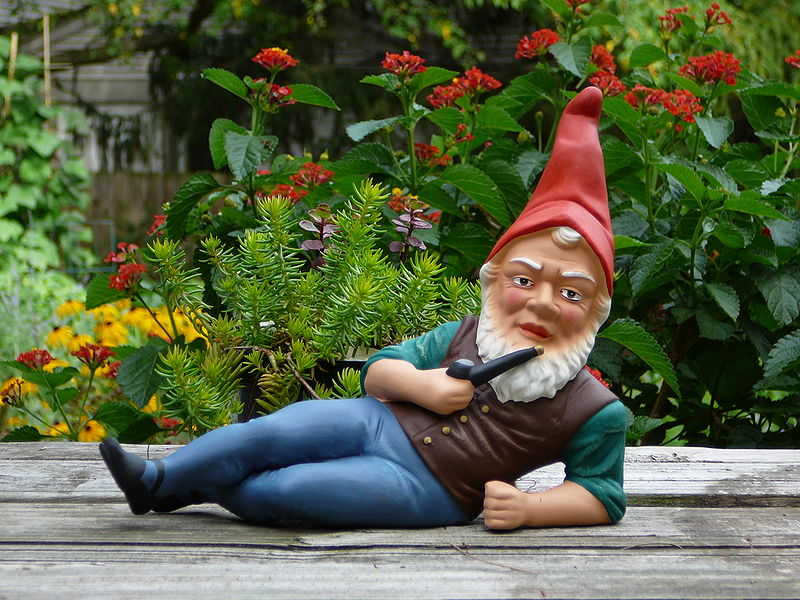
Attribution: Colibri1968

Attribution: Colibri1968 (Is this gnome too sexy?)

Five nights ago, coming home at days end, nosing my car into the drive, I startled. Where my headlights should have roamed over a patch of bare grass, instead the light glared off of the white beard and ruddy cheeks of one of my three lawn gnomes. I braked and swung the wheel hard to avoid grazing the gnome with my bumper. I could have sworn that gnome was always much closer to the house.

Somebody must have moved it.

By the light of the next morning, a ring of flattened, brown grass confirmed my suspicions from the previous night. I had no time to consider who might have moved the gnome.

No harm, no foul.  

*

Four nights ago, coming home, the gnome was not at the edge of the drive where it had been. I assumed that whoever had moved it put it back where they found it. But it wasn’t there either.

Rummaging through a drawer of loose tools and hardware, I grabbed a flashlight. I went through the front yard, swinging the beam of light in wide arcs, intent on finding the missing gnome. It was then that I noticed that the others were missing. I was considering whether it was worth calling the cops for the theft of a few cheap yard gnomes when I turned and my light reflected off something white in the side yard.

I rounded the corner cautiously, not wanting to piss myself if some prankster youths jumped out from my shrubs. There were no youths, just the three errant gnomes. The trio faced into the center of a circle as if they were conversants at a cocktail party. I looked around, in case this prank was being caught on some sort of candid camera. Not that I would be able to see the conspirators in the darkness, for I didn’t want to go shining my light into the neighboring properties. So I shrugged and went back in the house leaving the gnomes to their silent cabal.

The next morning, the gnomes were back in what— as far as I could tell— were their original positions.

*

Three nights ago, I came home hoping the prankster had gotten it all out of his system. But when my headlights washed over the front lawn, I gulped. One of the gnomes lie on his back. The other two stood gazing into each other’s eyes, one at the downed gnome’s feet and one at his head.

This is getting to be enough already, I’d thought.

Given the ominous tone of the latest prank, I didn’t venture outside to reset the gnomes that night. I had a largely sleepless night, wondering if this was more than a prank, if it was some sort of dire message. I put my sleepless night to good use devising my plan.

In the morning I found that two of the gnomes were back in their original positions and the third was missing altogether. That sealed it. I would move forward with my plan.

*

Two nights ago, I came home later than usual, having stopped at an electronics store to buy a video camera with night vision and a tripod. You’ll not be surprised to learn that one of the two remaining gnomes was smashed to shards while the other stood casually at its feet.

Anger now trumped fear, and I was prepared to catch the culprit in the act. Without turning on the light in the front room in order to avoid alerting my tormentor, I set up the tripod. In my bedroom, where nobody could observe me, I made sure the camera worked. I recorded the cat yawning and played it back. I cut the lights and made sure the night vision worked. I confirmed that I had sufficient memory for the entire night. Returning to the front room, I trained the camera on the gnome and gnome remnants. I checked and double-checked the power, memory, and the settings. Confident that all was set to capture the ne’er-do-well, I retired to bed for a sound night’s rest.

The next morning, I strode into the front room. I could see through my front window that the gnomes, broken and whole, were both gone from where they had lain, and that the camera’s red light was still showing recording in progress. I stopped the camera, confident I had captured the scallywag on video. I would call the police, and I would have the evidence I needed.

I pressed “play” and watched the green grainy video. There was nothing but stillness and the occasional branch trembling in the wind. In the interest of getting to work on time, I fast forwarded. When I was at eight times (8X) speed, I noticed there was and impression of movement, an inexplicable gradual shift of the standing gnome. The gnome shards also seemed to become faint, as if they were dissolving. I thought my eyes were playing tricks. At 32X speed, the standing gnome migrated itself out of the frame while the shards seemed to dissolve into thin air. No person or animal — other than a common squirrel– ever entered the frame.

Leaving the house that morning, hoping that the evil was now at an end, I was shocked to see that the remaining gnome hadn’t liberated itself from my property. It was right where I had set it years before. Unsettled and convinced that something wicked had taken up residence in my front yard. I grabbed an aluminum baseball bat from my garage and I swung hard into the gnome’s ear. The head flew off, revealing its hollow core. I must have looked like a madman to my neighbors as they went to work, gawking at me as I smashed the gnome to shards and then the shards to dust.

So you must be wondering why this is Part 1 and why there is further writing below. I just told you how to kill a rogue yard gnome. Did I?

*

Last night I came home to find a gnome sitting indignantly in the place of the gnome I had smashed that morning. It looked very much like the one that I had dashed to smithereens eleven hours before; except that instead of a big, beaming smile, its face was a scowl.

TO BE CONTINUED