BOOK REVIEW: If You Meet the Buddha on the Road, Kill Him! by Sheldon Kopp

If You Meet the Buddha on the Road, Kill Him: The Pilgrimage Of Psychotherapy PatientsIf You Meet the Buddha on the Road, Kill Him: The Pilgrimage Of Psychotherapy Patients by Sheldon B. Kopp

My rating: 4 of 5 stars

Amazon page

If Kopp’s title seems gratuitously bellicose and totally inappropriate for a book about psychotherapy, you may not recognize that it’s a quote from the 9th century Zen (Chán) Buddhist master, Linji Yixuan. In reality, the quote isn’t bellicose and is quite apropos of Kopp’s message. Linji was just saying that if one collects sacred cows, one is unlikely to be liberated from delusion and find a quiet mind. Kopp’s primary point is that patients tend to deify their therapists, thinking of therapists as people who can “fix them.” In reality, the therapist is a flawed human who can only help guide the patient on a personal pilgrimage. However, when patients find out that the therapist isn’t a sage who can make them feel better as if by magic without any real change on the patient’s part, they become disillusioned and the wheels can roll off any progress they may have made.

Pilgrimage is the central metaphor of Kopp’s book. The psychologist uses an interesting approach, without which I doubt I would have read this book. He uses pilgrims of classic literature as models. The second, and by far the largest, part of the book lays out the various paradigms of pilgrim. The use of works like Gilgamesh, Macbeth, Don Quixote, Dante’s Inferno, Kafka’s The Castle, and Conrad’s Heart of Darkness makes for a work of interest to more than just psychotherapists. Kopp skillfully employs the wisdom of both the Eastern and Western worlds, often in pithy stories that have been around for centuries.

In addition to all the well-known tales that Kopp relies upon, the latter part of the book has some interesting personal stories from when Kopp was working as a therapist in a prison.

I think this book offers some intriguing food for thought regardless of whether one is either a psychotherapist or a psychotherapy patient.

View all my reviews

BOOK REVIEW: Sorry I Ruined Your Orgy by Bradley Sands

Sorry I Ruined Your OrgySorry I Ruined Your Orgy by Bradley Sands

My rating: 3 of 5 stars

Amazon page

Contrary to the title, this isn’t an etiquette primer on how to make amends for a poor performance at a friend’s sexual soiree. It’s a collection of absurdist flash fiction that takes its name from a its introductory story in which a man shows up to an orgy wearing a bear costume and proceeds to behave badly.

Most of these stories are under a page long and few are longer than three pages. The stories don’t make sense, and are not intended to. (If they do make sense, the author has failed.) Instead, they are designed to subvert expectations to the maximum extent possible. Subverted expectations being the foundation of humor, there will be chuckles. However, it’s not just humor. It’s about defying one’s ability to judge what’s around the next corner by resisting any temptation to observe socio-cultural conventions about what could possibly and properly come next. Like spoken word acts, these stories are meant to invoke a response in the reader by surprises of language—often jarring surprises—more than by way of meaning.

If you are the type who doesn’t take words too seriously and take to absurdity like it’s a Zen koan, you might enjoy this brief work for the tickling it gives one’s mind. If you’re the type who takes words very seriously and are prone to get bent out of shape by “inappropriate” or loose word use, you will hate it and should avoid the trauma of reading it.

I’ll elaborate on my last statement. Irreverence, impiety, and a proclivity for the shocking are a few of the characteristics that go hand-in-hand with subverting expectations and conventions. Because of this, there’s a fair amount of profanity and jarring concepts included in the mix. I’ll offer one example of such a jarring concept that’s included in the book: “rape camp.” If you’re prone to be offended by the loose use of the word “rape,” then probably the only more reprehensible phrase than “rape camp” would be “rape fiesta” (though, to be fair, in the book a rape camp is more like a concentration camp than a summer camp.)

As a litmus test of how you’ll respond to this work, imagine opening a Hallmark card and reading the following sentence as contained in this book, “Sorry your grandma died! She molested me when I was eight.” If—despite realizing that it’s so wrong—you can’t help but grin, you’ll like this book. If your impulse is to write the author hate mail, you should avoid reading it.

It should be noted that the book is not all rape, molestation, and orgies. The book mostly consists of less prurient attempts to achieve the unexpected and/or shocking.

View all my reviews

BOOK REVIEW: The Heart of Yoga by T.K.V. Desikachar

The Heart of Yoga: Developing a Personal PracticeThe Heart of Yoga: Developing a Personal Practice by T.K.V. Desikachar

My rating: 5 of 5 stars

Amazon page

This book’s author, T.K.V. Desikachar, was the son and student of T. Krishnamacharya. If you’re not a well-read and/or Indian yoga practitioner, there’s a good chance the latter name means nothing to you, and yet your practice has likely been influenced profoundly by him. He was the teacher of B.K.S. Iyengar, Pattabhi Jois, and Indira Devi. Iyengar, who recently passed away, popularized the use of props (blocks, straps, bolsters, etc.) as a means to achieve proper alignment until one’s flexibility was sufficient to achieve perfect alignment without assistance. Jois developed the vigorous and flowing Ashtanga Vinyasa style of yoga, which is the direct ancestor of Power Yoga—a popular style among fitness buffs in the West. Indira Devi was a Westerner actress who took an Indian name and was among the first teachers to introduce yoga to America and to adapt it to American needs. While Desikachar wrote the book, his father’s presence is seen throughout the book in photos and quotations.

After reading the book, it will not come as quite the surprise that T. Krishnamacharya was teacher to several of modern yoga’s most innovative teachers. A central concept of Krishnamacharya’s teaching philosophy was that yoga is a personal path that must be optimized to the individual. That’s what this book tries to do. Its aim is not to teach one yoga for all, but to help individuals tailor yoga to their own needs.

The Heart of Yoga is divided into four parts. The first two parts form the core of the book, and make up the bulk of its length. The first introduces yoga at a basic level and then goes on to impart practical lessons on asana (poses), pranayama (breathing exercises), and bandha (locks.) The second part instructs on the philosophical aspect of yoga, and how an individual can bring these concepts into their life. This includes ideas that are traditionally associated with Yogic philosophy as well as those of Samkhya (Yoga and Samkhya are two of the six orthodox schools of Indian philosophy, and are closely related.)

Part III of Desikachar’s book is his translation of Patanjali’s Yoga Sutras with commentary. Some will appreciate that the sutras are written in Sanskrit, a Romanized phonetical Sanskrit, and in English. In addition to this, Desikachar’s commentary not only elaborates on each sutra individually, but offers insight into how they are grouped and what meaning their organization conveys. For those who have read Yoga Sutras, you’ll know that they consist of 196 lines of instruction, each so laconic as to be cryptic. Commentary is essential, particularly if one is reading the translated sutras and doesn’t have the historical, cultural, or linguistic background to distill the meaning from these mega-concise aphorisms.

Part IV is called the Yoganjalisaram, which is a poem of 32 stanzas each consisting of three to six lines. “Poem” might be a misleading description. Each Sloka (i.e. like a stanza) is a lesson in yoga. It touches on diet, physical technique, philosophy, and religion.

In addition to what I thought were well-written, concise, and informative chapters, there are a number of ancillary features that are beneficial. There’s an appendix that describes some of the prominent historical texts that are commonly referred to throughout the book. Another appendix provides a series of asana sequences that are consistent with the teachings of Part I of the book. There is a glossary of terms that are used throughout the book. Up front there is an interview with T.K.V. Desikachar that deals mostly with his father’s approach to yoga. In addition to the many photos of Krishnamacharya, simple line drawings are put to good use to convey ideas where necessary.

I think what I found so appealing about this book is that the author has a pragmatic, down-to-earth, and open-minded approach to yoga. Some yoga books are way out there in the stratosphere, and their ethereal qualities don’t inspire confidence in me that the author knows of what he/she speaks. Others are doctrinaire about absolutist beliefs and values one “must” hold to be a true yogi or yogini. Desikachar is neither an ideologue nor flighty. He may have benefited from his education as an engineer. His lessons are presented simply and practically, so as to give confidence that he knows of what he speaks.

I’d recommend this book for any practitioners of yoga–be they beginner or advanced. It provides food for thought for bringing yoga into one’s life at a physical and psychological/philosophical level, and in a personal way.

View all my reviews

BOOK REVIEW: The Coroner’s Lunch by Colin Cotterill

The Coroner's Lunch (Dr. Siri Paiboun, #1)The Coroner’s Lunch by Colin Cotterill

My rating: 4 of 5 stars

Amazon page

The Coroner’s Lunch uses a popular and intriguing technique of setting a crime novel in an unconventional landscape. Like Martin Cruz Smith’s Arkady Renko novels (most famously Gorky Park), James Church’s Inspector O novels (e.g. A Corpse in the Koryo), or Laura Joh Rowland’s Sano Ichirō samurai detective novels, Cotterill’s book places a protagonist staunchly devoted to the truth into a sea of ideologues who value appearances more than facts and who will do anything to maintain their precarious grasp on power.

This approach appeals for a couple of reasons. First, it maintains a line of tension in terms of the world against the protagonist on top of whatever other plot conflicts may exist (criminal against investigator.) It also allows us to recognize the virtues that we find appealing amid a people that we think are a world apart.

While crime fiction is plot driven, this particular variant requires strong character development. We must have a lead character that stands out against the bleak landscape of the authoritarian regime that employs him. However, at the same time, the character mustn’t stand out by being bold and defiant in the manner we might expect of a crime novel set in New York City. Such a character is unbelievable amid totalitarian regimes like the Soviet Union, North Korea, feudal Japan, or—in Cotterill’s case—Laos, circa 1975. We can’t believe such a character wouldn’t be killed by leaders who have people summarily executed on a regular basis. So the character must be clever, adroit at manipulating the system, and a quiet anti-ideologue.

Cotterill’s Dr. Siri Paiboun largely fits the mold, but is a little more irreverent than usual. The old doctor is drafted into being Laos’ national coroner because most of the educated class has fled the country–this despite the fact that Paiboun’s medical expertise is not in forensics. The ultimate source of his bold demeanor is that he is an old man, and he figures that there’s not much that they can do to him. If he were to be executed he wouldn’t lose much longevity over his natural lifespan, and if they sent him to camp, it wouldn’t be as foreboding as the places he has once been. Additionally, he has a highly placed friend, and—beyond that–they can’t replace him in short order. Making Paiboun disappear as Communist regimes were known to do is not an option. Still Siri is clever and does know how to ride the line without tipping across it.

The plot revolves around two crimes. The first is the death of the wife of a high-ranking Party official. The second is the discovery of three Vietnamese government agents in a lake in rural Laos. Both of these cases are high-profile and create incentives to keep truth from coming out.

One element of Cotterill’s novel that is outside the mold for this type of book involves supernatural activities. It seems that–like The Sixth Sense’s Macualay Culkin—Dr. Paiboun sees dead people. Perhaps this device was added to set the novel apart from others in the aforementioned class. For me, this approach seemed superfluous and disadvantageous. Siri’s “gift” kind of detracts from his strength of character because it’s not so much his brilliant mind that is solving murders as the victims giving him hints.

I will say that this supernatural element is introduced in a great way and that it could have been used throughout the novel to a much better effect. When the dead people first visit him, it’s in the form of a dream. At first we don’t know whether his subconscious worked out the solution or whether there is something supernatural going on. However, the author adds a manipulation of the material world so that we know this is supposed to have really happened and later this becomes abundantly clear. I think it would have been better to maintain the ambiguity. People reach solutions to difficult problems through sleep all the time, but we don’t live in a world in which the physical is manipulated supernaturally. Not that there is anything wrong with supernatural fiction (I read a lot of it.) However, crime fiction works best in a realistic world, as does historical fiction. This novel straddles those two genres, and throwing in supernatural events muddles the setting a bit.

Overall, I thought the book was well-written and the main character was humorous and intriguing. If you liked the kind of books I mentioned in the first paragraph, I believe you’ll like adding this to the mix.

View all my reviews

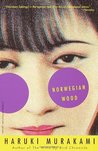
BOOK REVIEW: Norwegian Wood by Haruki Murakami

Norwegian WoodNorwegian Wood by Haruki Murakami

My rating: 5 of 5 stars

Amazon page

Norwegian Wood is about a quintessentially normal and likable guy named Toru Watanabe who has a thing for women who range between eccentric and completely off their rockers. The story is delivered as a flash back as an adult Watanabe mulls over his college days, during which all of these relationships took place.

At the center of his various relationships is his love for Naoko, who had been the girlfriend of Watanabe’s high school best friend until said friend committed suicide. Naoko is a beautiful girl in a fragile state–haunted by her former boyfriend’s suicide and probably a little unstable of her own nature. On the other hand, Watanabe begins a platonic relationship with another girl, Midori, who is sane, but a bit of a wild child and not devoid of her own neuroses. While, of the two, Midori is better for him, he cannot bring himself to take their relationship to the next level as long as Naoko is around—even though Naoko is institutionalized. A third woman, Hatsumi, is dating Watanabe’s college best friend, and she seems to represent the sweet, stable woman who Watanabe doesn’t seem to attract. Incidentally, Hatsumi eventually commits suicide. [Warning: this book is rife with suicide and probably has the highest rate of suicide of any novel I’ve ever read—fortunately it’s a relatively small cast of characters and so this amounts to only a few deaths.]

The character development and story are both excellent. Though I will say the character of Naoko is underdeveloped, but I suspect that is on purpose. I couldn’t tell whether Watanabi had reason to be so madly in love with her, or whether that was his curse. (I suspected the latter.) In contrast, Midori is tremendously likable, and– despite her kookiness–she is the kind of person almost anybody would be drawn to at least as a friend—though some might find it trying to be in an extended romantic relationship with her.

Murakami intersperses humor into this book with its overall somber tone. A lot of this is in the form of dialogue between Watanabe and Midori, or Watanabe and Reiko (Reiko is Naoko’s roommate at the institution and is an older woman for whom Watanabe holds a measure of affection as well.) (Among my favorite quotes is [paraphrasing], “I don’t like being alone. No one likes being alone. I just hate being disappointed.”) These flourishes of humor both add to the readability and the realism of the story.

I’d recommend this book for anyone who enjoys literary fiction. Not that it’s hard to digest literary fiction. It’s very readable, but if you need something beyond realism to hold your attention, this is probably not the book for you. Unlike some of Murakami’s speculative fiction, this work is quite centered in realism. [Though, it does have a fairly high body count.]

There was a movie adaptation made a few years back. I haven’t seen it, and so couldn’t tell how closely it follows the novel, but from the trailer suspect it’s as close as can be expected.


View all my reviews

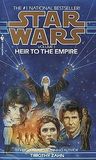
BOOK REVIEW: Heir to the Empire by Timothy Zahn

Heir to the Empire (Star Wars: The Thrawn Trilogy, #1)Heir to the Empire by Timothy Zahn

My rating: 4 of 5 stars

Amazon page

Heir to the Empire is set about five years after the first movie trilogy (by release date, i.e. after Return of the Jedi.) It features many of the principal heroes of the first trilogy including: Luke, Leia, Han Solo, Chewbacca, Lando Calrissian, R2-D2, and C-3PO. Obviously, gone are most of the bad guys from the movies, but in their place has risen Grand Admiral Thrawn—a master strategist who seeks to revive the Empire. Thrawn is portrayed more as a brilliant military man than a dastardly villain. This doesn’t mean he can’t be cold and villainous, but he also brings in a measure of intellect and rationality not seen in the movie universe. While it would appear that Luke is the last of the Jedi Knights, or the first of a new line if one prefers, that turns out to be not entirely true.

I enjoyed this book. I bought it during a Kindle sale on what Amazon considered to be the best Star Wars books. While I’d seen the movies, I hadn’t read any of ancillary works, and so I Googled to find out which of the books on Amazon’s list were considered by fans to be the best. Zahn’s Thrawn trilogy, and particularly this first installment, seemed to be on every fan’s list.

One of the great plot devices used in this book is a creature whose mere presence can nullify the force. This strips Luke’s powers away through a critical piece of the book. Yes, the introduction of this creature is deus ex machina, but it’s deus ex machina that challenges the protagonist–rather than making life easier for him–so it’s alright by me. Because Luke is the last of the known Jedi, he’s essentially a Superman among mere mortals, and so the book might have become tedious if Luke weren’t stripped to his native intellect and courage devoid of superpowers. Instead, he has to escape from the planet on which these creatures reside and help rescue Han and Lando in the process without any supernatural abilities.

As mentioned, this is the first book of a trilogy, and, therefore, it leaves many major issues unresolved. Multi-part series usually have less satisfying endings than a stand-alone book, and I can’t say it’s not true of this work. However, this first book of the Thrawn trilogy does contain a clear climax and a definitive tactical (battle-level) resolution.

The book intersperses chapters from the hero’s point of view (PoV) with those from the Thrawn’s ship. This book begins with a chapter from the enemy’s PoV, and so for Star Wars neophytes—such as myself—one enters into a whole new territory in which it’s not quite certain when or where one is in the Star Wars universe. However, in subsequent chapters Luke, Leia, and Han are introduced and we learn that Han and Leia are married and that Leia is pregnant, and this gives one insight into the timeline of the book. We also learn that while the Empire seems to have been destroyed, the Republic is on weak footing and is having trouble reestablishing itself.

The book introduces us to a couple of new characters that I understand will become established in the expanded Star Wars universe. The most intriguing and important of these is Mara Jade, the right hand woman of the most powerful smuggler in the known universe. We soon learn that Mara despises Luke Skywalker and wants nothing more than to dance on his grave. However, we don’t learn until much later why it is that she hates him, and we learn after a time during which the two are forced together by circumstances. Mara Jade is a force to be reckoned with. While she might not be a match for Luke the Jedi, she is more than a match for Luke stripped of his powers. It seems clear that Zahn is building a relationship between Luke and Mara with their interaction in this book. Luke is oblivious to why Mara dislikes him, or even who she is until he is explicitly told, but events force them to spend time together under trying circumstances.

All in all, I liked this book. I found it readable, and thought that it did a good job of maintaining tension throughout.

View all my reviews

BOOK REVIEW: The Beach by Alex Garland

The BeachThe Beach by Alex Garland

My rating: 5 of 5 stars

Amazon page

I imagine the elevator speech for this book being, “Lord of the Flies done Paul Theroux style.” While that may or may not sound appealing, this is one of the most gripping novels I’ve read recently.

The Beach will have its greatest appeal with travelers because understanding the mindset of a traveler versus that of a tourist (vagabonds versus regular folk, if you prefer) is essential to being able to feel the realism in the behavior of the book’s characters. (If you don’t know the difference between a traveler and a tourist, it’s safe to say that you are a regular person who travels as a tourist.) Like Moby Dick, this is a book about all-consuming obsession, but the obsession is in finding and protecting the traveler’s paradise. (Such a paradise is partially defined by a complete lack of tourists.) Unlike Moby Dick, The Beach isn’t rambling, and it maintains tension throughout.

The story beings on Khao San Road in Bangkok, a familiar haunt for backpackers and other low-budget world travelers. The protagonist, Richard, has just gotten in to Bangkok and checks into a hostel. Rooming next to Richard is a Scottish man named “Daffy” who seems to be a complete lunatic and who keeps talking aloud to himself about a “beach.” Owing to the accent, Richard first thinks Daffy is talking about a “bitch,” but soon realizes the man’s obsession is with a patch of sand. Richard has a brief and unusual interaction with Daffy, who throws a lit joint onto Richard’s bed. In the morning, Richard finds a meticulously hand drawn map on his door with “the Beach” prominently labeled. When he goes to see why the crazy stranger left it for him; he knocks on Daffy’s ajar door to find the man has committed suicide.

The beach is on one of the small islands that are kept off-limits as part of the Thai National Parks system. Richard teams up with a French couple who was also staying next to him. While Richard had heard their amorous sounds through the thin walls on the night he met Daffy, he didn’t meet the couple until they were all called in to talk to the police about Daffy’s suicide. For some reason Richard is unwilling to tell the police about the map, but he does tell the Frenchman. The map leads them to the island. It isn’t easy to get to. Once on the island, they discover they must get through a grove of marijuana guarded by heavily armed locals to get to the fabled beach.

It turns out a small community of travelers has already set up on the idyllic beach. As with any group, some people get along well and others rub each other the wrong way. We get the best insight into those individuals who become the friends and enemies of Richard, and many of the others are the novel equivalent of movie extras. At first, all is well on the island. Richard and the French couple have to do work a few hours a day on the fishing detail, but otherwise they are living in their Eden. However, as things begin to go wrong—and they do go frightfully wrong—Richard and others begin to be confronted by the question of what they are willing to do to protect the Beach, and how will their personal moralities be twisted in the process.

Garland uses a couple of interesting techniques in the book. First, Richard is plagued by dreams featuring Daffy, and later–as the burden of secrets to which he is party piles up—he begins to have hallucinations of Daffy during the day. In both cases, it seems that the dreams and hallucinations are an attempt to help him work out the mysteries of the Beach. No one on the island will tell him about Daffy, and he is desperate to know what drove the man mad—or whether he was always like that. There’s one character, Jed, who goes off every day and no one seems to know where he goes or what he does. Eventually, Richard comes to be in on some of these secrets (e.g. becoming Jed’s partner), and the burden of knowledge doesn’t improve his state of mind. In the end, Richard seems to realize that he is the new Daffy, and what drove Daffy into madness will surely do the same for him if he doesn’t get off the island.

Second, Garland uses what—for lack of a better term—might be called foreshadowing. However, it’s not so much a matter of subtle hints as a bold statements such as [paraphrasing], “It’s too bad _________ would die, especially in the way he did.” This should have seemed ham-handed, but there’s always enough mystery about what will come next that the these tips were like lighter fluid to intensify one’s reading so one could find out what would happen next and how.

I whole-heartedly recommend this novel, and think it’s one of the best pieces of travel-oriented writing that I’ve read. It’s a page-turn from beginning to end.

View all my reviews

BOOK REVIEW: Batman: Arkham Asylum by Grant Morrison

Batman: Arkham Asylum - A Serious House on Serious EarthBatman: Arkham Asylum – A Serious House on Serious Earth by Grant Morrison

My rating: 4 of 5 stars

Amazon page

This is the third, and probably last, installment in my “Happy 75th Anniversary, Batman” series of reviews. Batman: Arkham Asylum is an attempt to convey a nightmare on the page, and it succeeds both graphically and narratively. It’s quite different from other Batman comics in style and content. It takes the dark nature of the Dark Knight’s mythology to the extreme.

There are two story-lines woven together in Batman: Arkham Asylum. The main line involves Batman entering an Arkham Asylum being run by the inmates. There he finds himself pitted against his foes: the Joker, Two-Face, Scarecrow, and others. The other is the 19th century tale of Amadeus Arkham’s descent into madness.

As is common in the Batman mythology, psychiatrists are portrayed as walking the razor’s edge between sanity and insanity. For those who don’t read comic books, this is most readily exemplified by the character of Dr. Crane / Scarecrow in the first film of the Nolan trilogy, Batman Begins. I’m not sure whether the point is to create enemies that are so strong they can bend doctors to their will, or if there is a general disdain for psychiatrists—as one might see a dislike of lawyers in other stories.

Among the nightmarish elements of this work is the fact that Batman’s face is never seen clearly. The Dark Knight is always a vaguely and/or surrealistically silhouetted. There’s a mix of sharpness and haziness in the graphics. The Joker gets his own crazy scrawl font. The graphics are as creepy and strange as can be. On my low-end Kindle, the work was in black and white, which worked well. I did look at the sample pages, and the color version uses a lot of sepia and crimson.

Batman: Arkham Asylum asks us to consider whether Bruce Wayne / Batman is sane or just a lunatic with a moral code.

View all my reviews

BOOK REVIEW: Warrior Pose by Brad Willis / Bhava Ram

Warrior Pose: How Yoga (Literally) Saved My LifeWarrior Pose: How Yoga (Literally) Saved My Life by Brad Willis

My rating: 5 of 5 stars

Amazon page

It may strike one as hokey that this book has one author, but two names on the byline. But, it’s apropos of an autobiography describing the fundamental transformation of a man.

Part I is the story of Brad Willis, a journalist on the rise. Willis goes from stumbling into a reporter job at one of the smallest markets in the country to being the Asia bureau foreign correspondent for NBC (National Broadcasting Corporation, one of the largest American television networks.) There’s no mention of yoga in this part of the book. It’s the story of a driven journalist covering major world events. Willis made a name for himself reporting from Soviet occupied Afghanistan in the 80’s. He tells harrowing tales of covering the drug war in Latin America, the Desert Storm Gulf War, and human trafficking in Thailand. He was also one of the few American journalists to visit North Korea. There was nowhere he wouldn’t go for the story, and he took serious risks along the way. His highly driven nature is the one point of consistency throughout the book. Willis is not a man to do anything half-assed, be it following a story or pursuing the yogic path.

Then Willis’s world was torn asunder by health problems, and this is the subject of the second part of the autobiography. First, a fall caused a hairline fracture in one his vertebrae that became crippling when Willis refused to take time off from work or to do anything for it. He couldn’t be diverted from his on-the-go foreign correspondent’s pace. Considering the dangerous places Willis traveled, it’s ironic that he initially broke his back on vacation at a Caribbean resort while closing a window during a storm. When the deterioration of his vertebrae made work untenable, he underwent a surgery that failed and left him “permanently disabled.”

Then Willis was diagnosed with a cancer in his throat that spread from his tonsils into lymph nodes. On top of the ailments themselves, Willis’s health rapidly declined because he became dependent on painkillers and other prescribed medications, and—against advisement—he began to drink alcohol in conjunction with these meds. Not only did he become hooked on the medications and alcohol, he became dependent on a back brace, a cane, and a lethargic lifestyle that kept the body from healing itself. Yoga is only briefly mentioned in passing in this part of the autobiography.

The third part is about Willis’s transformation into the yogi Bhava Ram, and his successful battle against cancer. After an intervention that resulted in drug rehab, he was referred to a pain center at Scripps that employed alternative therapies. (As an aside, the book is in part an indictment of a healthcare system in which this Pain Center both helped many people and was completely unsustainable because insurance companies could reject claims on the basis of the treatments being unconventional—but because it was staffed by medical professionals it was too expensive for most people to afford without insurance. Willis points out that there was never a rejection of any claim for any of the expensive medications or surgery that failed to helped him, but the Pain Center that put him on the road to good health went under due to failure to pay.) The Pain Center was the key to his turn around. After progressing with physical therapy, biofeedback, and—most uninsurable of all—Jin Shin Jyutsu, Willis is introduced to Yoga.

The final part charts Willis’s pursuit of yoga both through a series of teachers as well as any books that he can get his hands on. He voraciously reads up on the subject, and begins a sadhana (personal practice) that is marked by all the drive he had earlier given to his journalism career. The practice starts out rough. His muscles have atrophied, his spine curved, and he gained a tremendous amount of weight on a steak, potato, and beer diet mixed with a sedentary lifestyle. However, over the period of a couple of years, well beyond when he had been told he would be dead, he transforms his body and his mind through an intense daily practice and an adjustment of his world view.

I’d recommend this book for anyone. It will definitely be of interest to yoga practitioners—though don’t be surprised that yoga doesn’t come into play until the final quarter of the book. It could also benefit individuals with serious health problems as a way to reconsider how they approach health and treatment. Willis points out that falling into the role of victim was one of the main killers. He inherited a bad situation through an accidental fall and a case of cancer that he believed was attributable to his experience in Iraq (i.e. related to depleted uranium shells.) However, it was only when he stopped gorging on food, alcohol, and self-pity that he made a turnaround.

Even if I wasn’t interested in yoga and alternative approaches to healing, I would’ve found this to be an intensely engaging read. Willis’s journalism career gave him a unique insight into some of the major world events of the 1980s and 90’s. Willis builds lines of tension and sustains them. One wonders what will happen to his marriage to a woman who married one man (a confident and successful foreign correspondent in Hong Kong) and found herself in a marriage with another—first a lethargic addict and then a man who sunk himself hook-line-and-sinker into to the yogic lifestyle. One wonders whether his cancer remission will hold. One wonders whether he can keep clear of the pain meds and stick to the life of a yogi. I haven’t read a book that caught me this much by surprise in some time. I hadn’t heard of this book before I bought it, and didn’t have particularly high expectations (it was on sale on Kindle or I probably never would have picked it up), but I quickly became hooked.

View all my reviews

BOOK REVIEW: Injustice: Gods Among Us by Tom Taylor

Injustice: Gods Among Us #1Injustice: Gods Among Us #1 by Tom Taylor

My rating: 4 of 5 stars

Amazon page

If you’re among those who were distraught over Superman’s uncharacteristic behavior at the climax of the Man of Steel movie, this graphic novel isn’t for you. However, the author and illustrator do know how to build tension and keep it rolling. That’s the good news. The bad news is that they achieve this via a mountain of corpses. If you’re good with that, you’ll likely enjoy this work. If not, you may find it a tad dark and / or gratuitous in its violence.

With the movie Batman v Superman: Dawn of Justice filming for a summer of 2016 release date, many are wondering how a Batman versus Superman battle might occur (and how the Caped Crusader could credibly avoid being smashed to pulp 30 seconds into the movie.) This comic offers one possible approach—though it’s exceedingly unlikely to be the tack portrayed in the movie. (This book is ancillary to a video game, and wouldn’t necessarily be seen as core canon of the Justice League.)

This book consists of six parts. In part I, the Joker outwits Superman, tricking him into an act that is so horrendous that it will shake the Man of Steel’s core values. In part II, Superman takes a proactive stance against global conflict. In part III, the U.S. government supports a covert action designed to give them leverage against Superman, and to dissuade him from enforcing his previously announced ceasefire. Aquaman and his nautical army oppose Superman in the fourth part because the former is displeased with a dictator setting rules in the maritime domain—even if it is a largely benevolent dictator. In the penultimate part, Batman and Nightwing resist Superman’s attempt to clear out Arkham Asylum and to put the lunatics somewhere where they can’t keep breaking out and causing trouble (as the Joker caused for Superman.) In the final part Batman is exposed to a life-altering event (as Superman had been at the book’s beginning), but the bulk of this section is just picking teams for the epic game of superhero dodgeball that is presumably to unfold in later volumes.

What worked? The setup in which the Joker bests Superman is well-played. The Joker’s willingness to die for the ultimate prank, his perfect psychopathy, and his love of sowing the seeds of chaos make him the perfect man for the job. Harley Quinn gets a few laughs in this otherwise morose book. There’s a lot to think about in terms of the morality of a benevolent dictator. If a god-like creature, i.e. Superman, were to exist on Earth, what should he/she/it take on and what should he leave alone? That’s a question that’s at the core of this book. As in many good storylines, there’s a blurring of the lines between good and evil, a blurring which is essential to have a Batman versus Superman battle make sense.

What doesn’t work? We come into the middle of the Joker’s plot and are supposed to accept that he and Harley Quinn could pull off the phenomenally complex plan in a manner in which it seems easy. It involves hijacking a nuclear sub, successfully taking control of and reprogramming a nuclear weapon, and not only giving Superman a hallucination but controlling the nature of the hallucination. For these events to play out, the Joker needs more than his usual complete lack of moral compass; he needs access to far greater intellectual ability than he usually has to display. And that’s not the only point at which events seem a little too easy. (However, yes, I do realize we are talking about a world in which there are people who can fly under their own locomotion and make complex constructs out of thin air. I didn’t say it was a deal breaker. I’m just saying there were some opportunities for tension missed.)

There is also a death that should have a profound impact on Batman, but which he seems to shrug off pretty well after a couple of hours of bereavement—and possibly some behind-the-scenes Catwoman nookie. I assume the effects of said death will play out in later volumes, but it seemed gratuitous given its lack of effect within the volume. Unlike the death that fundamentally alters Superman’s course, Batman seems to remain unchanged. I’m presuming that the death wasn’t just to create an excuse to bring Selina Kyle (Catwoman) into the storyline, and addition of mixed outcomes. Kyle’s left-of-Marx preachiness will grate on the nerves of politically conservative readers. (Not that it should, regardless of one’s views, one should be able to accept that realistic character development will include individuals with extreme views—just as one sees such individuals in real life… or on Facebook. I’m just saying that, sadly, in our world people don’t want to hear opposing views unless they are being lampooned, and so some will stay away just to avoid hearing characters spouting views contrary to their own. I don’t know how we got there, but…)

I enjoyed this comic overall. Like most entries in its genre, it’s a quick read, and it’s better written than most.

View all my reviews