BOOK REVIEW: Memetic by James Tynion IV & Eryk Donovan

MemeticMemetic by James Tynion IV
My rating: 5 of 5 stars

Amazon.in page


This story takes what happens to a brain on memes to an extreme (if absurd) conclusion. (To get the most out of the story, one needs to understand “meme” in the sense Richard Dawkins coined the term. Not just as a popular image one sees repeatedly on social media, but as any cultural artifact (image, idea, symbol, fashion, etc.) that behaves in a manner analogous to a gene – spreading, mutating, etc.)

In the story, a meme (featuring a sloth) goes viral. All is benign, at first. People are spending far too much time blankly staring at the meme because it engenders a euphoric feeling, but that doesn’t seem so bad (and — quite frankly – it’s not much different from how people engage with social media and online games in real life.) Then, like a time-release bomb in the brain, something is triggered and people start bleeding from their eyes, screaming, and engaging in Zombie-like behavior. [Except, as befitting a story about memes, the mindless activity of these “zombies” is designed to perpetuate the meme — rather than the eating of brains.]

The story plays out in two interwoven arcs. At the center of each arc is an individual who is – at least at first – immune to the meme by way of a “disability.” One story features a college kid who is color-blind, and the other a retired Colonel who is visually impaired so he can only see vague shapes (i.e. either glaucoma or cataracts.) The college kid’s story is the more human-interest piece, with him just trying to survive the apocalyptic world when he feels challenged enough by his usual world. The Colonel leads a team to try to defeat the meme by tracking its author.

In one sense, the perfect power of this meme and its ability to mutate to more effectively spread itself may feel ridiculous. However, without spoiling the story, I will say the author does offer a kind of explanation that may help quell the mental rejection. I’ll leave the reader to determine whether they think it helps or not. But, more importantly, I think it’s a story that knows it’s venturing into preposterous territory, and that’s kind of the point. We don’t necessarily see the freakish way we respond to memes and the online world, and so this story blows the problem up to absurd scale to make the reader more aware. [It’s also fun.]

I delighted in “Memetic.” I found the concept thought-provoking and the telling entertaining. It’s not just a concept, it offers a strong story. I’d highly recommend this graphic novel for those who find themselves aware of, and disconcerted by, how many people in their immediate environment are entranced by their phones.

View all my reviews

BOOK REVIEW: Titus Andronicus by William Shakespeare

Titus AndronicusTitus Andronicus by William Shakespeare
My rating: 5 of 5 stars

Amazon.in page


“Titus Andronicus” is Shakespearean tragedy at its most brutal. The play features forced amputations, rape, cannibalism, an “honor killing,” and a figurative orgy of sword stabbings.

Titus Andronicus, head of the family Andronici and a Roman military commander, has returned to Rome from a campaign in which he handily defeated the Goths. General Andronicus brings with him as prisoners the Goth Queen, Tamora, and her three sons. (The oldest of whom is summarily executed as a tribute.) This leaves two sons, Demetrius and Chiron, as the plays main villains, in cahoots with Tamora and her Moorish lover, Aaron.

Titus arrives in Rome to find the current Emperor, Saturninus, in an irritable state. The reason is that Saturninus knows the people would love to replace him with the victorious General Andronicus. Titus puts Saturninus’s mind at ease by publicly throwing his support to Saturninus. However, Titus does this believing that Saturninus will marry the General’s daughter, Lavinia, making her Queen. And that is the plan, but Saturninus – on a whim — decides to double-cross Titus and the Andronici by taking Tamora for his wife. [Saturninus could be counted among the play’s cast of villains, but he’s more of a doofus. He’s completely oblivious to his Queen shagging Aaron, the Moor, and – worse than that – that she’s biding her time in a plot to strategically takeover of Rome.]

The first scuffle occurs when Saturninus pulls this double-cross. Titus intends to put a beating on the punk Emperor, but his sons intercede. In the process, he stabs and kills one of his four remaining sons. Saturninus’s brother, Bassanius, preserves some of Lavinia’s dignity by marrying her. Everyone but Titus is alright with that as a next best alternative, including near as we can tell, Lavinia (to be truthful, as throughout most of the literature of that time, not a lot of consideration is given to what the woman wants. In this case, more than most. We know almost nothing about Lavinia but that she seems affable, and everyone loves her.)

Demetrius and Chiron are eager to know Lavinia in the biblical sense. This works into the greater plot being orchestrated by Tamora and Aaron. Step one is the murder of Bassanius by Tamora’s sons, and – because Saturninus would no doubt have some curiosity about who killed his brother –they frame two of Titus’s remaining sons for the act. As payment for taking out Bassanius, Tamora tells Demetrius and Chiron that they can rape Lavinia as they please as long as they silence her afterword. The two sons think it would be more fun to lop her hands and tongue off than to murder her, and thus they do that. As the reader might expect, Lavinia is eventually able to communicate the identities of her attackers and the murderer of her husband [briefly,] Bassanius. However, she can’t do it before swift justice leaves two of Titus’s sons headless.

To show how much of a loathsome character Aaron is, the Moor comes to Titus, telling the General that the Emperor will spare his sons if he cuts his own hand off and submits it immediately. Titus does so, giving his hand to Aaron to deliver back to the Emperor, but Aaron only pretends to go to deliver it because he knows the executions have already occurred and no such deal with Saturninus existed. However, Shakespeare does build complexity into his villain. The one bit of humanity we see in Aaron is when the Queen delivers a child who has far too much skin pigmentation to be the child of a Goth Queen and a Greek Emperor, but just the right amount to be the son of a Goth Queen and her Moorish lover. Aaron is the infant’s sole protector. Everyone else favors bashing the baby’s head in and telling the Emperor it was a miscarriage. Needless to say, Aaron’s plot to trade the black child out for white one that can be passed off as son of Saturninus fails in the final act.

The play is resolved by a plot that involves Titus’s oldest son, Lucius, going out to raise an army of Goths to defeat the Emperor’s forces while Titus plays his part by pretending to be even more mad than he actually is. This play of insanity allows Titus to deceive Tamora while she thinks she is deceiving him. Gaming a successful military commander turns out to not be a sound strategy. In true tragic fashion, the outcome doesn’t work out well for anyone, but revenge is served with a side of self-destruction.

This is a visceral read. It’s difficult to read at times. That said, it’s a very taut and gripping (if harrowing) story. It’s the first of Shakespeare’s tragedies, and is definitely worth reading – if you can stomach it.

View all my reviews

BOOK REVIEW: Tremor Dose by Michael Conrad

Tremor Dose (comiXology Originals)Tremor Dose by Michael Conrad
My rating: 5 of 5 stars

Amazon.in page


Full disclosure: I love trippy, mind-bending stories that use strategic ambiguity to keep one guessing about what’s truly happening. This is that type of story. The setup is brilliant and gets the book off to a captivating start. A college-aged girl is talking to some type of researchers, describing her dreams. The intriguing bit is that we find out that a man appears in this girl’s dream, and that what drew her to the research institute was a flyer with the man’s picture on it and a heading that read “Have you dreamed this man?” That had me hooked. Is this a Freddy Kruger scenario? Something else? I didn’t know, but I wanted to.

While this is a type of story I enjoy, it’s also a subgenre that’s easy to foul up. Capturing the unique logic and illogic of dreams is no simple task. Too ordered and dream becomes indistinguishable from base reality. Too bizarre and it becomes more of an acid trip than a dream. Then there is the challenge of balancing the maintaining of consistency with keeping the reader guessing. There is definitely a varied level of surrealism across the various dreams, but I can’t say I was bothered by this. Actually, the nature of comic is conducive to conveying some elements of a dream state even in a realistic setting – i.e. we pick up in the middle of events and jump from one locale to the next in different panels.

I felt “Tremor Dose” did pretty well with these issues. When I was perusing reviews, considering reading this book, I noticed a few comments about pacing issues at the end. I can definitely see people’s problems with regards to pacing, and I think it is largely a matter of the type of story being told. By that I mean, because one is trying to figure out what is base reality, if there is a base reality, when the climax and resolution are compressed it feels rushed because one’s mind is so engaged with trying to piece together what is happening. I don’t think the flow would have been as much of a problem. [One might reasonably ask whether this is something I would have noticed if I hadn’t seen it mentioned? Possibly not, but I think so. When I got to the end-reveal, I found myself stopping to think about whether the end made sense / was consistent with the story up to that point. I think that’s what creates the rushed feel is that one has to stop to mull rather than reading through it.]

The artwork is unique. It’s pencil-drawn and is not like what one typically sees in graphic novels. I don’t really know anything about comic art, and, so suffice it to say, the drawings weren’t distracting nor did they leave me confused. That’s about all I ask for in graphic novel artwork.

I enjoyed this story, and if you like stories that move in and out of layers of dreams, you’ll likely find it a worthwhile read.

View all my reviews

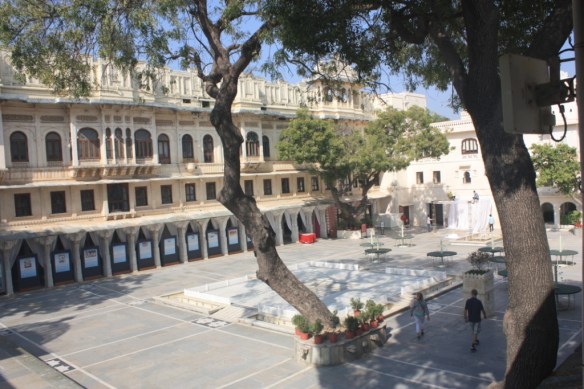
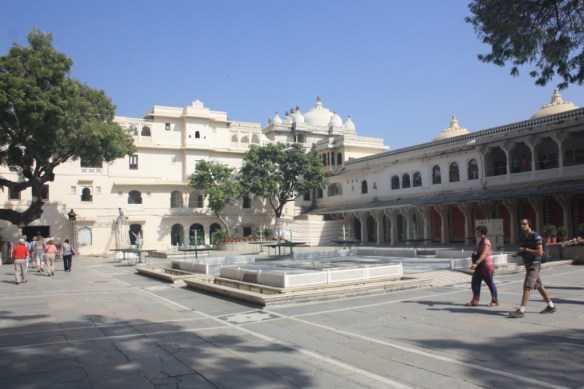
DAILY PHOTO: Badi Mahal & Courtyard, Udaipur City Palace

Taken in November of 2018 in Udaipur.

BOOK REVIEW: Baudrillard: A Graphic Guide by Chris Horrocks

Introducing Baudrillard: A Graphic GuideIntroducing Baudrillard: A Graphic Guide by Chris Horrocks
My rating: 4 of 5 stars

Amazon.in page


Jean Baudrillard was a French Postmodernist philosopher who passed away in 2007. To those who aren’t navel-gazers of the philosophical variety, he is best known – if he is known at all – for having influenced the conception of the game-changing sci-fi movie, “The Matrix.” While I haven’t yet read “Simulacra and Simulation” – the book said to have inspired the Wachowskis, it seems that the influence of Baudrillard on the film’s world is that he provided abstract ideas that the film takes in a more literal sense. If this book represents his ideas well, Baudrillard didn’t claim that we are in a computer simulation run by an AI [or by anyone / anything else, e.g. an alien overlord] (that would be more in line with ideas presented by Swedish Philosopher, Nick Bostrom.) Baudrillard’s claim is that we are increasingly building and gathering around us a world of things that are — at their most fundamental level – signs and symbols. However, it’s also true that there are some quotes and concepts that make there way into “The Matrix,” probably most famously, “the desert of the real.”

A film [and its source novel] that might be said to more directly reflect Baudrillard’s ideas is “Fight Club.” Which isn’t to say that Baudrillard deals with issues of lost masculinity [he is, to many in academia, infuriatingly contrarian on gender related issues — proposing seduction as the source of feminine power to balance the masculine.] Instead, the ideas that play into “Fight Club” are that human beings have become – first and foremost – consumers, and second that people are striving for hyperreality — an existence that is more real than real. These core ideas: 1.) human as consumer, more so than producer; 2.) the world as a simulation; and 3.) the pursuit of hyperreality are book’s bedrock.

Built on that bedrock is a flow of topics. There are considerations of what Baudrillard’s ideas mean for art and entertainment. What is art? Is high art and low art a meaningful distinction? Baudrillard’s ideas are contrasted with various schools of thought that were active at the same time such as Marxism, psychoanalysis, and feminism. Of course, as a postmodernist, Baudrillard takes aim at the arrogance and absurdities of modernity, e.g. criticizing the prevailing notions about “primitivism.”

As the subtitle suggests, this book uses graphics. In the case of this book, they are mostly cartoon drawings, along with a few diagrams. Some of the cartoons repeat key text and definitions [like a text-box, but including whimsical cartoon images] and other depict debates between Baudrillard and his contemporaries.

I found this book was an informative outline of Baudrillard’s thinking. Baudrillard’s ideas are complicated, and thus conveying them clearly is a challenge, still I think that there were points at which the author could have favored clarity over scholarly precision in his discussions. If this were a philosophy text, that wouldn’t be valid criticism, but as this book is meant to be a basic introduction, I think it’s fair to say.

View all my reviews

A Few Tiny Poems

I sit amid ruins,
on a pile of rubble,
seeking out the moment
when we burst our bubble.

***

the fuse is cut for a fast burn
pot-bellied keg too big around
leaking powder from every seam
all’s well ’til metal sparks aground

***

There was a young man who played bass,
he was quite hideous in his face.
But, still, he got paid,
and nightly was laid.
Last laugh to the player of the bass.

BOOK REVIEW: Sand Talk by Tyson Yunkaporta

Sand Talk: How Indigenous Thinking Can Save the WorldSand Talk: How Indigenous Thinking Can Save the World by Tyson Yunkaporta
My rating: 4 of 5 stars

Amazon.in page


This book does a good job of showing that there are fundamental differences in philosophy, worldview, and perspective between indigenous / aboriginal peoples and the rest of the world. It’s fair to say that differences exist between any two different cultures, but the argument is that these are deeper and more profound. Said differences run from how one visualizes abstractions to how one views and interacts with nature to one’s go-to pronouns.

What the book does not do, not by any means, is honor its sub-titular promise to show how changing to aboriginal modes of thinking would save the world. It doesn’t even strongly demonstrate that the world needs saving. Instead, it relies heavily on the looming sentiment among many in the modern world (myself included) that the world is FUBAR [if needed, please look it up.] That sentiment is what draws people to the book in the first place. (And to others, e.g. Daniel Quinn’s “Ishmael” books, that argue for overturning modernity in favor indigenous ways.) While I, too, feel the imminent fall of modernity on a visceral level, I also recognize that this inevitable collapse is a combination of fact and fiction, and that its bases are as well. So, in some sense, Yunkaporta’s book is an exercise in preaching to the choir. Because of this, it only tweaks and clarifies the reader’s philosophy and mode of thinking (sometimes in clever and fascinating ways,) but it doesn’t vastly overturn a reader’s thinking. But even if it did completely change modes of thought and philosophies, those things don’t automatically change behavior. And saving the world (if the world needs saving) requires changes in behavior. Ultimately, one needs to know whether, how, and to what degree incentives change. (FYI – the importance of incentives is not lost on Yunkaporta, as he discusses them himself in another context.)

That said, there were many ideas that resonated with me, and in which I found deep truths. I’ll go straight to what may be the most controversial idea in the book and that is that modernity’s discomfort with – and desire to do away with — every form of [non-state sanctioned] violence has not been without cost. Yunkaporta is not justifying domestic violence (although the perception – justified or not – that such acts are out-of-control in aboriginal populations is likely an impetus for bringing up the subject.) What he seems to be arguing is that what seems like a disproportionate problem of violence in aboriginal populations derives from looking at what is happening in tribal communities through the lens of modernity, and the resultant tinge blows things out of proportion while missing part of the truth of the matter.

I’ll elaborate how I came to have a similar view through the study of martial arts. For example, when I’ve traveled to Thailand, I’ve always had mixed feelings about child Thai-boxing. On the one hand, I recognize a reason for concern about concussions in a brain that’s not fully developed. On the other hand, those children display a combination of emotional control, politeness, and self-confidence that seems in decay in much of the world. On a related note, I think that the lack of coming-of-age ritual might be failing the kids in the modern world because they skip a step that puts a bedrock of self-confidence under their feet. As a result, it’s not that they all end up milquetoast, some end up murderous because they can’t process challenging emotions effectively, they have a feeling of powerlessness gnawing at them, and they have no grasp of how to moderate their response under challenging conditions.

As far as ancillary matter is concerned, it’s mostly line-drawn diagrams that are used to show how aboriginal people depict various concepts under discussion.

I enjoyed the book and found many new ideas to consider. I’d recommend it for individuals interested in approaches to thinking and problem solving – and for those who want to learn more about indigenous populations. Just don’t think you’ll have a map to fix the world at the end.

View all my reviews

DAILY PHOTO: St. James, Montreal

Taken in Montreal in the Spring of 2011

BOOK REVIEW: Pale Rider by Laura Spinney

Pale Rider: The Spanish Flu of 1918 and How It Changed the WorldPale Rider: The Spanish Flu of 1918 and How It Changed the World by Laura Spinney
My rating: 5 of 5 stars

Amazon.in page


Before the present-day COVID-19 pandemic, the Spanish Flu of 1918 seemed to be a largely forgotten historical footnote. It was overshadowed by its more explosive, if less lethal, co-event, World War I – the war that was fallaciously believed to hold the promise of ending all wars. Furthermore, Spanish Flu never achieved the mystique of the Black Death. In fact, among the fascinating questions this book examines is why such a world-changing event isn’t more diligently studied. Of course, these days there is a sort of grim desire to understand what happened in 1918 and what – if any – lessons can be learned.

[Which isn’t to suggest that that Influenza virus pandemic was perfectly analogous to the present Coronavirus pandemic. In 1918, science was still at a state in which there remained debate about whether the disease resulted from a bacterium or a virus, and — in some sense — it didn’t matter because they didn’t have good treatments for either. For COVID, we had accurate tests in short order, and will no doubt have a vaccine at some point in the coming months. That said, I’m not dismissive of COVID-19. As I understand it, COVID’s R-nought (reproductive ratio), and the fact that both pre-symptomatic and asymptomatic transmission occur make the current pandemic serious business. Furthermore, while scientific understanding has increased radically, human psychology is surprisingly similar and some of the same conspiracy theories and wishful thinking that made things worse a hundred years ago may prove to do the same today.]

The strength of Spinney’s book is that it takes global perspective. It doesn’t fixate on the United States (where the 1918 Flu was first understood to its own, new disease) or Europe (where it was inexorably linked to the fighting, and got its fallacious name of “Spanish Flu.”) In addition to these locals, Spinney’s telling visits and revisits China (one of the alternative candidates for ground zero,) India (which suffered tremendous fatalities from the disease,) Brazil, and a number of other countries around the globe.

The book’s twenty-two chapters are arranged into eight parts. While these divisions are topically organized, emphasis is given to the stories being told and so said topics aren’t in one’s face but are, rather, background that is subtly presented in narrative form. Chronological consideration is tertiary. The penultimate part (Part VII) does explore the world in the wake of the Spanish Flu, but discussion of attempts to find the true index patient (a.k.a. patient zero) don’t take place until chapter 11 [Part V.] [To clarify, the acknowledged patient zero was a soldier at a US military base in the middle of America, but there are widely divergent thoughts about how long the disease might have been infecting people before that – masked either by the war or by the lack of data collection and reporting throughout the world. The only thing that is widely agreed upon is that the “Spanish Flu” didn’t originate in Spain.] I’m certainly fine with meandering on chronology in order to serve a more appealing narrative.

A lot of the subjects covered are interesting, but are what one would expect, e.g. what was it like to live in the midst of Spanish Flu. Therefore, I want to focus on a few topics that I found particularly interesting because they were illuminating, but weren’t necessarily what I anticipated. One set of topics addressed sheds light on just how different a time 1918 was. I suppose different people have different ideas about how modern the early 20th century was — relative to today. To me it was interesting to hear about church leaders calling upon people to attend services because there was an idea that the Flu was a result of god finding humanity’s “lack of faith disturbing.” [I quote Darth Vader, not this book’s author.] I’m sure there are priests and preachers saying the same these days, but I also suspect those voices are so far into the lunatic fringe as to not merit much attention, but not so in 1918 (and, thusly, many went to sit in high-density churches only to spread the flu more effectively than any virus could hope for.) Another interesting insight into the level of modernity was Spinney’s explanation of the fact that medicine, as we know it, had not yet risen to a favored spot above approaches like homeopathy and shamanism. Lest it sound like I’m engaging in the outhouse fallacy; I will say that people are falling in many of the same holes despite more advanced understanding of viruses – particularly as regards to people’s desire to impose order and purpose on a natural event.]

The other discussion that I found unexpected and revelatory was about the dearth of art and literature on the subject of the 1918 Flu. Spinney describes the effects of Spanish Flu on many major artists of the time, but goes on to discuss how few of those who survived the flu in 1918 brought it into their works. She does also discuss some of the works that did come about, as well.

I found this book fascinating from cover to cover. The fact that it covered so much ground geographically as well as topically was part of that intrigue. Learning what changes occurred in the wake of the 1918 Flu has certainly helped me consider what to expect in our future. The similarities and differences between then and now also surprised me. Just like today, there were a lot of wildly bizarre conspiracy theories from people who had to make sense of both the randomness of the Flu’s action and the fact that it put such a nasty a crimp in their lifestyle. It’s also interesting to consider some of the more intellectually stimulating theories – e.g. that part of the reason for the lethality of Spanish Flu is that in the theater of war, the virus didn’t benefit from the internal restraint usually shown (because people were dying so rapidly) and so mutations that favored a quick and harsh influence made gains. [For those who aren’t aware, it was the second wave of the Spanish Flu that was really nasty. The first wave was like seasonal flu for almost everyone, and by the third wave the virus didn’t have much of a reservoir of those without acquired immunity and so petered out relatively quickly.]

If you want to learn more about Spanish Flu, I’d highly recommend this book – particularly if you are interested in the global story and the after-effects of the disease.

View all my reviews

POEM: Avalanche Prone


The snow fell everyday,
fell slowly and softly.
It piled into hills high,
making mountains lofty.

And avalanches slid
in rumbling certainty,
collapsing like poems
that grew too wordily.