BOOK REVIEW: Trigger Warning by Neil Gaiman

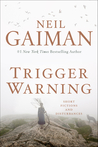
Trigger Warning: Short Fictions and DisturbancesTrigger Warning: Short Fictions and Disturbances by Neil Gaiman
My rating: 5 of 5 stars

Amazon page


“Trigger Warning” is a collection of 24 pieces of short fiction and poetry written by Neil Gaiman. If you know what a trigger warning is (I had to look it up) you may be thinking this collection is darker, edgier, and/or more risque than it really is. (For those who don’t want to look it up, a “trigger warning” is a blurb that intimates that a work has words or images that may induce a traumatic reaction.) However, these stories are Gaiman to the core, which means they are humorous, clever, and often quirky; but they are unlikely to throw one into catatonia or an apoplectic fit. The pieces include Sherlock Holmes and Doctor Who stories, spin-offs from Sleeping Beauty and American Gods, as well as a few homages to other authors, including Ray Bradbury, Gene Wolfe, and William Blake.


Without further ado, I’ll give a rundown of the included works:


1.) “Making a Chair”: This is a poem about writer’s block.

2.) “A Lunar Labyrinth”: An homage to Gene Wolfe’s work, “Solar Labyrinth.” This short story is about a maze that was destroyed, and that wasn’t to be walked on full moon nights.

3.) “The Thing About Cassandra”: This is among my favorite stories in the collection. What happens when your friends and family start bumping into the girl who you made up as a girlfriend back in school?

4.) “Down to a Sunless Sea”: This was written for a water-themed event. It’s about a person riding in a lifeboat down the Thames toward the sea.

5.) “The Truth is a Cave in the Black Mountains”: This one was inspired by an island off Scotland called Skye, but the story is fantasy with magic elements. A man strikes out in search of revenge and closing, regarding a daughter who he thought had run away. This is one of the most engaging pieces in the collection.

6.) “My Last Landlady”: This is a story, conveyed in poetic form, about a mean landlady.

7.) “Adventure Story”: In the Introduction, Gaiman calls this a companion piece to his novella “The Ocean at the End of the Lane.” However, I didn’t make that connection, (and I’ve read that story.) At any rate, it’s a great story about an intriguing artifact left behind by a [deceased] father whose stories were always painfully dull. It’s told by a mother to a son who is incredulous that his, seemingly milquetoast, father lived through such a fascinating event.

8.) “Orange”: Like several of the pieces in this book, this one is unconventional / experimental. However, it’s creative, and it works. It consists of answers to a questionnaire, from which the reader pieces together the story. One doesn’t have the questions, but most of them are fairly clear from the context of the answer.

9.) “Calendar of Tales”: This is what it sounds like, 12 stories each matched to a month. It’s another of the unconventional and unusual pieces. Each story was spun from a tweet response to a question about a given month of the year.

10.) “The Case of Death and Honey”: Few characters in the public domain have spurred as many offshoot stories as Sherlock Holmes, and this is Gaiman’s entry in the pool. Holmes’s interest in bee-keeping is central to the story.

11.) “The Man Who Forgot Ray Bradbury”: An homage to Bradbury. If one forgets a person, did they ever exist?

12.) “Jerusalem”: This work was influenced both by a poem by William Blake and a trip the author took to said city. The story is about a couple of tourists and the unique mental illness associated with this locale.

13.) “Click-Clack the Rattlebag”: A scary bedtime story told by a child about a different kind of monster.

14.) “An Invocation of Incuriosity”: A story about one of the strange and colorful people one might meet at a flea market.

15.) “’And Weep, Like Alexander’”: A lighthearted story about an “un-inventor,” one who keeps you from having flying cars and all the other promised technology from sci-fi.

16.) “Nothing O’Clock”: This is a “Doctor Who” story. It’s not necessary to be familiar with the series (necessary backstory is provided), but it could make it more appealing—i.e. the inside joke effect.

17.) “Diamonds and Pearls: A Fairy Tale”: This is from “Who Killed Amanda Palmer?” Palmer is a cabaret-punk singer/songwriter and Gaiman’s wife, and the aforementioned booklet consists of a series of photos of Palmer looking deceased with brief stories to go along. This is one of the stories that could stand alone. It’s a fairy tale of the adults-only variety.

18.) “The Return of the Thin White Duke”: Another fairy tale, this one about a Duke that strikes out on a quest for adventure in order to rescue a Queen who doesn’t need rescuing.

19.) “Feminine Endings”: A story about a human statue—by that I mean one of those people who deck themselves out and stand on a box in the town square in touristy places in many parts of the world.

20.) “Observing the Formalities”: A poem about one who doesn’t get invited.

21.) “The Sleeper and the Spindle”: A take on the story of “Sleeping Beauty,” but from a different point of view.

22.) “Witch Work”: This is another poem. I believe it’s the only one that’s not free verse. It’s about the life of a witch.

23.) “In Relig Odhrain”: This is a true story about a saint, written in free verse.

24.) “Black Dog”: This is a spin-off from the novel “American Gods” and it features that book’s protagonist, Shadow. You don’t need to have read that book, but you might have a greater affinity for the story if you have. It should also be noted that this is the one piece that is original to this collection, and it’s one of the most substantial pieces in the collection. i.e. it gives fans a reason to pick up the book even if they’ve read a lot of it from the original source.


I enjoyed this book. Gaiman is a masterful story-teller. Whether it’s one of conventional pieces based in established worlds (e.g. “Doctor Who” or that of Sherlock Holmes) or one of the off-the-wall, experimental pieces, these stories and poems are a pleasure to read.

View all my reviews

DAILY PHOTO: After the Harvest

img_2207

img_2264

img_2305

Taken in July of 2015 in Kullu District, Himachal Pradesh

Taken in July of 2015 in Kullu District, Himachal Pradesh

POEM: I am! Am I?

I am!
Am I?
What I?
Who is I?
I the me, or I the lie.
Where resides this sly I?
Is it fleeting and formless,
or seemingly seamless?

Somedays you see me,
but can you know me?
How can you know me?
If I’m “X,” the unknown?
A grounded plane
that remains unflown?
If I’m a tank
of grinding gears?
A blanket woven
sum of all fears?

I the river.
The bag of molecules
varying year to year.
In flux.
A current pulsed
through a wire—
a live wire.
Whose hum is felt
down a stringless string.

POEM: Subdued

Sail words through the dead of night
When no one can see wrong from right
Cause all the world is shadow gray
Free from the harsh light of day


The light, a white-hot burning truth
Sears like a rotten, broken tooth
Stripping secrets to full nude
Until dusk writes them subdued

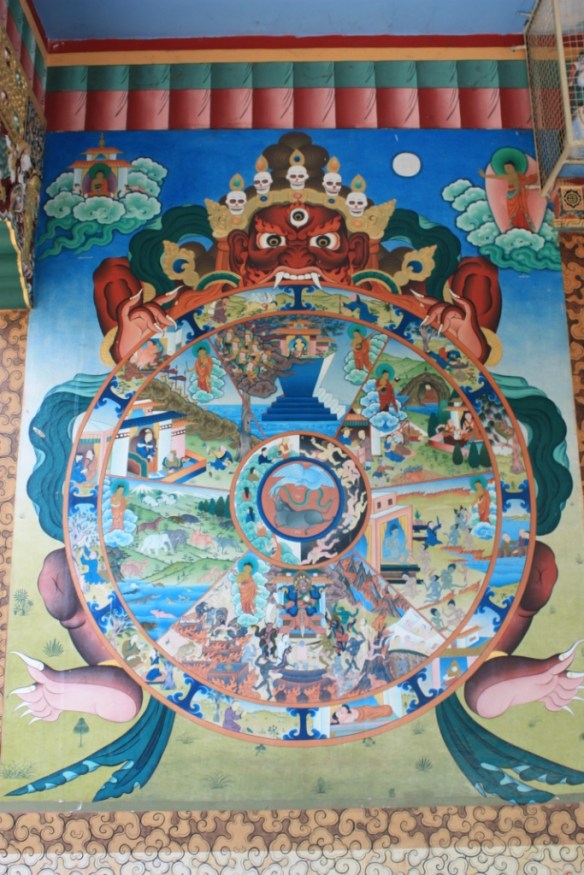
DAILY PHOTO: Namdroling Monastery Inside & Out

Taken in March of 2014 at Namdroling Monastery in Bylakuppe

Taken in March of 2014 at Namdroling Monastery in Bylakuppe

img_1576


img_1598

DAILY PHOTO: Dulhadeo Temple

Taken in August of 2015 at Khajuraho

Taken in August of 2015 at Khajuraho


img_3464

Taken in August of 2015 at Khajuraho

img_3472

DAILY PHOTO: India Coffee House Cup & Saucer

Taken in Kolkata (Calcutta) in July of 2016

Taken in Kolkata (Calcutta) in July of 2016

BOOK REVIEW: The Stationary Ark by Gerald Durrell

The Stationary ArkThe Stationary Ark by Gerald Durrell
My rating: 4 of 5 stars

Amazon page


If you’re like me, you have mixed feelings about zoos and aquaria. On the one hand, it’s an awe-inspiring experience to see the mighty, ferocious, and odd creatures that don’t make it into one’s backyard (for those who even have yards.) On the other hand, one has to wonder whether the creatures on display are as miserable as one would be in their shoes. (i.e. Figurative shoes. I do know that other animals don’t wear shoes… Except for horses… but I digress.)

In this book, Gerald Durrell examines the question of what makes for a zoo that’s good for the animals as well as for its human visitors. Most of us are sophisticated enough to realize that straight-up anthropomorphization (projecting human thought processes onto animals) isn’t a sound way to get to the bottom of an animal’s experience. Animals seem much more resilient than humans, but they aren’t infinitely tolerant. While one can’t conduct a “zoo resident satisfaction survey,” there are means by which to gain insight into the animal’s state of well-being, including: its health, its appetite, and its sex drive / reproductive success.

Durrell had the experience of opening a zoo, and was himself dismayed by what he saw at many of the zoos he visited. In some cases, they were designed for optimal viewing but didn’t give adequate consideration to the well-being of the animals. However, some zoos genuinely tried to act in the best interest of the animals, but they missed the mark by projecting human thinking onto animals–instead of examining the evidence for what conditions positively (or negatively) impact the animals’ health, appetite, and sex drive.

This short book (less than 150 pages) consists of seven chapters. The first chapter presents the challenges Durrell went through in trying to open a new and different kind of zoo. Chapters 2, 3, 4, and 6, respectively, examine the issues that must be taken into account with regards to enclosures, feeding, mating, and sick animals. Obviously, these chapters don’t cover the entirety of the subject in detail, but rather combine generalities with a few interesting (and often humorous) examples from specific species. Chapter 5 gets into the challenges of keeping records in a zoo that isn’t just about entertainment but is also focused on conservation and education. The last chapter sums up Durrell’s arguments for how Zoos can be of benefit to animal species other than humans.

There are no graphics, notations, or bibliography. It’s not that kind of book, but is rather an extended essay. It does feature both humor and insight in good measure.

I’d recommend this book for those who want to better understand what features of a zoo are good (or bad) for the animals, and how zoos might be restructured to advance their roles in conservation and education.

View all my reviews

DAILY PHOTO: Scenes from Nrityagram

Taken in August of 2015 at Nrityagram

Taken in August of 2015 at Nrityagram


img_1507 img_1509

BOOK REVIEW: How to Read Darwin by Mark Ridley

How to Read DarwinHow to Read Darwin by Mark Ridley
My rating: 4 of 5 stars

Amazon page


Few scientific ideas have succeeded so brilliantly and elegantly as Darwin’s theory of what he called “descent with modification” but which we know as evolution—least of all not in the wet and squishy sciences. Darwin realized that if a biologic system had three characteristics, one would end up seeing a wide variety of species, but with common characteristics such that one could discern how a species evolved from common ancestors. (BTW: this is invariably what we see in the world.) The three characteristics are: 1.) variation within the population (i.e. members aren’t carbon copies but have varying characteristics); 2.) inheritance (characteristics are passed from parent to child); and 3.) some individuals produce more offspring than others. Under such conditions, those with variations that allowed them to survive better in their particular environment would produce more children (i.e. natural selection.)

Ridley’s book offers readers an outline of the work of Charles Darwin that’s more extensive than Cliffs Notes but less daunting than the original works written in mid-19th century prose. (Darwin is generally credited as being quite readable for a scientist of that era, but it’s still a large lump of work.) Of course, the book is presented not as an alternative to reading the three major works of Darwin addressed herein (i.e. “On the Origin of Species…,” “The Descent of Man…,” and “The Expression of Emotion…,”) but rather as a preparatory guide.

The question arises as to why one should bother reading such a book if one intends to read Darwin anyway. One reason is to help put Darwin’s discoveries in the context of his time. For example, while Darwin knew of heredity, he didn’t have an understanding of genes and genetics. In other words, a neophyte looking back may not know where to put Darwin’s discoveries amid the important scientific ideas that came before and after. Another reason is to see how the critical claims that have arisen since Darwin’s time are dealt with. Darwin’s theory immediately came under attack (and has continued to) because it is inconsistent with the literal interpretations of most major religions’ creation myths, and, adding fuel to the fire, everything we learn has supported evolution to the detriment of creation myths.

The book consists of ten chapters. The bulk of these chapters (Ch. 1 through 6) lay out the argument made in Darwin’s most influential work, “On the Origin of Species by Means of Natural Selection.” These chapters explore what Darwin described as “one long argument” for natural selection, but in doing so address vital concepts like hybridism, biodiversity, and geological succession. These chapters also discuss the case for Evolution, and the charges that have been leveled against it.

Chapters 7, 8, and 9 describe the ideas of Darwin’s “Descent of Man,” which examines both human evolution and sexual selection. The last chapter introduces the reader to the topic that Darwin took up in his 1872 book on “The Expression of Emotions in Man and Animals.” This is an early look at what has continued to be an intriguing field of study, namely what is the evolutionary advantage of conveying emotion and why are we so good at reading other people—or, at least, capable of being good at it.

This book is one in a series of brief summaries of the ideas of important scientists, philosophers, and influential (sometimes infamous) thinkers. Other volumes cover the works of Freud, Hitler, Nietzsche, the Marquis de Sade, Wittgenstein, Foucault, Heidegger, Jung, Marx, Derrida, Machiavelli, and Shakespeare.

The book has no graphics and not much by way of ancillary matter. It does present a timeline of Darwin’s life and achievements, and has a “for further reading” section. Each of these features is just a couple of pages.

I found this book to be concise and readable. It’s only about 100 pages, and doesn’t get into supporting detail (that’s what reading the original work is for.) It does pull key paragraph length excerpts from the source material to discuss ideas in the modern context. I’d recommend this book for someone who intends to read Darwin, who has read Darwin but was left with a lack of clarity, or—even—someone who wants to understand the gist of the argument but doesn’t have time for hundreds of pages of 19th century prose.

View all my reviews