BOOK REVIEW: The Science of Science Fiction by Mark Brake

The Science of Science Fiction: The Influence of Film and Fiction on the Science and Culture of Our TimesThe Science of Science Fiction: The Influence of Film and Fiction on the Science and Culture of Our Times by Mark Brake
My rating: 4 of 5 stars

Amazon page


This book grew on me. The reason I didn’t like it at first has to do with how the title sells the book in the wrong direction. When one sees the title “The Science of Science Fiction” one expects a book like those by Michio Kaku (e.g. “Physics of the Future” or “Physics of the Impossible” – or perhaps like Kakalios’s “The Physics of Superheroes.” In other words, one is expecting a book that teaches one about science through examples of science fiction, i.e. using science fiction to make science interesting and relatable. If you are expecting that kind of book, I suspect you’ll be disappointed.

The book doesn’t go into any depth on scientific issues. Instead of a book about the nexus of science and science fiction, one gets a book about the nexus of the history of science fiction, the history of science, trends in scientific progress, and trends in science fiction. (The confusing title is a little bit justified, therefore, given the broad territory of the books “niche,” but it could lead to confusion.) If you are interested in questions such as which came first the fictional atomic bomb or the real one, you’ll be reading the right book. If you are interested in whether or not quantum entanglement can be used for an ansible (faster than light communication) or how fast Superman has to jump to orbit the planet, you’ll find this book a disappointment.

The book is divided into four parts and has many brief chapters in each. Most of these chapters take as their lead a recent work of science fiction (usually a movie) though the book is at its strongest when it’s teaching the reader about the history of science fiction and how that history was influenced by – and influenced – real world events.

The first part is about space. It considers such questions as whether we will see alien visitor or invaders, the likelihood of parallel universes, and when we can expect to colonize other worlds.

The second part is entitled “time” and it considers the many ways time has been explored through science fiction. The time machine is considered from several dimensions and through movies such as the “Terminator” series and “Looper.” However, other time-related plot devices are also given scrutiny, such as precognition.

The third part is about machines and the interaction between man and machine. What can we expect from the rise of artificial intelligence (AI) and robots? The reader learns about the earliest use of the term robot and how historical science fiction compares to the realities coming to fruition.

The fourth, and final, part is entitled “Monster” and it investigates the realm of biology. Can monsters or supermen be created through super-serums or genetic modification? What are the limits of the human body and mind? These are the type of questions that are investigated.

There are no graphics, notes, or back matter in this book. However, I did read a review copy, so your results may vary.

If you are interested in the history of science fiction and how science fiction relates to scientific progress and the effect of science on culture, then I recommend this book. As I said, if you’re wanting to learn about science through the lens of examples from science fiction, then this is probably not the book for you. As I said, the book is at its strongest when it explores the history of science fiction.

View all my reviews

BOOK REVIEW: Murderous Minds by Dean A. Haycock

Murderous Minds: Exploring the Criminal Psychopathic Brain: Neurological Imaging and the Manifestation of EvilMurderous Minds: Exploring the Criminal Psychopathic Brain: Neurological Imaging and the Manifestation of Evil by Dean A. Haycock
My rating: 4 of 5 stars

Amazon page


This book examines what neuroscience can tell us about the psychopathic mind, and how that compares to what other disciplines – such as psychology and genetics – have been telling us. This is no simple task because there remains a great deal of disagreement about what psychopathy is and how it relates to other behavioral conditions, like sociopathy.

The book begins with front matter (a Preface and an Introduction) that sets the stage for a reader who may have only a vague and Hollywood-inspired notion of what psychopathy is and who may confuse it with any number of psychiatric conditions.

Chapter 1 builds intrigue and offers a narrative introduction to psychopathy by telling the story of the architects of the Columbine shooting, Dylan Klebold and Eric Harris. The Columbine shooting gives the reader an ability to compare and contrast, because the two shooters had quite different psychological profiles. The chapter also uses the case of Jared Loughner, a Tucson shooter who killed or wounded almost twenty people – most famously Congressional Representative Gabrielle Giffords.

Chapter 2 dives into the controversial questions of what a psychopath is, how effectively can psychopathy be measured, and how it compares to conditions that have the same or similar symptoms. The obvious point of comparison is Sociopathy, about which a controversy remains as to whether it’s a distinct condition. However, the more interesting comparison is to “Kunlangeta,” which is a term from an Inuit tribe. The Kunlangeta – psychopathy comparison gets to the fact that aberrant behavior isn’t new. It’s just how these actions are viewed and responded to that has changed.

Chapter 3 describes the strengths and limitations of brain imaging as a tool for understanding the psychopath. We find that neuro-imaging has revealed tendencies – notably a reduction of gray matter in parts of the frontal and temporal cortex. However, we also discover that there remains much to be learned.

Chapter 4 is entitled “A Problem Behind the Forehead” and it continues the discussion of the neurological connection to psychopathy – particularly by considering the case of Jim Fallon (the neuroscientist who stumbled onto the fact that he had the brain of a psychopath — not to be confused with the late night talk show host.) The consideration of Fallon’s case foreshadows a discussion that is detailed in Chapter 8 about psychopaths who function just fine in society and who don’t kill people with axes.

Chapter 5 examines competing explanations for psychopathy that are more likely to be complementary to neuroscience than competitors – notably genetics and childhood abuse. This chapter highlights the fact that criminal psychopathy has complex causes and there is as of yet no single silver bullet that links to psychopathic behavior.

The idea in chapter 5 leads nicely into the next chapter (ch. 6) which considers to what degree we have enough (or will ever have enough) information to be able to predict who is likely to engage in bad behavior. Is a real world “Minority Report” scenario likely in which someday we’ll be able to know who’s going to commit violent felonies before they do (at least for some cases.)

Chapter 7 explores the most notable symptoms of psychopathic behavior, including the inability to empathize and a lack of fear.

Chapter 8, as mentioned, explores the fact that not everyone who has psychopathic traits runs afoul of the law. In fact, many lead productive lives running companies or performing surgeries.

The next two chapters reflect upon questions that may be of great interest to readers. Chapter 9 asks whether one can become a psychopath late in life. In other words, once one has lived out an abuse-free childhood, grown a fully developed brain, and reached an age where the relevant genes have or haven’t flipped on is one safe? Or, is there some way – an injury or ailment, perhaps – that one might become the victim of adult-onset psychopathy? The penultimate chapter asks whether one’s child might be a psychopath in the making.

The last chapter discusses how criminal justice works if it turns out that at least some individuals commit crimes because they got a bad brain. While there may be controversies over the death penalty, most people feel at ease with harsh sentencing and with locking convicted criminals away for life. However, if some individuals had no choice but to do what they did by virtue of a brain defect, it’s much harder to be confident one has taken a fair and reasonable course of action.

There’s a brief epilogue which presents a common fixture in science books: the scholarly rant about how the field is underfunded.

The book has a number of color and black-and-white graphics including photos, diagrams, brain scans, and brain cross-section pictures. There’s a recommended reading section in addition to the bibliographic notes. I read the Kindle version of the book, and it had excellent hyperlinks for the notes as well as in the index.

I’d recommend this book for anyone who is interested in the question of the degree to which brains determine who engages in criminally aberrant behavior. The author uses stories of famous cases of psychopathy to present a book that is very readable and doesn’t get lost in scientific minutiae. It’s a quick and fascinating read.

View all my reviews

5 Bizarre Moral Dilemmas for Your Kids to Worry Over

5.) Can “innocent until proven guilty” survive the next generation of predictive models?

I started thinking about this post as I was reading Dean Haycock’s book Murderous Minds, which is a book about the neuroscience of psychopathy. In that book, the author evokes The Minority Report, a Philip K. Dick story turned into a Tom Cruise movie about a police agency that uses three individuals who can see the future in order to prevent violent crimes before they happen. Haycock isn’t suggesting that precognition will ever be a tool to predict crime, but what if a combination of genetics, epigenetics, brain imaging, and other technology reached the point where the tendency toward violent psychopathy (not redundant, most psychopaths function fine in society and don’t commit crimes) could be predicted with a high degree of accuracy. [Note: unlike the Tom Cruise movie, no one is suggesting all violent crime could be anticipated because a lot of it is committed by people with no risk factors whatsoever.] One is likely to first go to the old refrain (Blackstone’s Formulation) that it’s better that 10 guilty men escape justice than one innocent man be punished. Now, imagine a loved one was killed by a person who was known to have a 99% likelihood of committing a violent crime?

Of course, one doesn’t have to lock the high-risk individuals away in prison. What about laws forcing one to take either non-invasive or invasive actions (from meditation retreats to genetic editing) to reduce one’s risk factors? That’s still a presumption of guilt based on a model that  — given the vagaries of the human condition — could never be perfectly accurate.


4.) What does “trusted news source” mean in a world in which media outlets tailor their messages to support confirmation bias and avoid ugly cognitive dissonance? (i.e. to give viewers the warm-fuzzy [re: superior] feeling that keeps them watching rather than the messy, uneasy feelings that makes them prefer to bury their heads in sand and ignore any realities that conflict with their beliefs.) Arguably, this isn’t so much a problem for the next generation as for the present one. The aforementioned sci-fi legend, Philip K. Dick, addressed the idea of media manipulation in his stories as far back as the 1950’s. However, it’s a problem that could get much worse as computers get more sophisticated at targeting individuals with messages tailored to their personal beliefs and past experiences. What about if it goes past tweaking the message to encourage readership to manipulating the reader for more nefarious ends? I started to think about this when I got the i-Phone news feed which is full of provocative headlines designed to make one click, and — if one doesn’t click — one will probably come away with a completely false understanding of the realities of the story. As an example, I recently saw a headline to the effect of “AI can predict your death with 95% accuracy.” It turns out that it can only make this prediction after one has shown up in an emergency room and had one’s vital statistics taken and recorded. [Not to mention “95% accuracy” being completely meaningless — e.g. in what time frame — minute of death, day, year, decade? I can come up with the century of death with 95% accuracy, myself, given a large enough group.]


3.) When is it acceptable to shut down a self-aware Artificial Intelligence (AI), and — more importantly — will it let you?  This is the most obvious and straightforward of the issues in this post. When is something that not only thinks but is aware of its thoughts considered equivalent to a human being for moral purposes, if ever?


2.) When is invisible surveillance acceptable / preferable? This idea came from a talk I heard by a Department of Homeland Security employee, back when I worked for Georgia Tech. He told us that the goal is eventually to get rid of the security screening checkpoints at the airport and have technology that would screen one as one walked down a corridor toward one’s gate. At first this sounds cool and awesome. No taking belts and shoes off. No running bags through metal detectors. No having to pitch your water bottle. No lines. No dropping your laptop because you’re precariously balancing multiple plastic bins and your carry-on luggage. [I don’t know if they would tackle one to the ground for having a toenail clipper in one’s bag or not, but — on the whole — this scheme seems awesome.] But then you realize that you’re being scanned to the most minute detail without your awareness.

One also has to consider the apathy effect. If one can make an activity painless, people stop being cognizant of it. Consider the realm of taxation. If you’re pulling a well-defined chunk of pay out of people’s income, they keep their eye on how much you’re taking. If you can bury that tax — e.g. in the price of goods or services, then people become far less likely to recognize rate changes or the like.


1.) If society can reduce pedophilic sexual abuse by allowing the production and dissemination of virtual reality child pornography (computer generated imagery only, no live models used, think computer games), should we? This idea is discussed in Jesse Bering’s book, Perv. It’s not a completely hypothetical question. There is some scholarly evidence that such computer-made pornography can assuage some pedophiles’ urges. However, the gut reaction of many [probably, most] people is “hell no!” It’s a prime example of emotion trumping reason. If you can reduce the amount of abuse by even a marginal amount, shouldn’t you do so given a lack of real costs / cons (i.e. presuming the cost of the material would be paid by the viewer, the only real cost to the public would be the icky feeling of knowing that such material exists in the world?)

5 Myths & Misconceptions About Hypnosis


In a continuing effort to plumb the depths of the human mind, I’ve begun to learn about hypnosis through lessons, books, the practice of self-hypnosis, as well as via internet sources (yeah, dangerous, I know, but I try to be cautious.)


It turns out that there’s a lot to learn, in part, because there are so many misconceptions about what hypnosis is and how it works. Many of these incorrect ideas result from the fact that most people’s experience with hypnosis comes from watching stage hypnotists. I don’t want to suggest stage hypnotists are a disreputable lot, but seeing a show (particularly on the television) is likely to give one many a wrong impression of hypnosis because: a.) one may miss the fact that there is screening process going on (often carried out in an entertaining and interactive fashion so as to be part of the show and including innocent elements like calling for volunteers) to get a very select group on stage who are highly susceptible to hypnotic trance  — and probably more gregarious / free-spirited than average. b.) stage hypnotists (and less reputable therapeutic hypnotists) will occasionally say things that are… strictly speaking… untrue. This isn’t [necessarily] to be conniving or underhanded, but instead to prime subjects to be less resistant and skeptical. c.) what makes for an impressive show isn’t what makes for the most effective hypnotic induction / deepening for the average person (which tends to be a rather dull and drawn out affair.)


5.) A hypnotic trance is an unattentive and zombified state of mind. In a hypnotic trance, one is extremely relaxed physically, but one’s mind is highly focused on one particular stimuli (often this is the hypnotist’s voice but it might be awareness of breath, bodily sensation, imagery, or it might involve systematically cycling through a number of different sensory inputs at the hypnotist’s suggestion.) A common example used to help an individual understand what hypnosis will be like is the condition of being zoned out while driving, arriving with no recollection of the past ten miles because one’s mind was focused elsewhere.


The fact that memory can be impaired (not unlike when one is falling asleep or sleeping) and that suggestion of selective impairment (e.g. forgetting one’s name or a particular number or letter) is a common stage trick, makes people think that the subject has mentally flown the coup.


4.) Every person can be readily hypnotized. There’s a sense in which this may be true, and that’s that everybody seems to fall into a trance now and again. Remember, it’s just like zoning out when one is driving. But what most people are thinking of with this myth is more along the lines that any hypnotist worth his/her salt can drop any random person into a deep trance with the snap of a finger and the word “sleep.” However, the science suggests a bell-shaped curve with a lower 15 %-ish who are extremely hard (if not impossible) to induce into a hypnotic trance and a higher 15%-ish who are a piece of cake to hypnotize. The rest fall in the meaty middle, and can be hypnotized but with greater effort and with lower levels of suggestibility. So when a person says, “Oh, I don’t think I could be hypnotized at all,” the odds are against them.  On the other hand, contrary to Hollywood hypnotism and the wishes of Sidney Gottlieb, anyone can resist hypnosis if they decide to — and, sometimes, if they just can’t help themselves.


3.) Dumb people can’t be hypnotized and smart people are more hypnotically susceptible. I see this a lot on YouTube videos and books by hypnotists, and it sounds good. However, when I looked at the peer-reviewed academic publications, I saw something else. Scholars studying what personality traits correlated with hypnotic susceptibility found no such relationship for intelligence and ease of entering a hypnotic trance.


I don’t think hypnotists are lying for the sake of duplicity. First of all, many are probably parroting a line that they heard, that confirmed their beliefs / wishes, and that they never thought to investigate. Others are just trying to make a hard job easier. Think about it, if you tell your audience that dumb people can’t be hypnotized, and that the smartest people are the most easily hypnotized, people are going to be more eager to appear hypnotizable and will be less resistant. People don’t like to look unintelligent, especially in front of huge groups of strangers.


If you’re interested in knowing what personality trait is the most strongly correlated to hypnotic susceptibility (of the limited set that’s been studied so far,) it’s absorption — i.e. the proclivity to get deeply absorbed in a task. So, if you know a person who consistently has to have his or her name called half a dozen times to pull them out of a zone, there’s a good chance that person would make an awesome hypnotic subject. (Note: we all get that way now and again, we’re talking about someone who is consistently / frequently prone to that state.)


2.) A hypnotist can make a subject do anything he wants. People get this idea from movies and from only hearing half the story of expensive (but largely ineffective) programs like America’s MK Ultra and Soviet Psychotronics. The consensus view is that a hypnotist can get the average subject to do something that they wouldn’t do without suggestion as long as it’s not something that they don’t want to do. So you might get an average person to raise their hand, because it’s not embarrassing, painful, or dangerous — and so they won’t be reticent to do it. Squawking like a chicken? Only if the person is the kind who doesn’t mind hamming it up. Murdering someone Manchurian Candidate-style? That’s pure fiction.


I heard a hypnotist say that gregarious people are more hypnotizable. In accordance with the scholarly findings mentioned in item 3, I suspect it’s more accurate to say that a stage hypnotist wants a subject who is both hypnotically susceptible and gregarious. That’s where selecting for people who are outgoing and who don’t object to hamming it up comes in. I don’t know that its true that outgoing folk are inherently more prone to reach a trance state, but they’ll be more fun to watch on stage because they are likely to follow suggestions to do more flamboyant deeds. Of course, studies of personality traits and hypnotic susceptibility don’t usually involve stage hypnosis, so maybe it is true that people who are more gregarious are more prone to trance (or, probably more accurately, less resistant to it) in that particular environment.


1.) Hypnosis involves a hypnotist taking over the mind of a subject. There’s a common refrain that one hears from hypnotists and that’s that all hypnosis is self-hypnosis. One’s mind remains one’s mind throughout, even if one is more prone to accept suggestions. The confusion arises from the fact that we hear hypnotists making suggestions and see the subject following said suggestions, even when they involve activities we wouldn’t want to (and probably wouldn’t) do. This looks like the subject is under the command of the hypnotist, but they call them “suggestions” for a reason. For reasons that still aren’t entirely understood, people are more prone to respond positively to suggestion while in the hypnotic trance state.


Here’s a video on the science of hypnosis:

BOOK REVIEW: The Memory Illusion by Julia Shaw

The Memory Illusion: Remembering, Forgetting, and the Science of False MemoryThe Memory Illusion: Remembering, Forgetting, and the Science of False Memory by Julia Shaw
My rating: 4 of 5 stars

Amazon page


Julia Shaw is a psychologist who conducted research into whether (and how) false memories could be “planted” in a person’s mind – and not just any memories, but memories of having committed a crime that one actually didn’t. That research is fascinating, and I think it’s tremendously valuable given the disparity between how accurate people believe their memories are and how fallible they are in practice. This disparity has played a major role in many a miscarriage of justice with eye-witnesses historically being considered the gold standard of evidence in criminal trials. Of course, I’m also a bit uneasy about people learning the recipe for an optimal process of generating false memories as it has the taint of being MK Ultra-level nefarious. (Though it should be pointed out that subjects must be active – if unwitting – participants in creating these false memories, so “planting” memories is an oversimplification.) This book discusses Shaw’s research, but it’s more of an overview of science’s understanding of the limits of memory and how those limits conflict with our beliefs – at least about one’s own memory [we often recognize how fallible other people’s memories are.]

The book consists of ten chapters. Chapter one dives into to one of the most common occurrences of false memory, and that’s the claim by some people that they remember events from their infancy – if not their own birth. Shaw presents the evidence for why such memories aren’t possible. This sets up the whole subject nicely because one must ask how so many people can claim to remember events that are physiologically impossible for them to have remembered, and to frequently be right about most key details. No one is suggesting that such people are liars (not all – or even most — of them, anyway.)

Imagine a school-age child hearing a story about his or her life as a baby. Hearing said story triggers a visualization in this child’s mind, and that visualization might well be filed away in memory, but when that memory is recalled the person in question may not realize she is recalling her imagined image of a story and not the actual event itself. Herein lies the crux of false memory: 1.) anything one visualizes in detail might potentially be stored away and become undifferentiated from the experiencing of an event; 2.) when we recall a memory we are recalling the last time we remembered it and not the event directly, and this can lead to a disparity between the memory and the actual event as it gets tied up with what’s going on in one’s mind at the time.

Chapter two explores perception, and how flawed perceptions may become flawed or tarnished memories. Just as memory isn’t the direct recording of events that we often feel it is, perception isn’t a direct replication of the world but rather a model generated in the brain. Therefore, the limitations and inaccuracies of the mental model are the first line of deviation of memory from reality. Chapter three describes how the brain’s physiology and evolutionary biology produce limitations to our ability to remember – limitations in spite of which we could thrive in the world in which we evolved.

Chapter four begins a series of chapters that take on specific objections that will arise to the ideas about false memory presented in the early chapters. This chapter counters an anticipated objection about people who seem to have perfect memories. In other words, a reader might admit that most people’s memories are crap (and even that his own memory isn’t infallible,) but what about the people with Las Vegas stage shows or the Asperger savant who knows every phone number in the Manhattan White Pages? Surely, these rare cases disprove the general idea of how memory works. Shaw shows that none of these people have perfect memory. Some have spectacular autobiographical memory (memory for their own life events) and others are exceedingly skilled at using mnemonic devices to remember any facts, but they all have limits. There’s also a discussion of how an unusually perfect autobiographical memory is often more of a curse than a blessing. We forget for good reason.

Chapter five examines another common memory fallacy, which is that one can remember best by getting the middleman of the consciousness mind out of the way and feeding data directly into the subconscious. In other words, it takes on subliminal learning. You may be familiar with the idea from ads suggesting that you can learn French in a couple of weeks without cracking a book just by playing audio tracks in one’s sleep and letting oneself learn effortlessly. Like every program that promises growth without effort, this one is debunked. Studies suggest that if one sleeps during such nights, one won’t learn, and if one learns, one isn’t actually sleeping. In other words, learning requires one’s attention.

I will say, the book fell off the rails for me a bit during this chapter. As I wrote in a recent blog post about psychological concepts that even psychologists repeatedly get wrong, Shaw denies the existence of hypnotic trance state as an altered state of consciousness. However, it becomes clear she isn’t arguing against the scientific perspective of what hypnosis is (a physically relaxed but highly mentally attentive state) and is rather denying the misconceived popular notion that seems to involve a person (possibly wearing a glittery cape) taking control of another person’s mind and making them into a zombified drone. She writes in an odd, round-about fashion on this subject as well as the topic of brainwashing – for which she offers her own value-laden definition. I’m not so sure that she didn’t understand hypnosis as much as she wanted to make sure her work was thoroughly distanced from hypnosis and brainwashing. It seems just seems strange and a bit dubious that a scholar studying false memory wouldn’t be thoroughly familiar with the literature on suggestibility and the states of mind most associated with it, i.e. hypnosis. I can only imagine the hoops she had to go through to get her research design through an IRB. (IRB’s are review boards that make determinations about whether a research project is – among other things – ethically defensible. After a series of famous — and ethically questionable — studies by the likes of Stanley Milgram, Ewen Cameron, and Timothy Leary, to name a few, psychology has come under great scrutiny.)

Chapter six asks whywe believe our memories are so awesome despite all evidence to the contrary. This comes down to why most of us unjustifiably judge ourselves superior in most regards. As is true of drivers, almost every person thinks she is better than average in the realm of memory. This is important because it’s not so much that our memory is fallible that leads to problems but that it’s fallible while we think it’s perfect. Chapter seven challenges the belief that there are certain events that are indelibly etched into our brains such as (depending upon age) the Kennedy assassination, the Challenger explosion, or 9/11. Such memories were once considered “flash bulb” memories, perfect renderings of societally traumatic events carved into our synapses. However, once these memories started to be put to the test, it was found that the details — vis-à-vis where one was and what one was doing at the time — are often wrong.

Chapter eight discusses how media and social media mold memories. One element of this is group-think. One’s memories may be molded through manipulation of the fact that people will readily believe that which is consistent with their beliefs while denying that which is inconsistent – regardless of facts and evidence. This chapter also takes on how social media influences memory as a distraction and because of so-called digital amnesia in which people remember less because they figure they can look it up at any time in the vastness of the internet.

Chapter nine proposes that even one’s most traumatic memories aren’t necessarily accurate, and – in fact – might be more likely to be fallacious. This may be the most important chapter of the book because it shows how a confluence of factors (namely, bad questioning tactics and peer / societal pressure) can result in the inadvertent planting of false memories. The chapter focuses on a series of Satanic ritual sexual abuse cases, a number of which were eventually disproved. So eager to build a case to bring believed wrong-doers to justice, law enforcement officers sometimes inadvertently pressured children into making up stories under the guise of trying to get them to open up, stories that sometimes became false memories.

Chapter ten shifts gears to consider what one can do about the issue of faulty memory – in other words how one can avoid being manipulated through exploitation of the limitations of one’s own memory. This is valuable information and not just for legal purposes but for life in general.

The book has a few graphics as necessary throughout the book and has end-notes to provide sources and elaboration on comments in the text.

I found this book to be immensely valuable as food-for-thought. The author presents many fascinating stories and the results of intriguing research studies, all in a readable package. I’d recommend this book for anyone who is interested in the subject of the limits of human memory, how these limits can be manipulated, and how that manipulation can impact the criminal justice process.

View all my reviews

5 Psychological Concepts Psychologists Disagree About [or Just Plain Get Wrong]

Every academic discipline has a concept or two that its scholars disagree upon. In the social sciences, these can even be the fundamentals of the subject, and, sadly, they aren’t always so much disagreements of definition as concepts the experts don’t grasp. In Economics [the discipline I was educated in], there is a famous war over whether economists understand “opportunity cost” — a concept that is raised not only in undergraduate texts but even in high school classes.

That said, Psychology appears to take the cake for being the most internally confused academic discipline. Ever. I first became aware of this problem with respect to a subject I have great personal experience with (by virtue of  being firmly lodged in said category), and that’s introversion.

Recently, this psycho-confusion has come up again as I’ve been reading two books that have major discussions around psychological definitions. One is Dean Haycock’s Murderous Minds, which devotes a whole chapter to the fight over how psychopathy is defined and differentiated from other conditions (in part, because another term — Sociopath — exists to spur confusion, but even without that term [which some psychologists think of as a synonym and others think of existing in another ballpark] there would be a huge gulf in expert opinion.)

The second book is Julia Shaw’s The Memory Illusion, which is a fascinating and generally thought-provoking book. In it, Shaw claims that hypnotism doesn’t exist.  I found this difficult to believe (both because I’ve been in a hypnotic trance state and because there is a well-established literature on the subject [i.e. it’s not like parapsychology concepts, e.g. clairvoyance, which are highly controversial]) until I realized that Shaw’s definition of hypnosis was filled with all the misconceptions that one would expect of an individual entirely unfamiliar with a hypnotic trance — except maybe having seen a stage hypnotist once or twice.

5.) Introversion: Introverts are often confused with those who have social anxiety disorder(severe shyness) — which an introvert may or may not have, but which an extrovert also may or may not have. (While it’s probably true that introverts experience social anxiety disorder at a higher rate than extroverts, there is a big problem with equating the two — not the least of which is that one can beat one’s social anxiety and still be an introvert.) It should be pointed out that Susan Cain’s excellent book Quiet (among others) has done a lot to bring a consensus view to the subject, but one still hears people — even experts — equating shyness and introversion.


4.) Psychopathy: Like many confused topics (including introversion and hypnosis), part of the problem is that everybody has a mental construct of what psychopathy is before they learn anything formally about it, and sometimes those preconceptions survive the presentation of formal knowledge — even, apparently, for the experts.  Maybe a person has read American Psycho or maybe they’ve seen Dexter or the movie Psycho, and so they know very well that a psychopath is a murderous maniac, and, therefore, they may not swallow the information that most psychopaths function just fine in society and aren’t even considered inherently mentally ill.


3.) Schizophrenia (v Split Personality): This is probably one of the most discussed of the confusions in the field. To be fair, this may be largely ironed out these days, but it certainly took long enough. Multiple Personality Disorder (commonly called Split Personality but today called Dissociated Identity Disorder [DID]) is usually a trauma-based disorder that results in schisming of personhood. Whereas, Schizophrenia is a genetically transmitted disorder that involves a disconnect with reality, but not necessarily a separation of personalities.


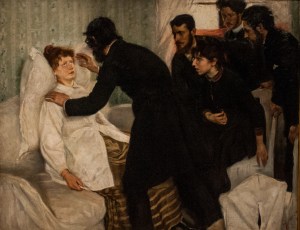
“Hypnotisk” by Richard Bergh (1887)

2.) Hypnosis: I mentioned Julia Shaw’s statement that hypnosis doesn’t exist. In her book, she mentions several preconceptions about hypnosis that are quite different from my limited (but existent) experience with hypnosis. To be fair, many hypnotists would tell you that the term hypnosis (coined by Scottish surgeon James Braid) is a confusing choice because “hypno” suggests the state is like sleep — which, not so much. First, Shaw calls the hypnotic trance state a non-attentive state. (This comes up because she is making the point that attention is critical to memory formation, which is probably entirely true and I don’t have any dog in the fight of whether hypnosis can help memory.) What I am arguing is that hypnosis is not a non-attentive state. It’s a highly relaxed state, but might be more accurately called a hyper-attentive state. Maybe the confusion is because stage hypnotists frequently successfully suggest participants temporarily forget things in deep trance, but keeping one’s attention focused  (on what may vary, though it’s usually voice) is critical to the hypnotic trance state. Second, she suggests that hypnosis is an act that must hinge on the activities of the hypnotist — i.e. the hypnotist as sine qua non.  I think many, if not all, hypnotists would admit (often begrudgingly) that the hypnotist is the most dispensable element of the process — or, as it’s more commonly phrased, “all hypnosis is self-hypnosis.” Third, she seems to have problem with hypnosis being considered an altered state of consciousness. To my mind, everything but ordinary waking consciousness is an altered state of consciousness. I don’t know of any way in which a hypnotic trance state could be confused with ordinary waking consciousness. (If you’re sure of it, go to a dentist who uses hypnotism for pain reduction and have them yank your tooth in a state of ordinary waking consciousness, and then compare your experience to the individuals who had it done under hypnosis. See here for a related BBC special on the Science of Hypnosis.)


1.) Delirium  (v. Dementia):  To be fair, by the time an individual is in a full-blown state of either, these conditions are nearly impossible to distinguish and have overlap. However, delirium has quick onset, involves severely impaired attention, and can fluctuate greatly from one day to the next. On the other hand, dementia often progresses slowly, begins with mild impairment of attention and focus, and is a far more consistent state.

BOOK REVIEW: The Drunken Botanist by Amy Stewart

The Drunken Botanist: The Plants That Create the World's Great DrinksThe Drunken Botanist: The Plants That Create the World’s Great Drinks by Amy Stewart
My rating: 5 of 5 stars

Amazon page


This book is about how plants are used in the making of alcoholic beverages from vegetative matter that serves as the primary ingredient in fermentation to obscure herbs and berries used to lend subtle flavoring. The book covers a lot of ground, being at once a guide to the chemistry of fermentation and distillation, a mixologist’s recipe book, and a guide to growing the plants used to make booze.

I will admit, if I weren’t such a neophyte to both subjects at hand – botany and alcoholic beverages – I probably wouldn’t have rated this book so highly. For me, almost every page offered new fun facts about alcoholic beverages, some of which I’ve consumed and many of which I never have. So if you have a high degree of understanding about one or both of these subjects, you may not find the book as intensely satisfying. Also, at times the book comes off a bit pretentiously – hardcore drunks probably don’t want to be shackled with so many rules for optimal alcoholic consumption (e.g. what type of glass they should drink a given drink from, etc.), but hardcore drunks are probably not a huge readership demographic. (It should also be noted that the reader gets some knowledge to fight pretentiousness as well, such as against gin drinkers who say they would never drink vodka when, in fact, they are drinking juniper berry-flavored vodka.)

The book consists of three parts. The first part describes fermentation and distillation and then offers two sub-parts dealing with the most everyday bases for alcoholic drinks (e.g. corn, grapes, potato, and wheat) as well as some of the more obscure and unusual objects of fermentation, respectively.

The second part delves into the plants that are added for flavoring or the like, and these are organized by: 1.) herbs and spices, 2.) flowers, 3.) trees, 4.) fruit, and 5.) nuts and seeds.

The final part gives some guidance on how some of these plants can be grown. It should be noted that this section is a bit thinner because a lot of information on growing the plants is covered in side-bars in the earlier sections and also this isn’t the book’s main thrust. The third part is similarly divided up between herbs, flowers, trees, berries & vines, and fruits & vegetables.

There are quite a few graphics, mostly in the form of line drawings, throughout the book – some are purely aesthetic and others are informative (e.g. drawings of plants.) There is also a recommended reading section that proposes further books to expand one’s understanding at the nexus of booze and plants. The book presents a lot of material in text boxes that set the information aside. These boxes include recipes, but also insights into how to best grow these plants with particularly emphasis given to how the process is optimized for those growing for beverage production (e.g. sometimes the optimal variety isn’t the most common variety.)

I enjoyed this book. It was readable, full of fun bits of information, and written in a light-hearted style. If you’re looking for a book on plants and alcoholic beverages, this is a good starting point. It doesn’t get too deep in the weeds but yet offers some obscure but amusing factoids.

View all my reviews

5 Myths of the Mind


I wrote a post a while back about six persistent brain myths that has some overlapping relevance to this one.

5.) A person is a unitary actor (the spherical cow of social sciences.) When I was a graduate student studying International Relations, a popular theoretical assumption was that nations were “unitary actors.” This meant that no matter how schizophrenic a government (and a nation’s civic institutions) might appear, they ultimately always pursued a national interest via a solitary hand. Like physicists assuming spherical cows, this makes life easier — even if it bears little resemblance to reality.

The full extent of the folly of the rational unitary actor assumption became apparent when I discovered that an individual isn’t even a unitary actor systematically pursuing its best interest. An individual is a collection of impulses, thoughts, feelings, etc. that seems like its under the command of a central authority only because that “central authority” [our conscious mind housed in our Pre-Frontal Cortex (PFC)] is really good at forming post-hoc rationalizations and making up stories that let us feel unitary. The reader may think I’m just talking about some slim segment of the population with a multiple personality disorder, but no. I’m talking about anyone who has ever agonized over whether or not they should have an ice cream treat or take the healthy route. At the end of an internal battle that ends with the levers of action being operated by parts of your nervous system beyond your conscious control, you walk away with your conscious mind building a nice story that explains how it chose to either treat its taste buds or take it easy on its pancreas by keeping insulin production stable.

To consider how the conscious and subconscious mind can be on two entirely different pages on a subject, we’re going to veer into controversial and provocative territory. [So be warned, and if you’re sensitive about sexuality and particularly coercive sexual fantasy, you may want to skip down to the next paragraph.] Across a series of studies, an average of 40% of subjects (generally, or maybe exclusively women) admitted they’d had a fantasy about being raped. Many readers will react with incredulity, perhaps suggesting that there must be something wrong with such a person. However, obviously numbers like that aren’t describing a lunatic fringe. The next response one might here is, “Why doesn’t a person with a rape fantasy know how horrible and decidedly unsexy rape is?” If you’re following my gist, you know the answer is that said person knows very well. Consciously, she is aware that rape is violent and horrific, and moreover she probably even knows that it’s about commanding power rather than sexual desire for the rapist. This knowledge doesn’t undermine the fantasy [unless, perhaps, she really forces herself to think about it intensely] because the arousal is driven by a more visceral part of the mind that FEELS that the act is about the rapist being overwhelmed with sexual attraction even though the person KNOWS that that’s not the case.

[Note: I do realize that it might theoretically be possible that a much more complex collection consisting of many individuals and organizations might behave in a more unitary fashion than an individual. That is, even though a nation his made up of many non-unitary actors, perhaps the nature of the game forces it to behave in a unitary fashion. I don’t buy it. I’ve been reading a great example in a biography by Ingrid Carlberg about Raoul Wallenberg where both the Soviets (who had Wallenberg in custody but wouldn’t admit it) and the Swedes (who didn’t know whether Wallenberg was alive and sent mixed signals) were befuddled by varying actors sending mixed messages and collectively behaving ineffectively. It’s hard to come away thinking that Stalin and his Ministers had a rational and unified decision process. Instead, it seems like a perfect storm of incompetency and incorrect assumptions resulted in an outcome that wasn’t ideal for any of the parties.]


4.) Everyone can be hypnotized via instant induction and then commanded to do anything that’s asked of them.  Hypnosis is among the most misunderstood activities around. There are a couple of reasons for this. One is that hypnosis is a favorite device in movies and fiction, and people draw information from these fictitious sources. The “Now You See Me” movies (see above) offer many such displays of a person being instantaneously hypnotized against his will even when the person is an expert himself, and made to do things against his interests. Misconception also flowers when people hear real or fictitious accounts of Cold War programs like America’s MK Ultra or the Soviet’s psychotronics. The lesson to be taken away from those expensive and morally-dubious programs is that it may be possible to break a person’s mind, but you can’t force someone to do something they abhor while programming them to forget all about it afterwards.

Another reason for the misunderstanding, is that there’s a disreputable group of stage hypnotists and others who love to spread these ideas because it’s more intriguing if people think they can do it to anyone at any time than if they understand that their subjects have been carefully selected to be among the more readily prone to achieve trance states and to be responsive to suggestion. It’s true that most people are hypnotizable and will respond to suggestions to do things they wouldn’t otherwise do (as long as it’s not something that they don’t want to do.) But highly hypnotizable individuals are only about 15% of the population, and there’s another 15% at the other end that are virtually impossible to hypnotize. The video below has more detail on the science.


3.) One has no access to one’s subconscious mind. The conscious mind is like the loudmouthed drunk who swears he invented the potato chip bag clip, the envelope-wetting sponge, and Velcro. That is, it’s hard to hear over the din of incessant yapping, and since the conscious mind claims credit for everything, it’s easy to be fooled that there’s nothing else to listen to in the mind. However, if you can knock the drunk out, you start to become aware of what the subconscious has to say. Those who don’t meditate may be aware of subconscious imagery as they are falling to sleep (the hypnogogic state), as they are waking up (the hypnopompic state), or sometimes even during dreams (i.e. so-called lucid dreams or dream yoga.) Those who do meditate will be well aware of images that spontaneously form and fade in the meditative mind, and which can give rise to conscious thoughts if left unchecked.


2.) Memory is a recording of life events.  I’ve been reading Julia Shaw’s “The Memory Illusion” recently. It’s a fascinating look at false memories. There are many famous cases of false memory, but what is most interesting is Shaw’s success in planting false memories of criminal activity. “Planting” isn’t the best term to describe this. It’s more about getting the subject to visualize events such that they create the false memory. While I stand by what I said about the myths of hypnosis, there have been a number of cases of false memories being implanted while an individual was in a hypnotic trance, and so one shouldn’t disregard the power of hypnosis altogether.  The fact of the matter is that what we remember isn’t the occurrence of the event itself, but the last remembrance of said event. This means that there’s a great deal of room for memory degradation over time, and for a false transcript of events to form in the mind.


1.) Emotions get in the way of good decision making. I just posted a review of Antonio Damasio’s book “Decartes’ Error,” which examines this subject in great detail. Damasio found that patients who had damage to parts of the brain responsible for emotion often became victims of paralysis by analysis. That is, without emotion to give them a kick, they can’t make decisions. Reason doesn’t always provide a clear answer because the world is filled with uncertainty. When there’s not enough information, we still need to make decisions, and this is accomplished by emotional “gut instincts.”

BOOK REVIEW: Descartes’ Error by Antonio Damasio

Descartes' Error: Emotion, Reason and the Human BrainDescartes’ Error: Emotion, Reason and the Human Brain by António R. Damásio
My rating: 5 of 5 stars

Amazon page


I’ve joked that there must be a law requiring any author writing a book on neuroscience for a popular audience to tell the story of Phineas Gage. This book is no exception. Its first couple chapters explore the case of Gage in detail. For those who don’t read much on this subject, Phineas Gage was a foreman for a construction company. By all accounts he was a reliable and solid individual, respected by his employees, trusted by his employer, and beloved by his family. Then one day a four-foot tamping rod was blown through his skull – literally, in one side and out the other. One might think that having a chunk of brain skewered out by a steel rod on a gunpowder-fueled ride through the skull would leave one – at best — a glassy-eyed, drooling, catatonic lump. Surely, a steel rod would wreak more havoc than the narrow needle used in lobotomies? However, what makes Gage’s story fascinating is that the injury resulted in no readily apparent disruption in cognitive function. Gage could still speak fluidly. He retained his memories. He could do math at the same level as before. However, this isn’t to say that the hole through his brain left him unchanged. The even temperament that made him an ideal employee and that endeared him to friends and family was gone. Gage became angry and unreliable.

So what is the relevance of the Gage story to Damasio’s book? Quite a lot, actually. Damasio’s book is about emotion, its influence on decision-making, and how bodily states create emotion. In parts two and three of this three-part book, after introducing the reader to the role of the brain in emotion via the cases of those with selective brain damage, Damasio lays out an argument for what he calls the “Somatic Marker Hypothesis” which says that bodily states are what create the sensations that we associate with emotion. The title-referenced error made by Descartes will be apparent to those familiar with Cartesian dualism. Descartes believed there was a dualism between mind and body – i.e. that there was this physical stuff that got us about from place to place, but there were these intangible thoughts and feelings that were matter-independent that were the makings of mind and which were really you (i.e. you think, therefore you are.) Damasio believes that you cannot separate what it feels like to be you from the body and all its hormones, neurotransmitters, vital statistics, neuronal firing, etc.

The book consists of eleven chapters divided into three parts. In the first part, the author lays out not only the case of Gage, but other examples of individuals who had injury or illness in the brain that disrupted emotion and its influence on decision-making. We learn that an unemotional being isn’t like Spock, but instead is paralyzed by indecision. It turns out that it’s emotion that give us a kick, particularly when he have no sound basis on which to make a rational judgement. The second part draws the connection between body and our emotional self, culminating in a description of the Somatic Marker Hypothesis. The final part describes how the Somatic Marker Hypothesis could be tested and where this line of study seems to be going. The book is annotated and has a bibliography as one would expect of a scholarly work – even one written for a popular audience. The book has a few graphics – graphs, charts, and diagrams, but not very many and of a clear and simple nature.

I’d highly recommend this book for anyone interested in the working of the mind. It’s a thought-provoking look at what it means to be an emotional being and challenges our preconceptions about feelings.

View all my reviews

BOOK REVIEW: Conversations on Consciousness ed. by Susan Blackmore

Conversations on Consciousness: What the Best Minds Think about the Brain, Free Will, and What It Means to Be HumanConversations on Consciousness: What the Best Minds Think about the Brain, Free Will, and What It Means to Be Human by Susan Blackmore
My rating: 4 of 5 stars

Amazon page


Blackmore gathers together interviews from a veritable who’s who of consciousness experts from neuroscience, philosophy, physiology, psychology, and physics. While the interviews are in part tailored to tap into the special insights of the given expert, a consistent series of questions is asked of each of the interviewees. Each expert is asked what they think is challenging about consciousness, what they think about the feasibility of philosopher’s zombies (a popular thought experiment about an individual who seems to behave like an ordinary human but who has no conscious experience), what they think about the existence of free will, what happens to consciousness after death, and what got them interested in the subject. This makes it easy for the reader to see not just differences in thinking across disciplines, but also different schools of thought within disciplines. There’s enough variety to make for intriguing reading. There is also a mix between individuals who have experience with meditation (e.g. the interviewer) and those who don’t, and so it’s interesting to compare views of those with such insight to those who study consciousness entirely abstractly.

I won’t list all the authors, but they include: David Chalmers (who famously coined the term the “hard problem” of consciousness, which is one of the most widely discussed ideas in the book), Francis Crick (of DNA fame who later shifted focus), Daniel Dennett (a well-known philosopher), V.S. Ramachandran (a neuroscientist famous for work on phantom limbs and behavioral neurology), and Roger Penrose (a physicist who believes that quantum mechanics may prove crucial to figuring out consciousness.)

It’s a straightforward book. There’s an Introduction by Blackmore and then the 20 or 21 interviews (one “chapter” is a married couple – Pat and Paul Churchland — whose insights are presented together.) The only back matter is a glossary, which is quite in-depth and which helps to clarify the many confusing concepts from various disciplines. There are a few cartoon drawings that lighten the tone, but serve no essential purpose.

I enjoyed this book and found it thought-provoking. It’s quite old at this point – having come out in 2005 – but since consciousness is so intractable, it’s not like any of the questions have been cleared up. (If it were a book on AI, I’d probably say it was worthless at this point, but not this book.) I’d recommend it for anyone looking to understand the lay of the land with regards thinking about consciousness.

View all my reviews