Happy 237th, America

IMG_9111America is the product of a set of exceptional human beings. Some may wish to humanize the founding fathers and to deflate the mythology that has grown up around them, but deflate the myth and one still has impressive facts. Who turns down a salary for the most sleepless and thankless job in the universe? George Washington, that’s who. Who writes a political document so artfully that its turns of phrase still chime poetically  in the ear 237 years after the fact? Thomas Jefferson, that’s who? Who can invent the lightening rod and bifocals, convince the French to move toward the sound of the guns (just kidding, France), and get the chicks despite the most hideous comb-over ever? Benjamin Franklin, that’s who.
Now this may be Golden Age fallacy talking, but today’s ruling elite seem a bit… well let’s just say “pathetic” by comparison. Sure modern-day rulers still have charisma out the wazoo, but Franklin had charisma plus a world-class intellect. Jefferson had charisma, and he didn’t need a speech-writing team and focus groups to craft his words for him. Washington had charisma, and–quite frankly–he could scare the shit out of a grizzly bear. It’s the rare modern-day leader who is  qualified for any alternative career besides ambulance chasing.

Still, I will remain optimistic about the fate of the nation as long as great ideas prevail. Checks and balances is a great idea. The compromise to appease both populous and small states is a great idea. The Bill of Rights is a set of great ideas. I’m a little amused whenever I hear people say that America needs to revise its Constitution if it wants to keep up in the modern world. I heard this most recently from a scholar who said that because it was relatively difficult to make laws and spend money, America was going to fall ever behind the likes of Scandinavian countries? What? Really? Seriously?

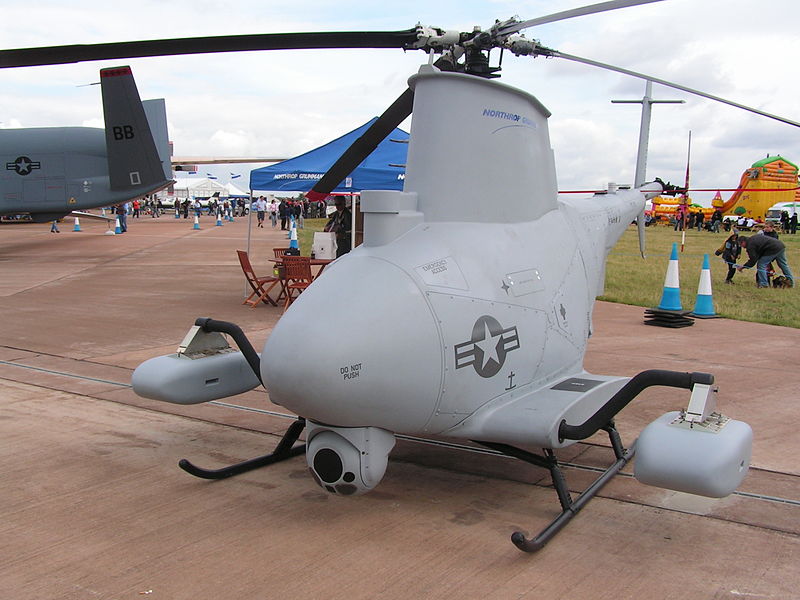
Drones over Des Moines: or, UAV’s in the Heartland

Source: Wikipedia; User: Dammit

Source: Wikipedia; User: Dammit

National Geographic has an interesting and well-timed article in this month’s issue called The Drones Come Home. I say well-timed because of all of the attention that Senator Rand Paul’s recent filibuster received. Senator Paul was filibustering the nomination of John Brennan as CIA Director, but his true purpose was to bring attention to the lack of transparency on policy regarding the use of drone strikes on U.S. soil. You’ll recall from your Civics classes that the 5th and 6th amendments (supported by other laws) require legal due process be conducted before anyone gets, to use the mafia-esque term, “whacked.”

The impetus for all this discussion of drones is the Obama Administration’s 2012 direction to the Federal Aviation Administration (FAA) to open the skies to Unmanned Aerial Vehicles (UAV’s) by September 30, 2015.

It should be noted that the use of armed drones for execution missions is only the most dramatic of many legal issues that will arise with the proliferation of this technology. The National Geographic article devotes more space to the use of drones by state and local law enforcement than they do to that of the Federal government.

Some other new legal considerations will include:

Searches:  I suspect that well before any government is terminating U.S. citizens at home with such devices, they will be using them for surveillance and investigation (i.e. spying.)  The Constitutional standard is that law enforcement can act on any evidence that can be seen from a place they legally have a right to be. So if you’ve got a stolen car in your front yard, they can arrest you.  However,  if the police get an anonymous tip that there is a stolen car in your backyard under your deck, things are trickier. They can ask you to see your backyard, but you can say no. They can ask a neighbor if the neighbor will allow them to look from the neighbor’s property onto yours, but, if that’s unsuccessful, they’d better be able to impress a judge sufficiently to obtain a warrant.

However, what  happens with UAV’s? Now the law enforcement officer can be parked perfectly legally on the street while his “eyes” are hovering over your backyard.  Your property rights overhead are not established (unless you are getting a check every time Delta flies over your house–I’m not.)

Extensions: What about peaking in through your window with an aerial telephoto lens? What if it’s not law enforcement, but rather the Neighborhood Watch? What if it’s not even the Neighborhood Watch, but rather the crotchety retiree at the end of the block who has self-appointed himself neighborhood watchman because he’s bored to tears… and more than a little bitter?

Sovereign Immunity: Many governments have laws that prevent you from suing them. So what happens given a scenario suggested in the National Geographic article, the government’s UAV falls out of the sky and it’s rotor-blade slices open the jugular of your four-year old daughter as she is innocently playing in the sandbox in your back yard?

There are many who are concerned that this technology is not perfected. The military is having its share of problems, and they are spending billions on UAV’s. Imagine what will happen when local governments, corporations, and other cash-strapped entities begin flying more low-budget versions?

Personal No Fly Zones: Despite the tenuous legal situation regarding the “airspace” over one’s head. You know that, sooner or later, someone will try to enforce a no-fly zone over their property. So what happens when a person sees that Sheriff’s department UAV peeping through their window, and they blast it out of the sky with a 12-gauge shotgun?

Of course, there will be a whole new wave of issues that will arise as the autonomous UAV’s are perfected. By “autonomous” I mean ones that don’t need a remote pilot, but are more “fire-off and forget.”

MASTER WORKS: Apology by Plato

ApologyApology by Plato

My rating: 5 of 5 stars

Amazon page

Apology is Plato’s account of the trial of Socrates. This brief work presents Socrates’ defense of himself as well as his reaction to the death sentence verdict against him. Of course, it is all through the lens of Plato, as Socrates left us no written works.

Socrates was charged with impiety and corruption of the youth. He acknowledged both that he was eloquent and that he was a gadfly of Athens (the latter being a role for which Socrates believes he should be valued.) However, he denied both of the formal charges.

Socrates refuted the charge of corrupting the youth first by denying that he had taken money in exchange for teaching. Taking money was a component of this charge. Socrates’ claim is supported later when Socrates tells the court that he can only afford a very small fine, even in the face of the alternative–a death sentence.

Socrates says that he sees nothing wrong with taking money for teaching–if one has wisdom to share. Socrates says that he has no such wisdom, and suggests the philosopher/teachers that are taking money aren’t in error for taking money, but rather because they really don’t have wisdom themselves.

This is summed up nicely by this pair of sentences, “Well, although I do not suppose either of us knows anything really beautiful and good, I am better off than he is–for he knows nothing and thinks he knows. I neither know nor think I know.”

While Socrates raised the ire of the Athenian leaders with what they no doubt believed to be his arrogance, in fact it wasn’t that he thought himself wiser than they, but that he thought they were deluded in thinking themselves wise.

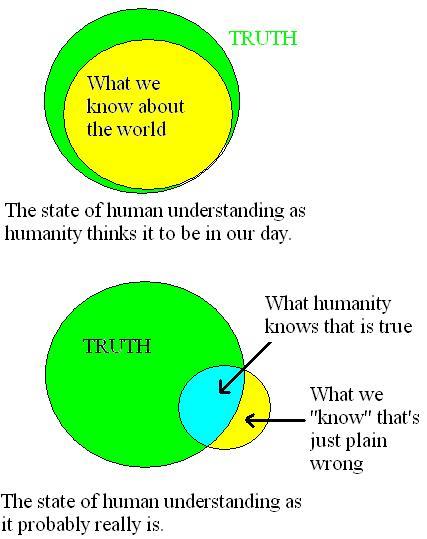
Socrates’ lesson remains valid today. It is the scourge of all ages to think that have finally attained true understanding of the world. Our posterity may know more, but we know all of the essentials and are rapidly converging on a complete picture of our world. We think our generation to be humanity’s sage elders, when, in fact, we are the impetuous teen whose growth spurt has made him cocky. I would propose to you that in all likelihood, even today, the sets of “that which is true” and “that which humanity ‘knows'” form a classic interlinking Venn Diagram. That is, some of the body of knowledge that we take to be proven true is, in fact, false. This occurs because we cannot accept that there are things we are not yet prepared to know, so we use sloppy methodology to “prove” or “disprove.” This one reason we have all these conflicting reports. E.g. coffee is good for you one week, and carcinogenic the next.

VennDiagram_WhatWeKnow

Socrates uses the method that today bears his name, i.e. the Socratic method, to challenge the arguments of Meletus, the prosecutor. The Socratic method uses questions as a device to lead the opposition to a conclusion based on premises they themselves state in the form of their answers. Socrates proposes that if it is he alone who is intentionally corrupting the youth, they would not come around–for no one prefers to be subjected to evil rather than good.

Socrates denies the suggestion that he does not believe in the gods, and in fact indicates that the very suggestion by virtue of the charges against him is a contradiction. What Socrates is guilty of is encouraging those who come around him to develop their own thoughts on god, and not to subordinate their thought to anyone–an idea the leaders found disconcerting.

Socrates goes on to say why he is unmoved by the death sentence. He wonders why it is thought he should beg and wail, when he doesn’t know for sure that an evil is being done against him.

The moral of the story is that those in power fear and will attempt to destroy advocates of free thinking.

This book should be read in conjunction with a couple other Platonic Dialogues, Crito and Phaedo.

View all my reviews

The Case of the Biggest Ego

Dear Leader, Version 3.0, and Dennis Rodman

Dear Leader, Version 3.0, and Dennis Rodman

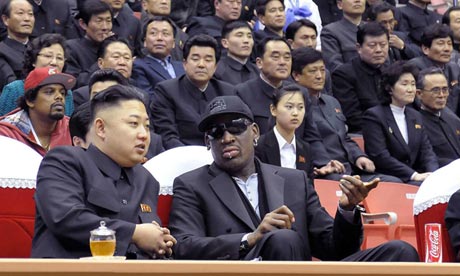
I was reading an article in The Economist over the weekend about the sanctions against North Korea, and Kim Jong Un’s “don’t mess with me, I’m CRAZY!” response.

The article featured the photo above. I was immediately struck by the fact that Kim Jong Un’s head is higher, despite the fact that Dennis Rodman is about six-and-a-half foot tall and Kim Jong Un is… well, let’s just say a dwarf.  I don’t know exactly how tall Kim is, and I’m sure nobody truly does. I tried to look up Kim’s height, but the figures ranged from 5’3″ to 5’9″. This isn’t surprising. The Kim family motto is, don’t let blatant facts to the contrary get in the way of a good lie; stick to your guns, execute people as necessary, and show your skeptics the crazy eyes. Kim Jong Il was believed to have worn six-inch lifts and a nine-inch pompadour to impress his underlings with his grand total 5’2″ physique. Of course, each successive generation of the Kim Dynasty has an easier time because the country’s citizenry is shrinking due to undernourishment, a fate that isn’t shared by the Kims. (Sadly, this isn’t a joke. North Korea is one of the few nations whose average height has been in decline over recent decades.)

It’s not really surprising that Kim insists on his head being higher than his guests. (I know what you’re asking. Whose set of phonebooks is he sitting on, because there sure as hell aren’t enough phones in North Korea for him to be sitting on the DPRK listings–which is more of a pamphlet?) Anyway, kings, emperors, and dictators have always required others to scrunch down so that the royal status will remain unquestioned.

However, if there is anyone who can match a dictator’s monumental ego ton for ton, it’s a professional athlete. Consider Lance Armstrong, he sued reporters for telling the truth about him. What kind of rarefied atmosphere does one have to live in to do that?  Then there are the many athlete-rapists whose defense was “Your Honor, I didn’t know I needed permission to have sex with that person. I think my lawyer may have failed to make you aware that I’m this year’s MVP… Even an MVP needs permission? That’s some crazy shit.”

As a society, we nurture the notion that the dictates of polite society don’t apply to those who are skilled at winning games. Coaches have been known to be fired mid-season for losing, but Bobby Knight beat the hell out of kids for decades before he got fired. We deify athletes just like the people of North Korea, who can’t afford leisure activities of any kind, deify their dictator.

So this photo answers for me an intriguing question, who’s more narcissistic: a professional athlete or a professional dictator. Seeing Dennis Rodman peering at the game over the twin humps of his knees answers the question nicely.

To be fair, Rodman did get a subtle dig in with his Team USA cap;  subdued as it may have been, that must have gotten Kim’s goat. Rodman also got in a nice Coca-Cola product placement. Fun fact: I was once told by a Coke employee that there were only two countries in which Coke was not sold. Everybody guessed that North Korea was one of them, but that’s not correct. It was Burma and Cuba (don’t ask me how the latter has been making Cuba Libres all this time.) Given Burma’s reforms, I wouldn’t be surprised if today it was down to one (or none.)  [World dominance… check.]

Our Most Beloved and Most Deadest of Presidents

Source: Kennedy Library

Source: Kennedy Library

Presidents live the ultimate catch-22, the only way to reliably boost their approval ratings is to shuffle off this mortal coil (i.e.become worm food.)  The more decomposed a president, the more fond our remembrances of him. The worst thing that anyone ever says about a long dead president is nothing at all. When was the last time you heard a scathing character impeachment of Millard Fillmore? (I do realize that a person with the supreme narcissism needed to be president may find silence more insufferable than being called the son of a syphilitic donkey whore.)

(Quick, without looking, name a president from the 19th century other than Jefferson or Lincoln [or Fillmore]?) FYI- there were 23 or 24 of them. If you drank your entire cup of coffee before you could come up with one of the other twenty names, congratulations you are a typical American– or an exceptional non-American.

I first noticed this phenomena when watching the Reagan funeral. Everyone from all walks of life had great things to say about our 40th president on that day. However, while I was still a minor at the time, I distinctly remember half of the country loathing the man spectacularly and engaging in ad hominem attacks against him at any opportunity. Well there was one period during which no one was saying horrible things about Reagan’s character and that was  during the brief period after the assassination attempt when his opponents thought he might die — at which point they went into dead presidents mode. Had Reagan passed away at the hands of John Hinckley, he would’ve achieved a level of freedom from being crapped upon usually reserved for a our first few (long decomposed) presidents.

Still, Reagan has achieved the broadly beloved status of being the Democrat’s “In-your-face President” just like Kennedy serves in that role for Republicans. An “In-your-face President” is one that political parties use to attempt to show that their current opposition is on the lunatic fringe by indicating that that iconic leader supported something vaguely, roughly approximal in a similar sort of way to what they are trying to do in the present day. These statements being followed by a silent, but understood, “IN YO’ FACE.”

I’m sure that when Carter dies, equally lovely things will be said about him — though never has a bigger train wreck of state been seen then the term of James Earl Carter. To be fair, some of the wheels that rolled off the RV-of-state were not his fault, but we  give all the credit and all the blame to the president. Why do you think Clinton is always grinning like he just had sex? No, it’s not because he just had sex– though he did (the speaking circuit is like fishing with dynamite), it’s because he reigned over the big bubbly part of the bubble. When we were rich because we thought we had a lot of valuable stuff, before anyone bothered to look inside and see what we had was rotten at the core.

Admittedly, Nixon’s demise did challenge everybody’s ability to grin and say nice things.  Comments were made such as, “That Checkers was a good boy, such a good boy, yes he WAS… YES he WAS. Oh yeah, and how about that China thing, that was a real work of diplomacy.”  (Checkers was one of Nixon’s dogs, made famous by a Vice Presidential speech of the same name.) The word “China” was used at Nixon’s funeral more than it was used at the Chinese Conference on China in Beijing, China. Of course, there wasn’t much nice to say about Nixon. Democrats can’t even take advantage of the fact that the Environmental Protection Agency (EPA) was a Nixon Administration initiative. Nixon can’t be an “In-your-face President.” It’s too much like slapping your opponent with a bloated dead fish; you may hit them, but you’re going to get the stink on you never-the-less.

5 Minefields of Armageddon for 2013

National Land Image Information, Ministry of Land, Infrastructure, Transportation & Tourism, Japan

National Land Image Information, Ministry of Land, Infrastructure, Transportation & Tourism, Japan

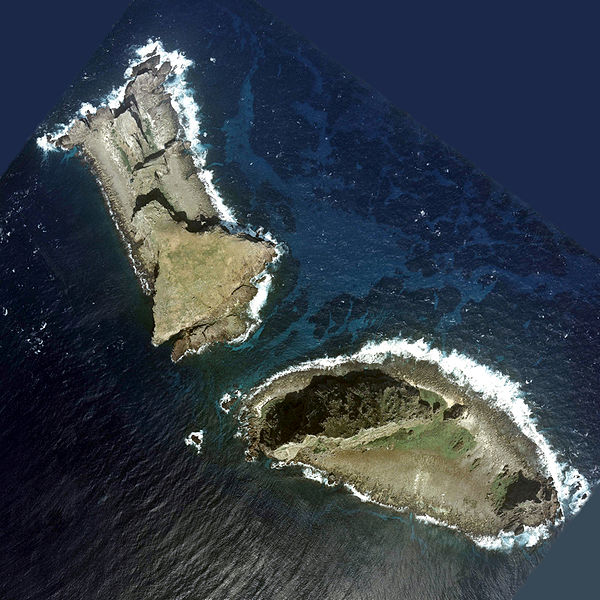
1.) Ever heard of the Senkakus? What about Diaoyus? If not, you should look them up. When you’ve been wearing a gas mask for the 33rd day straight, you may want to know about the chunks of rock in the East China Sea that we tripped into nuclear winter over. Simmering tensions between Japan and China have been flaring up over these islands of late. So you’re probably wondering who lives there who’s so important that it’s worth wandering through a minefield that could trigger World War III. If you answered, “absolutely no one,” give yourself a prize.  They’re uninhabited. It’s not the islands themselves that anyone gives a rat’s as about, it’s the ramification they have for underwater drilling rights.

The reader may accuse me of hyperbole. (Shh! Dont tell anyone, but– of course– that’s what I do.) After all, China has a boldly stated “No First Use” policy. That is, they claim they will not use nukes in a first strike. Given that Japan isn’t a nuclear weapons state (NWS), there doesn’t seem to be much risk. Except that a.) Japan lives under the U.S. nuclear umbrella;  b.) Japan is the non-NWS that could develop nuclear weapons in the shortest time imaginable — they have the material, infrastructure, and technical know-how (okay, Germany is in the same bag); and c.) see #2

KimJongUn3

2.) North Korea conducted its third nuclear test. This presents a risk because: a.) it provides an incentive for Japan to build its own nukes (particularly if faith in the US umbrella wanes.) b.) [and more importantly] Kim Jong Un has too many yes-men, and no one to slap him in his chubby face and say, “are you smoking powdered unicorn horn?” In other words, he doesn’t have a good idea of what he can get away with before the world unleashes a crate of whoop-ass on his sad country. So he wanders in the minefield.

3.) Europe is getting depressed. Fat and happy Europeans are productive and polite. Downtrodden Europeans have been known to swallow some pretty despicable narratives, and– in doing so– drag the world into war. At the moment this seems really far-fetched. These political movements are at best in the political fringe of countries on Europe’s fringe, right? Maybe so. Time will tell.

4.) If America’s economy is crash-landed, everyone is going to be hit by the debris. This will be depressing, see #3 and then multiply globally. Times like these  echo Churchill’s comment, “Democracy is the worst form of government, except for all those other forms that have been tried from time to time.” Any person, company, or government that sees the train coming in the distance but can’t find its way off the tracks can’t be expected to thrive for long.

5.) India and Pakistan, enough said…

BOOK PLUG: The Nuclear Renaissance and International Security

The Nuclear Renaissance and International Security 

Edited by Adam N. Stulberg and Matthew Fuhrmann

2013, Available Now

Buy this book

This is not so much a book review as a shameless plug (I have a chapter in this book.)

Nuclear energy has had a checkered past. From the 1950’s to the 1970’s, there was a massive build up of nuclear power reactors– granted among a fairly small number of nations. Recent decades have seen a drop off in the pursuit of nuclear power among all but a few diehards. This decline resulted from both accidents and unfavorable nuclear power economics (the former exacerbating but not entirely responsible for the latter.) With increasing desire to combat global climate change, there has been renewed interest in nuclear energy as part of a strategy to slow carbon emissions without crippling energy output. However, to date this interest has not turned into large-scale development of nuclear power anywhere except China. After the Fukushima Daiichi accident, even some diehards (e.g. Japan) are reconsidering nuclear power.

This book considers whether there will be a resurgence of nuclear power, if there is what shape it will take, and what the security ramifications of future nuclear power development might be.

Among the many questions addressed in the book are:

1.) Will the future bring more nuclear energy states, or will any expansion take place only within existing nuclear power states?
2.) Why do states supply other countries with nuclear energy technologies, and what are the ramifications of such supply efforts?
3.) Can an International Fuel Bank be successful in reducing the threat posed by proliferation of dual-use fuel cycle technologies?
4.) Will climate change drive a renaissance of nuclear power?
5.) What effect will an expansion of nuclear energy have on non-state nuclear trafficking?
6.) Are states with nuclear power more, less, or equally likely to get into wars?

If you are interested in these questions, this book is for you. 

TODAY’S RANT: Pudgy Dictators, Ugggh

This is my iron hand for which to rule you.

This is my iron hand for which to rule you.

Well, the new Kim on the block is about to pop his first nuke. This will be the third test for the PAB* Dynasty over all. Of course, as an AP article today indicates, we won’t necessarily know whether they succeed because any seismic event emanating from the country might just be a perfectly choreographed simultaneous jump by all citizens.

News reports suggest that Kim is upset about the latest sanctions. While sanctions generally don’t succeed (see Iran), we have hit the DPRK leadership where they live by restricting the flow of commemorative NBA bobble-head dolls– preventing the new Dear Leader from finishing his collection. This has led to veiled threats that he might, “Stop lavishing on the world glorious views of national splendor and brilliance… or bust a nuke up in America’s grill.'”

We need a better class of dictatorial villain. North Korea’s one success has been in killing the new Red Dawn movie by providing such an improbable nemesis. (They almost killed James Bond in the same manner.) Don’t let them kill again.

* PAB = Pudgy Ass Bastard

If you like dark DPRK humor, their state news service is hilarious.

P.S. I had real trouble deciding on which caption to use for the photo. Please let me know which caption you prefer [write-ins enabled.]

KimJongUn3

TODAY’S RANT: Emerson Haters

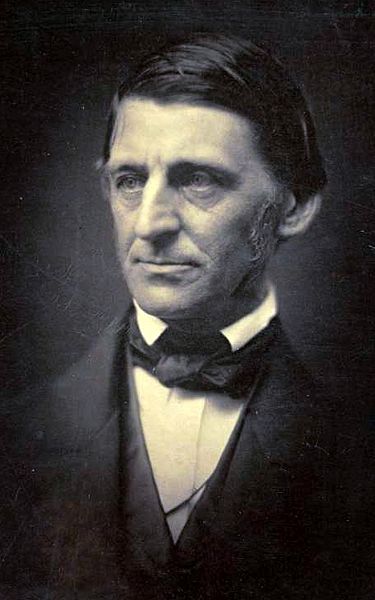
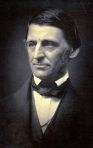
Ralph_Waldo_Emerson_ca1857_retouchedI began reading the Best American Essays of 2012 and was disappointed by the first  essay entitled, The Foul Reign of Self-Reliance by Benjamin Anastas.

Self-Reliance: In or out of the canon?:

Anastas rails against the essay Self-Reliance by Ralph Waldo Emerson. The only nice thing he has to say about Emerson (as a parenthetical insert) was that the philosopher spoke out against slavery and the poor treatment of American Indians.  Anastas suggests Emerson’s essay should be eliminated from the  canon of required reading. This desire to censor ideas that he (or his collective) find objectionable is a telling indicator of why he finds Emerson so vile. In my ideal world, students would read Emerson and Marx and Jefferson and Socrates and Confucius and eventually even the likes of Hitler and they’d make up their own minds about what ideas were sound and which were suspect. I’m  confident that on the whole that a free-thinking people will overwhelming reject the poorest and most vile of ideas. Obviously, not all will draw the same conclusions as I about which ideas are best, but I prefer the company of such people to those who completely agree with me but have turned their thinking caps off. Anastas seems to favor control of the flow of ideas to those society or teachers or some collective finds agreeable.

An undeniably powerful idea:

About all that Anastas and I agree on is that the thesis of Emerson’s Self-Reliance is powerful. By a powerful idea, I mean one that has the ability to grab a reader by the collar and demand his or her attention –whether they like it or not. Where Anastas sees Emerson’s ideas as perniciously powerful, I see them as sagely powerful. While we seem to be in near complete disagreement, I don’t want to go into a point by point refutation. I want to focus on what I believe is Anastas’s central point, that our current political dysfunction is the fault of Emersonian thinking. On this I think Anastas is shows perfection in his wrongheadedness.

The reason I don’t bother arguing point by point is because  much of my difference of opinion with Anastas comes down to being on radically different places on the Borg-Anarchist continuum. Reasonable people may disagree. I have a set of beliefs that inform my position on the Borg-Anarchist continuum that range from my opinion on free will to ideas about the value of optimizing (minimizing) what I would call “social friction” (others have used that term in another way.) That’s neither here nor there, Anastas may have his own justification for his views, though he doesn’t lay them out. For example, he uses the phrase, “excessive love of individual liberty” without indicating what he believes would be the appropriate amount to love liberty, let alone how he drew his conclusion. It may be that he doesn’t have a rationale, but rather has suborned his views to some collective that he believes is representative of society (that would be the true anti-Emersonian approach.)

The Borg-Anarchist continuum:

I should explain what I call the “Borg-Anarchist continuum” for those who are neither Star Trek fans nor wonky. Humans are inescapably both individualistic and social creatures. We know that people get morbidly depressed when they feel they aren’t valued as individuals (Tom Hanks at the beginning of Joe Versus the Volcano), but it’s also true that people go nuts when they are completely isolated from others (Tom Hanks in Castaway.) [Please, don’t draw conclusions about which is “better” on the relative merit of those two movies.] This leads to one of our most fundamental dilemmas. Where our individuality bumps up a social unit, how does one reconcile theses conflicts?

We can imagine a continuum where at one end are the Borg and at the other end are Anarchists. Borg were a powerful enemy in the Star Trek universe. The Borg were a collective in which any given individual was inconsequential and all gave themselves fully to the objective of the collective (i.e. universal domination.) Anarchists are those who feel there should be no authority over the individual. Virtually no one fits into the extreme camps because they’re both blatantly flawed. No one would have any incentive to do anything in Borg world, and an anarchy will inevitably devolve into chaos. No one would invite the Borg or Anarchists to their cocktail party. In practice, one might think of a Communist-Libertarian continuum. Communists believe the state owns the means of production and should be able to regulate ideas as intimately personal as religion, but they don’t attempt to completely stamp out all vestiges of individuality (e.g. people still have names instead of the Borg’s “4 of 7.”) Libertarians believe that authority over the individual should be minimal, but that there’s a role for governance in punishing the illegitimate use of force or the use of fraud.

Yes, I realize that in being one-dimensional, a Republican and a Democrat could occupy the exact same space on the continuum (i.e. wanting the same amount of governance, just not in the exact same domain.)

Is political dysfunction a product of Emersonian thought?:

So, let’s go back to the issue of blaming political dysfunction on Emersonian ideals. It’s my belief that we have political dysfunction because politicians aren’t following Emerson’s advice, rather than that too many are doing so. Let’s consider Anastas’s argument.

“’A man is to carry himself in the presence of all opposition,’ Emerson advises, ‘as if every thing were titular and ephemeral but he.’ If this isn’t the official motto of the 112th Congress of the United States, well, it should be.”

Anastas is saying that the idea that one shouldn’t bend to the ideas of other men, as suggested by Emerson, is the cause of the problem. However, this requires us to believe that politicians engaged in free thinking consistently come down in the perfectly bifurcated set of positions required for grid-lock to take hold on a wide range of issues.  This is dubious. I find it much more probable that politicians do not think freely, but rather they subordinate their opinion to their party and to what the people of their district think. That, my friends, is the source of the problem. Politicians are doing exactly what Anastas wants, which is subordinating their opinion to the majority in their districts. The two-part problem is that: a.) districts are drawn to have clear winners. b.) our society has abandoned the Emersonian idea and taken party and sect as a substitute for thinking. We’ve created a two-party grid-lock machine, and we’re surprised that it works.

Yes, Emerson tells us to be obstinate in holding to ones own beliefs in the face of other people. If every politician did this, our political field would be much richer with many sets of opinions and not just the two captured by the party platforms of the two ruling parties. (At least it wouldn’t hold sway always on anything important.)  What Emerson does not ask of us is to be obstinate in the face of new or better information. Anastas’s own selection of quotes says as much.

“Speak what you think now in hard words,” Emerson exhorted, “and tomorrow speak what tomorrow thinks in hard words again, though it contradict every thing you said today.”

In other words, Emerson is suggesting that one should be able to change one’s mind (one just shouldn’t do this in deference to the views of other people.) One should changes one’s mind when one has new or better information or one’s thinking about the subject is clearer. Changing one’s mind has a bad rap in our political system. There’s a kind of changing of one’s mind that should leave us with a bad taste in our mouths, and that’s pandering. However, not all mind-changing is pandering. If we ask a politician why he changed his mind and he says, “Because I learned X, and that new information made me conclude Y,” then that person should be applauded. The ideas of people of party and sect don’t change regardless of new information. This stagnancy is part of the problem as well. An individual can change his or her mind rapidly but an ideological organization is never swift. When people subordinate their thinking to their sect, this is when we end up unable to get out-of-the-way of slow-moving freight train problems like many that we face today.

The animus that characterizes our political domain is not a function of Emersonian thinking. While Emerson may not address it because it isn’t part of what he’s trying to get across in this essay, it stands to reason that if everyone thinks for themselves people will draw different conclusions. The Maytag repairman is not the loneliest person; the loneliest person in the world is a free-thinker who can’t get along with people who don’t share his exact slate of thinking across a range of  subjects. Thinking for oneself is not only consistent with tolerance, it breeds it. It’s only when one conforms one’s thinking to that of a collective that one can afford to act like people who think differently from one are pure evil.

Other thoughts on the subject:

For another post of mine about Emerson’s Self-Reliance see here.

Also, Emerson was not the only one in the 19th century who was dismayed by the trend toward subordinating political views to party, Mark Twain had a lighter essay on the subject called Corn Pone Opinions.