BOOK REVIEW: The Sonnets of William Shakespeare by Wm. Shakespeare

The Sonnets of William Shakespeare (Wisehouse Classics Edition)The Sonnets of William Shakespeare by William Shakespeare
My rating: 5 of 5 stars

Amazon page


This book consists of 154 sonnets that were published in a quarto dated 1609. It’s not all of the sonnets written by Shakespeare because there were a few stashed in his plays. It’s also not the entire contents of that 1609 quarto, which also included a long-form narrative poem entitled “The Lover’s Complaint.” However, these are the poems typically included in collections of Shakespearean sonnets.

For those unfamiliar with the sonnet, it’s a 14-line poem that’s metered and rhymed. In English language sonnets (and Shakespeare’s, in particular) that metering is iambic pentameter (five feet of alternating unstressed and stressed syllables.) Shakespeare’s sonnets follow a rhyme scheme that is often named for him: ABAB CDCD EFEF GG. (It’s also called English Rhyme, and is differentiated from Petrarchan Rhyme which has an octave of ABBA ABBA and a sestet that can vary, e.g. CDCDCD.) As with all rules of poetry, there is the occasional exceptions taken here and there.

Love, beauty, and death are common recurring themes in the sonnets, but there are occasional forays into tangential topics like lust, infidelity, and immortality through poetry. There are also humorous twists on the expected approach. The most famous Shakespearean sonnet is probably 18 “Shall I compare thee to a summer’s day?”, but we see in another popular contender, Sonnet 130 (“My mistress’ eyes are nothing like the sun;”), Shakespeare mocking hyperbole. Of course, he’s not just mocking hyperbole; he’s also saying that he can still love his lover despite the fact that she isn’t in all ways more beautiful than the most pleasing elements of nature (and might even have halitosis.)

There’s no division or formal organization of the sonnets. However, scholars do divide them up in various schemes. One simple way that they are divvied up is to put the first 126 in a category in which Shakespeare addresses a young man. The first 17 sonnets are a subgroup in which the poet attempts to convince the young man to be fertile and multiply. Sonnets 127 – 154 are sometimes called the “Dark Lady” (a.k.a. “Black Mistress”) sequence as they frequently refer to a brunette woman (i.e. the woman whose lips are not as red as coral in Sonnet 130.) One can see the difference in tone extremely contrasted in the two poems mentioned in the preceding paragraph – Sonnets 18 and 130.

Besides the aforementioned sonnets, a few others stand out as personal favorites:
– 55 “Not marble, nor the gilded monuments”
– 27 “Weary with toil, I haste me to my bed,”
– 1   “From fairest creatures we desire increase,”
– 65 “Since brass, nor stone, nor earth, nor boundless sea,”

But you should read them and find your own favorites. It’s Shakespeare, of course they are highly recommended.


View all my reviews

POEM: Flower Market

Taken in September of 2013 in Bangalore at K.R. Market

Garland coils in saffron and yellow.
Burlap bags of loose blooms in many hues.
Free petals strewn across the floor.

Vendors sit like stamen, still amid the chaos.
Customers waft around like pollen on the wind.
And workers flit about like industrious bees.

POEM: The Destroyer


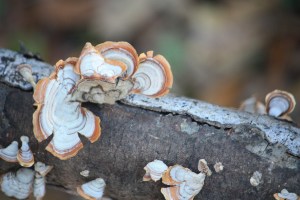
Mighty Fungi, the destroyer,
rending like a divorce lawyer.
There are no bonds you can’t dissolve.
It’s by your graces our world revolves.
Your rap is bad, but we all know,
the pile of stiffs would ceaseless grow,
if you weren’t breaking down the dead.

Plus, we love your work on beer and bread.

POEM: My Nature, or: Water Cycle

Lay me down amid the mountains,

where the sky can call to me.

Set me under the falling rains.

Let me flow down to the sea.

I will float up toward the heavens,

and I’ll glide across the sky.

I will tour the Wonders seven

as a tear drop, sans an eye.

Rain down, run down, rise and repeat,

cycling to the end of days,

feeding plants and beating the heat,

heeding the summons of sun rays.

Long vacation in a glacier.

This is just my human nature.

POEM: Dizzy

Public Domain photo from NASA – ISS [International Space Station]

i’m seeing the world through spin arc,
like long exposure photos of a night sky,
the ones that generate Van Goghesque color swirls,
and always offer a stock-still element for contrast:
a tree,
a windmill,
a radio tower,
or a satellite solar array.

“Stock-still” is a bold damned lie
for something moving at 600,000 meters per second,
as it:
revolves,
orbits,
and expands
its way through a universe
that loathes stillness so much
that even the atoms in a block of cold iron,
floating in the depths of space,
are jittery.

POEM: Some Clichéd Advice

Steer into that dizzy skid.

Don’t pop the top, blow the lid.

Life happens: while making plans.

No plans? Just kick that can.

Dance, like they ain’t watchin’ you.

Buy a vowel, get a clue.

Yesterday is history,

Tomorrow is a mystery,

Today is a gift, like socks.

Which you should grab, after dropping your…*

______________________________________________________________________

[*Note: I caught “Full Metal Jacket” on TV last night.]

POEM: Himalaya


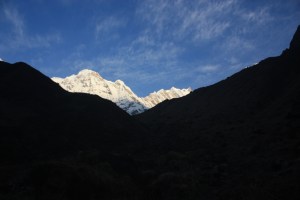
How the feet slow, up amid the ice flow.
Where air is rare, and each step goes higher,
thinking of those who froze or maybe lost a toe,
yet trudged through the scree, the snow, and the mire.

But who’s ever said it wasn’t worth the trip?
You may well hate to feel yourself suffocate,
but you’ll buy your permit, and get all equipped,
strapping on your pack, taking task with fate.

To see the orange glow on the ridgeline,
like fire dancing on the edge of a knife.

But what monster has such a wicked spine,
begging a fight to the last ounce of life.

Please meet the lovely “abode of snows,”
I think you’ll find her worth the throes.

Varanasi Haiku

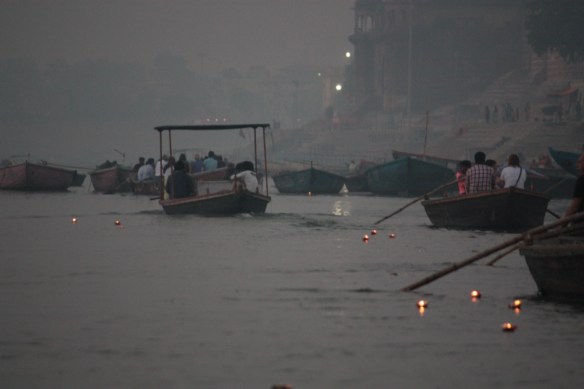
Sacred Ganga,
Welcome to our city.
What gifts you’ll take.


Narrow warren,
lanes lined with bright-hued goods,
bangle blind and lost.


Cattle herd
roams the parched mudflat,
kicking up dust.


A golden bridge
visits each morning, and
exits silently.


Wood stackers
endlessly working
the burning ghats.

Urban Wildlife Haiku

crowded skies,
circling raptors weave
invisible baskets.


little chipmunk,
screeching relentlessly,
stop! all are warned.


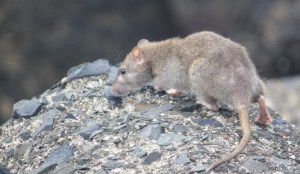
rat slinks away
as cat creeps near,
despite edge in size.


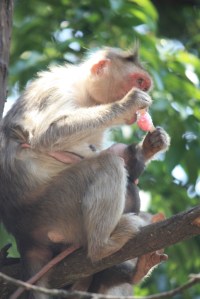
popsicle monkey,
crowd coos, “Cute copy-cat,”
idly stuffing faces.


Mumbai leopards?
Hollywood mountain lions?
cats seeking parts?

Lake Haiku

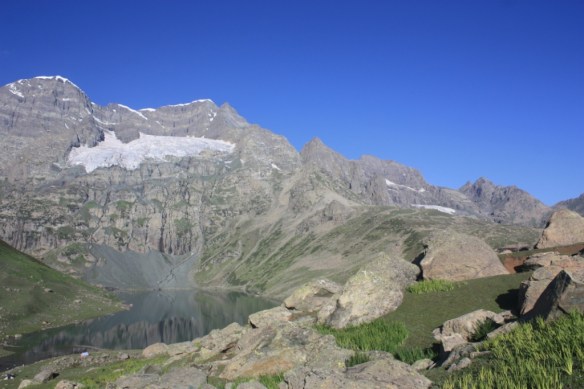
alpine lake,
depth a guarded secret,
mirroring mountain


ships sit
on your sandy bottom,
yet, you’re called “lake”


in sunlight
your glistening canvas,
a bowl of diamonds


winter ice cracks
with steel cable song,
sending shudders


barren pine
beside mud-rimmed lake,
heeding drought