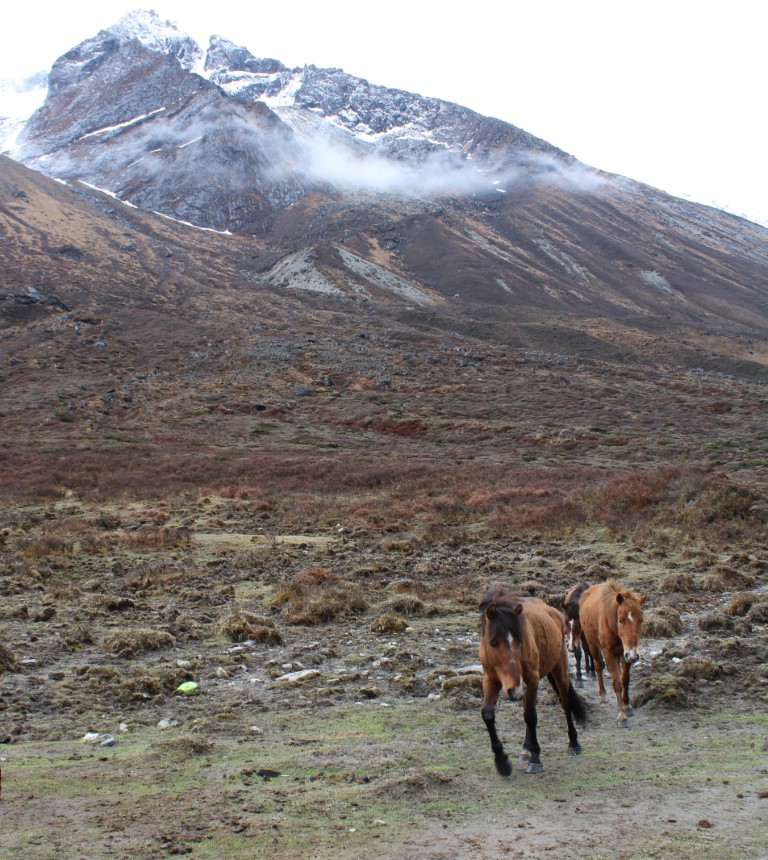
An unfamiliar horse --
   Saddled but riderless --
 Cautiously ambles
   Into the village.
 Its saddle, bags, and coat
   Spattered in black --
      Really, rust-red on brown.

The villagers want nothing
   To do with it,
      But each sneaks it food
         And lets it water at their
            Tank.
The shades of night were falling fast,
 As though an Alpine village passed
 A youth, who bore, 'mid snow and ice,
 A banner with the strange device,
     Excelsior!

His brow was sad; his eye beneath,
 Flashed like a falchion from its sheath,
 And like a silver clarion rung
 The accents of that unknown tongue,
     Excelsior!

In happy homes he saw the light
 Of household fires gleam warm and bright;
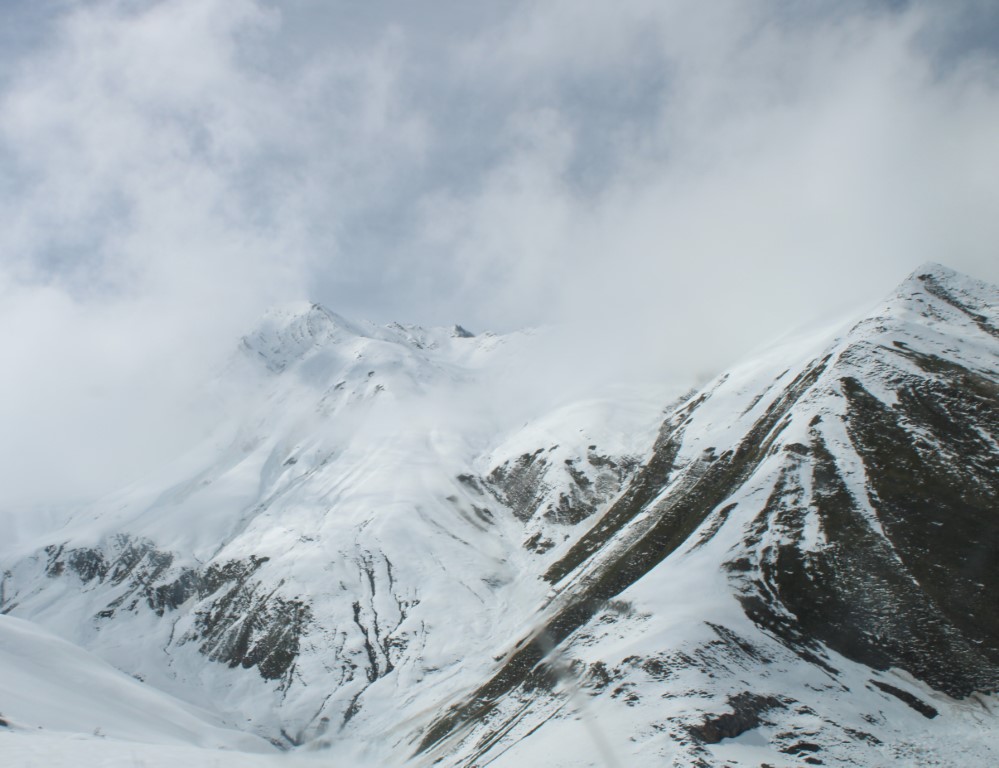
 Above, the spectral glaciers shone,
 And from his lips escaped the groan,
     Excelsior!

"Try not the Pass!" the old man said;
 "Dark lowers the tempest overhead,
 The roaring torrent is deep and wide!"
 And loud that clarion voice replied,
     Excelsior!

"Oh stay," the maiden said, "and rest
 Thy weary head upon this breast!"
 A tear stood in his bright blue eye,
 But still he answered, with a sigh,
     Excelsior!

"Beware the pine-tree's withered branch!
 Beware the awful avalanche!"
 This was the peasant's last Good-night,
 A voice replied, far up the height,
     Excelsior!

At break of day, as heavenward
 The pious monks of Saint Bernard
 Uttered the oft-repeated prayer,
 A voice cried through the startled air,
      Excelsior!

A traveller, by the faithful hound,
 Half-buried in the snow was found,
 Still grasping in his hand of ice
 That banner with the strange device,
     Excelsior!

There in the twilight cold and gray,
 Lifeless, but beautiful, he lay,
 And from the sky, serene and far,
 A voice fell like a falling star,
     Excelsior!
Project Gutenberg edition
This epic poem borrows from American Indian folklore and legend to build a fictional life story for the protagonist, Hiawatha. (There was an actual Hiawatha, but his life story apparently in no way resembles that of Longfellow’s Hiawatha, which is good because the fictional one had to deal with ghosts, tricksters, and deities.) The poem is part hero’s trials, part love story, and part tale of the supernatural, blending real world type tragedy with an otherworldly form.
The choice of trochaic tetrameter makes the poem rhythmically readable, while evoking a drumming sound that contributes to atmospherics.
When the poem came out in the mid-19th century, it faced some controversy. It was claimed that it was a knock off of the Kalevala of Finland. Longfellow’s reply was that he was influenced by that poem’s rhythm (the Kalevala is also trochaic,) but that all the plot events where from his conversations with American Indians and researchers, thereof, (or, presumably his own imagination,) and that any coincidence of events was owing to the broad brushstrokes of them both being heroic tales.
I enjoyed reading this poem and would highly recommend it for poetry readers and lovers of American Literature.
Once upon a midnight dreary, while I pondered, weak and weary,
 Over many a quaint and curious volume of forgotten lore --
 While I nodded, nearly napping, suddenly there came a tapping,
 As of some one gently rapping, rapping at my chamber door.
 "'Tis some visitor," I muttered, "tapping at my chamber door --
  Only this and nothing more."

 Ah, distinctly I remember, it was in the bleak December;
 And each separate dying ember wrought its ghost upon the floor.
 Eagerly I wished the morrow; -- vainly I had sought to borrow
 From my books surcease of sorrow -- sorrow for the lost Lenore --
 For the rare and radiant maiden whom the angels name Lenore --
  Nameless here for evermore.

 And the silken sad uncertain rustling of each purple curtain
 Thrilled me -- filled me with fantastic terrors never felt before;
 So that now, to still the beating of my heart, I stood repeating
 "'Tis some visitor entreating entrance at my chamber door --
 Some late visitor entreating entrance at my chamber door; --
  This it is and nothing more."

 Presently my soul grew stronger; hesitating then no longer,
 "Sir," said I, "or Madam, truly your forgiveness I implore;
 But the fact is I was napping, and so gently you came rapping,
 And so faintly you came tapping, tapping at my chamber door,
 That I scarce was sure I heard you" -- here I opened wide the door; --
  Darkness there and nothing more.

 Deep into that darkness peering, long I stood there wondering, fearing,
 Doubting, dreaming dreams no mortal ever dared to dream before:
 But the silence was unbroken, and the darkness gave no token,
 And the only word there spoken was the whispered word, "Lenore?"
 This I whispered, and an echo murmured back the word, "Lenore!" --
  Merely this and nothing more.

 Back into the chamber turning, all my soul within me burning,
 Soon I heard again a tapping, somewhat louder than before.
 "Surely," said I, "surely that is something at my window lattice;
 Let me see, then, what thereat is, and this mystery explore --
 Let my heart be still a moment, and this mystery explore; --
  'Tis the wind and nothing more."

  Open here I flung the shutter, when, with many a flirt and flutter,
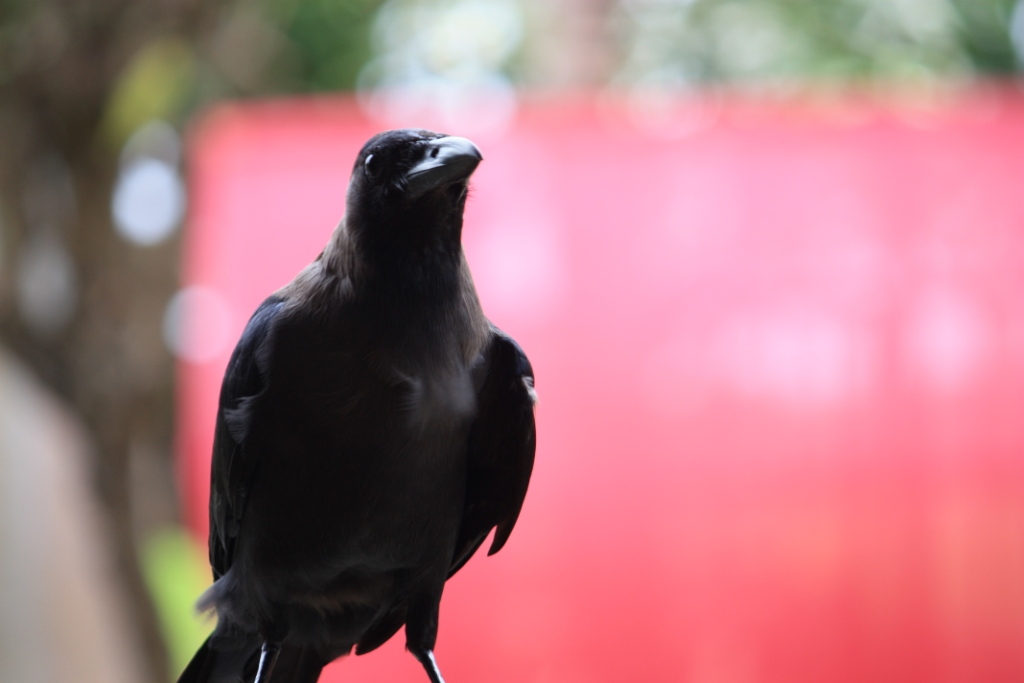
 In there stepped a stately Raven of the saintly days of yore;
 Not the least obeisance made he: not an instant stopped or stayed he;
 But, with mien of lord or lady, perched above my chamber door --
 Perched upon a bust of Pallas just above my chamber door --
  Perched, and sat, and nothing more.

 Then this ebony bird beguiling my sad fancy into smiling,
 By the grave and stern decorum of the countenance it wore,
 "Though thy crest be shorn and shaven, thou," I said, "art sure no craven,
 Ghastly grim and ancient Raven wandering from the Nightly shore --
 Tell me what thy lordly name is on the Night's Plutonian shore!"
  Quoth the Raven, "Nevermore."

 Much I marvelled this ungainly fowl to hear discourse so plainly,
 Though its answer little meaning -- little relevancy bore;
 For we cannot help agreeing that no living human being
 Ever yet was blessed with seeing bird above his chamber door --
 Bird or beast upon the sculptured bust above his chamber door,
  With such name as "Nevermore."

 But the Raven, sitting lonely on that placid bust, spoke only
 That one word, as if his soul in that one word he did outpour.
 Nothing further then he uttered -- not a feather then he fluttered --
 Till I scarcely more than muttered, "Other friends have flown before --
 On the morrow he will leave me, as my hopes have flown before."
  Then the bird said, "Nevermore."

 Startled at the stillness broken by reply so aptly spoken,
 "Doubtless," said I, "what it utters is its only stock and store,
 Caught from some unhappy master whom unmerciful Disaster
 Followed fast and followed faster till his songs one burden bore --
 Till the dirges of this Hope the melancholy burden bore
  Of 'Never -- nevermore."

 But the Raven still beguiling all my sad soul into smiling,
 Straight I wheeled a cushioned seat in front of bird and bust and door;
 Then, upon the velvet sinking, I betook myself to linking
 Fancy unto fancy, thinking what this ominous bird of yore --
 What this grim, ungainly, ghastly, gaunt, and ominous bird of yore
  Meant in croaking "Nevermore."

 This I sat engaged in guessing, but no syllable expressing
 To the fowl whose fiery eyes now burned into my bosom's core;
 This and more I sat divining, with my head at ease reclining
 On the cushion's velvet lining that the lamp-light gloated o'er,
 But whose velvet violet lining with the lamp-light gloating o'er,
  She shall press, ah, nevermore!

 Then, methought, the air grew denser, perfumed from an unseen censer
 Swung by Seraphim whose foot-falls tinkled on the tufted floor.
 "Wretch," I cried, "thy God hath lent thee -- by these angels he hath sent thee
 Respite -- respite and nepenthe from thy memories of Lenore;
 Quaff, oh quaff this kind nepenthe, and forget this lost Lenore!"
  Quoth the Raven "Nevermore."

 "Prophet!" said I, "thing of evil! -- prophet still, if bird or devil! --
 Whether Tempter sent, or whether tempest tossed thee here ashore,
 Desolate yet all undaunted, on this desert land enchanted --
 On this home by Horror haunted -- tell me truly, I implore --
 Is there -- is there balm in Gilead? -- tell me -- tell me, I implore!"
  Quoth the Raven, "Nevermore."

 "Prophet!" said I, "thing of evil! -- prophet still, if bird or devil!
 By that Heaven that bends above us -- by that God we both adore --
 Tell this soul with sorrow laden if, within the distant Aidenn,
 It shall clasp a sainted maiden whom the angels name Lenore --
 Clasp a rare and radiant maiden whom the angels name Lenore."
 Quoth the Raven, "Nevermore."

 "Be that word our sign of parting, bird or fiend!" I shrieked, upstarting --
 "Get thee back into the tempest and the Night's Plutonian shore!
 Leave no black plume as a token of that lie thy soul hath spoken!
 Leave my loneliness unbroken! -- quit the bust above my door!
 Take thy beak from out my heart, and take thy form from off my door!"
  Quoth the Raven, "Nevermore."

 And the Raven, never flitting, still is sitting, still is sitting
 On the pallid bust of Pallas just above my chamber door;
 And his eyes have all the seeming of a demon's that is dreaming,
 And the lamp-light o'er him streaming throws his shadow on the floor;
 And my soul from out that shadow that lies floating on the floor
  Shall be lifted -- nevermore!




 Tiger Riding for Beginners