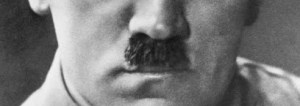
POEM: My Theory on the Long Shadow of Hitler’s Mustache

People once saw in it great panache,
but Hitler killed the toothbrush mustache.

Now no one would dare to wear it.

Except that groundskeeper from Magnum P.I.

who turned out to be the mysterious millionaire.

Maybe, his wealth was Nazi gold?

But that isn’t my theory of the long shadow of Hitler’s mustache.

My theory is that when the short mustache comes back in fashion,
great evil will sit upon our doorstep.

For it is more than a choice of facial hair,
it’s a barometer of remembrance
that lacks an indicator of the half-life
of evil’s stain upon our collective consciousness.


Or, maybe, it just looks stupid on your face.
As if you made a dreadful razor error
and tried to play it off as a plan
through use of symmetry.


In which case, someone should be charting
the rate of application for name change by
Hitlers, Himmlers, Goebbels, and Görings.

An Introvert’s Poem

Please don’t take this the wrong way,
but I wish you existed fewer hours per day.
 
It’s not that I don’t like your company.
 
It’s just that I wish your dosage were smaller.
It’s not like I wish you thinner, prettier, or taller,
 
I just wish there were less of you — temporally speaking.

POEM: Joker, or: Disruptive Forces

Among the brick rubble, down a side street from the temples encased in spiky, cuboid scaffolds, next to a bulging wall bolstered by beams knocked in at a slant, someone painted this graffiti of Heath Ledger’s Joker.

I stare at the maniacal face and can’t help but wonder whether someone painted it in the seven years between Ledger’s portrayal and the 2015 earthquake that broke Bhaktapur, or whether it’s a commentary on disruptive forces.

POEM: Dad’s Strange Lexicon

My father had a strange lexicon.

In second grade, we were playing a word-guessing game like the game show Password (if it were in a classroom of spastic 2nd graders.)

The word was: “BARN.”

I offered the clue: “HAYMOW.”

You can imagine the puzzlement in a classroom of mostly “city” kids raised on Richard Scarry vocabularies. I almost got beat up when my team — the losing team — decrypted my clue into “hayloft,” a clue that would’ve easily won the game.

Our house had a DOG-TROT. I know it was toward the middle of the house, but have no idea what its defining characteristic might have been. I do know that I never saw a single dog trot through the middle of our house because of the policy of “Outside for Animals – Inside for Humans” that reined in our household, except when a wily field mouse snuck in through the basement or a wood duck — distinctly lacking wiles — snuck its way down the chimney and into the wood stove.

I was told, with great conviction, that a “HAN-YAK” was second cousin to a “POT-LICKER.” As a child, I missed that these were terms of derision, and — I fear — I may have hung a slander upon my cousins by licking some marinara off the lip of a piece of cookware once upon a time.

POEM: Park in Motion

Three sights seen on my run in the park:

1.) a pup trotting in yaw as its nose and spine aligned on another dog while its neck followed the vector of the leash

2.) a slim-wristed, kurta-clad woman marching with such vigor of arm swing as to make it appear that her arms were rubber from the elbows down

3.) pairs playing net-less badminton such that making one’s “opponent” take a step would be considered bad form

POEM: Rush

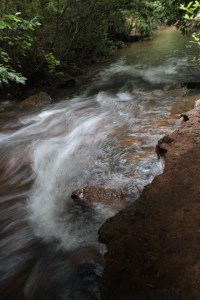
Rushing water carves rock and clay away,
gouging out a statement in nature’s hand.
Water spatter creates a misty spray,
stinging sharply as pelted with wet sand.

A foamy ridge takes a serpentine form
on the glassy warp field glazing brook stones.
This wild water isn’t born of savage storm;
it’s the effortless effort of Zen koans.

My camera fails to capture the calm scene,
but blurs it into a tiny tempest,
transforming a mundane forest stream
into a world scarring menace.

In these rapids I see a tsunami
washing over isles of Izanami.

BOOK REVIEW: Erotic Poems ed. Peter Washington

Erotic PoemsErotic Poems by Peter Washington
My rating: 5 of 5 stars

Amazon page


This collection stands as one volume in a series entitled “Everyman’s Library Pocket Poets.” Other volumes in the series feature the work of a particular author, a regional or national poetic tradition, a type of poem (e.g. sonnets,) or – like this one – a central theme (e.g. friendship, love, animals, war, etc.)

It’s a broad ranging collection. It covers a period from before Christ (e.g. the Roman poet Catullus) to twentieth century poets such as Sylvia Plath and Joseph Brodsky. The poetry also spans the globe including not only English language poets of Britain and America, but also translated poetry from India, the Middle East, China, Japan, and elsewhere. The poem’s lengths range from the brevity of a Bashō haiku to long poems such as Keats’s “The Eve of St. Agnes.” Epically long poems aren’t included, though there are excerpts such as that of Shakespeare’s “The Rape of Lucrece.” There is a favoring of classical English forms (e.g. iambic pentameter) even among many translated poems, but that doesn’t mean that the collection lacks diversity of form.

One nice thing about the diversity of poems is that one gets to see how various cultures and time periods dealt with erotic content. It should be noted that readers who are expecting poems that are erotic in the sense of being pornographic or bawdy by today’s standards are likely to be disappointed. That said, while many of the erotic elements are veiled in symbolism, that isn’t the case throughout. There is some explicitly erotic content among the collected poems. (Though, not as explicit as one sees in the works of Allen Ginsberg, for example.) It was interesting to see that it isn’t necessarily that the further back one goes in time the more repressed or veiled the writing is. On the contrary, some of the Latin and old Indian poems were among the most explicit. Of course, decoding the meaning of poets, and the savoring of reading that requires, is part of the joy of reading poetry.

I enjoyed this collection. I thought it was nice gathering of poems that explored sensuality, romance, and eroticism.

View all my reviews

POEM: The Curious Tower [a Sonnet]


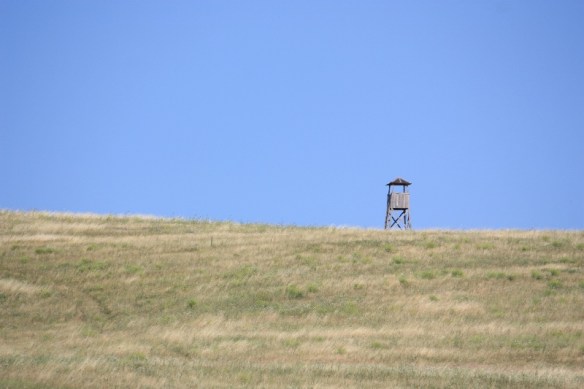
And in my dream I saw a vast expanse.
To the horizon tawny hills did roll.
Stood nothing but a tower in stout stance,
to burden the barrenness of this knoll.

Such an anomaly must draw one near.
So I began to march with all my might.
Hours down, feet sore, with vanishing good cheer,
as the tower retreated from my sight.

What devil played these tricks inside my mind,
and thieved that wonder under the blue dome
that suggests the existence of mankind
in this slumber simulacrum of home.

When I awoke the world seemed right again,
a world where all resides beyond my ken.

POEM: Literary Allusions

Captain Ahab, go chase your whale!
Better obsession end in death than jail.
Though Thoreau’s case for the latter
takes task with escapees like Hatter.
But then again everyone needs a head.
Perhaps, just let them think one dead?
Ask Tom and Huck what could go wrong
when found out by an aggrieved throng.


Should one tilt at windmills and take beatings,
or pass upon the heroic moment fleeting?
La Mancha versus Fleming, which one is penned
to know what’s true in the end?

POEM: Lonely Oak


I
lonesome oak on a hill


having outlived your peers


your progeny denied the light
by scythe and mower blade alike


II
it’s said you speak by pheromone
but no whiff is caught when alone
your words disperse unsmelt
lost across a manmade veldt


III
if it’s any consolation
you have our unflagging admiration
you’re the model of stately poise
to all the little girls and boys


who swing about your stout limbs