BOOK REVIEW: Cat’s Cradle by Kurt Vonnegut

Cat's CradleCat’s Cradle by Kurt Vonnegut

My rating: 5 of 5 stars

Cat’s Cradle is Vonnegut at his most brilliant and witty.

The book follows a writer, John/Jonah, as he does research for a book on the Hiroshima A-bomb. To learn about the (fictitious) inventor of the bomb, the deceased Felix Hoenikker, he interviews  Hoenikker’s children and former supervisor. In the process he becomes entangled in global catastrophe in a way he couldn’t have imagined.

As it turns out, Hoenikker had invented another weapon of mass destruction, one that would make the H-bomb look like a firecracker. However, ice-9, as the weapon was designated, wasn’t intended as a weapon at all. Ice-9 turns all water into ice at temperatures below 114 degrees Fahrenheit. The idea was to make marshes crossable by Marine Corps units. It’s the failure to anticipate the ramifications of using such a chemical, i.e. the hydrologic cycle, that’s the central premise of this book.

A lot of the book deals with a fictitious religion called Bokononism. Bokononism is the cynical faith of the Island of San Lorenzo, and it perfectly reflects Vonnegut’s mildly misanthropic attitudes. The first sentence of the Book of Bokonon says it all, “All of the true things I am about to tell you are shameless lies.”

At the beginning of Cat’s Cradle we find out that John is a Bokononist, but that he’d grown up a Christian. Bokononism is prohibited on the island by the dictator, Papa Manzano. The reader comes to discover that not only is the prohibition a fraud designed to give the religion more sex appeal, but also that Manzano is a practitioner himself. This is just one of the quirky oddities that defines life on San Lorenzo.

It’s when John and all the Hoenikker children are assembled in San Lorenzo that the action really unfolds. Manzano is dying and turns the presidency over to Franklin Hoenikker (the non-midget son of the father of the bomb); Manzano later commits suicide in the oddest imaginable way. Franklin convinces John to take the presidency, but it becomes moot as the book approaches climax.

I’ll leave you with my favorite piece of Bokononist wisdom, “Peculiar travel suggestions are dancing lessons from God.” By the way, you should go to San Felix island off the coast of Chile. [Picked via a spinning globe.]

View all my reviews

BOOK REVIEW: Ishmael by Daniel Quinn

Ishmael: An Adventure of the Mind and SpiritIshmael: An Adventure of the Mind and Spirit by Daniel Quinn

My rating: 4 of 5 stars

A man answers an ad that says, “Teacher seeks pupil. Must have an earnest desire to save the world. Apply in person.” Expecting to find a charlatan, the man is surprised to find his new teacher is, in fact, a gorilla.

Like Socrates, this gorilla, Ishmael, uses questions to guide his pupil toward crucial knowledge. Ismael teaches his student to challenge some of his most deep-seated beliefs such as, the world was made for humans, humans are the ultimate culmination of biology, humans are inherently separate from (and above) nature, and that humans are fundamentally flawed in such a way as to make ruination of the planet inevitable.

The core of the book differentiates two human cultures. The author calls them the “takers” and the “leavers,” but they correspond to what we might call “us” and the “aboriginal peoples.” Takers are specialized, agricultural, and technologically advanced (if you’re reading this review on a computer and not chiseled on a cave wall, you, my friend, are a taker.)

The lives of “Leavers” aren’t that different from those of humans 10,000 years ago. They are tribal as opposed to (to borrow Desmond Morris’s term) super-tribal. [In a tribe everyone knows everyone else. Morris suggests that things go to shit –re: war, crime, and deviant behavior– in super-tribal societies.] Leavers live like animals in that they tend towards equilibrium within their ecosystem. Takers do not.

If you long for thrillers or potboilers, this isn’t the book for you. It’s a thinking person’s book. The nice thing about Ishmael’s use of the Socratic method is that one can think through the questions in parallel to the narrator’s discovery. In this way, the reader can install himself or herself into the conversation.

At the most generic level, the book’s value is in showing one how much one takes for granted. We can’t see forests for trees.

One may agree or disagree with the author, but either way one will be subjected to powerful food for thought. Some of the discussion may evoke a visceral emotional reaction that one may have trouble reconciling with logic, such as the discussion of the morality of feeding the starving.

The downside of the book is that the dialogue can be strained in places and it can get a bit repetitive. The latter serves to reinforce key concepts, but some of them feel as though they are reinforced inordinately. In making the narrating protagonist struggle, Quinn creates a lead who seems a bit dense sometimes. Also, as I indicated, the journey is by-and-large in the mind, and so the tension is limited. There is some drama when the narrator shows up one day to find that Ishmael has been evicted. However, this is resolved without too great a difficulty and they resume lessons with  Ishmael’s irritability being the only change to be seen. There is drama at the end that will remain unspoiled herein.

I’d recommend this book as a thought-provoking exercise for the mind.

View all my reviews

BOOK REVIEW: The Sun Also Rises by Hemingway

The Sun Also RisesThe Sun Also Rises by Ernest Hemingway

My rating: 4 of 5 stars

Get Speechify to make any book an audiobook

Whatever the blurbs or critics might say, this book is about the raft of men left in the friend-zone after brief dalliances with Lady Brett Ashley. One may have been led to believe it’s about the life of Jake Barnes. Barnes is the lead character, but he’s not the most influential character.

Besides Barnes, the list of men who fall hard for Lady Brett Ashley include, boxer Robert Cohn, the bankrupt Michael Campbell, and the bullfighter Pedro Romero. Oddly enough, the physically toughest, Cohn, is the one who falls the hardest. Barnes may be the strongest in this sense; perhaps because his relationship with Ashley is over before the novel begins. Barnes comes off as likable with a pragmatic “live and let live” nature. (He can maintain a friendship with a woman that he loves, a feat that seems beyond Cohn’s ability. Campbell is used to having lost everything, and so seems to bob comfortably in Ashley’s wake. We don’t reliably learn about how Romero takes it.)

As the blurb says, The Sun Also Rises is about a journey from Paris to Pamplona. In Paris, the cast of Lost Generation friends hang out in cafés. In Pamplona they attend bullfights. In between, Barnes goes fishing with friends.

In a broader sense, the book is about dissatisfaction and restlessness, and not only within Ashley. This is summed up nicely by Cohn’s words to Jake, “Don’t you ever get the feeling that all your life is going by and you’re not taking advantage of it?”

Of course, the book shines in its language. Hemingway’s lean buy meaty prose is readable and engrossing. The minimalist dialogue beautifully conveys the interaction of a group of intimate friends.

Here’s a great line that captures the character of Hemingway’s writing in this book, “The beer was not good and I had a worse cognac to take the taste out of my mouth.”

The book rises to crescendo with the Pamplona bullfights and Hemingway adeptly ends on a sad note apropos of the morning after a great party.

View all my reviews

BOOK REVIEW: The Girl with the Dragon Tattoo by Stieg Larsson

The Girl with the Dragon Tattoo (Millennium, #1)The Girl with the Dragon Tattoo by Stieg Larsson

My rating: 4 of 5 stars

A disgraced reporter and an emotionally-troubled/intellectually-gifted ward of the state pair up to solve a forty-year old locked door mystery. In the process of investigating what happened to a young woman who vanished without a trace from an island estate, they end up solving a much bigger set of mysteries– and putting their lives in peril in the process.

Both of the lead characters are well-developed and sympathetic, if not necessarily likable in a conventional sense. Mikael Blomkvist is a bit of womanizer or at least a lady’s man– whatever you wish to call him, he sleeps with at least three major female characters over the course of the book. He is also rash (or, perhaps, aggressive) in his professional life. However, he is also pragmatic and kind. Lisbeth Salander is not just tattooed but also pierced, leather-clad, and goth. Her story of female empowerment may be largely responsible for the wild success of this book. When she finds herself abused and violated, she takes matters into her own hands. Her strength and intelligence, wrapped in a package that suggests neither trait, is beguiling.

The book is obviously highly readable, but it’s oddly structured. It climaxes early, leaving well over a hundred pages at the end to wrap up subplots. This includes the disposition of Blomkvist’s professional predicament and the question of with whom he will ride off into the sunset. These are threads that couldn’t be left hanging, but it begs the question of why one reads to the bitter end– though you certainly will.

I guess I should mention that this isn’t a book for the faint of heart or the puritanical– in case one hadn’t already grasped that. It is graphic and intense in spots.

I did see the Daniel Craig/Rooney Mara version of the movie. I’m told it was not as good as the first film, which was made is Sweden (I should have mentioned the book is set in Sweden.) However, I thought it was quite good, and fairly true to the book given the challenges of turning a 650 page novel into a movie.

View all my reviews

BOOK REVIEW: Dracula by Bram Stoker

DraculaDracula by Bram Stoker

My rating: 4 of 5 stars

Dracula leaves Transylvania to find a new pool of victims, and the only thing standing between him and the people of London is Dr. Van Helsing and his cast of allies.

The novel begins with the arrival in Transylvania of Jonathan Harker, a real estate agent from England. Both Harker and his beloved wife, Mina, play an important role in unraveling the mystery of Dracula. Soon after a ghost ship rams into port, Lucy Westenra (a friend of Mina’s) begins to suffer an unusual illness. A Dr. Seward brings in Dr. Van Helsing who has a rare expertise in her particular ailment. Professor Van Helsing’s knowledge is essential to driving Dracula out of London and back to Transylvania. They pursue the vampire– resulting an a final show down.

Bram Stoker uses a series of journal entries, letters, and memos to convey the story. This is an interesting approach, and popular at that time, but it does have its limitations.

Dracula was written early in the age of science and reason. While it was an age of superstition, there is an attempt to elevate vampirism from a strictly supernatural phenomena to one in which science has something to say.

The 19th century language and approach to tension makes for a less gripping tale than one would likely see today, but it is still a very readable book.

View all my reviews

BOOK REVIEW: The Road by Cormac McCarthy

The RoadThe Road by Cormac McCarthy

My rating: 5 of 5 stars

Sparse and haunting.  The Road is about a father and son walking cross-country in search of a safe harbor in a post-apocalyptic world. The story pulls one in and leaves a tightness in one’s gut. Every person the duo comes across on the road must be treated as a dire threat, making them each other’s only thread of connection to humanity. One particularly powerful moment is when they get to the ocean and see nothing but ghost ships lolling in the water. To reach the end of the road, the end of one’s world, without a flicker of hope is crushing, but they make a left turn and keep going.

McCarthy uses description in vivid flourishes, but it’s the spartan dialogue that really creates the tone. I was distracted by the lack of quotation marks and dialogue markers at first, but with only two speaking characters McCarthy’s approach works just fine. One soon gets a feel for the unique voice of each, and then the minimalist approach works.

McCarthy cuts away everything that is non-essential. Some of these non-essentials, like names, we so take for granted that their absence helps create a somber tone.

If you don’t like sad stories, this one won’t be for you. I found the ending to be tragic, but some may see it as hopeful.

I haven’t seen the movie, but from the trailer and what I’ve heard, it’s a bit different. Hollywood not willing to take the risk of stripping it bare.

View all my reviews

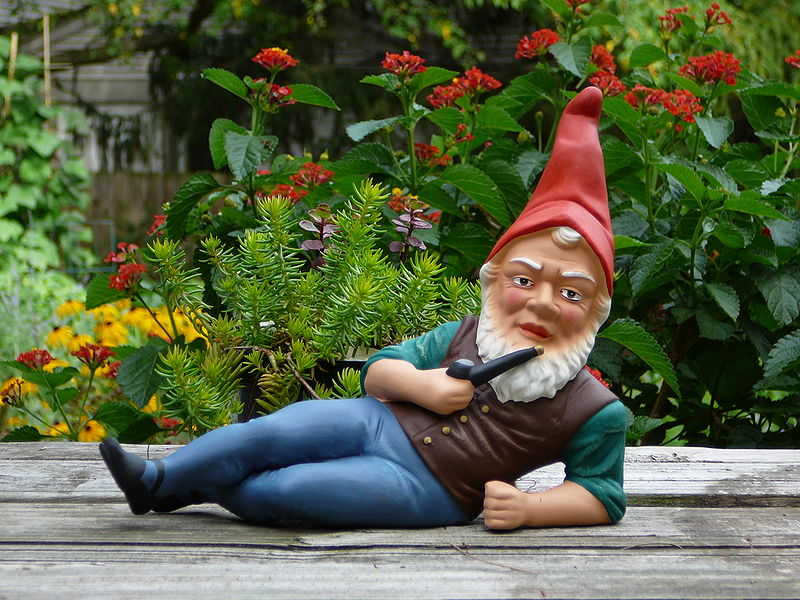
How to Kill a Rogue Yard Gnome, Part 3 of 4

Part I can be read here.

Part II can be read here.

[Notes: a.) Sorry, I meant to do this in three installments, but this one was getting long.  

b.) For the best reading experience, assume all of the continuity gaffes in the dream sequence are on purpose and intended to convey the capricious and surreal nature of a dream—most of them are ; ) .]

Attribution: Colibri1968

Attribution: Colibri1968

I cringed when I heard my voice on tape. I always thought I sounded sexier, less like Ferris Bueller’s teacher. But what brought on the nausea was hearing me describing events of which I had no recollection. It was difficult to fathom that such drama could unfold in my dreams without me having any memory of it.

I should take a step back to say that I’d sought therapy immediately after returning home to find the scowling gnome. It was a decision made after a sleepless night. I didn’t dare destroy the scowling gnome for fear I’d end up with a glowering golem in my front yard when I next came home.

Logically, I recognized two possibilities. The first was that someone was playing an elaborate hoax upon me. I couldn’t figure out how, but this was what I wanted to be true. But watching the tape repetitively had given me no clue about how the trick could be perpetrated. The vanishing gnome and the self-propelled gnome were tricks worthy of David Copperfield. The second possibility was that I was out of my mind— but in a manner that was localized to my front yard. That was equally hard to explain. The therapist was my attempt to explore all options, but I didn’t tell her the details.

My therapist said hypnosis would be a good idea, presumably because she’d just gotten her hypnotherapy license and needed the registration fee to pay for itself. As you might suspect, I was skeptical. Lying on a brown leather divan, fingering the brass upholstering rivets along its edge, I listened to fantastic words spew from my own voice as she played the tape back for me.

I’m standing in front of a mammoth mansion made of rough, gray stones. It looks like a castle—like something out of Bram Stoker’s Dracula. It’s dark out, but yet I can see. It’s as if the moon is shining bright, but yet it’s dismally overcast. So much so that I feel like I could jump up and touch the thick, gray clouds. I’m staring at an ornate carving on the door. It’s an elaborate mountain scene. How can I see it? There’s no porch light. Something is wrong here.

I don’t want to go inside, but inexplicably I know I have to. I hear bleating and cowbells. Turning around, I see a herd of goats strolling up the drive. I’m curious about the goats for a moment before a T-rex-like monster darts its head out of the tree line and clenches one of the goats in its jaws. The T-rex’s teeth puncture the goat like a bite into a wonton, and the beast shakes its head from side to side until the goat stops thrashing. I want to save the other goats, but even more so I don’t want to be eaten.

I watch the T-rex; he doesn’t seem to notice me; his chin is covered in crimson. The T-rex looks at the flock of goats like one might look at a box of sampler chocolates, searching out the most desirable morsel. He raises his head, sniffing the air, twisting his thick neck to point his face toward me, and then he begins to run at breakneck speed towards me. I realize that I am the last solid milk chocolate in a field of dark chocolate-covered marzipan.

I spin around and, losing all sight of politeness, begin to twist frantically at the doorknob. The cold, metal knob cuts into my palm, but doesn’t budge. I pound on the door with my fists.

“One moment, Sir.” A voice replies dully from inside. How he knows I am a sir, I don’t know.

“Help me. Please hurry.” I’m too scared to turn and look at the lurching beast, but I hear its footsteps getting closer as the tremors they create run together. I shake the door knob frantically, but the door doesn’t so much as rattle— it’s like a solid piece of wall.

I shut my eyes. I’m sure that the T-rex is now within lunging distance, and in a nanosecond I will feel agony followed by whatever lies beyond agony. I tense up, awaiting my demise. The tremor of a loud thud reverberates up through my feet. I stand there a minute in shock before realizing that all is silent.

I turn around to see the T-rex lying on its side, a gash torn through its throat. There’s a man, a knight, cleaning a large broadsword with a piece of cloth. He discards to cloth and it disappears into thin air. The knight wears chainmail armor under a tunic that has a red and green crest on the chest. I can’t make out the detail in the crest, though I’m looking right at it. It’s as if it has been pixilated, like news stations do to faces when they are talking to an endangered witness or basic cable does with boobies in movies.

“Thank you.” I say, adding, “Who are you?”

“I… I am your protector.” The knight says, looking himself over as though he were surprised to see that he is dressed thusly.

“Do I still need protection?”

“Probably. That remains to be seen.”

The door opens, and I find myself loomed over by a man who is tall, gaunt, and sallow. His black coat has tails like maestros, but there’s a small towel draped over one arm. I conclude that he’s a butler. I turn around to look for my protector, the knight, but he’s not there. Neither is the T-rex.

I turn back, almost surprised to see that the butler hasn’t abandoned me. He speaks, “Right this way, they are waiting for you.” He makes an ushering gesture with his hand as he steps aside inside the foyer.

I eagerly enter, still afraid the wounded T-rex might be around the corner. I start to ask a question, but pause when I realize that the servant’s unusual gait is due to the fact that he is stepping over vipers that are slithering across the rough stone floor. I can hear their hissing, but it doesn’t seem I should be able to.  

I stop, petrified, but the butler turns and waves me forward with what I recognize as uncharacteristic urgency. I walk onward slowly and with great care. I step over the black, shiny snakes, and they seem to take no notice of me. When I finally reach a snake-free patch of floor, I look around. The ceilings are high, and the windows are about two stories up. The moonlight breaking through the windows illuminates a row of gargoyles. I stare at them. I’ve never seen gargoyles on the inside of a building.

As I walk, looking upward, I suddenly feel a panic attack as it occurs to me that I might step on an errant snake. Just as I level my gaze, I run straight into the butler, who has come to a stop. Dust flies off his coat, which had earlier seemed impeccably clean.

“Pardon.” I say.

He glowers at me.

I ask, “Who’s waiting for me?”

He turns and walks silently onward. I can’t tell whether he is hostile or indifferent.

We walk past rusty suits of armor, each with a halberd, pike, or battle-axe positioned beside it as if it were being held upright. It occurs to me that there might be men in those suits, men who could swing those implements of death at will.  I moved closer to the giant butler.

Soon we are at the head of a stone staircase that spirals downward. It’s lit with flickering gas lamps. As we descend, it gets darker and the mustiness becomes more pungent. At the bottom of the staircase, I’m ushered through a large oaken door that is shaped like an inverted heraldic shield, which is to say flat on the bottom and coming to a point at the top. The butler leads me up onto a stage.

I look out into the auditorium and see the room is packed, but every audience member is wearing a goat’s head mask. It’s only then that I feel the cold air on my skin and notice that I’m completely naked. As if that weren’t bad enough, I realize that I have no idea what I’m supposed to speak to the creepy goat-man audience about. It’s like showing up to a test and realizing you forgot to crack the book. There’s no podium to hide behind, just a skinny mike stand center stage and a barstool that’s near the far wing of the stage. I approach the stool and notice that there’s a small remote on it. Turning around, I discover the bright white screen, and notice a harsh light is shining on to it. I consider doing shadow puppets to amuse the audience. They are now grumbling.

Instead I snatch up the remote and advance the slide, figuring that maybe I can wing the talk. Maybe it’s a topic that I know about, such as shadow puppetry. The audience is now laughing, and that doesn’t feel good when one is standing naked at the front of the room.

The first slide reads, “HOW TO GET AWAY WITH MURDER.”

I don’t have any particular expertise on this subject, and am a little dismayed that someone would choose me to deliver such a lecture. I figured there must be a mistake.

The knight strides across the stage, but he is no longer dressed as a knight, now he wears the same tux and tails as the gaunt butler. He extends a large overcoat out in front of him as a gentleman would hold a coat for a lady to slip into. I awkwardly wriggle into the coat and button a few strategic buttons. Now I just look like a flasher, which is—oddly enough— vastly preferable.

I whisper to the knight, “Do you know what I’m doing here? What am I supposed to talk about?”

“Furk wants to plant a murderous seed in your mind, but you should not let him.” The knight-butler says.

The audience stops laughing and grumbling, and makes a bleating sound like “mehhehhehhe!” I assume that this is the sound a goat makes. I consider whether the angry goat sound is preferable to laughter or not.

I turn back to my self-proclaimed protector, but he has once again vanished into thin air. A bell rings and it gets quiet as a grave and I know that I am supposed to start talking.

Keeping in mind the words of the knight-butler, I begin, “Obviously, this is not to be taken literally.” I gesture to the projected slide. “You shouldn’t commit murder, and you can never count on getting away with it.”

The stuttered goat cries become louder and louder. I don’t know how I’ve inherited knowledge of the emotional lives of goats, but somehow I know they’re getting angrier.

I continue, “I mean, imagine that I shoot a person,…”

A chorus of goaty cheers rises up.

“I’ll always be caught and punished.”

The audience turns on me.

Stalling, I advance the slide. In big block letters, it reads, “HOW TO DECIDE WHO YOU SHOULD KILL!” and then a subtitle in smaller letters, “sometimes it’s harder than you think.”

I couldn’t help myself, my notoriously ill-timed sense of humor came through, “Some key questions that you might consider are: Is your potential victim a lawyer, a bureaucrat, or a teenager? Does your victim contribute to society, or is he or she a politician? Would killing that one person lead to the need to kill again, as in the murder of a member of a boy band?” I notice that while I am amusing myself, I am whipping the crowd into a frenzy. The fun dissolves as I see myself as a warmongering dictator, stirring up hatred among a frothy-mouthed constituency.

I say, “I’m kidding, of course, one shouldn’t murder anyone.”

They turn on me once again. This time they’re really raging, as if I had led them on with my little joke. There’s a moment of stillness before the crowd charges the stage. I turn to run, but don’t know where to go. I look over my shoulder, and– as the first few of the audience members leap onto the stage— I can see that they have actual goat heads, not goat masks.

I freeze, but then I’m yanked by the arm. I turn to see the knight-butler, but now he’s dressed in a police uniform. He says, “Come with me; you are in grave danger.”

I’m pulled behind a curtain that skirts the back of the stage, and I see there is another door shaped like an inverted heraldic crest. I move through it. The police officer shoves it closed. A couple hooved appendages get caught in the door, but he slams his body into them and then lets up just enough for the wounded goat-men to retract their injured forelimbs. As they do, he closes and bars the door. There’s clawing, scratching, and knocking from the other side of the door.

The policeman lights one torch off another, and hands one to me. I don’t know how either of the torches materializes. The corridor extends into the distance farther than the torches illuminate. It looks like a sewer tunnel, but the stone floor is only damp, as are the walls. Beyond the torch light lies an inky shadowland that is only held at bay by the precarious, flickering light. We march into that claustrophobic unknown.

“Who is Furk?” I say, remembering the man’s earlier words.

“Furk is the one bringing you this nightmare. He is one of your yard gnomes,” the policeman says.

“Who are you?”

“I’m another gnome.”

“Why is one gnome trying to kill me and another to save me?”

“That’s a long story.”

“Was Furk the gnome by my driveway?”

“No that was me.”

 “Should I wake myself?” It doesn’t come as a surprise to me that I’m dreaming. Maybe I knew it all along.

“Unless you intend to never sleep again, that won’t solve your problem.”

“What if I get rid of the bad gnome?” I ask.

As we quicken our pace, he answers, “You won’t remember to do that when you wake up. We are in the deepest recesses of your subconscious mind. It is a part of your mind that you are not aware of on a conscious level at all.”

I stop. “Wait a minute, if this is a dream, it doesn’t matter what happens—particularly if I’m not even going to remember it.”

“Unfortunately, that’s not so. Future behavior and moods often originate in the subconscious. Haven’t you ever been in a bad mood for no apparent reason, or, alternatively, been happy for no good reason?” he says, stopping for just a moment.

We resume walking, and I say, “I guess I have.”

From behind me, I hear a series of loud thuds. It sounds like they have a battering ram. I turn to look over my shoulder but can’t see the door anymore. We quicken our pace again. Soon I hear splintering. The policeman breaks into a sprint. I follow suit. I soon get winded and can’t figure out why I need air in a dream. More than burning lungs, it feels as if there is a belt tightening around my chest.

The imagined belt tightens further as I hear the echoed clack of hooves on the cobblestones down the corridor.

“You need to try to thin the herd.” The policeman says.

“What?”

“Only one of those goat-men is Furk, the rest are all projections of your mind. Furk may have conjured them, but they are dependent on your mind.” He says without breathing hard in the least.

“Oh, cool.” I say, and I stop and turn toward the onslaught of goatmen pursuing down the pitch black corridor. I concentrate. I will them to disappear. The hooves keep coming, unabated.

When the first faces break into the torch light, I turn and run, screaming, “It didn’t work. It didn’t work.”

“Yeah, I didn’t think it would.” The policeman says, his voice well ahead in the inky distance; he never stopped – some protector.

“What do you mean… you… didn’t think… it would?” I said, gasping as I ran hard to close the gap.

“This part of your mind is like a river that runs underground below your property, just because you own it doesn’t necessarily mean you can stop, or divert, it at will.” The protector says. He is not winded at all.

A door lies ahead. If we can just get through it, I can catch my breath. It occurs to me that I have no idea what will confront us on the other side of the door. Maybe there’s something worse than a flock of goatmen. The hoof clomps sound as though they are closing on us.

The two of us shoot through the door, slamming it shut, putting our backs up to it. Wherever we are, it’s bright. The sunlight assaults my eyes. I squint, trying to glean something about our new environs. The nameless police impersonator produces a heavy wooden beam that fits into metal hardware on the doorframe to form a bar. How he conjures such items, I don’t know. We are supposedly in my mind, and yet I seem impotent.  

“So why did you tell me to try to eliminate them if you didn’t think I could?”

“It was worth a try.”

We are at the base of a hill in grassy prairie lands, the knee high grass is tousled by a breeze. At the top of the hill is a big oak tree, it’s perfectly shaped and stands strong, the iconic tree of life. I turn around and the door from whence we emerged is nowhere to be seen.

“Are we safe here?” I ask.

“It’s your mind.” He responds.

We instinctively walk toward the tree. The ground shakes. The earth splits open. I am falling.

TO BE CONCLUDED (this time for real)

BOOK REVIEW: You Suck by Christopher Moore

You Suck (A Love Story, #2)You Suck by Christopher Moore

My rating: 4 of 5 stars

I haven’t read Twilight or any of the many YA vampire books that have glutted the market in recent years, but You Suck perfectly captures what real teenage vampires would be like. Tommy Flood is not a confident, suave, sexy vampire. He’s an awkward, if likable, dumb-ass. Christopher Moore’s characters are hilarious and, sadly, true to life.

Moore tickles the funny-bone as he tells a love story of a young couple up against an elder vampire, a group of other young idiots, and the cops. The fact that the couple isn’t pitted against each other– despite the fact that the female, Jody, turned Flood into a vampire– is testament to the strength of the relationship. If anything can sour a relationship, it’s one half of the couple turning the other into a vampire (or a Zombie for that matter.)

While the tension is not intense, the humor is ubiquitous. More importantly, one gets food for thought on such mundane vampire questions as:
– how does one recruit a good minion? (Abby Normal holds her own as a font of humor.)
– do cats make suitable substitutes for a blood meal?
– what happens when you bronze a vampire?

I enjoyed this book, and suspect you will too.

View all my reviews

BOOK REVIEW: The Restaurant at the End of the Universe by Douglas Adams

The Restaurant at the End of the Universe (Hitchhiker's Guide, #2)The Restaurant at the End of the Universe by Douglas Adams

My rating: 5 of 5 stars

The adventures of Arthur Dent and company continue as Zaphod Beeblebrox chases after whatever it was that he made himself forget, and the group seeks the question to match the answer to life, the universe, and everything. Neither of these issues is resolved with great satisfaction (leaving plenty to be covered in the remaining three books of this five book trilogy.) However, we do learn why Earthlings are so prone to war and bureaucracy.

Time travel is a key plot device in this book. If hilarity will get you over any hurdle, you’ll love The Restaurant at the End of the Universe. But if you’re the kind who geeks out on the minutiae like the grandfather paradox, this book may drive you crazy. They travel forward through time from a period shortly after the end of Earth until the end of the universe. Then they go back to a period 2 million years before the end of Earth.

Spatially they travel from a Vogon-threatened Heart of Gold (ship) in deep space to the Ursa Minor headquarters of the publishers of Hitchhiker’s Guide to the Galaxy to a planet in the Frogstar system that is home to the Total Perspective Vortex (or so Zaphod thinks) to the Restaurant at the End of the Universe (which, coincidentally, is on the same Frogstar planet) to a planet where a ship full of management specialists and telephone sanitizers (and Arthur Dent and Ford Prefect) crash lands. All the while they run into new puzzles and adventures.

While the book is named for the Restaurant at the End of the Universe, that locale is not especially significant to the story. They visit the restaurant in the middle of the book. The restaurant does provide more than its fair share of gags. For example, the group’s interaction with a cow that is bred to encourage diners to eat it is classic Douglas Adams.

This is definitely a character-driven novel. There’s not much of a plot to speak of, but it is hilarious.

View all my reviews

BOOK REVIEW: Brave New World by Aldous Huxley

Brave New WorldBrave New World by Aldous Huxley

My rating: 5 of 5 stars

In Huxley’s utopianish dystopia, an individual’s fate is determined through a combination of genetic engineering, operant conditioning, and hypnopedia (sleep-teaching.) It’s a different dystopian vision than that of Orwell or Atwood; individuals are drugged and encouraged in unlimited promiscuity in order to pacify them and keep them believing that they are happy (without allowing exposure to alternatives by which they might contrast their lives.) Gone are the arts and religion as we know it, and science exists only as a shadow of its former self.

The book follows the story of a “Savage”, named John, brought from an Indian reservation on which this “Brave new world” is unknown. He cannot understand the “civilized” world, and to its occupants he is an interesting anomaly to be gawked at at cocktail parties.

The book ends on an upbeat note as the reader learns of a third world, a world beyond the Brave New World or the brutally impoverished aboriginal lands.

Everyone should read this book to learn that one can be killed with “kindness” as well as with sternness.

View all my reviews