
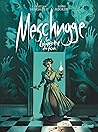
BOOKS: “Meschugge” by Benni Bodker

Meschugge: Le Labyrinthe du fouMeschugge: Le Labyrinthe du fou by Benni Bødker
My rating: 4 of 5 stars

Seller Site

This graphic novel reminded me of “The Alienist” TV series (based — itself — on a popular novel,) particularly the Sara Howard (Dakota Fanning) arc in which a young, upper-class woman becomes a detective in the (turn of the 20th century) world which sees women as too delicate to be subjected to such horrors.

While the lead in this book bears striking resemblance to Sara Howard and the settings are quite similar, the book also features major differences that make it its own unique story. First of all, Kabbalistic Judaism plays a central role in the crimes in this book. Secondly, this story creates the impression that the supernatural might be involved. I don’t believe it is unambiguously supernatural, one could explain things in a rational way as well, but “The Alienist” takes a clear rationalist approach.

I enjoyed the story, and it kept me reading. There were a couple points in the story that didn’t make sense to me, particularly an occurrence in which a character is being pursued and seems to be in a dire situation, and then suddenly is free. This mechanism is sometimes used with characters who’ve been established as being extremely capable individuals because it is as if to say, “I don’t even need to show you this person getting out of this spot because it’s not a big enough trouble to fuss about,” (it’s also often done in poor TV and movies for budget reasons,) but this character is not a master escape artist (being out of her depths is part of what creates such great tension throughout the story.)

An exciting premise and interesting characters, but with a few rough edges in plotting.

View all my reviews

BOOKS: A Double-Barreled Detective Story by Mark Twain

A Double Barrelled Detective StoryA Double Barrelled Detective Story by Mark Twain
My rating: 5 of 5 stars

Amazon.in Page

This novella is Mark Twain’s satirical jab at the whole Sherlock Holmes concept. In particular, it pokes fun at a detective who eschews everything supernatural in favor of cold rationality, but who produces results so impossible that they are themselves supernatural.

The story has two temporally disjointed parts that almost seem like independent stories until the very end when all is tied up. (Holmes only appears in the second part.) This works nicely for parody of Holmesian detective fiction as it’s an approach that was used by Sir Arthur Conan Doyle on occasion — e.g. in A Study in Scarlet. The first part tells the tale of a woman who is treated foully by Jacob Fuller, the husband she eloped with but who harbored resentment towards her father, a man Fuller believed felt wasn’t good enough for his daughter. The woman makes her son, named Archy Stillman, promise that he will track down Fuller and make the man’s life a living hell.

The second part revolves around a murder that seems to be independent of the case described above, the killing of a man named Flint Buckner. Here Sherlock Holmes, who happens to be in town visiting his nephew – Fetlock Jones, “solves” the case only to be shown to be entirely and humiliatingly wrong by Archy Stillman using only a superior sense of smell and basic observation of the facts (with no elaborated inductions.)

While I never had anything against the Sherlock Holmes stories — in fact, I enjoyed them all — I did find Twain’s satire amusing and compelling as a story. [And it’s true that Arthur Conan Doyle did regularly strain credulity — that’s what made Holmes an intriguing character.]

Well worth reading.

View all my reviews

BOOK REVIEW: The Rope Artist by Fuminori Nakamura

The Rope ArtistThe Rope Artist by Fuminori Nakamura
My rating: 5 of 5 stars

Amazon.in Page

Release Date: May 2, 2023

This is a hard-boiled detective novel centered around the mysterious death of a kinbaku artist, kinbaku is a Japanese art of tying up a person with rope, the practice sprung from the need to bind prisoners of war and criminals, but it came to be associated with the BDSM (Bondage, Domination / Submission, & Sado-Masochism) activities of kinky sex. The death of the rope artist, Kazunari Yoshikawa, is but the first of a few fatalities that are somehow connected, though the reader only learns how by following the story through to the end. There are several novel elements of the story that grab the reader’s attention, including: sex worker doppelgangers and a man with a missing finger and no known name.

I was engrossed by this novel. It captured my attention from the beginning. The psychology on display in the story is at once fascinating and bizarre. The story is told via three perspectives. The first is a junior detective, Togashi, who is a bit libido-driven and prone to ill-considered decisions. As a main character, one anticipates some of Togashi’s decisions because one knows what drives him, he’s a sucker for a pretty woman, but what the reader doesn’t know is when and how it will blow up in his face. The other main perspective is that of another detective, Hayama, who is the antithesis of Togashi. Hayama is immune to libidinous temptations and is solid as a rock where Togashi is nervous and neurotic. (The third perspective is Yoshikawa’s epistolary confession [no one has completely clean hands in this book.])

If you like crime fiction that’s a bit edgy, you may want to look into this book. That said, a warning for sensitive readers, it is sexually explicit and, while it’s not so sex-centered as to be primarily classified erotica, sex of various types occurs throughout the book.


View all my reviews

BOOK REVIEW: Punishment of a Hunter by Yulia Yakovleva

Punishment of a Hunter: A Leningrad Confidential (The Leningrad Confidential Series Book 1)Punishment of a Hunter: A Leningrad Confidential by Yulia Yakovleva
My rating: 5 of 5 stars

Amazon.in Page

This is “Seven” meets “1984” — i.e. an American-style work of crime fiction where an obsessive and deceptively savvy detective attempts to solve a string of bizarre murders but set under a totalitarian regime in which the powers that be are more concerned about quashing liberties that might bloom into insurrection than solving the odd murder. Yakovleva isn’t the first to do such a fish out of water crime novel, but she does a fine job of it. The mash-up does spin things around a bit vis-a-vis the genre’s usual conventions and mechanisms. In the typical American version, the police detective teeters on roguishness, but in the Soviet Union, “going rogue” has an entirely different meaning and set of consequences. I enjoyed the psychology that plays out in this story.

This book does demand attentive reading. There are quick and dirty transitions that can make the book read in a disjoint fashion, and – if you blink – you may miss something crucial to the story. That said, it’s not a murder mystery precisely, and so it’s not like one is engaged in a clue hunt. The story has a fascinating premise and I enjoyed reading it tremendously.


View all my reviews

BOOK REVIEW: Batman: The Complete Hush by Jeph Loeb

Batman: The Complete HushBatman: The Complete Hush by Jeph Loeb
My rating: 5 of 5 stars

Amazon.in Page

Over the course of this twelve-chapter story, Batman is pitted against much of his rogues’ gallery, but they’re puppets to a shadowy unknown, a secret villain: Hush. Batman has to do his best detective work, and still faces twist after turn in uncovering this enemy that knows him all too well, who knows all his pressure points. Batman has to battle Killer Croc, Poison Ivy, Harley Quinn, Joker, Scarecrow, and Clayface – and even [due to mind control] Superman and Catwoman, but nothing is as it seems. One might expect that a book this packed with enemies would face problems of pacing and poignancy, but the way the story is crafted (and the villains are effectively subordinated) it’s quite the opposite.

This was one of the smartest comics I’ve read. It’s a mystery that offers foreshadowing, but also false flags. There’s a sub-plot love story between Batman and Catwoman in which the relationship matures, but the question of whether one can ever really trust someone in that world remains ever in the background.

I thought this was one of the best comics I’ve read, and if you’re a Batman fan, it’s definitely a must-read.


View all my reviews

BOOK REVIEW: Follow Me Down: A Reckless Book by Ed Brubaker

Follow Me Down: A Reckless Book Vol. 5Follow Me Down: A Reckless Book Vol. 5 by Ed Brubaker
My rating: 5 of 5 stars

Amazon.in Page

Release Date: October 18, 2022

Get Speechify to make any book an audiobook

This hard-boiled crime graphic novel is a gritty PI story turned grittier revenge journey. In the manner of Hollywood films, it’s over-the-top in places, but it’s also a visceral and (at times) touching story. (Perhaps, because the pacing and drama of the love story are more realistic than the depictions of action – which isn’t a criticism. The book knows what it is, given the almost camp tone of a lead with the surname “Reckless.”) The protagonist, Ethan Reckless, is hired to track down a missing young woman. Ethan isn’t a PI but engages in “problem-solving” activities – often of a legally questionable variety. Finding the girl draws him into a greater mission.

I think pacing is what this book does so masterfully, such that even though the lead character may be a functional psychopath there’s a strong emotional resonance to the story.

This is supposedly the last volume in the “Reckless” series (volume #5,) and I love that it functions so well as a standalone story. If you enjoy crime stories, this one is worth looking into.

View all my reviews

BOOK REVIEW: Black Water Lilies by Michel Bussi; Adapted by Fred Duval

Black Water LiliesBlack Water Lilies by Fred Duval
My rating: 5 of 5 stars

Amazon.in Page

Release date: October 11, 2022

This is a murder mystery novel by Michel Bussi adapted into a graphic novel. It’s a bold move to transform it into a graphic novel because the story is so setting-dependent, that setting being the timeless tourist village of Giverny in France, a village that served as the model for many of the paintings of Monet. That said, the book worked for me. I found it engrossing from cover to cover.

A trio of police detectives arrives in Giverny to investigate the death of a man who was stabbed and subsequently bludgeoned, his corpse found in a picturesque stream. So, one has this small town where everyone knows everyone else — and the secrets and the rumors, except these outsider detectives who must learn what they can from questioning locals who are used to keeping things to themselves. The detectives aren’t even clear about whether the victim was done in by his womanizing, his attempts to acquire rare paintings, or some unknown cause. Therefore, they have to purse multiple lines of investigation at the same time.

I found the story to be well-crafted in terms of how information is concealed and revealed and how the loose-ends and anomalies are tied up in the end. The art is beautiful and green, and captures the scenic appeal of Giverny. Though I should note that I don’t read many mysteries and those who do and who have intense attention to detail might find problems that I missed altogether.

I’d highly recommend book. Those with an interest in art will find the book particularly intriguing.


View all my reviews

BOOK REVIEW: Arsene Lupin, Gentleman Thief by Maurice Leblanc

Arsene Lupin, Gentleman ThiefArsene Lupin, Gentleman Thief by Maurice Leblanc
My rating: 4 of 5 stars

Amazon.in Page

Out: July 5, 2022

This is a beautifully illustrated edition of the first collection of stories featuring the fictional burglar-extraordinaire, Arsène Lupin. While some of the nine stories reference others, they each read standalone.

Arsène Lupin is the Sherlock Holmes of crime. Like Holmes, he’s extremely intelligent, gifted in observation, with deep insight into human nature, and with a range of practical skills from hand-to-hand combat to disguise, but Lupin puts these talents to use for the purpose of theft. While one might think of Prof. Moriarty as “the Sherlock Holmes of crime,” Lupin operates by a code, eschewing senseless violence, carefully targeting his victims, and returning items he feels inappropriately taken. (Mirroring how Holmes occasionally lets a [technically] guilty party go free due to extenuating circumstances.) Besides cameo references to Holmes in multiple stories, the final story pits England’s greatest detective against France’s greatest burglar (though in a way that mostly allows each to retain an unblemished record and mutual admiration.)

I found these stories to be enjoyable to read, and generally clever, but – having been forced to make the comparison due to the repeated references to Holmes – I couldn’t help but see their inferiorty to the stories of Sir Arthur Conan Doyle. Lupin is more one-dimensional and fantastical than Holmes. In Holmes, one recognizes that one is unlikely to get extreme intelligence without some sort of countervailing cognitive challenges – e.g. Holmes is an addict who needs to fill his days with work lest he fill them with heroin, and for all his great observational skills, Holmes frequently doesn’t recognize when he’s offending others with his brusque nature and sense of superiority. Lupin can come off as an arrogant jerk (he recognizes that he’s being narcissistic, but doesn’t care) but it seems we’re supposed to conclude that he’s just that good. Lupin is a fantastical mix of super intelligence, preternatural charm, and zero weaknesses – i.e. a perfect being made for pure escapism.

The stories are enjoyable and the art is beautifully rendered, and if you can avoid comparing it to Sherlock Holes and take it as mere escapism, you’ll likely find this book pleasing.

View all my reviews

BOOK REVIEW: Murder on the Orient Express by Agatha Christie

Murder on the Orient Express (Hercule Poirot, #10)Murder on the Orient Express by Agatha Christie
My rating: 5 of 5 stars

Amazon.in Page

This is one of Agatha Christie’s most popular and beloved murder mysteries, in large part because of the atmospherics and premise of the book. It’s not just that the murder takes place on a long-distance luxury train, an exotic and exciting setting to be sure, but that said train is stopped indefinitely by a build up of snow on the tracks in the mountains. What this does is to cut the detective, Hercule Poirot [who just happens to have ended up on the train,] off from the usual resources he would have at hand to solve a case – e.g. forensic science, law enforcement officers, etc. (Though forensic science wasn’t so advanced during the early twentieth century when the story takes place.) This requires Poirot to solve the case with only his wits, encyclopedic knowledge of crimes, and skepticism to piece together a solution to this locked-door mystery.

This was the first Agatha Christie novel I’ve read, and I felt it was a fine entry point into her work. While Poirot – like Sherlock Holmes – is a recurring character that features in a number of short stories and novels, this is a completely standalone story that requires no knowledge from the nine Poirot books that precede it. Poirot has other aspects in common with Sherlock Holmes, but is also quite distinct. Both detectives know pretty much everything there is to know about investigating crimes, but Poirot is much more personable and suave. This makes the Frenchman a more likable but less interesting detective than Holmes – i.e. Poirot is unflawed but correspondingly less believably brilliant.

I enjoyed this story. It does a spectacular job of building intrigue, and that is no doubt largely responsible for the book’s great success.


View all my reviews

BOOK REVIEW: The Case-Book of Sherlock Holmes by Arthur Conan Doyle

The Case-Book of Sherlock Holmes (Wisehouse Classics Edition - With Original Illustrations)The Case-Book of Sherlock Holmes by Arthur Conan Doyle
My rating: 5 of 5 stars

Amazon.in Page

The dozen stories in this collection make up the final book in the Sherlock Holmes canon. It’s not the most beloved of the Holmes’ books, but Doyle did take some bold diversions from the usual Sherlock formula (probably in an attempt to maintain his own interest in the character.) Some of the experiments are regarded as fails. I’ll discuss the anomalous tales, with the understanding that most of the other stories follow the recipe.


In “The Adventure of the Creeping Man” Doyle ventures into what some have called bad sci-fi with a tale in the vein of “Island of Doctor Moreau.” While the farfetched nature of the story stands in contrast to the usual enlightened rationality of Holmes, to be fair, it’s hard to fault anyone living through the early decades of the twentieth century for imagining some outlandish possibilities — given the wild scientific and technological advances being seen. In this collection we see microscopes and other disruptive technologies.


In “The Adventure of the Blanched Soldier” Holmes, himself, takes up narration (i.e. Doctor Watson’s job.) In my view, besides Holmes’s occasional chiding of Watson and his writings, there didn’t seem to be as great a distinction in voice as Doyle might have hoped to achieve.


“The Adventure of the Lion’s Mane” is also narrated by Holmes, but is also anomalous for the nature of its solution. While a murder investigation is solved using Holmes’s arcane knowledge, it might leave many readers feeling that it was an anticlimactic variation on the formula.


A couple stories, “The Adventure of the Veiled Lodger” and – to a lesser extent – “The Adventure of Shoscombe Old Place” skip the usual necessity of Holmes solving the case and taking part in the explanation of discoveries, and – instead – the solution is presented entirely by individuals involved in the mystery. This harms the protagonist’s agency.


Despite the lack of love this collection receives, generally, it does still present some interesting cases and I credit Doyle both for taking chances and for showing an evolution of Holmes and his world.


View all my reviews