BOOK REVIEW: Behave by Robert Sapolsky

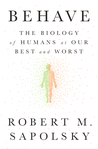
Behave: The Biology of Humans at Our Best and WorstBehave: The Biology of Humans at Our Best and Worst by Robert M. Sapolsky
My rating: 4 of 5 stars

Amazon page


This book examines the role of biology in the best and worst of human behaviors – as well as presenting factors that compete with or complement biological explanations, as the author finds relevant. Sapolsky is neuroscientist (specifically, a neuroendocrinologist) with a unique perspective as his research cuts across species – involving not only human beings but also baboons. Sapolsky investigates why humans fight, cooperate, rape and forgive by comparing and contrasting human behavior with what is seen in the animal kingdom.

The first thing a potential reader must realize is that Sapolsky dives into the weeds more so than most scientists writing for a popular audience. This will be a plus if one’s grasp of science (biology, in particular) is strong. However, if the reader hasn’t read anything on biology since high school or freshman year of college, one is likely to find the names and descriptions of hormones and neurochemicals, brain sectors, and protein processes a bit daunting. The book has three appendices that offer primers on neuroscience, endocrinology, and proteins, respectively, to get readers up to speed on the basic science. Furthermore, Sapolsky is quick to point out what can be skipped by readers who don’t want so much detail. I don’t want to give the impression the book is boring. Sapolsky uses humor and story to good effect. It’s just that he gets into Latin names and physiological minutiae at a level that most of his counterparts don’t, and that some readers will find challenging.

While not formally divided so, the seventeen chapters of the book can readily be split in two parts. The first ten chapters discuss the types of behavior that Sapolsky is taking on, and then work back from what happens immediately before a behavior (i.e. one second before) through neuronal, hormonal, and other proximal causes to the far distant causes rooted in human evolution. The first half of these chapters take one to a point in the individual’s life at most months out from the behavior under consideration. Chapters six through eight go back to the individual’s youth, exploring the role of adolescence, infancy, and fetal development. Chapters nine and ten peer back before the birth of the individual to those who contributed indirectly to the individual’s vice or virtue, including the role of the broad run of human evolution. It should be pointed out that this first part is where the aforementioned technical depth is mostly observed.

The second part of the book changes the approach by taking a more topical approach. Said topics include: us/them discrimination, hierarchy (and the acceptance / rejection thereof), morality, empathy, metaphors and symbols that become integral to good and bad behavior, the biology of free will (or the lack thereof,) and consideration of the question of whether humanity is getting more peaceful (as Steven Pinker argues in his book “The Better Angels of Our Nature” [which is arguably one of the main competitors to Sapolsky’s book, though the focus is a little different.]) This second part gets much more into the social science perspective, and isn’t as scientifically dense as the first portion of the book.

I would recommend this book to anyone interested in the good, the bad, and the ugly of human behavior. With the exception of getting a little technical in spots, it’s quite readable and interestingly organized and presented. As one can’t help get into political and cultural norms in a book on human behavior, Sapolsky betrays his personal biases here and there, but is quick to admit when there is evidence against them (or no evidence at all, either way.) I felt he maintained a reasonable scientific objectiveness, but others may feel differently.

View all my reviews

BOOK REVIEW: The Heart’s Necessities by Jane Tyson Clement

The Heart's Necessities: Life in PoetryThe Heart’s Necessities: Life in Poetry by Jane Tyson Clement
My rating: 4 of 5 stars

Amazon page


At its heart, this is a collection of the poems of Jane Tyson Clement, who lived from 1917 to 2000, but there’s more going on in the book than the poetry. As the subtitle, “A Life in Poetry,” hints, the poems range over the almost sixty-year writing career of this author and poet. Having a selection of verse that runs from Clement’s teenage years into her seventies, offers the reader an opportunity to watch the growth of this poet and to see how the dictates of life influenced the style and content of her poems. The poems cover a range of topics, including: relationships, art, and nature. I found the nature poems particularly evocative, but they are all skillfully composed and endearing. Also, it should be noted that the Prelude and commentaries were presented by a musician and songwriter, Becca Stevens, and her interest skews to the artistically oriented works. While I’ll discuss at length how these poems were spread across the life of a little known but skillful 20th century poet, I should point out that the poems don’t feel dated or obsolete. Dealing in fundamental issues of humanity, the selections have aged well.

The collection is divided into five chapters. There is a roughly chronological progression to the collection, but chronology isn’t strictly followed in favor of supporting each chapter’s theme. (Though the themes are informed by what was going on in the poet’s life during various points.) The first chapter presents poems written between 1935 and 1939 (age 18 to 22.) The second picks up in 1939 and while it ends on a poem from 1953, mostly covers a period to 1941. Chapter three includes selections from 1940 to 1953 (ages 23 to 36.) The penultimate chapter includes poems from 1954 and 1955. The last chapter is stretched out from 1955 to 1991 with much less temporal density to the poems than is seen in earlier chapters.

I said in the introductory paragraph that there was more going on than the poems. Here I’ll discuss what these ancillary additions were, ranging from what I found to be most to least beneficial to the work overall. First, there are photographs throughout the book that are warm, heavily oriented toward nautical-coastal themes, and which create a retro vibe appropriate to a book on the life of a twentieth century poet. Besides the coastal and nautical photographs, there are many that revolve around music, including photos of Stevens but also more artsy still-lifes.

Second, each chapter begins with a brief biographical statement of where Tyson Clement was at during the period in question in terms of relationships, family, religious beliefs, where she was living, and what else was occupying her time besides poetry writing. It was interesting to see what was going on with the poet as she was composing the selected works.

Finally, there are commentaries interspersed amid the poems here and there, presented as though Becca Stevens is letting the reader into her head as she ruminates on some of the poems. At this point I’ll confess my own bias. I’m not a big fan of commentaries in poetry collections. There is a famous saying by E.B. White about humor that I think equally applies to poetry: “Analyzing humor is like dissecting a frog. Few people are interested and the frog dies of it.” I’m not saying that Stevens didn’t offer insight, particularly related to her life as a musical artist. She is certainly articulate and thoughtful. Still, I think commentary detracts from the poetry reading experience by overwriting what the reader takes from a piece with the commentator’s thoughts. But, your mileage may vary.

I would recommend this work for poetry readers. The poems are evocative and the language is beautiful. The poems are readable and have aged well.

View all my reviews

BOOK REVIEW: The Unlimited Dream Company by J.G. Ballard

The Unlimited Dream CompanyThe Unlimited Dream Company by J.G. Ballard
My rating: 5 of 5 stars

Amazon page


The protagonist, Blake, crashes a stolen small aircraft into the Thames River beside the sleepy English town of Shepperton. In short order, Blake discovers that he cannot escape Shepperton and gradually he comes to realize that he can do anything else that he can imagine. This gradual discovery is like a dream becoming lucid. At first the world seems right even though there is plenty that is odd about it, as is the case when one is dreaming and oddities and anomalies don’t trigger a response as they do when one is conscious. Despite the fact that Ballard captures the surrealism of the dream state well, and even uses the word “dream” in the title, the reader is never sure what is going on exactly until the book’s conclusion. Is Blake dreaming everything? (including the plane theft?) Or, was he knocked unconscious in the crash? Or, is something supernatural going on that is dreamlike, but not a dream. There are a cast of townsfolk who sometimes behave oddly, but who seem like they have enough depth to be more than projections of Blake’s subconscious. The unfolding of the story involves the surreal nature of Shepperton becoming more obvious as the reader — little-by-little — gets a better idea of what is going on there.

Readers with a prudish streak should be aware that references to sex are ubiquitous. It’s not that there are a lot of graphic sex scenes, but – as in a dream state, the subconscious mind is at the fore and primal urges take center-stage. Blake imagines having sexual relations with everyone in the sleepy town. He doesn’t, but he speculates about it. There is also symbolic sexual reference – e.g. flowers growing from his seed. Frequent references are made to Blake being naked, but the townsfolk not realizing it. There’s generally not graphic description, this recurring device primarily serves as a means to show how the other people in the story aren’t lucid, because Blake’s nudity doesn’t set off their weird-o-meters as it would in waking consciousness.

I enjoyed this book, and, if you like surreal and trippy stories, you should give it a read.

View all my reviews

BOOK REVIEW: Food: A Very Short Introduction by John Krebs

Food: A Very Short IntroductionFood: A Very Short Introduction by John R. Krebs
My rating: 4 of 5 stars

Amazon page


This volume in the Oxford University Press AVSI series examines human eating habits. The first chapter puts the human diet in the context of evolution, reflecting upon how we got where we did in terms of food consumption. Here one gains insight into where the Paleo-diet fad is flawed, and one learns how cooking had a huge influence on human evolution.

The second chapter delves into the issue of likes and dislikes in food. We see that there are species-wide commonalities, but there are also differences both at an individual and cultural group level. e.g. Why is spice so common in the tropics and so rare in the great white north?

The third chapter looks at the ways food can do us in and what we’ve done – besides [and including] the aforementioned cooking – to reduce the threat of food gone awry. The penultimate chapter examines nutrition and how we get what we need from food.

The last chapter takes a bit of a turn, but investigates the fascinating topic of how (and whether) we will continue to feed our species. Readers will likely remember the name Malthus from either history or economics classes. He was an economist who suggested humanity was in dire straits, vis-à-vis food. Malthus noticed that population was growing geometrically while agricultural output grew arithmetically, and he reasonably noted that this was unsustainable. Of course, Malthus failed to foresee the huge technological advances from fertilizer to mechanization. However, that doesn’t make his concerns forever moot – perhaps just tardy. It remains far from clear whether the limited land space and resources can take billions more humans – especially without killing off all the other species. (Especially, if we aren’t willing to give up eating resource-intensive foods like cow in favor of less intensive one’s like grasshopper.)

The book has some graphics as well as both a “references” and a “further reading” section.

If you’re interested in food in a general sense, I’d recommend this as a great way to take in the outline of the topic.

View all my reviews

BOOK REVIEW: Hidden Depths by Robin Waterfield

Hidden Depths: The Story of HypnosisHidden Depths: The Story of Hypnosis by Robin Waterfield
My rating: 4 of 5 stars

Amazon page

“Hidden Depths” is a history of hypnotism in the Western world from speculative discussion of its use in the ancient world through its employment for self-improvement in the modern era. It’s a bold undertaking. For one thing, hypnotism as we know it today given the insight of modern science is a relatively new phenomenon. Historically, what we call hypnotism has existed variously in the domains of religion, spirituality, pseudo-science, entertainment, and outright fraud. For another thing, the hypnotic trance is a subjective experience and an individual’s susceptibility varies greatly, leaving some scholars to doubt to this day that a hypnotically-induced trance is a real thing. Added to all that, another aspect of confusion is that there are few activities that are so firmly wrapped in misconceptions in the popular mind as hypnosis. The hypnosis of fiction and film is different from the practice as it exists in the real world.

Waterfield takes on the aforementioned difficulties throughout the book. He tends to error on not calling any practice hypnosis unless the descriptions of it in historical documentation are quite explicit on a range of criteria we currently associate with hypnosis. I was ambivalent about this skew. On the one hand, I sometimes wished that Waterfield had more expertise in hypnosis (as a practitioner rather than as a historian) as it might have given him greater insight into hypnotic activities before that word (or its predecessor “mesmerism”) evolved. It seems dubious that all mentions of hypnotic activities are going to be described in a way that makes the state of consciousness readily identifiable to a lay reader, and some reading between the lines might be of benefit. On the other hand, I’ve read books by hypnotists who are what Waterfield (quite properly) calls “hypnotic imperialists” – i.e. individuals for whom any activity that involves suggestion or persuasion is hypnosis. So, it is easy to go to far, and to start calling everything hypnosis. While at times I thought Waterfield suffered from that chronic malady of historians (i.e. thinking that a thing never existed before the first mention of it in the earliest texts they can find), ultimately, I think his approach was sound in that he presented the thoughts of other authors about what activities constituted hypnosis and then offered his reasons for discounting (or not discounting) them. That seems to be a sound line to take.

The first couple chapters discuss this complex question of what hypnosis is and how we can tell it from other states of consciousness (if we can) and they also refer to the earliest mentions of activities that may (or may not) have involved hypnotically-induced trance. It is only when we get to chapter three that we get onto terra firma on the history of hypnosis. That’s when Franz Anton Mesmer enters the picture. Some credit Mesmer with inventing hypnosis. [Note: It wouldn’t come to be called “hypnosis” until a surgeon by the name of James Braid later coined that term. It did become known as “mesmerism,” reflecting Mesmer’s role in development of the technique and / or his fame. Personally, I always cringe when I hear someone in the modern world credited with “inventing” mental and physical techniques that require only a body and conscientiousness, rather than a particular state of technological advancement. It stinks of what a beloved professor of mine used to call the “outhouse fallacy” – the idea that because earlier people had no indoor plumbing that they were complete blithering idiots.] Mesmer was a study in contrasts. He thought himself a man of science and railed against the accusations of false science, but he also wore a cape and engaged in bizarre showmanship that one wouldn’t want to see if one went to one’s doctor’s office for a check-up. While it turned out that the hows and whys of Mesmer’s method are generally considered pseudo-scientific quackery (Waterfield is more diplomatic), it seems clear that the man had a gift and /or a skill for inducing trances.

There are chapters on the early use of hypnosis in both the United States and the United Kingdom, including by both doctors and religious men. There is also a discussion of the early debate about whether hypnosis presented a public safety danger. While the consensus view today is that a hypnotist can get most people to do something they wouldn’t ordinarily do, he or she can’t make them do something they don’t want to do, at the time there was a concern that nefarious hypnotists might use hypnosis to prey on women or even to make an assassin of an unwitting stooge. There is a lot of interesting legal history to be discussed involving individuals who pled non-guilty by way of mind control. The discussion of hypnotism for nefarious purposes is revisited in chapter 12, which deals not only with persuasion by advertisers but also [unsuccessful] government attempts to make Manchurian Candidates (programmed assassins who would kill on command, but have no recollection of it in a state of ordinary waking consciousness.) The idea that a hypnotist could make a subject do anything they wished is a notion that has died hard, but remains alive and well in fiction. I should point out that Waterfield addresses many of the more prominent fictitious applications of hypnosis, and – as an avid reader – I found this to be of literary interest, while as a person interested in human behavior I was intrigued by the influence of fiction on people’s decisions and behavior.

The middle of the book also has a chapter that discusses a widespread notion that hypnosis was key to unlocking super-normal skills of extra-sensory perception (ESP.) While that part of the chapter might not be of much interest to the skeptically minded reader, chapter 8 also addresses the fascinating and well documented phenomena of false memories. The book devotes a chapter (ch. 9) to Freud, another individual who went from being at the top of his field to being widely disregarded by modern psychology.

Chapter 10 elucidates the debate over whether the hypnotically-induced trance is actually an altered state of consciousness, distinct from other states. As I said, there are many psychologists today who believe that it’s just suggestible people in a state of waking consciousness. This chapter lays out the arguments on both sides. While the author argues for the considering hypnotic trance a unique state, to his credit he gives fair hearing to the opposition.

Chapters 11 through 13 consider hypnosis in the modern era as a tool used in medicine, mind-control, and self-improvement. The first and last of these applications are alive and well. Attempts to use hypnosis for mind-control seem to have been written off with the debacle of MK-Ultra. However, that chapter (ch. 12) also deals with hypnosis related to sales and persuasion. However, use of hypnosis as drug-free analgesic as well as for other medical purposes, as well as to quit smoking or stick to diets is alive and well. The final chapter is a short plea to keep interest in genuine hypnosis alive. The book has illustrations, annotations, and a bibliography.

I found this book to be interesting and thought-provoking and would recommend it to anyone wanting to learn more about hypnosis — particularly its history in the Western World.

View all my reviews

BOOK REVIEW: The Velderet by Cecilia Tan

The VelderetThe Velderet by Cecilia Tan
My rating: 4 of 5 stars

Amazon page


The dual protagonists of this novel, Merin and Kobi, live in a society in which equality is the supreme value, and in which sexual freedom is nearly complete (except where it bumps up against the aforementioned value.) For many, this would be a utopia, but the problem for Merin and Kobi is that they crave subjugation. That might seem an unusual desire, but one need not look far to see how urges develop for little apparent reason other than a person being told that such activities are prohibited or taboo. Merin is a straight female serving as legislative worker bee. Kobi is a bisexual male who bartends at a leisure club that not only serves drinks but facilitates virtual reality cyber-sex. The two are roommates (part of equality is a pairing of unattached without consideration of gender or sexual orientation), and one evening in a buzz-fed stupor Kobi admits that he would like to know what it’s like to be enslaved.

This story in which these two try to figure out how to develop an underground community of those who revel in power dynamics as part of sexual activities, plays out in a larger geo-political and historical context. It turns out that the reason that this society (i.e. the Belledonians) is so keen on equality in all activities is that they were once a slave-owning empire, and they basically killed off another race of people who they’d enslaved (i.e. the Gehrish.) So, it’s a guilt-driven policy. As the individual level actions play out, this society is in trade and security negotiations with the Kylarans, a more technologically advanced society that still practices slavery. There is a fear that the Kylarans might decide not to trade as equals but to colonize the Belldonians.

The resolution of the story brings this sadomasochism fight club story line into contact with the larger geo-political story, and that raises the stakes and presents one with varying philosophical stances on the dominant – submissive relationship. While the Belledonians had brutally oppressed the race they subjugated (i.e. the Gehrish,) the Kylarans have a much more traditional, protocol-driven, and complex approach to these power dynamic driven relations. For example, leaders must spend time as slaves before they can progress upward in the chain of command.

As I hope has been made clear, this book combines erotica with sci-fi and sex scenes are ubiquitous and kinky. Readers who are squeamish about such matter will probably want to steer clear. However, if one isn’t disturbed by sex, and sexual power play, this story is readable and intriguing. I would recommend it for those who are intrigued by stories at the nexus of science fiction and erotica.

View all my reviews

BOOK REVIEW: Stories of Your Life and Others by Ted Chiang

Stories of Your Life and OthersStories of Your Life and Others by Ted Chiang
My rating: 5 of 5 stars

Amazon page


This collection of eight smart short stories is most well-known for the eponymous story that served as the basis for the movie “Arrival.” The stories are sci-fi, but in the broadest sense of that word. “Speculative fiction” is probably a more apt descriptor. At any rate, the pieces all have nerd appeal and offer philosophical food-for-thought as well as entertaining stories.

1.) “Tower of Babylon:” The Biblical myth re-imagined. What if god didn’t sabotage construction by introducing varying languages and spreading humanity to the four winds? What if, instead, the tower did eventually reach to the heavens?

2.) “Understand:” A man who suffered severe brain damage due to a fall through thin ice, is put on an experimental medicine that begins to stimulate neurogenesis on a massive scale. The protagonist becomes preternaturally intelligent, realizes that such super-intelligence is considered a threat, but is able to keep one step ahead of the ordinary minds who pursue him. That is until he runs into another patient who had a similar accident and treatment. A thinking man’s “Lucy” (referring to the Scarlett Johansson movie), this piece considers the question of how different people would use such a gift, and whether differences could be reconciled.

3.) “Division by Zero:” If a scholar’s life was invested in an idea or way of thinking about the world, but then the scholar proved that that way was in error, might it cause a descent into madness and even a crumbling of one’s world?

4.) “Story of Your Life:” This is the story that the Amy Adams’ movie “Arrival” is based upon. The protagonist is a linguist charged with helping to communicate with a newly arrived alien species that has a very different approach to language. In the process of learning their language and interacting with them, she begins to see the world as they do – time being an illusion. Stories from her daughter’s life, which the lead character has seen in full before conception, are interspersed with the description of her work with the alien language.

5.) “Seventy-Two Letters:” This is a golem story. In this world, names have the power to animate matter and golems can be created. (A Golem is a living being created from inanimate matter; the idea comes from Jewish folklore.) The story ads a layer to the question of what would be created if humans could make a simulacrum of themselves – e.g. Frankenstein’s Monster style – and asks the reader to consider what would be the reaction to the dawn of an era in which the golems might be able to make themselves.

6.) “The Evolution of Human Science:” This is one of the shorter pieces and is also the least story-centric entry. It considers philosophical questions around the development of meta-humans.

7.) “Hell is the Absence of God:” This story is also not as story oriented as most of the others, but it is thought-provoking. It revolves around a support group for people who’ve lost significant others in tragedy and asks one to consider the various approaches to belief in the wake of tragedy.

8.) “Liking What You See: A Documentary:” This clever piece imagines a technology that prevents wearers from being able to recognized beauty (and ugliness as well.) As the subtitle suggests, it’s presented as if it were a documentary that is following a college’s debate over whether to require the student body to use said technology.

I enjoyed this collection of stories. “Understand,” “Stories of Your Life,” and “Seventy-two Letters” are gripping stories, and all eight are thought-provoking and well-written. I’d highly recommend this book for readers of short fiction, particularly speculative fiction.

View all my reviews

BOOK REVIEW: Careless Whispers: Pritish Nandy Recreates the Best of Sanskrit Love Poetry

Careless Whispers: Pritish Nandy Recreates the Best of Sanskrit Love PoetryCareless Whispers: Pritish Nandy Recreates the Best of Sanskrit Love Poetry by Pritish Nandy
My rating: 4 of 5 stars


This is the third in a series of [at least] three short, illustrated collections of love poetry. As with the others in the series, the poems are said to be based upon the work of historical poets though not – strictly speaking – translations of these poets’ work. The books were release in 1994 by Rupa & Co. with the sub-subtitle of “Classic India: Images of Love.” This book is different from the preceding volumes in a couple of ways that result in it having a different feel. First, the poems anthologize from the works of various poets rather than having a single inspiration. Second, they changed artists, and the artwork bears little resemblance to the previous volumes except with respect to being erotic in subject matter.

The book begins with a short introduction by Nandy that seeks to both introduce the reader to the anthology which serves as the basis for the poems included, as well as to explain that the poems are not translations but rather work with the gist of that poet’s verse to create new works, and why he took that approach. The source matter is said to have been originally anthologized by a Bengali Buddhist scholar named Vidyakara.

Beyond the introduction, the 50-ish pages are covered with poems and black and white line drawings. The poems are sparse free verse poems. Unlike the previous collections, it is quite clear where one poem begins and the next ends because these are attributed to different authors.

The artist who did the drawings is M. F. Husain. The drawings are not only monochrome, but are more crudely drawn and stylistic. (I’m not suggesting the artist is less skillful. They may well be purposely cruder, intending to reflect a historical artistic style rather than being modernistic like the previous volumes. The previous volumes’ art was very 1980’s.)

Despite the campiness of the titles, which are based on American pop tunes or romantic pop culture references, these books have insightful moments amid language that can sometimes drip with cliché and bland – if lustful — imagery.

If you read love poetry and run across a copy of this book, it’s worth a read.

View all my reviews

BOOK REVIEW: Unchained Melody: Pritish Nandy Rediscovers the Love Poems of Amaru

Unchained Melody: Pritish Nandy Rediscovers the Love Poems of AmaruUnchained Melody: Pritish Nandy Rediscovers the Love Poems of Amaru by Pritish Nandy
My rating: 4 of 5 stars


This is the second in a series of [at least] three short, illustrated collections of love poetry. As with the others in the series, the poems are said to be based upon the work of historical poets (in this case, Amaru) though not – strictly speaking – translations of their work. The books were release in 1994 by Rupa & Co. with the sub-subtitle of “Classic India: Images of Love.”

The book begins with a short introduction by Nandy that seeks to both introduce the reader to Amaru and to explain that the poems are not translations but rather work with the gist of that poet’s verse to create new works, and why he took that approach. Amaru was a Sixth Century poet and anthologist. As for why Nandy rewrote, rather than translating from the Sanskrit, he offers an Italian quote that says that poetry translations are like women, “the more beautiful, the more unfaithful.”

Beyond the introduction, the 50-ish pages are covered with poems and colorful drawings. The poems are sparse free verse poems, and it’s not always clear where one is meant to begin and another end. Because the topic throughout is love, sex, and romance, and the imagery thereof, the poems often flow together — whether that was intended or not is not clear. One can choose to read them as short pieces or as a longer flowing pieces.

The artist who did color drawings (the look to be colored pencil drawings) is Samir Mondal. The plates are always erotic, sometimes symbolically so, but in most cases explicitly so – involving nude figures or sensuous lips.

Despite the campiness of the titles, which are based on American pop tunes or romantic pop culture references, these books have insightful moments amid language that can sometimes drip with cliche and bland – if lustful — imagery.

If you read love poetry and run across a copy of this book, it’s worth a read.

View all my reviews

BOOK REVIEW: Untamed Heart: Pritish Nandy Rediscovers the Love Poems of Bhartrhari

Untamed Heart: Pritish Nandy Rediscovers the Love Poems of BhartrhariUntamed Heart: Pritish Nandy Rediscovers the Love Poems of Bhartrhari by Pritish Nandy
My rating: 4 of 5 stars


This is the first in a series of [at least] three short, illustrated collections of love poetry. As with the others in the series, the poems are said to be based upon the work of historical poets (in this case, Bhartrhari) though not – strictly speaking – translations of their work. The books were release in 1994 by Rupa & Co. with the sub-subtitle of “Classic India: Images of Love.”

The book begins with a short introduction by Nandy that seeks to both introduce the reader to Bhartrhari and to explain that the poems are not translations but rather work with the gist of that poet’s verse to create new works, and why he took that approach.

Beyond the introduction, the 50-ish pages are covered with poems and colorful drawings. The poems are sparse free verse poems, and it’s not always clear where one is meant to begin and another end. Because the topic throughout is love, sex, and romance, and the imagery thereof, the poems often flow together — whether that was intended or not is not clear.

The artist who did color drawings (the look to be colored pencil drawings) is Samir Mondal. The plates are always erotic, sometimes symbolically so, but in most cases explicitly so – involving nude figures or sensuous lips.

Despite the campiness of the titles, which are based on American pop tunes (except this one which appears to be taken from an American romantic comedy film), these books have insightful moments amid language that can sometimes drip with cliche and bland – if lustful — imagery.

If you read love poetry and run across a copy of this book, it’s worth a read.

View all my reviews