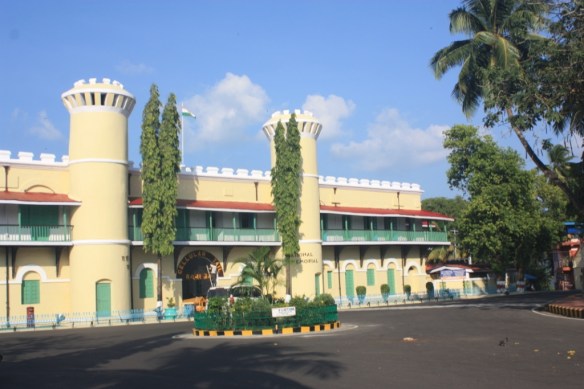
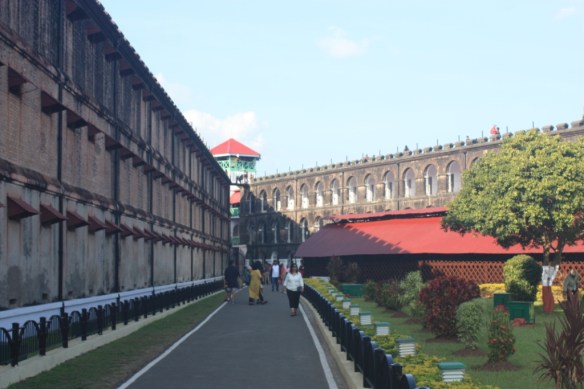
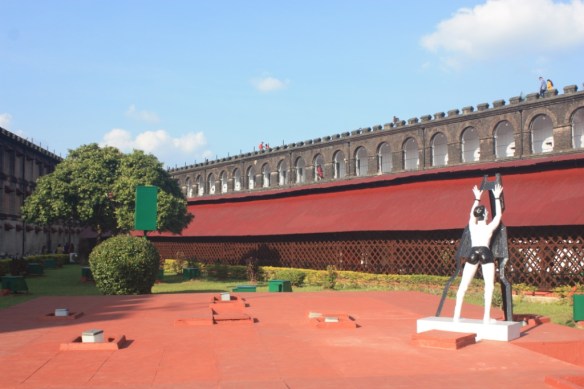
Taken in December of 2018 on Neil Island



 Here Is Real Magic: A Magician’s Search for Wonder in the Modern World by Nate Staniforth
My rating: 4 of 5 stars
When stage magician, Nate Staniforth, becomes disillusioned with traveling around America performing magic tricks on college campuses — and the distinct lack of wonder that it entails, he packs his bags and flies to India to explore the centuries old magic traditions of the subcontinent. Part memoir and part travelogue, the first part explores how Staniforth got into magic and his struggle to achieve everything he always wanted, i.e. the ability to make a living performing magic – a desire far more would-be magicians have than the market will support. However, he finds a disjoint between the feeling of wonder and surprise that made him love magic and what he witnesses in the audience night after night – which include a heaping mix of indifference, skepticism, hostility, and even the occasional pious fear that he is dabbling in dark arts.
In India, he finds a mix of some of the same but also some very different perspectives on magic. One the one hand, he learns that magic tricks aren’t just a good way to break the ice with strangers, but also a means to bridge cultural divides. Sleight of hand doesn’t require perfect communication to build bonds between people. As he travels from Kolkata to Varanasi to Rishikesh to Hardiwar to Delhi to Jodhpur, he shares magic tricks with young and old alike, as well as getting to witness some of India’s magic. The highlight of the trip is when he meets with a family of street magicians from Shadipur Depot slum in Delhi, and can at last exchange ideas and learn about their long lineage as illusionists.
However, Staniforth also finds many Indians who are hostile toward the practice of illusions and magic tricks. To understand this hostility, one must know that historically “godmen” who used illusion and sleight of hand to convince individuals of their divinity were more common than those who practiced it as entertainers. This resulted in a couple different types of hostile witness to magic in India. On the one hand, there is the scientifically-minded individual who is distraught by the image of India as a land of superstition and naively pious followers. (A war on superstition in India probably made it harder to research this book because doing street magic is largely prohibited because of the history of duping people for personal gain.) On the other hand, there are those who are ardent believers who dislike magicians who do magic tricks because it contributes to a general skepticism about their gurus — who such individuals believe can actually do magic. It should be said that variations of those two types of individual could be found almost anywhere, including his home nation of America. What is more uniquely Indian is the individual who fits into a third category of simultaneously believing both of the aforementioned criticisms. That is, said individual believes that any illusion someone like Staniforth performs can be scientifically explained and is merely a deceit against the gullible, but at the same time this person believes that there are spiritual masters who can do “real magic.”
The title, “Here Is Real Magic,” could be received in many ways. However, taking it literally, as though the author believes that there are those in India with supernatural powers, isn’t consistent with the book’s message. In one sense, the title is meant to be controversial, but Staniforth is also indicating that he rediscovered wonder in India — not through the supernatural, but through surrender to the experiences he had there.
As an American who has lived in India for many years now, I found this book to be fascinating in places. I believe that it’s useful both as a call to rediscover the wonder that we usually lose somewhere before adulthood, as well as a primer into the similarities and differences between the Indian and Western mindsets on magic in the modern world. I’d recommend this book, particularly for anyone who has interest in magic.
 The Master and Margarita by Mikhail Bulgakov
My rating: 5 of 5 stars
The Devil comes to Moscow with his entourage of henchmen – a tram-riding cat, a fallen angel turned assassin, an ex-choirmaster, and a vampiress – and chaos and malevolence ensue. While most of the story unfolds in early 20th century Soviet Union, a few chapters focus on the story of the crucifixion as seen from the perspective of Pontius Pilate. We learn well into the book that Pontius Pilate is the subject of a novel written by the character who calls himself “the Master.” A love story between he and Margarita is central to the story, though mostly in the latter half of the book.
While Bulgakov’s book is whimsical and humorous in places, its theme is demons and supernatural beings acting in a rational, modern world that has abandoned belief in the supernatural. The Devil (who goes by the name Woland, a variation on a Germanic word for demon) and his troupe perform a black magic show that the audience assumes to be illusionism though it produces far more disturbing effects than a David Copperfield show. The story is a dark carnival tale (think Bradbury’s “Something Wicked This Way Comes” but not so much horror as a macabre comedy. One will also note that the relationship between God and the Devil is more on the order of Pratchett and Gaiman’s “Good Omens” than the Biblical rendition.)
While the book is pure fantasy in its story, it presents a thinly veiled commentary on Soviet life. Part of the reason why the mischief of Woland and his lackeys goes unthwarted is because it takes place in a world where the government “disappears” people on a regular basis and in which the quashing of religion means that even seeing doesn’t result in believing. Anyone witnessing a supernatural act is written off as drunk, insane or – at best – easily duped.
Although, as I think about this, it might not be so much a contrasting and ancient and modern life as it appears. After all, Pontius Pilate is at the fore of the historical part of the novel. Pilate, who viewed Jesus as a harmless lunatic, was troubled by the decision to execute him when the violent figure of Barabbas was selected instead for release based on a Passover norm. (Hence, Pilate’s famously “washing his hands” to the whole business of Jesus’s execution.) In this light, it may be more of a general commentary on humanity’s simultaneous need to believe in, and inability to believe in, the supernatural.
This novel is well-written, engaging, and thought-provoking, and I’d recommend it for all readers.
 Station Eleven by Emily St. John Mandel
My rating: 5 of 5 stars
This is a work of dystopian fiction set in post-pandemic America. It’s the Zombie apocalypse sans Zombies, but with something additional: arts and entertainment. The fact that, not only is there an arts and entertainment industry but that it’s central to the story, is critical to Mandel’s ability to set her story apart amid the sea of post-apocalyptic wasteland stories that have been gracing the shelves of bookstores in recent years. Other branches of dystopian fiction have entertainers (e.g. “Hunger Games”) – often in a morbid form of gladiatorial combat – but one of the ways that post-apocalyptic wasteland stories show how dismal and colorless life has become is to eliminate all mentions of art or entertainment – presuming that in survival mode people “put away childish things.” Mandel, on the other hand, places members of a traveling symphony that roams about performing music and Shakespearean plays among her core characters.
The title, Station Eleven, is the name of a sci-fi comic book. I won’t get into specifics as it’s involved in the resolution of the story in a way that I don’t want to spoil. However, I will say that emphasizing what seems like a minor element of the story (through most of the book, anyway) is interesting in that it’s another way in which the author shines a light on how art – highbrow or low – will inevitably shape human culture, behavior, and mythology.
Mandel also shows how, even in a world in which the majority of the species have been killed off, there will always be connections in the web of human interaction. Through out the book flashbacks to pre-apocalyptic happenings are offered, mostly around an actor who – if not patient zero – was one of the early casualties of the pandemic. The actor was married multiple times and sired one child that is known about, and these characters – as well as friends and acquaintances — are seen in pre- and / or post-apocalyptic settings. And this allows the reader to imagine a web of humanity surviving massive fatalities. Often in this sub-genre, at most a dyad (e.g. Cormac McCarthy’s “The Road”) survives, and that existence amid strangers is part of how the wasteland is shown.
This is a highly readable book, and well worth the read. Even if one is prone to think, “Ugh, another post-apocalyptic wasteland novel,” one will find something a bit different in its supposition that art is necessary and inevitable for humanity and that there aren’t enough degrees of separation to kill off all connections without killing off the species.

misshapen lumps of dead coral rise from the sea-shore
miniatures of the karst monolithic islands of coastal southeast asia
a tiny archipelago facing constant nightmare tsunami

Taken in December of 2014 in Budapest
there’s a certain madness
running through this world
times of tiding gladness
lightning bolts are hurled
discombobulation
in the soul of state
riding tides of nation
as we’re dodging fate
singing songs of nowhere
drumming beats of now
stumbling down the upstairs
counting whys and hows
subcutaneous drum beat
sinking to the bone
sitting in the fire seat
deflecting all the stones
so many without sin
or so they seem to feel
tossing stones on whim
sharpening their steel

Taken in December of 2014 in Naiharn, Phuket

Taken in May of 2018 in Bhaktapur, Nepal