Unknown's avatar

About B Gourley

Bernie Gourley is a writer living in Bangalore, India. His poetry collection, Poems of the Introverted Yogi is now available on Amazon. He teaches yoga, with a specialization in pranayama, and holds a RYT500 certification. For most of his adult life, he practiced martial arts, including: Kobudo, Muay Thai, Kalaripayattu, and Taiji. He is a world traveler, having visited more than 40 countries around the globe.

BOOK REVIEW: The Sign of the Four by Arthur Conan Doyle

The Sign of the Four (Sherlock Holmes, #2)The Sign of the Four by Arthur Conan Doyle
My rating: 5 of 5 stars

Amazon.in Page

This novel is the second of the books in the Sherlock Holmes canon. It begins with a client (Miss Morstan) coming to see Holmes to acquire his advice as to whether she should make a rendezvous to which she has been summoned by mysterious means, Morstan being a beautiful young lady who is weary of showing up to a random public location, having been told to not involve the police. We learn some intriguing facts from the conversation, such as that she began receiving a pearl from an anonymous source each year and that her father (Capt. Morstan) has passed away.

With Sherlock and Watson in tow, Miss Morstan does attend the rendezvous, and we learn that the meeting is with the son (Thaddeus Sholto) of a man with whom her father served in the military at Port Blair in the Andaman Isles (Maj. Sholto.) The mystery of the pearls is cleared up as we discover that Maj. Sholto cheated Capt. Morstan out of his share of a treasure that the Major came into possession of while stationed in India, and his two sons (particularly Thaddeus) feel the need to make amends to Capt. Morstan’s heir, but would like to do so without dragging the family name through the muck or creating legal hassles.

It seems everything is wrapped up with a nice bow, when Thaddeus takes Miss Morstan, Holmes, and Watson to see his (more reluctant to be fair to Morstan) brother Bartholomew, who is the one in actual possession of the treasure. However, when they find Bartholomew dead and the treasure gone, the true mystery begins. The balance of the book involves a chase to find the missing treasure, the men who stole it, and to unravel the mysterious circumstances behind the treasure. The final chapter tells the elaborate backstory of the treasure, going back to India and to the titular four men, the four whose names were found at the scene of Bartholomew’s murder and who previously possessed it — one of whom serves as the storyteller. Along the way, a mangy bloodhound, the Baker Street Irregulars (street urchins employed by Holmes,) and – of course – the brilliant reasoning of Sherlock Holmes are used to solve the case.

Arthur Conan Doyle created one of the most intriguing fictional characters ever with Holmes. If he were just a brilliant man with supreme skills of observation and reasoning, he’d be no more interesting, and have no greater longevity, than any of the many other characters. But in Sherlock we see that brilliance always has a cost. Holmes is also an addict, is troubled by insomnia, and is – in some ways – socially dysfunctional. (e.g. When Watson develops a relationship with Miss Morstan, Holmes confesses that he can’t grasp the value of marriage / long-term intimate relationships.)

What the author does with character, he also does with setting by bringing into the story (through backstory) locales that are exotic and intriguing – e.g. Port Blair. Even by today’s standards there are always little tidbits of the exotic drawn into the story, even though most of the Holmes’ stories — this one included — don’t venture far from London.

If you enjoy crime and detection fiction, this book is a must. It’s highly readable and offers a compelling story. In terms of the Holmes canon, I wouldn’t say it’s particularly better or worse than others, but I don’t find there is a huge variation in quality among these novels and stories. It is one of the better-known titles (except that some call it “The Sign of Four” and others “The Sign of the Four” – the latter being the original title as far as I can discern.)

View all my reviews

DAILY PHOTO: Tree & Kalyana Mahal, Gingee Fort

Taken in October of 2019 at Gingee Fort

BOOK REVIEW: Van Helsing vs. Dracula’s Daughter

Van Helsing vs. Dracula's DaughterVan Helsing vs. Dracula’s Daughter by Raven Gregory
My rating: 3 of 5 stars

Amazon.in Page

Out: July 13, 2021

This comic book imagines the daughter of the Van Helsing character (from Bram Stoker’s) pitted against the daughter of Dracula in what appears to be more-or-less the present day. It is action-packed, if juvenile and prone to rely on hackneyed dialogue and story points. To clarify, it’s a small team of scantily clad supermodel vampire hunters taking on a scantily clad supermodel Vampiress and her army of expendables. I liked it in the way that one likes movies that one picked on Netflix while mentally exhausted and uninterested in anything mentally or emotionally draining, but rather just some vapid entertainment.

It’s part of a serialized universe of stories, and so, while it can be understood as a standalone story, it is not optimally organized to be read in a standalone fashion. It sort of begins with some action that the [standalone] reader has no context for, and which will not be circled back to in the way a story opening in media res typically would. Put in another way, in the second half of the story, I had to consciously reflect back and try to piece together what the opening material had to do with the overall story being told. I suspect (but cannot confirm) that if one binge read the whole collection, it would probably make more sense.

Besides the ridiculously untactical (virtually painted on) outfits, there is some reverse villain monologuing – which is to say the hero interjects into the action to explain her plot to snatch victory from defeat. Granted that victory would be completely deus ex machina, i.e. out of the blue, otherwise, but that’s not really a redeeming point. [The most (I presume) unintentionally hilarious line involves Van Helsing telling Dracula’s Daughter that VH can’t blame the vampire progeny for missing VH’s super-stealth colleague as the reader sees a pictures of one of the aforementioned supermodels with her skirt slit up two inches above her pelvic crest operating a spade with one leg bare from toes to waist, standing as models do to accentuate the shapeliness of the calf. It’s the most conspicuous ninja operation one could possibly imagine.

As I say, I found this an okay story for a mindless read, but I wouldn’t have too high of hopes for it beyond that.


View all my reviews

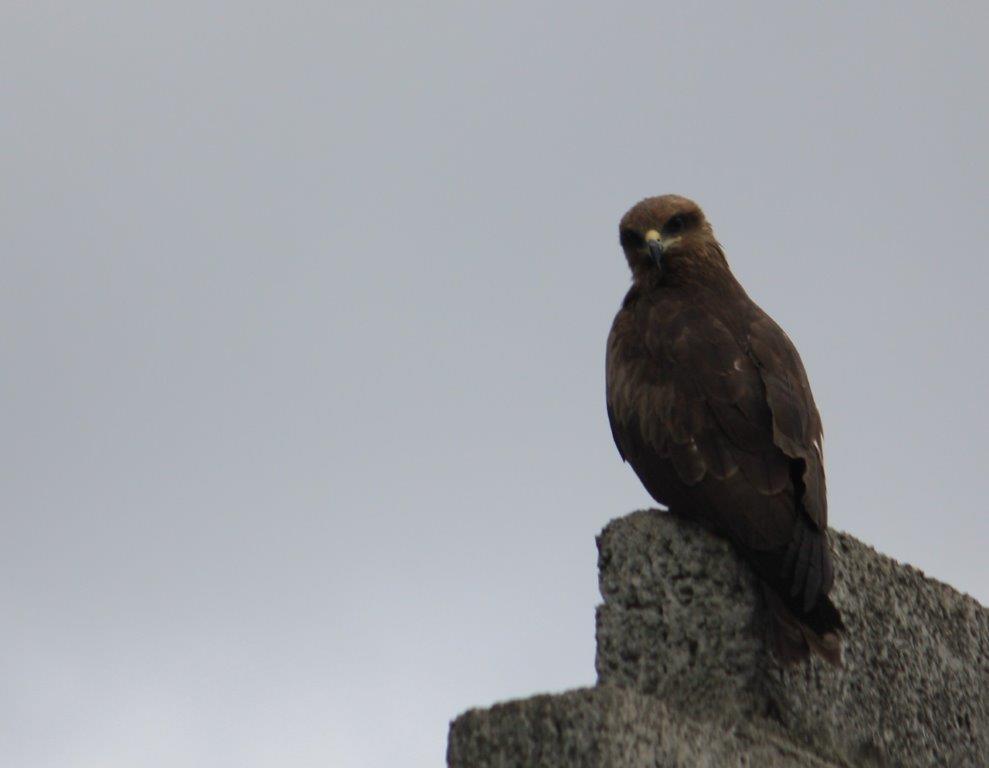
Hawk Kyōka

I watch the hawk
as it sits, watching me
It turns away first,
knowing I can't reach it
nor see it as it sees me

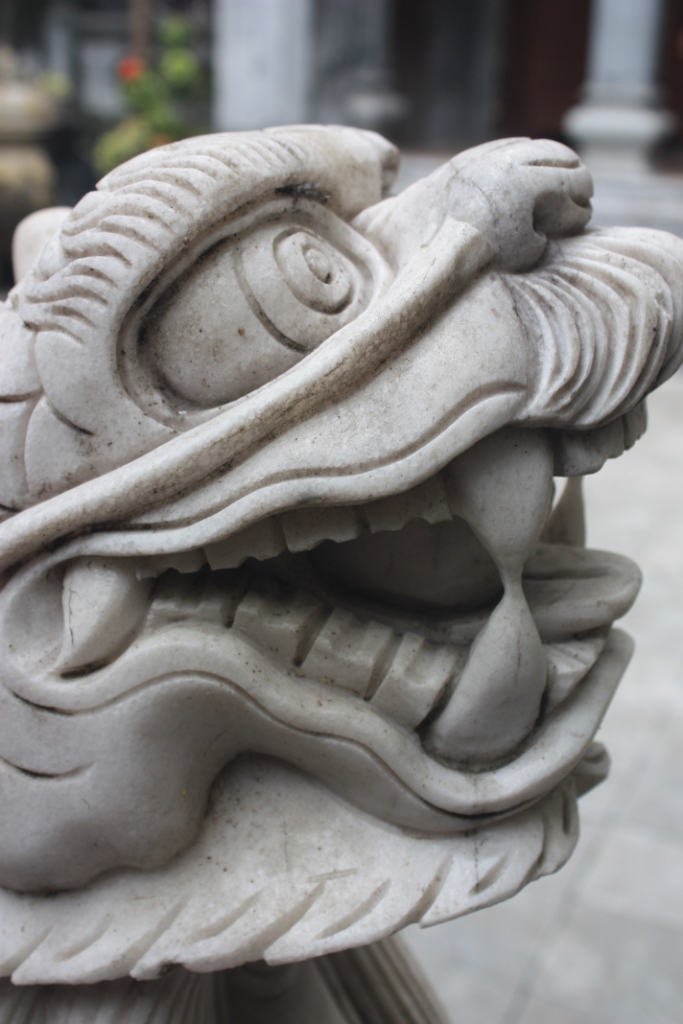
DAILY PHOTO: Foo Dog Closeup [in Profile]

Taken in Hanoi in December of 2015

POEM: Fairy Tale Wisdom

We watch the naked emperor
like nothing is amiss,
and recoil upon sight of frogs
wise of what lies in a kiss.

We trust the familiar too much,
and the odd too little.
We love a beauty even when 
she's selfish or she's brittle.

There is a Jack for each giant,
and many clever cats,
and, sometimes, we cheat the man who
takes out all our rats.

The other foot will always fall,
even when blinded by hope.
Sometimes it pays to play dimwit,
but not be an outright dope.

Each tale tells us of ways to be
a better, kinder soul
in a world filled with all manner
of monster, fiend, and troll. 

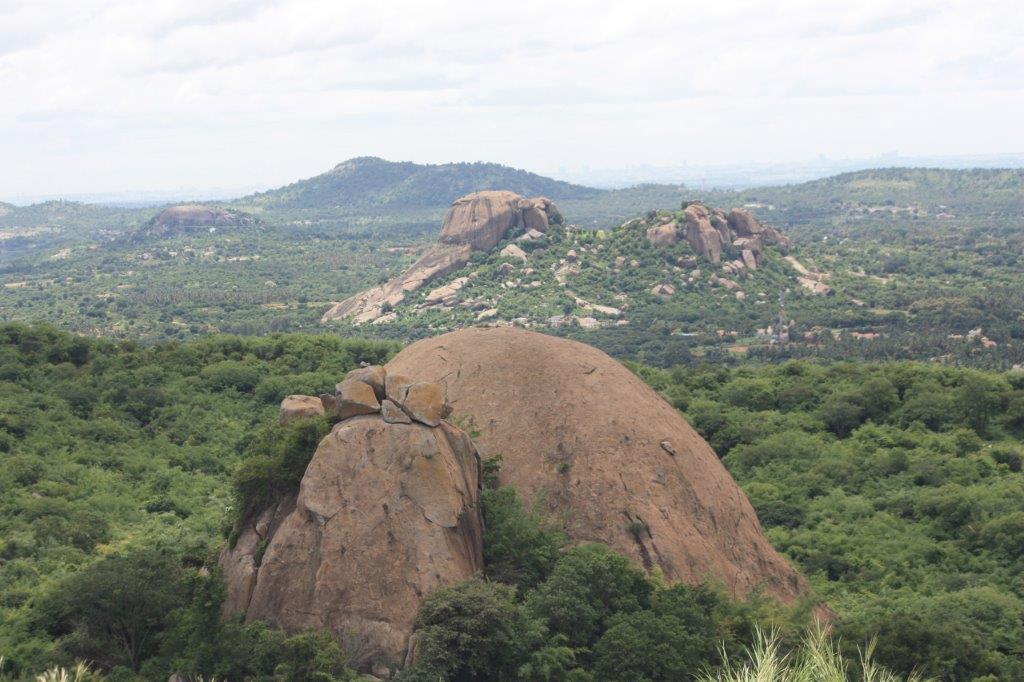
POEM: Below the Stone Dome

The stone dome
bubbled from the jungle
stands stern
like a knob of nothing.

The green growth
that girds that whole hump
is living, like 
some hallowed habitat --

filled full 
of all forms of flora,
with big bugs, and
 all the creepy creatures.   

DAILY PHOTO: Hanging Hibiscus

Taken in Coorg in May of 2017

POEM: Knee-Jerk Speciesism

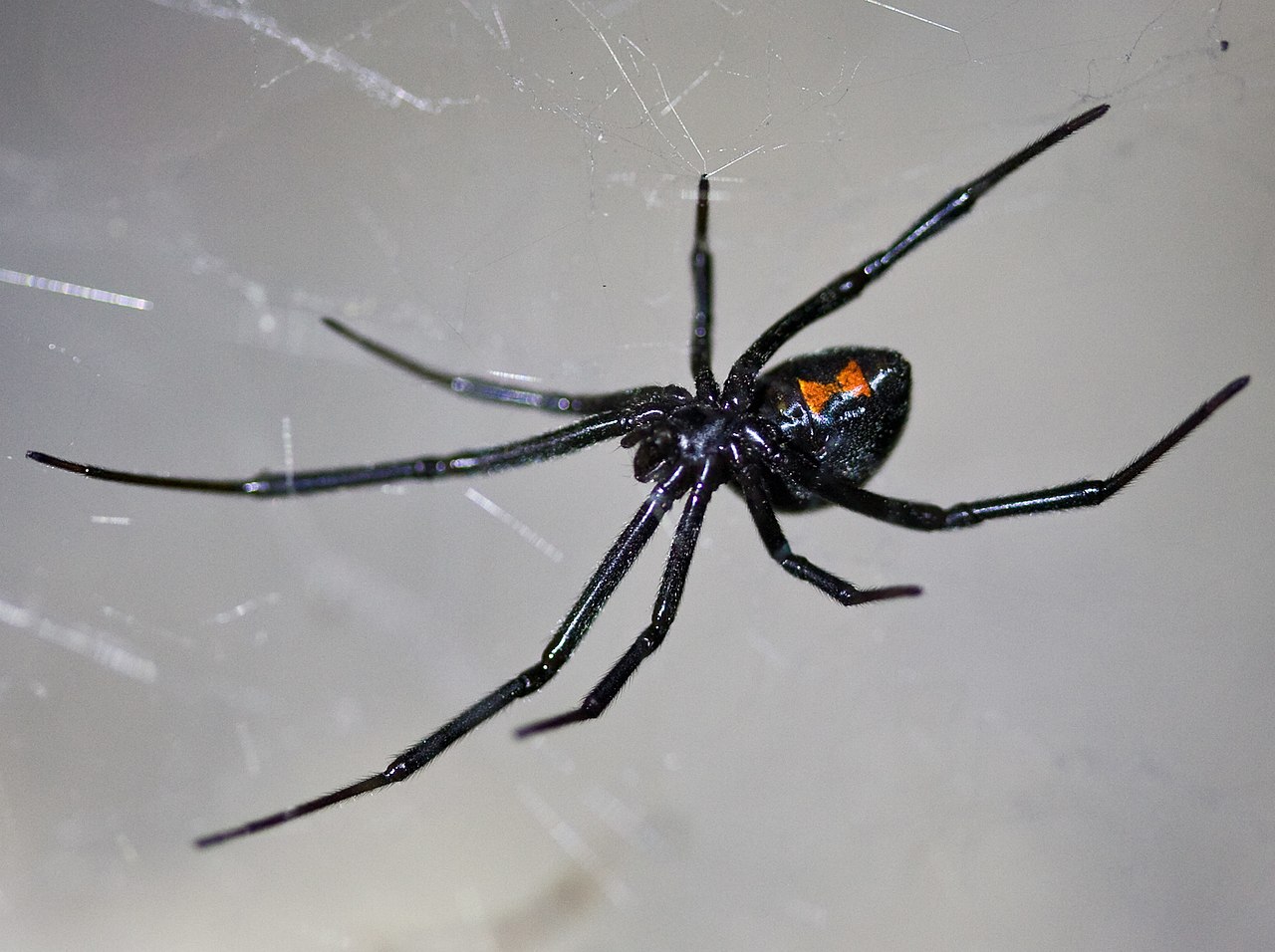
Photo Source: Ken-ichi Ueda – 
https://www.inaturalist.org/photos/121 [via Wikipedia]
I glimpsed the red hourglass,
vibrating in a stone wall --
a Black Widow spider,
bouncing on a thin web
spun within the void
of an absent rock --
that gap forming the
 spider's recessed hide.

And instead of being happy
that the spider 
had found a fine shelter,
I worried that a child would
stick a careless mitt 
deep into that wall hole,
and be bitten on the hand.

In retrospect,
this seems so unfair 
to the spider.

BOOK REVIEW: Dreaming Eagles by Garth Ennis

Dreaming EaglesDreaming Eagles by Garth Ennis
My rating: 5 of 5 stars

Amazon.in Page

New Edition Out: June 1, 2021

This graphic novel by the author of “The Boys” and “Preacher,” tells a story based on the experiences of the Tuskegee Airmen, and does so as a story within a story. The framing story is set in 1960’s America and finds a World War II veteran (a pilot of the Tuskegee Airmen) trying to talk his teenaged son down from getting too entangled in the Civil Rights movement — for reasons that are only revealed as he completes the telling of his experiences at war. Through flashbacks, the protagonist depicts not only the thrilling exploits of air-to-air combat over Europe and the visceral tragedies that occur when hot lead meets with aluminum high above the world, but it also shows the unique tribulations experienced by these particular military men – such as “leaders” who wanted to see them fail and widespread discrimination.

The story-in-story approach is an excellent one because it allows for a character arc in which the protagonist grows. Without getting into spoiling details, as the protagonist revisits his story, he comes away with a new and changed perspective (which is always a valuable feature in storytelling.) The frame also breaks up the history and helps maintain reader attentiveness by showing the influence the story has on the attentive son. (Young men not being famous for being interested in the life stories of their parents.) I don’t mean to suggest that the war story is not interesting. It’s full of action, heroism, and the tension of interpersonal conflict. However, for those who aren’t history buffs and are acclimated to Ennis’s more popular fare [i.e. full of superheroes and random acts of violence and titillation,] the story may feel a bit flat only by virtue of the fact that it is constrained by actual historical events.

I found the art to be well-crafted. The chaos of air combat is conveyed without being so chaotic that one can’t tell what is happening, and the graphics offer a great sense of setting and era.

This volume is definitely worth giving a read. It tells a compelling story of the combative exploits and the political / social travails of these groundbreaking and heroic pilots, while holding a mirror to the rank societal biases of the era.


View all my reviews