5 Lessons One Learns Teaching Kids Yoga

During the last half of April, I taught a kid’s camp at a1000 yoga‘s Kormangala studio. Below are some ideas about my experience.

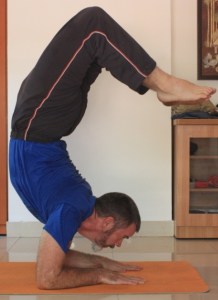
Playful Scorpion

The Playful Scorpion

1.) Kids can’t down shift from 4th to 1st like adults. This was once a major point of frustration for me in teaching kids. When you ask kids to settle down after an activity they were really excited about, there’ll be a lag. There’s a temptation to see this unresponsiveness as a lack of respect, but it probably isn’t. (Which isn’t to say that the kiddies never attempt to test the waters.) The fact is that adults don’t get so amped up, and so it’s not so difficult for them settle down. Instead of getting frustrated with the kids, maybe one should feel sorry for the adults.


2.) Kids need a more advanced class, but not because they’re more advanced. Attention to detail isn’t a child’s strong suit. They have difficulty focusing on the finer points of alignment and breath–unless they’ve found a fun challenge in the pose. During the camp, we played with vrschikasana (scorpion pose) during the first few days. That’s not something I would do with adults. Kids get in the zone and, therefore, they don’t tense up and injure themselves so easily.


3.) Kids are natural flow hackers. If you don’t know what “flow” is, I’d recommend Mihaly Csikszentmihalyi’s book Flow, Steven Kotler’s The Rise of Superman, or Marer / Buzady / Vecsey’s Missing Link Discovered. (Depending upon your point of interest: psychology, athletics, or business, respectively.)  However, in a nutshell, flow is the state of mind in which we perform at our best because of a combination of concentration and the quieting of one’s inner critic. One of the keys to catching the flow is finding a challenge of the appropriate level. The challenge should be just beyond one’s current capability. If it’s too easy, one gets bored. If it’s too difficult, one gets frustrated. Children instinctively seek out the Goldilocks’s zone in challenges.

I noticed this when we were playing a game in which each kid had to cross the floor walking only on wooden yoga blocks. This helps with balance, which tends to be a weakness among kids. Every time all the kids have finished crossing, a block or two is removed. So, the game gets harder the longer it goes on. The position of the remaining blocks can be adjusted, and, after a while, the kids wanted to adjust the blocks themselves because I was making it too easy. In other words, they wanted to make gaps that they would have to stretch to their utmost to succeed.


4.) Don’t assume that kids experience fear the same way you do. I suspect there may be some readers who will say, “that guy had kids doing scorpion on their second day of yoga, he must be a complete lunatic.” But, adults superimpose their fears on children. Kids’ excitement more easily overcomes their anxieties. In my last post on yoga, I referred to a FaceBook meme that I saw recently that said, “A child who falls down 50 times learning to walk, never says, ‘I don’t think this is for me.'” Somewhere along the line, people become mortified of failure or the risk of a bruise, but it’s not in childhood.

Have you ever seen a child fall down and start to get up–everything apparently fine–until he or she sees the gasp from mom (or another adult,) and then the child bursts into tears? If you’re the adult in the aforementioned scenario, let me suggest that teaching kids physical activities isn’t yet for you–at least not until you can manage your own anxiety a bit better. That’s not to say that there’s anything wrong with such people, but a teacher’s job is to show the child a world of possibilities and not to infect them with his or her own limitations.


5.) Finding the balance between inner child and outer adult can be a challenge, but is necessary. My working theory is that kids don’t trust an adult whose inner child doesn’t show through at least a little bit. Kid’s yoga is typically taught differently from the adult version. When teaching adults, one doesn’t practice alongside the students, but that’s the norm in teaching kids. (Kids can mimic better than they can follow complex verbal instructions.) The kids enjoy having the teacher participate, but one must also ensure that it remains clear who is the teacher. Otherwise, kids may be confused. When you’ve been participating in practice, playing games, and letting the children have some say in what they do (which is also a sound practice to some degree) they may gradually start to forget about your role as authority figure.

What RYT300 Taught Me About Fear

IMG_2752

I recently completed the RYT300 course at Amrutha Bindu Yoga to obtain my RYT500 yoga teacher certification. (i.e. The 200 hour course–which I completed a couple years ago–plus the 300 hour course are the primary requirements for the 500 hour certification.) The essay below is about one of the key lessons I learned in this phase of training.


I walked through the streets of Bengaluru barefoot and with not so much as a 5 rupee coin in my pocket. [If your response to that is “big whoop,” you probably live somewhere like Singapore, Helsinki, Kobe, or Calgary where the streets are immaculate and the rats aren’t so bold. If you’re familiar with what goes on in and near the streets in India, you may be wondering what the hell is wrong with me.]  It was an unconventional teaching tactic to be sure, but it ranks among the most valuable lessons of the training—surpassing no small revelations about postural alignment, pranayama methods, bandha technique, physiology, and yogic philosophy. It was even up there with the experience of advanced shatkarma (cleansing practices) that were completely new to me.


What’s the lesson?  If you’re going to teach yoga–particularly at the intermediate / advanced level that RYT500 is intended to prepare you for–you need to work on not being ruled by fear. That isn’t to say one must be fearless. We imagine fearlessness to equate to courageousness, but courage is action under fear. Neuroscience tells us what a fearless person is like. We know from individuals who’ve had the parts of their brains damaged that are responsible for the emotion—they are paralyzed by indecision. Our emotions provide a basis for choosing–at least as a tie-breaker when no clearly superior path exists. We need our fear, just like our other emotions, but if you can’t move forward because of it you may have a hard time keeping learning.


Not being ruled by fear isn’t just—or primarily—about being able to keep practicing advanced techniques until you can get a grasp on them.  Yes, mastering a handstand requires a fair amount of falling down (hopefully, in a controlled fashion), and that’s a lot of potential for anxiety, but there’s more at stake.  What precisely? One might start, as many do, with what Patanjali has to say on the subject, and one can start from square one. “Chitta Vrtta Nirodhah.” (Quieting the fluctuations of the mind.) Many of the fluctuations of the mind result from anxieties and our obsession with solving them. Our brains are wired to try to anticipate worst case scenarios so we can develop ready-made solutions for them. This can result in excessive pessimism, extended stress, and all the problems that go along with that stress.

IMG_2642

There’s a popular saying that goes, “money is the root of all evil.” But, I think it’s wrong. Fear is at the heart of all evil—not to mention a fair amount of run-of-the-mill pettiness.


So what is the path to anxiety management? Start small, and dispassionately observe your discomfort. Don’t try to squelch the emotion, just watch it while trying to avoid putting good or bad labels on it. Of course, sources of anxiety are personal. As far as prescriptive yoga practices, that depends upon one’s personal anxieties. For some inversions might do the trick, for others extreme back bends, for some external breath retention, for others it may be balancing. Then, of course, there are the advanced shatkarma practices I mentioned earlier–such as vaman dhauti (cleansing by vomiting) or poorna shankhaprakshalana (i.e. clearing out one’s digestive tract via massive ingestion of salt water.)


I recently finished teaching a Kid’s Camp (a post about that to come.) At the beginning of the camp, I was telling someone that the kids were fearless, but what I came to discover was that kids just allow their enthusiasm to swamp their anxieties. I had seven-year-olds doing pinchamayurasana (forearm stand) and vrschikasana (scorpion) within the first few days. That would be a hard sell for adults. [I don’t think I’ve ever taught those postures to adults.]  It’s not just that kids are bendy, they’re also ready to get up after they fall down. (And since they’re not stressed about the possibility of falling they don’t tense up and get badly injured.) Someone posted a great meme on Facebook recently. It said, “A child who falls down 50 times learning to walk, doesn’t go, ‘I don’t think this is for me.’”

BOOK REVIEW: The Yoga of Max’s Discontent by Karan Bajaj

The Yoga of Max's DiscontentThe Yoga of Max’s Discontent by Karan Bajaj
My rating: 4 of 5 stars

Amazon page

Max is a making a good living in New York City, but feels an inexplicable void that leads him to give it all up to travel to India in search of wisdom. This novel is a hero’s journey in which the quest isn’t for adventure (not in the usual sense) but for insight into his mind and a path to bliss. Along the way he finds a teacher and is assisted by others, but must ultimately find his own path. As is appropriate to such a quest, he faces hurdles within and without and it’s not always clear whether he will find what he’s searching for—or even whether it exists.

This book kept me reading. It had humor (particularly in the first part) and maintained awareness that it was a novel throughout. What I mean by the latter statement is that there is temptation for books that deal in spirituality to devolve into a muddle between story and self-help book. However, I think the author avoids that error and keeps advancing the story in a readable fashion. The descriptions of yogic practices don’t bog down the story. Those experienced with yoga will breeze right through said descriptions and know what’s happening, and those without such knowledge won’t lose much by grazing over such segments.

The book consists of 38 chapters divided into three parts. The first part covers the period during which Max moves from the US to India and seeks out a teacher. The second part describes his time studying yoga in a south Indian ashram. The final part is the period after which he’s achieved enlightenment, which he spends in the Himalayas.

I found the first two parts to the most interesting and enjoyable. The first part has all the humor and emotional turmoil one would expect from a well-developed and relatable human character. The descriptions of an austere life amid the harsh landscape of a south Indian ashram that comprise the second part make for a visceral read. Where the third part falls flat for me is that supernatural abilities are introduced, and that makes it more difficult to care about Max anymore. It’s a problem inherent in writing this type of story. While Max becomes wiser in the second section, that part doesn’t fall so flat because the life he’s living is so challenging. It’s certainly not that Max’s life is easy when he moves to the Himalayas, but by then he can speak languages he never learned and create sparks with his mind and as far as the reader knows he may be able to leap tall buildings in a single bound and other superman type magic. I suspect the author was aware of the risk of this because he backs away from having Max start a fire with his mind early in the third part and the last part unfolds much more quickly.

I’d recommend this book for anyone who’s interested in a story about personal transformation. Those who’ve spent time in India will find much that resonates and those who are considering (or curious about) such a quest will glean many insights from this book.

View all my reviews

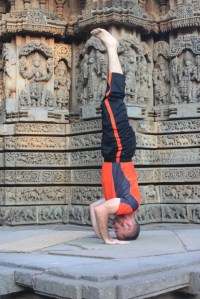
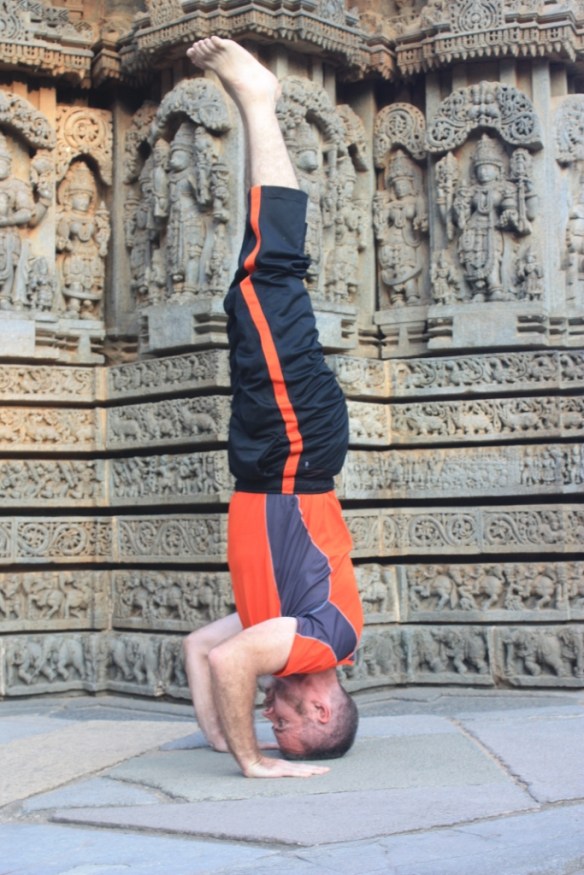
DAILY PHOTO: Upside-Down in Somanathapura

Taken on January 26, 2016 at Kesava (Chennakesava) Temple in Somanathapura

Taken on January 26, 2016 at Kesava (Chennakesava) Temple in Somanathapura

The Good and Bad News About Yoga for Weight Loss

IMG_2643The good news is that yoga can help one lose weight. The bad news is that the mechanism by which this occurs isn’t what most people expect, and it involves the mind a great deal more than the muscles.


While many people hope for a secret to weight loss, there’s no secret. Weight loss is a function of calories eaten being less than calories burned.  This simple formula means that one can either eat less or exercise more. Both the diet and exercise matter for good health, but the eating part is more important to cutting weight. This statement may be controversial and seemingly gratuitous—particularly for people who think exercise is going to single-handedly shed excess pounds–and so I’ll take some time to try to make my point.


The first thing one should know is that our voluntary activity only accounts for about one-third of calories consumed. The other two-thirds are used whether we move a muscle or not. Between 20 and 25% of our energy consumption is devoted to our brain, and much of the rest is used to keep us at 37°C (98.6°F) because we are, after all, mammals. This means that increasing the intensity or amount of exercise—while it has tremendous health benefits—will achieve only a marginal increase in calories burned. From the Mayo Clinic website, I learned that a 109kg (240lb) individual will burn about 273 calories doing a typical hata yoga class or about 436 calories with Power Yoga. (Compare this to about 327 calories / hr. for tai chi or 654 calories / hr. for hiking.) So your hour of yoga has maybe knocked off a 32oz soft drink or one medium size French fries. Most people have trouble finding more than one hour of time and energy for exercise per day. And as someone who sometimes spends more than an hour a day exercising, I can attest that there is a point of diminishing marginal returns. So while exercise is an important part of weight loss, one can’t go hog-wild in eating just because one exercises.


[One should also note that many yoga practitioners experience a reduced basal metabolic rate (BMR) because of the calming aspect of the practice. A lower BMR means that you burn fewer calories just living and maintaining your metabolism. All things being equal, this makes cutting weight all the more challenging—though the effect is certainly counterweighted by the stress reduction aspect of the practice that will be discussed below.]


To summarize: unless you’re an elite athlete in training for something like the Olympics, the idea that you can eat whatever you please and cut / maintain a healthy weight is likely to result in disappointment.  A common piece of dietary advice for elite athletes is to daily eat one gram of protein for every pound of ideal bodyweight and eight fist-sized servings of vegetables. Beyond that, they can pretty much eat what they want. But with that much slowly digesting material, they’re probably not going to go overboard—even if they weren’t already, almost by definition, very disciplined people.


IMG_2737So if an hour of yoga a day doesn’t even make up for having a Mars bar, what good is it?  For one thing, the yoga student has the opportunity to become more attuned to his or her body and, in doing so, to learn to differentiate physiological hunger from the many other permutations of hunger that overtime merge into a multi-headed hydra of craving. What are these other hungers? First and foremost, there’s psychological hunger, or the use of food as therapy. People use food to reward themselves, to medicate themselves, to take their minds off of their woes. Secondly, there’s sensory hunger in which we have no real need to eat but the food looks or smells too good to avoid.


One of the forms of hunger that often remains hidden is social hunger. That is, one eats to be part of the in-group and to bond. For example, imagine you’ve just eaten, are not hungry, and someone offers you food. Depending upon who it is and what your relationship is that person, you may feel compelled to eat even if you don’t need it. The double whammy is that eating as socializing is so deeply engrained and that we humans—contrary to popular belief—are dismal at multitasking. We can’t converse and be aware of what we are eating, and thus one may overeat because one is so engrossed in the distraction of socializing. This isn’t to say that there is anything inherently wrong with social eating. We all have to do it to some degree or another. One just needs to recognize that if it becomes a habit to be distracted from one’s food, one may have problems.


Relating back to the idea of psychological hunger, yoga helps one destress.  Stress can be a perfectly healthy phenomenon, but when it’s prolonged it can have many adverse consequences. One such consequence is having cortisol levels remain too high, and this has the effect of ramping up the appetite. Your body has been pressed into fight or flight mode, it expects that you’re hauling ass away from a sabretooth tiger or an angry woolly mammoth mamma, and that you’ll soon need to replenish depleted energy stores. Your endocrine system doesn’t know that you’re curled up on the couch with a pint of ice cream… yeah, let’s call it a “pint.” As a form of exercise, yoga helps reduce this problem. However, beyond exercise, yoga offers many relaxation techniques such as yoga nidra, kaya sthairyam, restorative postures, and some forms of pranayama(breathing exercises) that can help you turn off the “fight or flight” and turn on the “rest and digest”—what Herbert Benson called the “relaxation response.” Sometimes you might delve into an intense practice like Ashtanga Vinyasa or Power Yoga, and other times restorative yoga might be just what the doctor ordered. [Disclaimer: “What the doctor ordered” is a figure of speech. I’m not a doctor, and I haven’t even played one on TV.]


IMG_2633There is yet another way in which yoga can help. Yoga helps one dispassionately observe one’s drives and this way one can slowly, over time, rewire one’s attitudes toward food.  One can begin to think of hunger pangs as a sensation, rather than projecting a negative connotation onto them. In this way, one can learn to begin to watch the sensation and learn from it rather than running for the food.


Finally, an important benefit of yoga is in teaching one to be contented with oneself, even if one isn’t content to live with one’s present health or physical capability. Santosa is one of the niyama, and it teaches one to be content with who one is–perhaps even while one is simultaneously practicing the austerities of tapas (another niyama) in pursuit of personal development. If one isn’t contented with oneself, one can fall into a shame spiral that may create the kind of persistent stress that I warned about above. Also, if one is at a healthy weight, but has some deep-seated drive toward “perfection,” the lessons of santosa can inform you as well.


Best of luck in the pursuit of good health.

BOOK REVIEW: Kalaripayat by Patrick Denaud

Kalaripayat: The Martial Arts Tradition of IndiaKalaripayat: The Martial Arts Tradition of India by Patrick Denaud
My rating: 4 of 5 stars

Amazon page

There’s a dearth of books on Indian martial arts, in general, and Kalaripayattu, specifically. The few books that do exist, such as Ranjan Mullaratt’s “Kalari Margam” (a fine book which I’ve previously reviewed), focus heavily on the techniques of the martial art. Denaud builds a niche by writing perhaps the only English-language book yet that turns its focus on other aspects of the art, including the art’s history, philosophy, customs, psychology, and its influence on–and interaction with–other systems both in India and abroad (e.g. yoga, Kathakali, Ayurvedic massage, and Tai Chi.)

After three forwards by luminaries and an introduction, the book consists of seven chapters. The chapters cover the history and mythology of the art, Kalaripayattu as a martial art (weapons and techniques in general terms), the psychological aspects of the art, the art’s relationship with Ayurvedic practices—particularly massage, its relationship to other elements of Keralan culture, the results of interviews with modern-day masters, and the influence of India and Kalaripayattu on foreign martial arts.

When I picked this book up, I was somewhat expecting that it would contain little in the way of intriguing and relevant information, and that it would be stuffed with generally known background information. I’ve come across far too many books on topics for which there’s little information, and have become well-acquainted with the many methods by which authors pad out a pamphlet’s worth of information into a book. However, I was pleasantly surprised by how much information on Kalaripayattu this book contained, and how relevant the background seemed. While there’s a fair amount of background, the book doesn’t feel padded. Granted, I can’t be certain how much of this information is accurate. I know common myths are repeated that are now believed to be false (e.g. Bodhidharma spreading Kalaripayattu to Shaolin), but I saw nothing that seemed like pure fabrication (though I’d be unlikely to recognize such a thing.) Denaud does cite his sources (not in bibliographic format, just by attribution of authors and texts) on most occasions and it certainly wrings authoritatively.

I’d recommend this book for individuals interested in martial arts, and the history of martial arts. It’s a rare glimpse into various aspects of Kalaripayattu. Also, some people who are interested in south Indian culture more than martial arts may also find it worthwhile.

View all my reviews

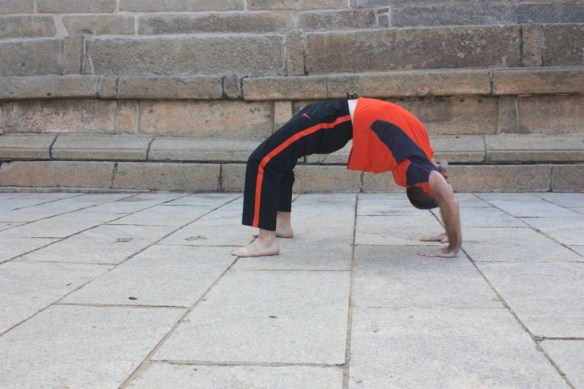
DAILY PHOTO: Balancing on the Keshava Plinth

Taken on January 26, 2016 at Keshava Temple

Taken on January 26, 2016 at Keshava Temple

Flexibility & Power in Kalaripayattu: Confessions of a Gravitationally-Challenged Student

IMG_4269Learning third level material was when Kalaripayattu became daunting. Until then, it was just exhausting.


I’d been doing a lap of the kalari consisting of high kicks flowing into Hanumanasana (a scissors split.) Each split is on the opposite side from the last. By yoga standards, my split alignment was off. My hips weren’t perpendicular to my legs, but I’d allowed them to twist open to make the split easier. However, that was probably the least of my errors, and–unlike in yoga practice during which one might take minutes to ease into this intense split–the cadence in kalari was kick – split – struggle to one’s feet. [Okay, the “struggle” shouldn’t have been, but it’s an accurate description of my rendition.]


This wasn’t the hard part, by the way. I’ll get to that. The structure of the class up to that point was logically arranged to facilitate those splits. The practice started with warm ups of rapid repetitive motions that got the muscles and core warm. Then there were a series of kicking exercises that also served as dynamic stretches. Next, there was a vertical version of the splits done in a static form. With the inner edge of one’s bottom foot posted along the base board, the heel of one’s upper foot is slid up a piece of wood lathe worn smooth that has been tied vertically–perpendicularly to the steel burglar bars that one uses to pull oneself into the stretch. (This is an inner city kalari, and not the traditional version dug into the ground.) Then one revisits a high kick, swinging the leg with greater intensity. Only then does one do the lap of splits.

A traditional kalari looks like this. This is the Kalari Gurukulam in Chikkagubbi (parent school to the one at which I train.)

A traditional kalari looks like this. This is the Kalari Gurukulam in Chikkagubbi (parent school to the one at which I train.)


The next piece is where the third level kicked my butt. One’s hamstrings and quads stretched to the max, feeling more like limp noodles than coiled springs, one is now expected to work through a series of leaping maneuvers. There are seven leaping exercises (besides some basic warm-up leaps): a leaping circle kick, a spinning kick that takes one 360-degrees, a split kick in which one leaps up and kicks out laterally in both directions simultaneously, a split kick in which one leaps up spinning 360 degrees [theoretically] and does the same split kick in the middle, a flip kick in which one kicks up and forward and flips one’s body over in mid-air to come down on one’s hands and feet (in a lunged position with palms down next to the feet), and then there are two versions of leaping/spinning kicks that proceed down the length of the kalari.


IMG_1661Why does one do these plyometric techniques in the wake of such intense stretching? I suspect that experts in exercise science would tell me this isn’t the best way to improve my leaps. One should do the leaps when one’s muscles are more like rubber bands than al dente linguine. Still, I dutifully comply. Maybe there’s an ancient wisdom at work here. Maybe there’s not. There’s no way to find out without giving it a try. I fall down a number of times that first day, and on all subsequent sessions. As I write this, I’m now learning level five material, but I continue to revisit the leaps every session for two reasons. First, I’m not happy with my abilities. Second, I want to find out whether I can improve my balance of flexibility and power, and whether the kalari approach does the trick. (Note: I’m using the word “power” in the specific sense of work performed per unit time. In other words, it’s not synonymous with strength. It’s a function of both speed and strength.) At any rate, I still fall down.


IMG_2278However, looking beyond my own limited capacity to have my cake and eat it too (i.e. retain flexibility as I gain power), I see evidence of the success of this approach. There are a number of advanced people who’ve been using this approach for many years and have a preternatural balance of flexibility and jet propulsion. Said individuals seem to go from deep stretches to phenomenal vertical leaps without difficulty.


If nothing else, I’ve learned a great deal about my muscular composition. While I’m challenged by ballistic movements, my stamina is quite respectable. Type I (slow twitch) musculature seems to be disproportionately common in comparison to type II (fast twitch) in my body. While I’m including more power building training in my workouts, my progress is glacial. If I was smart, I’d take up long-distance running or some other endurance activity. But I tend to find such activities tedious, while I love the martial arts. And so I struggle.

IMG_4275


2015 Top 10: Highlights From the Year That Was

These aren’t necessarily in any order.


1.) Trekking the Great Himalayan National Park [June]:

IMG_1898


2.) Teaching kids at KAMMS and Socare [September & October]: I finished my RCYT course in April and have been teaching kids when I have a chance:

IMG_0101


3.) Completing Level I Examination at the Muay Thai Institute [September]:

IMG_1926


4.) Riding camels at Pushkar and Jaipur [November]:

IMG_3002


5.) Boating on the Ganges in Varanasi [October]:

IMG_3538


6.) Wandering around a coffee plantation near Chikmaglur [April]:

IMG_1966


7.) Completing the Level III and IV reviews in Kalaripayattu [February & August]:

IMG_4289


8.) Touring the Glenloch tea factory in Sri Lanka [May]:

IMG_0572


9.) 108 Surya Namaskara Against Child Trafficking [March]:

IMG_3331


10.) Junk boat tour of Ha Long Bay, Vietnam [December]: This may be jinxing us to put it on the list,  before we’ve been (we leave tomorrow) but I’m optimistic that our three weeks in Vietnam will be awesome, and I’m told Ha Long


What to expect in 2016? Lilla and I will be moving back to the States around mid-year. (To where, exactly, remains a mystery.) In January and February I’ll be doing an RYT-300 course to round out my 500 hour yoga teacher certification. I plan to make at least one more trip to Thailand to MTI for Level II. I’d also like to complete the 10-day Vipassana meditation course before returning. Lilla and I are thinking about another Himalaya trek for the summer.

I’ll also be continuing to work on press handstand progression, as that’s been a focus for me of late and I still have a ways to go.

IMG_4354

IMG_4342

BOOK REVIEW: Yoga Education for Children, Vol. 1 by Swami Satyananda Saraswati, et. al.

Yoga Education for ChildrenYoga Education for Children by Swami Prakashanand Saraswati
My rating: 3 of 5 stars

Amazon page

This is the first of a two-volume set on teaching children yoga, and was the textbook for the Registered Children’s Yoga Teacher (RCYT) training course that I completed earlier this year. The focus is on integrating yogic teachings as part of a child’s broader education. It’s not just about how one can squeeze some postures into the life of a busy student, but about what yogic education can provide that mainstream education is lacking and how mainstream and yogic education can work together to produce healthier and more well-balanced children.

The book consists of three parts. Part I is entitled “Yoga and Education” and it considers a range of topics at the intersect of yoga and education. Here we learn why formal yogic education begins at age eight, and what the differences between children and adults are as they pertain to learning yoga—and learning in general. This section presents the specific practices that have historically been a child’s introduction into yoga (surya namaskara, nadi shoudhana [alternate nostril breathing], and a specific chant known as the Gayatri mantra.) The tone of the book is scientific, although it does vastly oversimplify some topics—e.g. the deterioration of the pineal gland—over what is being reported by scientists.

The middle section considers yoga as a therapeutic tool for emotionally troubled children, disabled children, and those with juvenile diabetes. This is the shortest part by far. It’s just three chapters, each linked to a subject mentioned in the topic sentence. The chapters are short and general. It should be noted, that the first section also addresses the issue of behavioral problems in a more general and less clinical sense.

The final part of the book, and the largest by page count, is yogic practices for children. There’s a brief section on pre-school exercises. As mentioned, children are formally introduced to yoga around age seven or eight. Younger children’s yoga training best takes the form of play. Therefore, the practices for younger children are more game-like. There’s a section on yoga for the classroom. In other words, practices that one can complete at a desk–as opposed to needing the full mat space.

The bulk of part three is taken up by asana. The postures are laid out as they are in the “Asana Pranayama Mudra Bandha” (APMB) book that is also put out by the Yoga Publications Trust of Bihar. For each posture there’s a line drawing, a description, and a list of benefits and contraindications. In some cases these posture listings look exactly the same as those in the APMB, but in many cases they are “marketed” differently. That is, a posture might be listed by its similarity of appearance to an animal or letter of the alphabet so that asana can be taught in conjunction with other topics—as well as be made more interesting for the young student. The grouping of asana is meant to assist in creating child-suitable lessons (as opposed to being grouped by type of posture–e.g. forward bends, back bends, twists, etc.)

The last part doesn’t deal only in asana, it also talks about pranayama practices suitable for children as well as other common practices like trataka (concentrating gaze) and yoga nidra (yogic sleep.) It’s important to note that not all pranayama practices are deemed suitable for children. Practices like yoga nidra have to be modified for children because they will not be able to sit still for extended periods, and so the yoga nidra practice must be abbreviated. Children may also have trouble following some of the instructions as used for adults.

I’d recommend this book for yoga teachers who are interested in teaching children. There are many unique features of teaching children that must be considered. This volume is under 300 pages, and the second volume is about the same thickness. I haven’t read volume two but it seems to take a similar approach, expanding on some items and focusing on a different set of practices. That volume also apparently reports on the findings of a couple studies on yoga in the educational environment.

View all my reviews