
The Bohemian writer Franz Kafka,
 more conflicted than Queen Jocasta,
  wrote tales, absurd -n- surreal...
   yet how factual they feel.
The Bohemian writer Franz Kafka, more conflicted than Queen Jocasta, wrote tales, absurd -n- surreal... yet how factual they feel.
scribe & chronicler:

face unknown,
name unknown,
soul laid bare by way of words --

words that reveal from
the inside out --

it's not the way
we're accustomed
to getting acquainted

we're used to surface learning
'til we scratch through,

but here we have:
no name,
no face,
but deep insight
 Smile When You’re Lying: Confessions of a Rogue Travel Writer by Chuck Thompson
My rating: 4 of 5 stars
Smile When You’re Lying gives the reader an insider’s view of the deceit rife in travel writing. In the process, Chuck Thompson tells a story of life on the vagabonding circuit. Instead of being a story of idyllic and pristine white sand beaches, it’s the story of drug- and booze-riddled expats and the prostitutes they frequent.
Thompson lived a colorful life. He tells of how his interest in Thailand began when he heard stories while in a jail in Alaska. He introduces cast of characters, such as Shanghai Bob, many of who are even more colorful than he. It’s this wild living that makes the book an interesting read, but, ironically, it also makes such stories impossible to sell to any of the travels magazines–all of which make money off of advertiser dollars, advertisers who have an interest in making travel seem safe, clean, and family-friendly.
Thompson tells of how he began teaching English in Japan, a common point of origin for expats taking to Asia. Japan has a large and well-developed program, called JET, that brings native English speakers to Japan to teach language or work in government offices as translators.
In addition to the intro on Thailand, a chapter on his Alaskan youth,and one on his JET days, there are chapters on Latin America, the Caribbean, the Philippines, and Eastern Europe. Furthermore, there is a chapter that lends travel advice for aspiring travel writers and one about what travel mags don’t want readers to know. It should be noted that besides having written for such magazines, Thompson did a stint as an editor as well.
Thompson also devotes a chapter to countering the myth that Americans are–on the whole–bigger travel bastards than the people of other Western nations.
If you are interested in travel writing or vagabonding, this is a worthwhile read.
Let me begin by being forthright; I know almost nothing about art. If you’re thinking this post might offer you insight into what makes for a good painting, you’re in the wrong place. A few years back, I did get a couple books on “art for philistines” (…isms: Understanding Art and 50 Artists You Should Know) Being fascinated by just about everything, I immensely enjoyed both books. However, my objective wasn’t to develop any great expertise, but simply to not be a clod. I wanted to be able to tell Monets from Manets from mayonnaise. And I did learn some nifty lessons, mostly about what art wasn’t. Did you know that Neo-impressionist art is NOT art that makes a new impression on one, as contrasted with paleo-impressionist art that makes one feel their inner-caveman. Secessionism was NOT the art of the Confederate States. Neither sensationalism nor naturalism necessarily involve nudity, darn. One the other hand, Pointillism is exactly what it sounds like, paintings made of little pointills.
As a writer, the story that I see in a painting has a lot to do with its appeal to me. That’s why there aren’t any Jackson Pollack’s or Mark Rothko’s on my list. I’m sure their work is aces in aesthetics, but I don’t get much out of it.
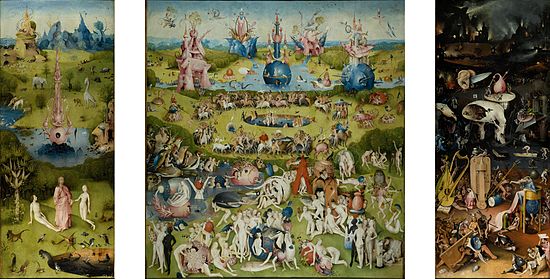
The Garden of Earthly Delights by Hieronymus Bosch, 1510
I usually don’t care for paintings that are as busy as The Garden of Earthly Delights, but I find it fascinating that an early 16th century artist could produce so much wild surrealism. I didn’t even know they had LSD in the Netherlands back then. Today we have decades of monster movies to help us think up weird and bizarre images, but Bosch had only his imagination.
There are an infinite number of stories packed into this tri-sectional painting. A question being the root of a story, a world in which some people have flowers and berries blossoming from their heinies, makes for a lot of fodder. However, the first thing that strikes the eye is that God is the only one wearing clothing. (Lets avoid a tautology. One could say that the only reason I know that that’s God is that he’s wearing clothing. If he were naked too, the viewer would just assume that he was a perv trying to horn into a menage a trois. I would say the world’s first threesome, but if you look in the middle section, you can see that about everyone is getting their freak on.) So why is God wearing robes? We can assume that it’s not that he has shame. He’s God, you can be sure he’s sporting the perfect specimen of masculinity (if he cares about such things.) Is it drafty in heaven? If so, doesn’t his omnipotence extend to the heavenly thermostat, or is it that the Holy Ghost likes to crank the AC? I see tension, and tension is the root of a story. (I realize that I said that a question was the root of a story. Live in the moment.)

The Sea of Ice by Caspar David Friedrich, 1823
Sea of Ice, also called The Wreck of Hope, at first looks like just a landscape. However, if one directs one’s glance to the right hand side, one can see the stern of an old sailing ship. As the alternate title suggests, it’s about a shipwreck. A shipwreck in the sailing age in the Arctic Ocean makes an outstanding setting for a story. Those men are all going to die, but not with the suddenness of drowning. They will freeze to death over the course of hours. If they can start a fire, they may have many hours, but they are not going to be rescued and they cannot walk to home. The tension between wanting to survive and knowing you are just extending your misery is good stuff for story-telling. If this image doesn’t send a shiver down your spine, nothing will.
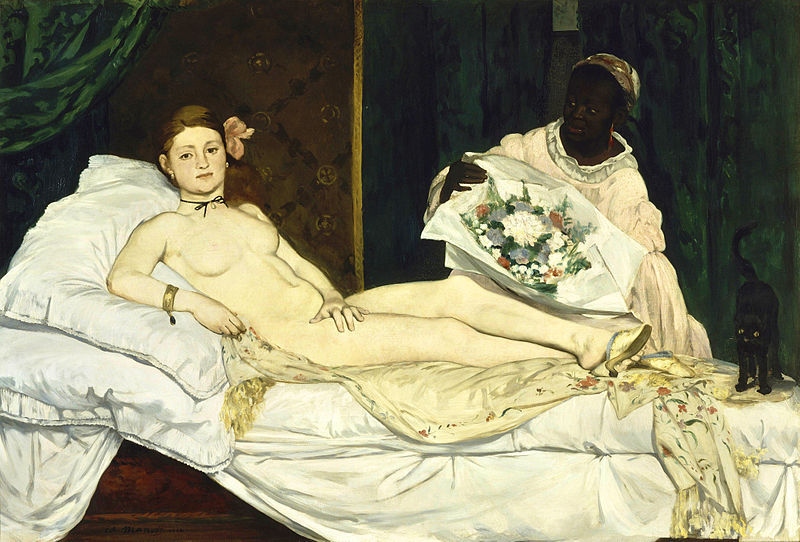
Olympia by Édouard Manet, 1863
Olympia was a scandalous painting when Manet first revealed it. Nudity has been around for ever in paintings, right? Certainly, but it’s the context that enraged people. Society was used to characters of classical mythology being nude, e.g. Venus. They were also used to Biblical nudity (see Garden of Earthly Delights above.) However, Olympia made them think of the Parisian prostitutes that they didn’t visit, but somehow knew exactly what they looked like. There are several stories to be told here. The one that springs to mind is why the servant is about to try to suffocate Olympia with a pillow. Will she, or won’t she, go through with it? If she does, will she prevail? Olympia looks like a fighter. If she doesn’t, will the cat?

Impression: Sunrise by Claude Monet, 1872
In Impression: Sunrise two boats are out on the water, even though the sun has broken over the horizon. They are rivals. The early bird got the worm, and the other will have to fish with fake lures.

Lighthouse Hill by Edward Hopper, 1927
Lighthouses make good settings for tragedy. They are remote. Ships depend upon them to avoid the rocky shoals. This lighthouse keeper’s family left because they didn’t like living in the middle of nowhere with a drunk. Now it’s just a man living in a big house alone. He runs out of Jack Daniels, and drives off to town at dusk. Being on the other side of the hill, he can’t see the lighthouse when he briefly glances into his rear-view mirror and wonders, “Did I turn the beacon on?”

The Persistence of Memory by Salvador Dalí, 1931
The Persistence of Memory, a.k.a. Melting Time, is a dream state. It makes no sense. Nature is ordered into square edges. Watches are the only evidence of humanity’s existence. There is one creature living, or once living, that looks like the Thalidomide abortion of a three-way mating between a donkey, a Portuguese man of war, and Dalí himself. The story is about being trapped in a dreamscape where time has become stuck. Our protagonist must seek the wisdom of the Portuguese man-o-Dalí.

Bonus pages for active readers
I miss the days when they put extra blank pages at the end of a book so that you could rewrite an unsatisfactory ending. (Someone once tried to tell me that the extra pages were the result of bulk paper cutting methods. They said it was cheaper to include the blank pages than to remove them. Yeah, I know. How ridiculous, right?) Of course, it wasn’t long before ads began to sully these blank pages, making them less than blank.
I’m not a fan of wastefulness, but if I have to rewrite your ending, why should I incur the cost of paper.
Being lazy, there are not many cases in which I feel compelled to rewrite someone else’s ending. Most books that manage to get published have at least a tolerable ending.
One book always springs to my mind when I think of bad endings. It’s a book called Hostage by a writer named Robert Crais. For those who saw the movie, the movie ending is vastly different–presumably because moviegoers would have insisted on their money back otherwise. While Hostage is not among Bruce Willis’s best, it’s also a prime example of the rare case when the movie is better than the book–for just this reason.
Part of the disappointment stems from the fact that the book has an outstanding premise for a thriller, and in my opinion it was carried off well until the end. (Another reason that I don’t come across too many terrible endings may be that I jettison books that aren’t so good, but this one fooled me.) Anyway, three delinquent kids rob a house and end up with a hostage situation with the homeowner’s two kids. The tension is ratcheted up when it turns out that the upscale home where the kids are being held up is owned by a mob accountant. Inside is evidence that could put half the mob away. The mob gets proactive by taking the police chief’s (i.e. the protagonist’s) family (ex and child) hostage and insisting that he get the evidence out before the house is stormed by the sheriff’s department and falls into an evidence locker.
SPOILER ALERT: Ultimately, our hero has no agency in the survival of himself or his family. It’s purely the decision of a mob enforcer that leaves them alive. I guess it could have been worse. It could have ended with him awaking from a dream.
What book gets your award for “worst-ending-ever”?


 Tiger Riding for Beginners