
The police questioned an old statistician
 Whose department had suffered attrition.
   "My memo was wrecked
   by auto-correct:
 Distribution of 'Poisson' became 'Poison.'"

The police questioned an old statistician
Whose department had suffered attrition.
"My memo was wrecked
by auto-correct:
Distribution of 'Poisson' became 'Poison.'"
I’ve often been surprised how little intuitive grasp people have of basic mathematical or statistical ideas or relationships, even when they have had the education to understand with a little effort.
One example of this is what I call “unilateral mathematics” where people fixate on one term or side of an equation while ignoring that changing a term changes the equation’s other side (or to keep the other side static, something else has to give.) For example, I hear people getting so excited by the new salary they will earn when they move to a new place. Then they get to the new locale only to find that the cost of living is so much higher that even their hefty pay boost supports only a diminished quality of life. One sees this tendency a great deal in people’s policy discussions when someone will say, “just set a maximum (or minimum) price” without understanding that shortages or surpluses will come along for the ride. [The Law of Unintended Consequences is another good answer to this prompt.]
We all saw flaws in statistical thinking during the pandemic when people said things like, “See, she got the vaccine and then she got COVID, so obviously the vaccine doesn’t work!” I’m convinced this is because people don’t have good intuition for statistical thinking and — instead — they want to treat a low probability as an impossibility and a high probability as a certainty.
By the way, you see this from people of all persuasions, including those who are highly educated, conservatives, progressives, believers, atheists, etc. One can see the universality of the flaw most commonly in climate change comments. You’ll hear one person say, “See, it’s the hottest day on record, that’s evidence global warming is real!” Another person will say, “See, it’s the coldest day on record, global warming is obviously hokum!” Somehow, even with diametrically opposed viewpoints, these two manage to both be wrong because one day’s WEATHER is not instructive of what is happening to the CLIMATE. In other words, a sample of one provides no insight into state changes in the population. [Maybe it’s more appropriate to use Wolfgang Pauli’s terms and say the two are “not even wrong.”]
 Nature’s Numbers. Discovering Order And Pattern In The Universe by Ian Stewart
 The Joy of X: A Guided Tour of Mathematics, from One to Infinity by Steven H. Strogatz
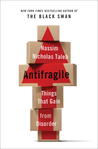 Antifragile: Things That Gain from Disorder by Nassim Nicholas Taleb
My rating: 4 of 5 stars
Nassim Nicholas Taleb has a gift for uncovering simple and fascinating topics that have remained buried–not because they are unfathomable, but–because of the institutional blinders and group-think present in academia (at least within the social sciences.) I don’t mean to diminish what Dr. Taleb does by saying these are simple ideas, it takes a great intellect to not only recognize the ideas others have missed but to clarify them for a broad audience and to unravel the challenging ideas that must be made clear as one moves beyond the crux of the idea. Furthermore, it takes a bold writer to push these ideas out into the open against brute institutional antagonism. (If Taleb hadn’t written books that were highly readable and that presented the ideas in a manner readily digested by a broad audience, he’d likely still be being completely ignored by academicians.)
By “simple” I mean ideas that can be captured in a single sentence—often a pithy one at that. In his second book (his first work for popular audiences), Fooled by Randomness, the idea was that randomness is more pervasive than most people imagine and that false explanations are often built for chance occurrences. Black Swan told us that statistical forecasting fails catastrophically when one has “800 pound gorillas” in the data set (e.g. if one is comparing countries—a situation in which one will virtually always be in, as Taleb calls it, “Extremistan.”) The book in question, Antifragile, is built around the notion that some entities get stronger when subjected to stressors and disorder.
One can see many “antifragile” elements in one’s own body. A muscle subjected to exercise often gets tiny tears in fibers, but when the body does its repair work those fibers will be stronger than ever before. Wolff’s Law tells us that bones subjected to an increased load will increase their density. In fact, our bodies are testaments to the concept of antifragility on many levels. For this reason, Taleb uses many examples from the field of medicine—in addition to those from disciplines more closely related to his own, e.g. finance, economics, and risk. A lot of the medical discussion deals with the proclivity of Western medicine towards interventionism (in contrast to the “first, do no harm” motto often heard.) An example with which many people are familiar is that of the over prescription of antibiotics. While there are obviously cases for which antibiotics are necessary and beneficial, prescribing them willy-nilly robs the body of antifragility (i.e. if the body defeats the infection itself, it has inborn resistance.)
As with other of Dr. Taleb’s writings, I found Antifragile to be interesting as well as informative. The author does a good job of providing examples to elucidate and bolster his arguments and puts it all together in a readable package. He also does a great job of pulling examples and discussions from a number of different fields. This book doesn’t read like it’s about an Economics or Business subfield as much as it’s a book that can teach you something applicable to whatever your field might be. The book also covers a number of other critical but related ideas, such as the value of heuristics in decision-making, how antifragility can be increased (and fragility reduced), and the ethical issues involved.
My primary criticism is that the book overdoes the jabs at scholars and economists. I can understand where Taleb might have some pent-up rage against many academics. He has certainly had to weather a lot of equally petty assaults from the academics who loath him. The work of many a social scientist and economist looks pretty silly to those who grasp the concepts Taleb is presenting. Still, we got it. Halfway through the book, one wonders why Taleb is still so vigorously and maniacally whipping such a skeletal horse. While it’s hard to imagine anyone less strong-willed than Dr. Taleb could get these messages out in the face of the institutionalized opposition he faced, the flip side is that he will probably strike you as a pretentious jackass on occasion.
The book is organized into seven sections (each of multiple chapters.) It begins by describing antifragility and then proceeds through relevant concepts like optionality, nonlinearity, via negativa, and ethics. The book has handy appendices for those who prefer graphic or mathematical representations. (Like all popular science / social science works, there’s an attempt to keep the overly technical and visually intimidating material out of the body of the work.) There is also a works cited section.
I’d recommend this book for those interested in wonky type books.


 Tiger Riding for Beginners