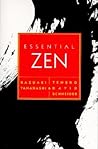
BOOKS: “Essential Zen” ed. by Kazuaki Tanahashi & David Schneider

Essential ZenEssential Zen by Kazuaki Tanahashi
My rating: 5 of 5 stars

Google Books Page

This is a collection of short writings (poems, koans, and prose excerpts) on Zen Buddhism arranged into loosely themed sections. The writings tend toward the artistic, creative, and metaphorical, with relatively few straightforward descriptions of technique or philosophy. The writings range from those of Chinese and Japanese monks who lived hundreds of years ago to present-day poets and Zen practitioners. Among the more frequently drawn from sources are: Hanshan, Ikkyu, Dogen, Ryokan, Hakuin, Gary Snyder, Robert Aitken, Seung Sahn, John Daido Loori, Thich Nhat Hanh, and Peter Levitt. But there are many others, including some who have only a single piece included.

There’s a substantial “Notes” section that gives source, translation, and — in some cases — background information. Most of the translations (both Japanese and Chinese) are by the editors, Kazuaki Tanahashi and David Schneider. There are illustrations, but they are all ensō (circular brush paintings) and related forms.

This is a highly readable and insightful collection of short writings, and I’d highly recommend it for individuals interested in Zen or Eastern Philosophy more generally.

View all my reviews

BOOK REVIEW: Dropping Ashes on the Buddha by Seung Sahn

Dropping Ashes on the Buddha: The Teachings of Zen Master Seung SahnDropping Ashes on the Buddha: The Teachings of Zen Master Seung Sahn by Seung Sahn
My rating: 4 of 5 stars

Amazon.in Page

This book’s one-hundred brief chapters mostly consist of interactions between the Korean Zen Buddhist teacher, Seung Sahn, and students of his. However, there are also some old Zen stories, and a few odds and ends: such as the transcript of a completely unproductive “dialogue” between Seung Sahn and a Hindu yogi. Some of the student-teacher interactions are epistolary, but others are face-to-face “dharma combat” or Q&A sessions (which also, ultimately, became dharma combat — given Seung Sahn’s teaching methods.) Dharma combat is a dialogue that resembles Socratic dialogue except that the goal isn’t to use logic and sound reasoning to persuade another, but rather to demonstrate a lack of attachment and proclivity to overintellectualize. It involves a lot of seemingly nonsensical answers and occasional shouting and slapping / hitting. It sounds unproductive, but the objective is to break established cognitive modes and to induce epiphany, rather than to build a rational argument.

It’s a thought provoking and informative book, if a bit repetitive. Most of the conversation revolves around less than a dozen ko-an [kong-an in Korean,] which are questions or statements that’re intended to provoke a kind of realization rather than to produce a straightforward / rational answer. It’s not a problem that there’s repetition, as these aren’t straightforward ways of thinking, and oftentimes it takes many varied looks at a ko-an to grasp what’s being conveyed. That said, I felt this book could’ve used some editing to streamline the dialogue a bit to make it feel a bit less punitively redundant.

If you’re interested in ko-an and dharma combat, this is a great book to look into. However, if you’re familiar with many of the popular ko-an and Zen stories, it may feel a bit redundant.


View all my reviews