5 Myths of the Mind


I wrote a post a while back about six persistent brain myths that has some overlapping relevance to this one.

5.) A person is a unitary actor (the spherical cow of social sciences.) When I was a graduate student studying International Relations, a popular theoretical assumption was that nations were “unitary actors.” This meant that no matter how schizophrenic a government (and a nation’s civic institutions) might appear, they ultimately always pursued a national interest via a solitary hand. Like physicists assuming spherical cows, this makes life easier — even if it bears little resemblance to reality.

The full extent of the folly of the rational unitary actor assumption became apparent when I discovered that an individual isn’t even a unitary actor systematically pursuing its best interest. An individual is a collection of impulses, thoughts, feelings, etc. that seems like its under the command of a central authority only because that “central authority” [our conscious mind housed in our Pre-Frontal Cortex (PFC)] is really good at forming post-hoc rationalizations and making up stories that let us feel unitary. The reader may think I’m just talking about some slim segment of the population with a multiple personality disorder, but no. I’m talking about anyone who has ever agonized over whether or not they should have an ice cream treat or take the healthy route. At the end of an internal battle that ends with the levers of action being operated by parts of your nervous system beyond your conscious control, you walk away with your conscious mind building a nice story that explains how it chose to either treat its taste buds or take it easy on its pancreas by keeping insulin production stable.

To consider how the conscious and subconscious mind can be on two entirely different pages on a subject, we’re going to veer into controversial and provocative territory. [So be warned, and if you’re sensitive about sexuality and particularly coercive sexual fantasy, you may want to skip down to the next paragraph.] Across a series of studies, an average of 40% of subjects (generally, or maybe exclusively women) admitted they’d had a fantasy about being raped. Many readers will react with incredulity, perhaps suggesting that there must be something wrong with such a person. However, obviously numbers like that aren’t describing a lunatic fringe. The next response one might here is, “Why doesn’t a person with a rape fantasy know how horrible and decidedly unsexy rape is?” If you’re following my gist, you know the answer is that said person knows very well. Consciously, she is aware that rape is violent and horrific, and moreover she probably even knows that it’s about commanding power rather than sexual desire for the rapist. This knowledge doesn’t undermine the fantasy [unless, perhaps, she really forces herself to think about it intensely] because the arousal is driven by a more visceral part of the mind that FEELS that the act is about the rapist being overwhelmed with sexual attraction even though the person KNOWS that that’s not the case.

[Note: I do realize that it might theoretically be possible that a much more complex collection consisting of many individuals and organizations might behave in a more unitary fashion than an individual. That is, even though a nation his made up of many non-unitary actors, perhaps the nature of the game forces it to behave in a unitary fashion. I don’t buy it. I’ve been reading a great example in a biography by Ingrid Carlberg about Raoul Wallenberg where both the Soviets (who had Wallenberg in custody but wouldn’t admit it) and the Swedes (who didn’t know whether Wallenberg was alive and sent mixed signals) were befuddled by varying actors sending mixed messages and collectively behaving ineffectively. It’s hard to come away thinking that Stalin and his Ministers had a rational and unified decision process. Instead, it seems like a perfect storm of incompetency and incorrect assumptions resulted in an outcome that wasn’t ideal for any of the parties.]


4.) Everyone can be hypnotized via instant induction and then commanded to do anything that’s asked of them.  Hypnosis is among the most misunderstood activities around. There are a couple of reasons for this. One is that hypnosis is a favorite device in movies and fiction, and people draw information from these fictitious sources. The “Now You See Me” movies (see above) offer many such displays of a person being instantaneously hypnotized against his will even when the person is an expert himself, and made to do things against his interests. Misconception also flowers when people hear real or fictitious accounts of Cold War programs like America’s MK Ultra or the Soviet’s psychotronics. The lesson to be taken away from those expensive and morally-dubious programs is that it may be possible to break a person’s mind, but you can’t force someone to do something they abhor while programming them to forget all about it afterwards.

Another reason for the misunderstanding, is that there’s a disreputable group of stage hypnotists and others who love to spread these ideas because it’s more intriguing if people think they can do it to anyone at any time than if they understand that their subjects have been carefully selected to be among the more readily prone to achieve trance states and to be responsive to suggestion. It’s true that most people are hypnotizable and will respond to suggestions to do things they wouldn’t otherwise do (as long as it’s not something that they don’t want to do.) But highly hypnotizable individuals are only about 15% of the population, and there’s another 15% at the other end that are virtually impossible to hypnotize. The video below has more detail on the science.


3.) One has no access to one’s subconscious mind. The conscious mind is like the loudmouthed drunk who swears he invented the potato chip bag clip, the envelope-wetting sponge, and Velcro. That is, it’s hard to hear over the din of incessant yapping, and since the conscious mind claims credit for everything, it’s easy to be fooled that there’s nothing else to listen to in the mind. However, if you can knock the drunk out, you start to become aware of what the subconscious has to say. Those who don’t meditate may be aware of subconscious imagery as they are falling to sleep (the hypnogogic state), as they are waking up (the hypnopompic state), or sometimes even during dreams (i.e. so-called lucid dreams or dream yoga.) Those who do meditate will be well aware of images that spontaneously form and fade in the meditative mind, and which can give rise to conscious thoughts if left unchecked.


2.) Memory is a recording of life events.  I’ve been reading Julia Shaw’s “The Memory Illusion” recently. It’s a fascinating look at false memories. There are many famous cases of false memory, but what is most interesting is Shaw’s success in planting false memories of criminal activity. “Planting” isn’t the best term to describe this. It’s more about getting the subject to visualize events such that they create the false memory. While I stand by what I said about the myths of hypnosis, there have been a number of cases of false memories being implanted while an individual was in a hypnotic trance, and so one shouldn’t disregard the power of hypnosis altogether.  The fact of the matter is that what we remember isn’t the occurrence of the event itself, but the last remembrance of said event. This means that there’s a great deal of room for memory degradation over time, and for a false transcript of events to form in the mind.


1.) Emotions get in the way of good decision making. I just posted a review of Antonio Damasio’s book “Decartes’ Error,” which examines this subject in great detail. Damasio found that patients who had damage to parts of the brain responsible for emotion often became victims of paralysis by analysis. That is, without emotion to give them a kick, they can’t make decisions. Reason doesn’t always provide a clear answer because the world is filled with uncertainty. When there’s not enough information, we still need to make decisions, and this is accomplished by emotional “gut instincts.”

BOOK REVIEW: Descartes’ Error by Antonio Damasio

Descartes' Error: Emotion, Reason and the Human BrainDescartes’ Error: Emotion, Reason and the Human Brain by António R. Damásio
My rating: 5 of 5 stars

Amazon page


I’ve joked that there must be a law requiring any author writing a book on neuroscience for a popular audience to tell the story of Phineas Gage. This book is no exception. Its first couple chapters explore the case of Gage in detail. For those who don’t read much on this subject, Phineas Gage was a foreman for a construction company. By all accounts he was a reliable and solid individual, respected by his employees, trusted by his employer, and beloved by his family. Then one day a four-foot tamping rod was blown through his skull – literally, in one side and out the other. One might think that having a chunk of brain skewered out by a steel rod on a gunpowder-fueled ride through the skull would leave one – at best — a glassy-eyed, drooling, catatonic lump. Surely, a steel rod would wreak more havoc than the narrow needle used in lobotomies? However, what makes Gage’s story fascinating is that the injury resulted in no readily apparent disruption in cognitive function. Gage could still speak fluidly. He retained his memories. He could do math at the same level as before. However, this isn’t to say that the hole through his brain left him unchanged. The even temperament that made him an ideal employee and that endeared him to friends and family was gone. Gage became angry and unreliable.

So what is the relevance of the Gage story to Damasio’s book? Quite a lot, actually. Damasio’s book is about emotion, its influence on decision-making, and how bodily states create emotion. In parts two and three of this three-part book, after introducing the reader to the role of the brain in emotion via the cases of those with selective brain damage, Damasio lays out an argument for what he calls the “Somatic Marker Hypothesis” which says that bodily states are what create the sensations that we associate with emotion. The title-referenced error made by Descartes will be apparent to those familiar with Cartesian dualism. Descartes believed there was a dualism between mind and body – i.e. that there was this physical stuff that got us about from place to place, but there were these intangible thoughts and feelings that were matter-independent that were the makings of mind and which were really you (i.e. you think, therefore you are.) Damasio believes that you cannot separate what it feels like to be you from the body and all its hormones, neurotransmitters, vital statistics, neuronal firing, etc.

The book consists of eleven chapters divided into three parts. In the first part, the author lays out not only the case of Gage, but other examples of individuals who had injury or illness in the brain that disrupted emotion and its influence on decision-making. We learn that an unemotional being isn’t like Spock, but instead is paralyzed by indecision. It turns out that it’s emotion that give us a kick, particularly when he have no sound basis on which to make a rational judgement. The second part draws the connection between body and our emotional self, culminating in a description of the Somatic Marker Hypothesis. The final part describes how the Somatic Marker Hypothesis could be tested and where this line of study seems to be going. The book is annotated and has a bibliography as one would expect of a scholarly work – even one written for a popular audience. The book has a few graphics – graphs, charts, and diagrams, but not very many and of a clear and simple nature.

I’d highly recommend this book for anyone interested in the working of the mind. It’s a thought-provoking look at what it means to be an emotional being and challenges our preconceptions about feelings.

View all my reviews

BOOK REVIEW: Conversations on Consciousness ed. by Susan Blackmore

Conversations on Consciousness: What the Best Minds Think about the Brain, Free Will, and What It Means to Be HumanConversations on Consciousness: What the Best Minds Think about the Brain, Free Will, and What It Means to Be Human by Susan Blackmore
My rating: 4 of 5 stars

Amazon page


Blackmore gathers together interviews from a veritable who’s who of consciousness experts from neuroscience, philosophy, physiology, psychology, and physics. While the interviews are in part tailored to tap into the special insights of the given expert, a consistent series of questions is asked of each of the interviewees. Each expert is asked what they think is challenging about consciousness, what they think about the feasibility of philosopher’s zombies (a popular thought experiment about an individual who seems to behave like an ordinary human but who has no conscious experience), what they think about the existence of free will, what happens to consciousness after death, and what got them interested in the subject. This makes it easy for the reader to see not just differences in thinking across disciplines, but also different schools of thought within disciplines. There’s enough variety to make for intriguing reading. There is also a mix between individuals who have experience with meditation (e.g. the interviewer) and those who don’t, and so it’s interesting to compare views of those with such insight to those who study consciousness entirely abstractly.

I won’t list all the authors, but they include: David Chalmers (who famously coined the term the “hard problem” of consciousness, which is one of the most widely discussed ideas in the book), Francis Crick (of DNA fame who later shifted focus), Daniel Dennett (a well-known philosopher), V.S. Ramachandran (a neuroscientist famous for work on phantom limbs and behavioral neurology), and Roger Penrose (a physicist who believes that quantum mechanics may prove crucial to figuring out consciousness.)

It’s a straightforward book. There’s an Introduction by Blackmore and then the 20 or 21 interviews (one “chapter” is a married couple – Pat and Paul Churchland — whose insights are presented together.) The only back matter is a glossary, which is quite in-depth and which helps to clarify the many confusing concepts from various disciplines. There are a few cartoon drawings that lighten the tone, but serve no essential purpose.

I enjoyed this book and found it thought-provoking. It’s quite old at this point – having come out in 2005 – but since consciousness is so intractable, it’s not like any of the questions have been cleared up. (If it were a book on AI, I’d probably say it was worthless at this point, but not this book.) I’d recommend it for anyone looking to understand the lay of the land with regards thinking about consciousness.

View all my reviews

BOOK REVIEW: The Forest Unseen by David George Haskell

The Forest Unseen: A Year's Watch in NatureThe Forest Unseen: A Year’s Watch in Nature by David George Haskell
My rating: 5 of 5 stars

Amazon page


The premise of this book is simple but the result is fascinating. The author, a naturalist, picks a small patch of old-growth forest in Tennessee and visits it three or four times per month over the course of a year. He then writes an essay on something that he observed in (on, above, below, etc.) that patch that he calls “the mandala.” (FYI- A mandala is a symbolic representation of the universe, or an aspect thereof, that some Eastern religions use for meditative purposes.) While botany and zoology form the heart of Haskell’s subject matter, the subjects vary and include geology, behavior (animal and human), light, medicinal use of plants, and more.

Using a full year as his scope, Haskell catches some of the rare and ephemeral forest happenings. He drills down and offers the reader insight into what is happening beneath the bark and fallen leaves, providing background and context through his research that supplements his observations. In some of the articles we learn how the mandala may have changed over the centuries. In others we learn about happenings at scales too small for us to observe directly.

Haskell’s descriptions are often beautiful and always necessary as he conveys all through words. There are no graphics, and so the reader benefits from vivid descriptions. The chapters / essays stand alone nicely, so one doesn’t have to read the book straight through, but can rather pick the book up once in a while over an extended time — as it was written. Reading this book over the course of a year wouldn’t be a bad way to go about it, particularly if one lives in an ecosystem similarly forested.

There is a bibliography, but that’s about the extent of ancillary matter. It’s a simple book and that sparseness resonates well with the book’s theme and style.

I enjoyed this book and think nature lovers will find it intriguing and enjoyable.

View all my reviews

BOOK REVIEW: The Psychobiotic Revolution by Scott C. Anderson, et. al.

The Psychobiotic Revolution: Mood, Food, and the New Science of the Gut-Brain ConnectionThe Psychobiotic Revolution: Mood, Food, and the New Science of the Gut-Brain Connection by Scott C. Anderson
My rating: 5 of 5 stars

Amazon page


For centuries there have been cases in which a change in diet –often accidental– led to relief from a mental illness. However, given the sporadic nature of such effects and the complete lack of understanding of microbes, the enteric nervous system (i.e. the gut’s own “brain” that communicates with — but is also autonomous of — our “first” brain,) and the complexity the symbiotic relationships involved, these anecdotal cases had limited influence on the state of medicine. However, recent years have seen an explosion of understanding in this domain. This has resulted in a vast number of books being written on the role of microbes in the gut for overall health, the role that changing diet can have on changing our microbiota, and related topics such as how the overuse of antibiotics can have a deleterious effect on health by tossing out the microbial baby with the bath water. This book touches on all those topics (and more) as it explores the role of our bacterial hangers-on on our mental health.

The book consists of nine chapters. The chapters are organized so as to first present one with the necessary background to understand how changes to one’s gut microbiota can improve one’s health —particularly one’s mental health (though many of the mental illnesses influenced by microbiota are linked to physical ailments)— before moving on to the specifics of what microbes have been shown to have a given effect and what diseases can be influenced by consumption of probiotics.

The first five chapters give the reader an introduction to the topic and an overview of information one needs to know to understand the later chapters. Chapter three gives one an overview of the changing profile of one’s microbiota over the course of one’s life. Particular emphasis is given to one’s youth and to the transfer of bacteria to infants. [Readers may be aware of the problem that c-section births result in a failure of babies to receive a dose of beneficial microbes imparted by passage through the vaginal canal.] Chapter four takes one on a quick ride through one’s alimentary canal from mouth to rectum, with particular emphasis on questions such as how bacteria survive the stomach’s acid bath, and which parts of the digestive system contain which microbes (and to what effect.)

The last four chapters dig deeper into the specifics. These chapters look at specific probiotics, how one can get them into one’s system, and what science has found out about probiotics and psychobiotics (like probiotics, but specifically ones that influence mood and mental states) effects on specific ailments. Chapter eight, which deals with major diseases, does cover physical ailments as well as mental ones because – as mentioned— these afflictions often go hand-in-hand. The last chapter (Ch. 9) looks at where this body of knowledge is going. It delves into practices that are presently well-established, such as fecal matter transplants, but also into challenging works-in-progress such as attempts to develop narrower spectrum antibiotics so that we can get the life-saving benefits of these medications without their crippling side-effects.

The book has many graphics, as one would expect from a work that investigates such a complex scientific topic. I can’t really speak to the quality of the graphics as the review copy I read didn’t have completed graphics. However, the subjects of the graphics seemed appropriate and well-placed. The book also has a glossary, annotations, and a further reading section to assist the reader in the study of this subject.

I found this book to be informative and engaging, and would highly recommend it for anyone interested in the role of microbiota on mental health. The text was well-organized and readable. Given the scientific nature of the material, it’s easy for such a book to become ponderous, but the authors made attempts to keep the tone light and the presentation non-intimidating.

View all my reviews

5 Books to Introduce You to Your Gut Microbiota

5.) The Wild Life of Our Bodies by Rob Dunn: This book takes a broad look at the role that hangers-on have on  human life.


4.) The Psychobiotic Revolution by Scott C. Anderson et. al.: This book focuses on the role that our gut microbiota have on our mental well-being–which increasingly appears to be substantial.


3.) Missing Microbes by Martin J. Blaser: The focus of this book is on how our love of antibiotics in every form– from pills to antimicrobial soaps–is killing us by denying us microbiotic diversity and robustness.


2.) 10% Human by Alanna Collen: Collen’s book addresses many of the same issues as the other books mentioned, but–as the title suggests–it emphasizes the fact that a human has 10 times as many hangers-on of other species as it does cells that are contiguous to the body. (If you’re wondering how this could be, it’s because the human body has some pretty big cells [some macroscopic, in fact] and the bacteria and other single-celled species tend to be relatively tiny.)


1.) I Contain Multitudes by Ed Young: This is probably the most highly-regarded of the books on this subject. It was considered one of the best science books of 2016.

5 Essential [and Sometimes Hilarious] TED Talks About the Human Body

5.) 3 Clues to Understanding your Brain by VS Ramachandran: Ramachandran discusses three afflictions that offer insight into the working of the brain. Capgras Syndrome occurs when individuals think loved ones have been replaced by impostors. Phantom limbs occur when there is an amputated limb which the brain continues to feel the presence of. Synesthesia is a muddling of sensory inputs /experiences.


4.) Charming Bowels by Giulia Enders: How we poop. How our gut nervous system influences our central nervous system. Why there is such a thing as “too clean for your own good.”


3.) Can We Create New Senses for Humans by David Eagleman: Our senses are narrowly attuned to taking in that information that offered evolutionary advantage to our ancestors. How might technology help us transcend those bounds?


2.) 10 Things You Don’t Know about Orgasm by Mary Roach: Eyebrow orgasm, thought-induced orgasm, orgasm among the deceased, and how orgasm may cure your hiccups.


1.) The Biology of Our Best and Worst Selves by Robert Sapolsky: Sapolsky explains that one can’t look at one biological system to understand violence or cooperation. Instead, genetics, environment, our nervous system, our endocrine system, and even the digestive system come into play. He also considers how we change.

BOOK REVIEW: Caesar’s Last Breath by Sam Kean

Caesar's Last Breath: Decoding the Secrets of the Air Around UsCaesar’s Last Breath: Decoding the Secrets of the Air Around Us by Sam Kean
My rating: 5 of 5 stars

Amazon page


A book about air and the gas molecules that float about in it may not sound gripping. However, Sam Kean has a gift for finding interesting little stories to make talk of nitrogen-fixing, the discovery of oxygen, and the improvement of the steam engine fascinating. Such stories include that of a vaporized resident of Mount St. Helens, a gas-belching lake that suffocated families in their sleep (not a horror movie plot—a documented event), the scientist who both made millions of new lives possible through his nitrogen-fixing process and then took killing to its most despicable with poison gas, the pig who survived nuclear fallout, and, of course, how the last breath of a Roman Emperor came to be his last–and how likely it is that you’re breathing some of it right now. Along the way you’ll learn about farts, about the use of nitrous oxide for fun and surgery, about Einstein’s venture into refrigerator design, about lighter-than-air air travel, and about what air might look like on another planet.

The book is divided into three parts and nine chapters. There are also eight “interludes” that each takes up an intriguing subject that is chemically or topically related to the preceding chapter. The first part, and its three chapters, addresses the components of air and where they come from. The three chapters explore sulfur dioxide and hydrogen sulfide as molecules released by geological processes (e.g. volcanoes,) the abundant but—without great effort—useless element of nitrogen, and oxygen—useful for breathing and setting the world on fire.

The middle part deals with how humans have used components of air for our own purposes. These three chapters discuss nitrous oxide’s invention, the exploitation of steam to power the Industrial Revolution, and the use of lighter-than-air elements for air travel.

The final part both describes ways in which humanity has changed the air, and looks at what we might have to contend with if we need to go to another planet to live. The seventh chapter explores nuclear testing and the radioactive isotopes that have been spread by it. The penultimate chapter examines the ways in which humans have tried to make weather more predictable by engineering it—usually with little to no effect. The last chapter is about what air might look like on other planets, be they planets on which we’d have to make air or ones that already have their own atmospheres.

There are a number of graphics, including molecule diagrams, photos, and artworks. There are also notes and a works cited section.

I’d highly recommend this book. I found it to be fun to read and fascinating. If you’re into science, you’ll love it, and—if you’re not—you may change your mind.

View all my reviews

5 Ways the World May Be Weirder Than It Seems

Werner Heisenberg famously said, “Not only is the Universe stranger than we think, it is stranger than we can think.”


5.) Ancestor Simulation: The idea that we could be in a simulation isn’t only a staple of science fiction–e.g. The Matrix. It’s been given serious thought by thinkers who aren’t exactly on the lunatic fringe–most famously inventor /entrepreneur Elon Musk. The core of the argument goes like this. 1.) We are getting better and better at making simulations ourselves. 2.) At some point we will achieve a simulation indistinguishable from reality. 3.) If 2 is true, then it’s vastly more likely that we are already simulations because if it can be done, it probably already has been done many times over. (Thus, we’re more likely to be in one of the simulations than so-called “base reality.”)


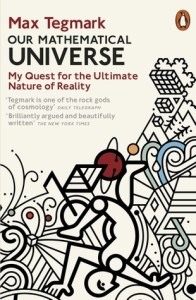
4.) Mathematical Universe Hypothesis: Max Tegmark proposes that the universe may be–at its core–a mathematical structure, making us self-aware substructures. This may sound like a different way of stating the preceding hypothesis, but not necessarily. The simulation hypothesis suggests certain motivations of a simulation creator. MUH doesn’t require a creator or an objective. It could be the nature of reality at it’s most basic.


3.) A Holographic Universe: This idea sprang from thinking about what happens to the information when something falls into a black hole. The idea being that the information is trapped on the outside of the event horizon–i.e. information for a three dimensional entity stored in two dimensions. As physicists pondered this, some concluded that it might be that we are a projection of data, or–alternatively–much of what we see when we look out into space is.


2.) One of Myriad Universes: The idea that our universe is one of many (or an infinite number of) universes comes in several flavors and is a prediction of several theories widely given credence. In some versions, all the universes have different sets of laws and constants such that many flash in and out of existence and only a small proportion are capable of hosting life (but the math of infinity is weird and a small proportion of the infinite may also be infinite. I don’t know, I’m not a mathematician and the infinite never mattered in economics because ground zero is that everything is limited but desires.) This answers the Goldilocks zone issue nicely–i.e. we couldn’t exist if the equations and constants that govern our universe were very much different, but if there are many universes with many sets of laws then we just happen to be in one of the ones we can be in–hence, credulity remains unstrained. Other versions propose universes with the same laws such that there could be an infinite number of you living out lives that may be slightly different than yours (or–for that matter–in which you might be the Supreme Galactic Overlord.)


1.) Time is slowing: A couple Spanish physicists have suggested that the universe might not be expanding at an accelerating rate (as is the consensus view in physics,) but rather time may be slowing. This slowing would be anticipated to continue until one final moment is captured frozen in time–note: said point would be long after the Sun swallows the Earth.

BOOK REVIEW: Our Mathematical Universe by Max Tegmark

Our Mathematical Universe: My Quest for the Ultimate Nature of RealityOur Mathematical Universe: My Quest for the Ultimate Nature of Reality by Max Tegmark
My rating: 4 of 5 stars

Amazon page


In this book, physicist Max Tegmark makes an argument for the possibility of a reality in which the universe is a mathematical structure a theory that predicts a Level IV multiverse (i.e. one in which various universes all have different physical laws and aren’t spread out across one infinite space [i.e. not “side-by-side.”]) Nobel Laureate Eugene Wigner wrote a famous paper entitled, “The Unreasonable Effectiveness of Mathematics in the Natural Sciences.” The article describes one of the great mysteries of science, namely, how come mathematics describes our universe so well and with such high precision. Tegmark’s answer is because the universe is fundamentally mathematical—or at least he suspects it could be.

The first chapter serves as an introduction, setting the stage by considering the core question with which the book is concerned, “What is reality?” The book then proceeds in three parts. The first, Chapters 2 through 6, discuss the universe at the scale of the cosmos. Chapters two and three consider space and time and answer such questions as how big is the universe and where did everything come from. Chapter 4 explores many examples of mathematics’ “unreasonable effectiveness” in explaining our universe with respect to expansion and background radiation and the like (a more extensive discussion is in Ch. 10.) The fifth chapter investigates the big bang and our universe’s inflation. The last chapter in part one introduces the idea of multiverses and how the idea of multiple universes acts as an alternative explanation to prevailing notions in quantum physics (e.g. collapsing wave functions)—and, specifically, Tegmark describes the details of the first two of four models of the multiverse (i.e. the ones in which parallel universes are out there spread out across and infinite space), leaving the other two for the latter parts of the book.

Part two takes readers from the cosmological scale to the quantum scale, reflecting upon the nature of reality at the smallest scales—i.e. where the world gets weird. Chapter 7 is entitled “Cosmic Legos” and, as such, it describes the building blocks of our world as well as the oddities, anomalies, and counter-intuitive characteristics of the quantum realm. Chapter 8 brings in the Level III approach to multiverses and explains how it negates the need for waveform collapse that mainstream physics requires we accept (i.e. instead of a random outcome upon observation, both [or multiple] outcomes transpire as universes split.)

The final part is where Tegmark dives into his own theory. The first two parts having outlined what we know about the universe, and some of the major remaining mysteries left unexplained or unsubstantiated by current theories, Tegmark now makes his argument for why the Mathematical Universe Hypothesis (MUH) is at least as effective at explaining reality as any out there, and how it might eliminate some daunting mysteries.

Chapter 9 goes back to the topic of the first chapter, namely the nature of reality and the differences between our subjective internal reality, objective external reality, and a middling consensus reality. Chapter 10 also elaborates on the nature of reality, but this time by exploring mathematical and physical reality. Here he elaborates on how the universe behaves mathematically and explains the nature of mathematical structures—which is important as he is arguing the universe and everything in it may be one. Chapter 11 is entitled, “Is Time and Illusion?” and it proposes there is a block of space-time and our experience of time is an artifact of how we ride our world lines through it—in this view we are braids in space-time of the most complex kind observed. A lot of this chapter is about what we are and are not. Chapter 12 explains the Level IV multiverse (different laws for each universe) and what it does for us that the others do not. Chapter 13 is a bit different. It describes how we might destroy ourselves or die out, but that, it seems, is mostly a set up for a pep talk. You see, Tegmark has hypothesized a universe in which one might feel random and inconsequential, and so he wants to ensure the reader that that isn’t the case so that we don’t decide to plop down and watch the world burn.

While this book is about 4/5ths pop science physics book, the other 1/5th is a memoir of Tegmark’s trials and tribulations in coloring outside the lines with his science. All and all, I think this serves the book. The author avoids coming off as whiny in the way that scientists often do when writing about their challenges in obtaining funding and / or navigating a path to tenure that is sufficiently novel but not so heterodox as to be scandalous. There’s just enough to give you the feeling that he’s suffered for his science without making him seem ungrateful or like he has a martyr complex.

Graphics are presented throughout (photos, computer renderings, graphs, diagrams, etc.), and are essential because the book deals in complex concepts that aren’t easily translated from mathematics through text description and into a layman’s visualization. The book has endnotes to expand and clarify on points, some of which are mathematical—though not all. It also has recommended reading section to help the reader expand their understanding of the subject.

I enjoyed this book and found it to be loaded with food-for-thought. If Tegmark’s vision of the universe does prove to be meritorious, it will change our approach to the world. And, if not, it will make good fodder for sci-fi.

View all my reviews