BOOK REVIEW: The Rape of the Mind by Joost A. M. Meerloo

The Rape of the Mind: The Psychology of Thought Control, Menticide, and BrainwashingThe Rape of the Mind: The Psychology of Thought Control, Menticide, and Brainwashing by Joost A.M. Meerloo
My rating: 4 of 5 stars

Amazon page


This book, first published in 1956, describes the various tactics used by Totalitarian states, and explores why some people stand up to them better than others. It discusses brainwashing, menticide (a term coined by the author), attaining false confessions, and the gamut of tactics of mental submission — be they active or passive in nature and whether they target individuals or the whole of society. The author, Joost Meerloo, was a Dutch psychiatrist who fled the Nazis, served as a Colonel and psychiatric expert in the Dutch military-in-exile during the Second World War, and then immigrated to the United States where he taught at Columbia University and continued his research on this subject.

The first question a reader might have is whether the book is worth reading, given that it was written so long ago and so many books have come since. In other words, does it hold up? It’s true that it’s a little bit of a mixed bag. On one hand, there’s occasional referencing of psychoanalytic notions that have fallen out of favor (e.g. Freudian ideas.) On the other hand, I found the section on technology as a means of indoctrination and mass manipulation to be even truer now than it was at the time. Meerloo was only thinking about radio and television, and couldn’t have imagined how technologies are being infused with lessons from neuroscience to make them, quite literally, addictive — or how even mass media is being tailored to appeal to various groups (granted this seems to be more demand driven, but its nefarious potential is apparent.)

I believe this book is a worthwhile read even more than sixty years later. The author had a lot of personal interaction with individuals affected by these tactics, and there is a great deal of insight. The value of the personal insight far outweighs the influence of any outmoded thinking. Further, I would say that the book is an interesting and informative read even if one isn’t interested in North Korea or any of the few other blatantly authoritarian nations still around today. If one is interested in questions such as why so many people can believe incorrect notions in the face of overwhelming evidence, this book provides food-for-thought on the topic. Even if one’s government is not authoritarian, in-groups may use some of these same tactics to influence members’s thinking.

While the book is famous for discussing the cases of the American soldiers brainwashed during the Korean War (i.e. the basis of the “Manchurian Candidate” novel and original movie [1962,]) Joost uses many examples from the Nazis — including a little of his personal experience — as well as Cold War stories (generally focusing on the Soviets, but touching upon the Totalitarian-style tactics of McCarthyism.) There are famous cases like Cardinal Mindszenty, but many lesser known cases with which the reader is unlikely to be familiar.

The book’s eighteen chapters are divided into four parts. Part I (chapters 1 through 4) expounds upon the tactics used to cause individuals to submit. Meerloo discusses how false confessions are elicited using techniques from Pavlov’s classical conditioning to drugs to manipulation by doctors to playing on the subject’s guilt. It should be pointed out that a central idea in this book is that it’s just a matter of time. It’s an idea that’s revisited later in the book when considering the ethics of sentencing for treason and when evaluating how to best train soldiers to hold out as prisoners of war. It’s true that some individuals are much more resistant to these techniques but no one holds out forever. One can become more robust to interrogation, but the idea is to do so in the hope that one can outlast the enemy.

Part II (ch. 5 to 9) discusses techniques for mass submission. This dives into how totalitarian leaders affect thinking by controlling semantics, the information available to the public, and by using fear through various methods including the surveillance state and show trials. One key concept is how having spies everywhere isn’t necessarily about gaining information so much as keeping the populace in fear so as to influence their behavior. It creates a steady state prisoner’s dilemma in which one never knows whether someone is going to roll over on one for his or her own benefit.

Part III (ch. 10 to 14) continues on the theme of mass compliance but with a focus on “unobtrusive coercion.” Running a totalitarian state isn’t all about torture, truth serum, and having spies everywhere. There is a soft power component to totalitarianism. This section explores this side of the coin with special attention to the roles of technology and bureaucracy. These chapters also consider how education and child development can be a tool of the dictator or authoritarian regime, and how indoctrination about concepts of treason and loyalty can be exploited by totalitarian governments.

Part IV (ch. 15 through 18) considers how individuals and societies can make themselves more robust against authoritarian tactics. This section delves into how members of democratic societies might best think about concepts of loyalty and treason in light of the fact that even the most stoic soldiers and spies can be weakened given enough time. There is one chapter that mirrors material in part III, except that instead of discussing how totalitarian systems use education to weaken and manipulate, this one suggests how education might be used to make a society of individuals less vulnerable to authoritarian arguments and tactics. This is also where Meerloo offers analysis of what traits tend to make one more robust to brainwashing and other totalitarian tactics and why.

There is no ancillary matter (i.e. graphics, appendices, notes, or bibliography) in the edition that I read. However, I can’t say that it was missed. The author uses many cases and anecdotes to make the book interesting to read, and much of it comes from the author’s personal knowledge.

I found this book intriguing, and would recommend it. As I mentioned earlier, one needn’t be exclusively interested in Nazi Germany, Stalinist Soviet Union, or countries like the DPRK (N. Korea) to find this book interesting. Sadly, the book has a lot to say of relevance to individuals in modern-day democracies.

View all my reviews

BOOK REVIEW: The Unthinkable by Amanda Ripley

The Unthinkable: Who Survives When Disaster Strikes - and WhyThe Unthinkable: Who Survives When Disaster Strikes – and Why by Amanda Ripley
My rating: 5 of 5 stars

Amazon page


Ripley investigates a range of disasters and tragedies – natural and man-made – with an eye toward her sub-titular question of who survives and why. Of course, in the process she answers the [often more interesting] converse question of who dies and why? By that I’m specifically referring to those who die while facing the same situations as survivors. i.e. Who dies having had the capacity to survive? Obviously, some people fail to survive because they face a fundamentally unsurvivable event (e.g. a plane explodes in mid-air with said person in it), but a surprising number die who could have walked to safety if they’d have managed to get moving – and some die because they play out a mental script that makes no sense contextually, e.g. trying to get a carry-on out of the overhead compartment as though one is at the gate at Heathrow Airport when in fact one is sinking into the ocean while the crashed airliner one is in is being buffeted by ocean waves.

Over the course of eight chapters, an introduction, a conclusion, and ancillary material, the author presents cases involving airplane crashes, tsunami, hurricanes, police shootings, hostage situations, fires, stampedes (of humans by humans), and even touches on the psychology of tragedies of a personal [rather than mass] nature (e.g. sexual assault.) A particular emphasis is given to events that the reader will likely be familiar such as 9/11 and Hurricane Katrina, but the book also opens up the reader to events they may have scarcely heard of from the many crushing deaths in Mecca during recent Hajj pilgrimages to the Halifax harbor incident of 1917. Along the way, the reader hears from survivors, heroes, and a wide-range of experts on subjects such as gunfights, risk perception, evacuation dynamics, the physics of crowds, evolutionary psychology, and emotional resilience.

After an introduction that sets the context for the book, the first chapter discusses one of the most salient features of whether ones lives or dies, delay. The case of the evacuation of the World Trade Center (WTC) on September 11, 2001 is used to examine why some people loiter about while others are johnny on the spot to hit the road. The WTC on 9/11 makes an interesting case because there were certainly people who died who could have survived if they’d had better knowledge or training. However, at the same time, it could have also been vastly worse if some of the people didn’t have the training they did (famously, a huge WTC tenant, Morgan Stanley, had a man in charge of emergency procedures, Rick Rescorla, whose persistent drills no doubt saved many lives [though he did not survive, himself.])

Chapter two discusses risk, and the weird way in which human beings perceive and respond to uncertainty. For example, the author describes Kahneman and Tversky’s Prospect Theory, which showed that a person responds to risk much differently if there’s a possibility of losing something rather than only of making gains. (Prior to work of these two social scientists, the prevailing view was that humans were rational actors, i.e. a $100 is a $100.) Prospect theory confirmed that anxiety mattered, and people didn’t just use their clockwork frontal cortex to calculate and compare expected values. (This may seem self-evident, but it began the process of up-ending the precise and predictable rational actor model from classical economics.)

Chapter three is entitled “fear” and it discusses that emotion and the various behaviors (and lack of behavior) that goes hand-in-hand with it, including: distortion of the experience of time, tunnel vision, and self-talk. (Panic and paralysis behaviors are each given their own chapter later in the book.) This chapter presented a fascinating discussion with a man who may have been involved in more shoot outs than any other police officer (the officer, no doubt, having a valuable perspective on how to respond in fearful situations.)

Chapter four is about the personality traits that link to resilience and the survivor personality. There is a fascinating discussion with an undercover agent in Israel, a man who faced a number of situations in which he had to coolly make a life-or-death decision in the way that most of us only experience in Hollywood movies. It should be pointed out that while we all admire such people when they save the day, the personality traits they display aren’t necessarily ones that we find desirable in daily life. Chapter five is entitled “groupthink” and it discusses the role that social dynamics play in survival, which is often considerable. Some survivors are people who would’ve perished if left to their own devices – i.e. if a more resilient stranger hadn’t taken them by the hand or shouted in their face.

The last three chapters discuss three relatively common behaviors that occur in the decisive moment of a tragedy. Chapter six discusses panic behavior. As it happens, there are some types of tragedies in which panic is almost unheard of and others in which it is nearly ubiquitous. Personality does play a role. Just as some people have personality traits that make them more resilient, others have traits that make them more likely to panic. However, researchers also found that there are characteristics – e.g. people feeling trapped but as if there’s a glimmer of hope of escape. [People who know they are unequivocally doomed are often surprisingly calm.] The chapter also offers some useful insights into how crowds kill people that may be useful for those who find themselves in massive crowds like those seen during pilgrimages or at any number of festivals in India (where human stampede deaths are disturbingly common.)

Chapter seven is about “paralysis” behavior. Readers may be familiar that there’s been a tendency of experts to add either one or two new “F’s” to the phrase “fight or flight” – such as “freeze” or “fright” – to describe other extremely common responses to severe sympathetic nervous system engagement. It’s common to dismiss such behavior as that of cowardly or milquetoast people, but the reality is more complex. On the evolutionary timescale, there was one tragedy that counted for an overwhelming percentage of such dire events — being in the jaws of an apex predator. It turns out that if a grizzly bear or lioness is atop you, freezing isn’t a bad strategy. You aren’t going to pop up and out run a tiger or defeat it in unarmed combat, your only hope may be to make it think you are a diseased carcass – i.e. shit yourself and lie limply. One has to train alternative behaviors; otherwise, the body does what is evolutionarily programmed into its genetic code.

The last chapter is on heroic acts and why some people engage in them when most people don’t. (Consider the people in the Titanic lifeboats who listened to people struggle and drown for fear that their [almost empty] boat would be swamped with clawing victims. Or, the case of Catherine Genovese who was screaming bloody murder for half-an-hour while being raped and stabbed to death while none of the 40-ish witnesses so much as called the cops.) As with the question of what makes a survivor, the answer to what makes a hero is a mixed bag. While we tend to idolize people who engage in heroic actions, the evidence suggests that the image of pure beneficence – lacking all self-interest – may be mythical. Many a hero is as much responding with a combination of subconscious mind and genetic programming as is the individual who burns to death 100 feet from an unlocked exit – just to vastly greater adoration.

I found this book to be fascinating. There are many books on this topic, but I think the author did an excellent job of choosing cases and experts to produce an interesting and informative read — even for a reader for whom this literature is not new.

View all my reviews

BOOK REVIEW: Running Flow Mihaly Csikszentmihalyi, et. al.

Running FlowRunning Flow by Mihaly Csikszentmihalyi
My rating: 5 of 5 stars

Amazon page


This book examines how Flow can be achieved by runners. Flow, in this usage, means a specific state of mind in which the activity at hand becomes effortless, self-criticism quiets, and one becomes pleasantly fixated on a task. It’s a term coined by the book’s lead author, Mihaly Csikszentmihalyi, based on his research into how some people were able to slip into a mental state in which even mundane activities could become an almost blissful obsession. This was part of a broader inquiry into how people can achieve a higher quality of life at work or at home.

The book is divided into two parts. The first four chapters lay out the concept of Flow in detail, and provide the necessary background for readers who may not be familiar with the concept. These chapters describe the role Flow can play in running, examine the components of Flow (i.e. necessary conditions and outcomes), and explain what personality traits are most conducive to achieving Flow.

The second part consists of five chapters, and it delves into how a runner can achieve Flow. Chapter five explores in detail three of the nine components that were introduced in chapter two, and tailors the explanation for runners. These three are the antecedents of Flow: clear goals, a match of challenge level and skill level, and immediate feedback. Chapters six and seven suggest the ways in which Flow can be facilitated in non-competitive and competitive runs, respectively. Chapter eight discusses the limits of flow. Because Flow is associated with feelings of effortless performance, some think of it as a sort of panacea for all that plagues their running. Furthermore, it’s not a state that easily happens and consistently returns; it’s often fickle and elusive. This chapter not only disabuses one of such notions, but also explains how failing to achieve Flow need not be the end of the world (or of one’s race.) The final chapter takes Flow beyond the concept of running and suggests what it’s pursuit can do for an individual more broadly.

The chapters use mini-case studies in which the authors describe the experience of professional runners in races and the effects of Flow on their performance and their experiences of races. There are numerous graphics. Many of these are color photos of the athletes who the authors spoke to, but there are also diagrams used to clarify key concepts. There is a glossary and references section as well.

I enjoyed this book. I’ve always thought of running as a task for which Flow would be hard to achieve because the matching of skill level to the amount of challenge is so crucial to achieving Flow and the movement pattern of running is so repetitive and monotonous. (The reason this matching is important is that if one’s skill level is far beyond the challenge, then one is bored, and if it’s the other way around, one is frustrated and overwhelmed – and neither boredom nor frustration facilitates Flow.) The book is a quick read that offers runners everything they need to make their mental experience of running more enjoyable and productive.

View all my reviews

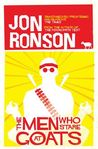
BOOK REVIEW: The Men Who Stare at Goats by Jon Ronson

The Men Who Stare at GoatsThe Men Who Stare at Goats by Jon Ronson
My rating: 5 of 5 stars

Amazon page


Ronson investigates the US military intelligence community’s forays into extrasensory perception (ESP) and mind control. Those who’ve seen the movie loosely based on this book will be aware of the quirky-humorous tone it takes. (If the title wasn’t enough to convey that the author was aiming for quirky humor.) Ronson’s style, favoring punchy simple sentences, offers a kind of deadpan delivery that supports the tone of the book.

That said, the book also has a sad edge as it can be seen as a commentary on military officers who came back from the war in Vietnam damaged and grasping at straws as to how to prevent history from repeating itself. It’s as if what these men experienced made some eager to believe because they so wanted to believe they could win with the mind and avoid the carnage of war.

While the book’s sixteen chapters are not divided by the author, they can be roughly divided into three parts. The first is the pursuit of ESP starting in the late 1970’s. This includes remote viewing and the titular psychokinesis (i.e. starring goats to death.)

The middle section is the resurgence of these esoteric approaches in the late 90’s and, especially, after 9-11 (also speaking to how dire blows to the psyche lead to wild approaches.) Much of this section is about mind control rather than ESP. One may remember the news story of the “I Love You, You Love Me” song from Barney [i.e. the purple dinosaur] being played over and over again to break terror suspects. The question remaining unanswered is whether there was anything else going on besides torture by Barney song (i.e. subliminal messages or sonic / ultrasonic frequencies [as used in non-lethal weapon technology.])

The latter section deals with the famous case of a scientist who jumped from a hotel room window to his death. It was later admitted that the scientist had been the unwitting victim of hallucinogen experimentation as part of the famed MKUltra project, and his death was written off as a trip gone bad. Ronson presents the story of the scientist’s son, a man who firmly believes that the story copped to was neither the full story nor the true story.

This book is interesting and entertaining, despite the fact that many of the questions that Ronson sets out to answer remain unanswered and probably always will. While the author got several key people to talk to him, the projects discussed are highly classified and the possibility of disinformation is ever-present.

Ronson manages to walk a fine line throughout the book. He presents all this quirky and bizarre activity in a way that neither comes across as mocking nor even particularly skeptical. (His punchy delivery does hint at this intention on occasion.) He lets the reader do the mocking and be the skeptic. At times he comes across as a believer. That is, while many of the happenings of the book reflect bat-shit crazy behavior / decisions, he suggests that all but the most hardened skeptics would believe that some of the people involved had inexplicable gifts.

I’d recommend this book. If you’re interested in government sponsored esoteric activities like psi and mind control and related scandals / conspiracies, you’ll find it fascinating. On the other hand, even if you’re not, it’s still an entertaining read that provides a sort of commentary on the effects of war on the psyche.

View all my reviews

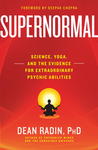
BOOK REVIEW: Supernormal by Dean Radin

Supernormal: Science, Yoga and the Evidence for Extraordinary Psychic AbilitiesSupernormal: Science, Yoga and the Evidence for Extraordinary Psychic Abilities by Dean Radin
My rating: 4 of 5 stars

Amazon page


With this controversial book, Dean Radin presents the scientific evidence for an array of psychic powers, but he frames the discussion in terms of yogic siddhis. “Siddhi” is a Sanskrit term for an ability that isn’t seen among the general population–at least not reliably so– and for the most part these “accomplishments” correspond to the categories discussed in parapsychology (i.e. telepathy, precognition, psychokinesis, and clairvoyance.) [Note: As mentioned, this is a controversial book. I will attempt to provide as unbiased a review as possible. I am generally skeptical, but don’t believe in poo-pooing the study of subjects because they offend my skeptical sensibilities. Furthermore, I try to keep an open mind because: 1.) there is no scientific consensus about what consciousness is or how it works, 2.) quantum biology is a subject in its infancy and we may yet learn there is more quantum “spookiness” going on in the brain than we think. 3.) for all I know we are in an simulation and then it’s all a matter of programming.]

The yogic emphasis doesn’t change the book much from the pop psych literature review of parapsychology studies it would otherwise be, except to necessitate background information on yoga and siddhis. However, this emphasis may or may not have opened up a huge additional readership. Outside of a fringe, siddhis aren’t much in vogue among yoga practitioners these days. Among modern day yogis and yoginis, there are some who believe in them and some who think they’re throwbacks to an era of superstition, malnutrition, and wishful thinking. However, even among the former, siddhis are generally considered a distraction. The advice of most of the great yogis has been to not get lost in the pursuit of such powers because chasing siddhis can derail one from one’s ultimate objective (e.g. liberation.) Still, if even a small fraction of yoga practitioners take an interest, that’s a fairly large readership.

So what exactly is the controversy? Obviously, there are many divergent demographics with differing views on the topic. For hardcore skeptics, parapsychology is right up there with alien abduction, bigfoot /yeti sightings, and the anatomy of the Loch Ness monster with respect to being a legitimate topic for scientific study. On the other hand, there are believers who are offended by the mere notion of studying such phenomena with science, and who say such investigations are an assault on their beliefs.

But that’s not a very interesting controversy—i.e. there are some people who won’t believe in such abilities no matter what the evidence, and others who will believe in them no matter what science has to say. So let’s chop off the hardcore skeptics and hardcore believers and ask what the controversy is as it pertains to those of us who consider evidence when drawing conclusions.

The root of the controversy can be stated rather quickly and clearly. Here it is: the effect size is small but statistically significant. What does that mean? Say this study asks a subject to determine which of five randomly selected shapes has been chosen using nothing but his / her mind. Using pure guessing, one would expect to be right 20% (i.e. 1/5th) of the time. If a person happened to get 32% right in a given trial, that means nothing because small samples don’t give one a convergence towards a mean value. (i.e. Intuitively, you know that if you flip a coin 10 times and get 7 heads, it doesn’t necessarily mean anything. If you repeat that 10-flip set 10,000 times, and still get 70% heads, then you probably have a trick coin or something else odd is going on.) So the issue is that even when experimenters repeat the experiment over and over again such that the average value should converge on 20%, it doesn’t. It stays at, say, 30% (exact effects vary but it’s on this order.)

At this point the reader might be thinking of all the factors that could result in this effect (i.e. cheating [insider or outsider], subconscious observation of facial expressions, random selection that is biased, etc.) Well, so have the scientists. In any study, one wants to account for alternative explanations to the utmost. Over the years, researchers like Radin have put all manner of protections in place from quantum random number generators to booths with extreme sound-proofing and Faraday cages (prevents radio signals from transiting.) Still they get this small positive effect that can’t be explained by alternative explanations.

There is also the issue of the filing drawer problem, which Radin devotes considerable space to discussing. It’s the idea that when drawing conclusions from many similar studies, one must accept that there may be many unpublished studies that sit in file drawers because they didn’t produced negative results. These filed / unpublished studies could negate the outcome of the body of studies of that nature. While this remains an open criticism, there is mathematics for determining how many negative studies would have to be turned up to make the results insignificant. Radin argues that the numbers calculated strain credulity.

So this “small but statistically significant effect” is generally agreed upon by all, excepting conspiracy theorists. Now we get to the controversy, which is how to explain this effect. Skeptics run the gamut from hot-blooded haters who claim that it’s all just a scam perpetrated by hoaxers with tenure, to more diplomatic challengers who provide thoughtful, plausible, and non-nefarious explanations for what they believe are false results. Said objections include file drawer problems, statistical “crud factor” (an observed effect in which large sample size studies can show a significant correlations between any two random variables—i.e. everything is correlated with everything else to some degree), and outlier effects.

The latter is a particularly revealing controversy. Say your study results in this 30% instead of 20% effect, and there’s one subject in the study who (over many trials) got the shape right 80% of the time. If you’re a skeptic, you call that an outlier and you want to cut it out of the study because it may be causing part, most, or all of the effect you see. Your assumption is that that this outlier could be anything from a data entry error to an outright cheater, but it’s obviously not a gifted psychic. If you’re a believer, not only do you want to keep that result, you want to find that person and study them to find out if the result was a one-time fluke, or if you have some rare, gifted person.

The book is arranged into three parts. The first part offers background on yoga and siddhis. The second part is the heart of the book and it presents an overview of results from studies of precognition, telepathy, psychokinesis (both of animate and inanimate objects), clairvoyance, and the effect of meditation on these abilities (which also shows a small positive effect, i.e. the general population outdoes probability by a little bit and experienced meditators outperform the general population by a little bit.) The last section is just a couple chapters about the future of parapsychology.

I found this book to be interesting and thought-provoking. Radin comes across as a reasonable investigator who is willing to accept that there is a lot of duplicity going on out in the world, but yet when one uses the methods of science one obtains results that would be generally accepted as successful across the social sciences. At times he does go on anti-skeptic rants. On the other hand, one can imagine his frustration in dealing with individuals unwilling to pin down how much higher the bar must be for parapsychology results over results in more mainstream topics. I think Radin’s greatest mistake was in discussing levitation. Besides at a quantum level, the effects of gravity are well-understood and non-negotiable. While our lack of understanding of consciousness leaves wiggle room to at least consider some unusual happenings, levitation seems a non-starter. Fortunately, as it hasn’t been studied, Radin just presents a couple historical anecdotes and moves on (while—to be fair–acknowledging the fundamental risk in relying on anecdotes.)

I’d recommend this book. I can’t say it swayed my belief on the topic, which tends skeptical, but it did inform my confusion. (It should be pointed out that not all these abilities are equally reviled by science. Precognition is the most fundamentally opposed because it seems to violate the fundamental cause and effect nature of the universe at our scale and larger [as opposed to the quantum level were all sorts of weird happenings transpire.]) I do agree with Radin that there shouldn’t be taboos in science in which scientists are afraid to study a subject of interest because the prevailing notion is that it probably doesn’t have merit. If there weren’t scientists with the cojones to study “crazy stuff” we’d no doubt be far behind our current understanding of the world.

View all my reviews

5 Thought-Provoking Novels About Mental Illness


5.) Veronika Decides to Die by Paulo Coelho

Premise: A young woman who attempted suicide is told that in the process her heart was damaged and she now has only five days to live. While it might seem that this would be all the same to a suicidal patient, it turns out to matter.


4.) Norwegian Wood by Haruki Murakami

Premise: The lead character, Toru, doesn’t suffer from mental illness, but his life is shaped by those who have. He must decide between two women. One of whom, Naoko, has been institutionalized since her boyfriend, Kizuki, committed suicide. Kizuki had been Toru’s high school best friend, and this weighs heavily in Toru’s feelings of obligation. Add into this Naoko’s roommate–a sage influence in Toru’s life, despite being institutionalized herself.


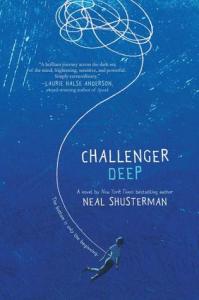
3.) Challenger Deep by Neal Shusterman

Premise: An adolescent boy, Caden Bosch, is transformed from a model student to a paranoid schizophrenic. The title refers to the deepest point on Earth, down in the Marianas Trench, and comes into play because the institutionalized Bosch believes he’s on a ship who’s Captain thinks all the treasure in the oceans got swept to the deepest point.


2.) Fight Club by Chuck Palahniuk

Premise: The unnamed narrator meets the eccentric Tyler Durden and soon Fight Club is born. It’s fueled by a feeling that men have been tamed to be turned into consumers. However, the underground fights are only the beginning, and our lead character is dismayed to discover that from the Club has sprung Project Mayhem with a nefarious terrorist plot.


1.) One Flew Over the Cuckoo’s Nest by Ken Kesey

Premise: Randle McMurphy has convinced authorities that he’s insane for the purpose of getting out of hard labor in prison and into a “cushy” insane asylum. The ward is run by the iron hand of Nurse Ratched. McMurphy on the other hand is rebellious and unruly. The clash is inevitable. McMurphy increasingly disrupts Ratched’s sedate and harmonious ward (re: heavily drugged and cowed into submission.) The story is told from the perspective of a patient named Chief Bromden who has the staff convinced that he’s deaf and mute. Like McMurphy, he’s not what he appears. The book is a scathing indictment of how mental health care was conducted in Kesey’s day.

5 Minds You Meet in Meditation


No matter what style of meditation you practice, you’ve probably heard the following refrain: “And if you find your mind wandering, non-judgmentally make a note of where your mind went, and let that thought drift away as you return your awareness to __________.”


I’ve certainly heard many takes on that teaching, and had plenty of opportunity to implement that advice. In the process, I’ve noted that the places my mind wanders can be classified into several categories.


5.) The Planner: Our conscious mind is first and foremost about answering the question, “What’s the worst that can happen, and how can I make that worst case less bad?” The mind wants to anticipate undesirable events and either make an end run around them or figure out a way to make them less troubling. The Planner wants to rehearse everything from making dinner to being interviewed for a job to having a dreaded conversation.


4.) The Entertainer: This is the mind that sticks songs in your head and replays clips of movies.


3.) The Walter Mitty / The Bolsterer: This is the daydream mind which cooks up scenarios in which you are the hero.


2.) The Subconscious Image Generator: In a relaxed state in which the conscious mind is quieted, one may find oneself seeing images that probably don’t make a lick of sense. The pictures may come and go in a way that make them hard to maintain even a glimpse of. This is the same kind of imagery that one experiences in the hypnagogic state–as one is drifting towards sleep.


1.) The Critic: Saving the most despicable for last; this is your inner critic. The one who thinks that you won’t succeed at any given task.

BOOK REVIEW: Perv by Jesse Bering

Perv: The Sexual Deviant in All of UsPerv: The Sexual Deviant in All of Us by Jesse Bering
My rating: 4 of 5 stars

Amazon page


“Perv” is an examination of human sexuality outside the norm. As one might expect from the back blurb mention of a woman who was aroused by the Eiffel Tower, the book provides many a revelatory “things-that-make-one-go-HUH?” moment. The author’s humor–and willingness to offer cringe-worthy personal confessions–makes the book all the more readable. (e.g. As an example of the author’s humor: “As an adolescent male, you’re basically an ambulant sperm factory with an incompetent foreman…”) The book is in the vein of Mary Roach’s “Bonk” (something about sexuality triggers the urge to go monosyllabic), but Bering carves out his niche in deviant territory, while Roach’s book provides a more balanced look at the subject (although both books exploit anomalies to make for interesting reading.)

There are two ways in which this book wasn’t the one I expected, one of which is entirely my fault for reading too much into some words in the book blurb while ignoring others. I think the author and/or publisher must take some responsibility for the other as the subtitle itself leads one to expect a different emphasis in the book beyond the first chapter. First, I expected more insight into why people engage in these behaviors. Are there explanations rooted in our evolution? Does a given act result from some cross-wiring in the brain? There’s a cursory mention of science in the book’s description which led me to expect it to go much further beyond a cataloging of anomalous sexual behavior. To be fair, the author does back load an interesting discussion on the role of theory of the mind into the last chapter and there is some of this discussion throughout. However, the book spends much more time on history and semantics than I expected. Semantics sounds boring, but there are some fascinating insights into how words came to be used, and how usages have changed over time. (Also, the reader may be surprised at the huge vocabulary of “-philias” [objects of love / attraction] that’s not unlike the more well-known one for “-phobias” [fears.])

The second way this wasn’t the book I expected was that—owing to the subtitle “the sexual deviant in all of us”—I expected much more discussion of widespread but unconventional sexual proclivities (e.g. exhibitionism, voyeurism, dominance / submission, role-play.) Instead, Bering spends a lot of time discussing rare fetishes for materials, animals, objects, etc, and also extremely high-profile (but also rare) proclivities such as pedophilia and vovarephilia (cannibalistic arousal.) One can see the appeal from the book selling perspective. Said emphasis provides a lot of WTF and giggle-inducing moments to keep up the reader’s interest. However, if you’re expecting drilling down into [no double entendre intended] why people engage in these activities, mostly you’ll get playful variants on “the heart wants what the heart wants” and not so much insight into whether there are unseen Darwinian mechanisms at work or whether there’s some synaptic cross-wiring. I doubt this is a conscious attempt to avoid dealing with the un-PC ramifications of finding some deviant behaviors to be explicable in terms of brains that are operating within expected parameters while others may only be explained in terms of something not working as usual. I doubt this because Bering seems quite willing to take the book in uncomfortable directions. I’m not certain that there’s not an unconscious bias away from considering the “why” questions because it risks putting one in the cross-hairs even if one reports in an objective and non-judgmental way. (Perhaps there’s a lack of scientific findings to report for the same reason.)

Still, while I didn’t get the book that I expected, there were some surprising bonuses to weigh into the mix. Bering provides interesting food-for-thought on a few topics. One of these is what he calls the “naturalistic fallacy,” which is the idea that whether an activity can be considered acceptable depends upon whether one sees it elsewhere in nature (i.e. besides humanity.) This has been used over the years to divide acceptable from unacceptable “perversions”—often by people who had little to no idea what activities are or aren’t seen across the animal kingdom. (We do, after all, see monkeys literally throwing their poop.) Another challenging area of consideration is whether society’s extreme distaste for pedophilia leads us to write laws that actually exacerbate child abuse and exploitation (e.g. completely CGI [computer generated imagery] pornographic material is illegal, and—according to the author—there is reason to believe that–were it not—exploitation of children would decline.)

The book consists of seven chapters. An introductory chapter sets up the idea of sexual deviance and its changing definitions. Chapter 2 is about the many ways in which people manage to overcome their instincts toward disgust in order to engage in sexual activities. Chapter 3 looks at various forms of hypersexuality (e.g. nymphomania) and the changing definitions over time—and the biases contained therein (i.e. it was once thought to be a condition only females could experience.) Chapter 4 considers various paraphilias—i.e. unconventional sources of arousal. Chapter 5 deals with the subjective experience of many of these sexual behaviors and how that brushes up against societal norms. Chapter 6 delves into the topic of age and attraction discussing pedophilia, hebephilia, ephebophilia, teleiophilia, and gerontophilia. Of these, the vast majority of people are teleiophilics (attracted to full-grown adults) with hebephilic and ephebophilic tendencies not being uncommon (i.e. attraction to pubescent or post-pubescent youths.) Much of the discussion is about pedophilia and the legal entanglement of pedophilia and ephebophilia. Chapter 7 delves into the science and psychology in a way that I wished the rest of the book had.

There are no graphics in the book. It does have both chapter end-notes and bibliographic notes (the former being more foot-note like elaborations and the latter being mostly sources.)

I found this book interesting. It was more historical and semantic (dealing in the terminology of deviant sexuality and its changing nature over time) and less scientific and psychological than I expected, but it was still loaded with interesting information and insights. I’d recommend this book with the provisos mentioned, i.e. that it might not be the book you expect and may deal much more in rare proclivities than one expects.

View all my reviews

5 Tools to Hulk Your Way Out of Your Comfort Zone


5.) Take a class / Join a group: While I’m partial to yoga and the martial arts, the class could be in any area that presents a challenge.  However, there are a couple of advantages to the aforementioned two (to which I would add dance.)


First, these disciplines train one to be expressive with one’s body and to move more freely. This can do wonders for confidence. People store tension in their bodies without even realizing it. Many have postural problems that effect confidence and self-perception.  A 2014 New Zealand study found that posture can have a strong effect on emotional state.


Second, no matter who one is, one will be challenged by new approaches to movement.  The average person has great difficulty learning to use their body in new ways. One needs to drill in movements conscientiously to achieve competency. Our conscious mind, frequently gets in the way. Even the most athletic and coordinated people will need to work it, failing repeatedly until they succeed.


Why is the challenge so important? Many people go through life afraid to fail, but far too few fear never failing. Sounds idiotic. Nobody wants to fail. I have some hard news. If you’ve never failed, it’s not because you are unmitigatedly awesome in all things. It’s because you’re living in a box and cherry-picking life experiences that feel unthreatening.


If, like me, you’re an introvert, this approach offers the additional benefit of social interaction that is of a predictable / schedulable nature. One needs the interaction, but the problem comes when one has social interactions and / or sensory stimulation that go on too long and in an unpredictable fashion. Therefore, being able to schedule such time is a good way to go about being a more productive introvert.


4.) Writing  / Visualization:  These two approaches to mentally rehearsing allow one to keep one’s inner critic in check. The problem with simply day-dreaming it is that critic can chirp in without being that cognizant of it.

In visualization, one quiets the mind and can then non-judgmentally acknowledge and dismiss the negative thoughts. In writing–be it as a journal entry, poem, or a story–we may not notice the nagging voice of the inner critic on the first draft, but you can take note of it and undo it in rewrites.


3.) Travel / Living abroad: I should point out that not just any old travel will have the desired effect. Many people plan their travel with the objective of being comfortable at the fore.  They eat at places that serve the same kind of food as at home. They stay in hotels with virtually all of the comforts of home, and sometimes many more. This is understandable because the traveler might just be seeking rest.  However, if one is seeking the epiphany or enlightenment experiences talked of by backpackers and ashram-dwellers, that’s not something that comes from staying in resorts or eating at American fast food joint. Those kinds of brain changing experiences come when one is stripped from the familiar and has to surrender one’s attachments to the way one thinks the world should be. One’s perception of culture and worldview changes radically when immersed in a foreign environment.


2.) Game it / Roleplay: There’s a big movement to gamify all manner of everyday activities.  In her book, “Reality is Broken,” scholar of game design Jane McGonigal describes a game called “Chore Wars” that incentivizes the doing of mundane household chores.


What is it about games that help one move beyond one’s limits? First of all, it incentivizes actions. And if you’ve ever noticed people playing games on their phone or FB for hours on end, you’ll note that it doesn’t take much reward to keep people plugging away—as long as the game is structured well.


Second, good games provide a built-in process of “leveling up.” This means that the challenge keeps being intensified as our skill level advances. Those familiar with Csikszentmihalyi’s conception of “Flow” will recognize that matching skill level to challenge level is one of the most crucial elements in facilitating flow-state.


Roleplaying is a bit like the previously mentioned tools of visualization and gaming in that it’s a way to have a low-cost rehearsal. If one has someone with whom one can engage in such a roleplay, than one also has someone to help make you aware of your inner critic and its deleterious effects. And that brings us to the final tool:


1.) Have a spouse, partner, and or confidant: In “Why Zebras Don’t Get Ulcers” Robert Sapolsky tells a story of being interviewed by a magazine. He was asked what the number one thing that they could tell their readers about reducing stress.  To which he replied that the most well-established factor in stress reduction is to have a spouse / life partner with whom to share one’s challenges.  Unfortunately, this was a magazine for women business leaders, a significant portion of whom had given up on permanent relationships and families. They, therefore, asked him what else he had.  Still it’s hard to overlook the anxiety-fighting effects of having someone around with whom to share one’s dread.

BOOK REVIEW: Wired to Grow by Britt Andreatta

Wired to GrowWired to Grow by Britt Andreatta
My rating: 3 of 5 stars

Amazon page


This is one of those books that is hard to rate and review. It does a thing well, and if one is looking for a book of its strengths, it’ll serve one well. That thing it does well is to concisely and clearly summarize research in neuroscience relevant to learning new skills. If that is something one is interested in, and one hasn’t done much reading on the subject yet, this book will get one up to speed in just over 100 pages while offering insight into where to go to flesh out what one has learned.

That said, if one has read up on pop-sci neuroscience and /or self-help books applying said research, one is likely to find that this book offers little value-added while lacking the depth and narrative approach of competing works. The latter is particularly intriguing as this is a book about effective learning, and it seems clear that humans like learning through stories. However, Andreatta does little story telling beyond brief mentions of approaches she’s used in her seminars and occasional recaps of the stories of the researchers whose work she’s drawn upon. Some may find this isn’t so bad because it keeps the book compact. Story telling is page intensive. On the other hand, a lack of story-telling means that the material is a bit less prone to stick than it might otherwise be.

The author’s approach to making the material stick is to hang it on a three-phase model (learn-remember-do) and to keep it brief. Many of the chapters consist largely of bullet points, and in places the book feels like a PowerPoint handout. (I’ll let the reader decide whether that’s a good thing or not.)

The book is organized into twenty chapters arranged in five parts. (That tells one a lot about the brevity of chapters, given the book is 102 pp.) The five parts consist of: I.) an overview of neuroscientific fundamentals; II.) a description of research related to the “learn” phase of Andreatta’s model; III.) the same for the “remember” phase; IV.) coverage of the “do” phase; and V.) a section called “design” that helps the reader to apply what they’ve learned in the earlier parts to build approaches to teaching and learning.

There is some useful ancillary material. First, there are many graphics of a variety of types (pictures, line drawings, tables, and graphs) that are nicely drawn and effective. Second, there are “Your Learning Journey” sections interspersed throughout the book. These are one page or less exercises that are designed to help one put one’s learning to use. Thirdly, there is a bibliography that includes crucial reference materials divided by type: i.e. journal / scholarly research, books, journalistic / media accounts, and cited scholars. Finally, there are apparently additional resources accessible online, e.g. downloadable pdf files, but I didn’t investigate these features.

I would recommend this book for those looking for a concise summary of recent developments in neuroscience as they apply to education and learning. If you’re well-read on the subject, however, you might not find that this book delivers much extra. It should be noted that the author is speaking from an educator’s perspective (i.e. not a scientist or psychologist) and readers may find that a plus or not.

View all my reviews