PROMPT: Disagree

Daily writing prompt
What public figure do you disagree with the most?

These days? Trump — hands down. Beyond a few of his stated policy objectives, there is more and more I disagree with every day. (I emphasize “stated” because there is so little that’s coherent in his actions to prove he is really interested in advancing said objectives.) For example, I do agree that the swelling deficits (budget and trade) are something that should be treated as unsustainable. I’m not of the “a current account deficit is just a capital account surplus, so turn that frown upside-down” ilk. However, erratic and untargeted tariff policies that hurt successful sectors (e.g. agriculture and services) and which will only put the toothpaste back in the tube (bring [human] factory labor back to the US on a huge scale) by crashing the US into Third World status are not the way.

I disagree with this inexplicable monomaniacal obsession with heavy industry, while injuring those sectors that have done well in recent decades.

I agree with… Powell, that there is a high chance of stagflation if the Fed takes a loose money stance. The problem is… Trump. Ordinarily, it would be good to dump some money on an economy that is struggling. But the problem is that Trump is like a salesperson that would like to sell customers something, but he also enjoys chasing them around the store with an axe. The problem is that people and companies don’t make big purchases when they are afraid and the future is uncertain. (This is why even getting investment in robotic factories isn’t happening.) There’s uncertainty because of the tariffs. There’s uncertainty about whether companies will have to pay bribes to Trump, personally. There’s uncertainty about whether the legal and institutional frameworks that have so long made America an appealing place to invest and innovate will survive. So, if the Fed injects money but consumer confidence and investment are flat because of said uncertainty, then that money will be purely inflationary. [Remember, inflation is too much money chasing too few goods. More money needs to meet more demand for stuff.]

I disagree that one can have one’s cake and eat it, too. Specifically, tariffs need to be either for revenue generation or for policy negotiations, they can’t be both, but Trump talks like he doesn’t understand this. If tariffs are going to be the new primary source of government income, they need to bring in money sustainably. If they are a negotiating tool to lever policy, you need to be ready to negotiate them away in return for your own objective wins.

I definitely disagree with the ignoring of Supreme Court decisions. It’s particularly disconcerting to see him ignore 9 – 0 decisions, which means that even his own appointees could not find a hairsbreadth of wiggle room in the law by which his actions could be viewed as lawful.

I disagree with picking a raft of pretty-idiots / talking-heads for positions that require high levels of emotional intelligence and — you know — intelligence intelligence. If it weren’t for the fact that America has the most awesome and professional military in the world, I’d be especially afraid that Hegseth was going to destroy it. But while I think the US Military will be around long after he’s gone, I’m suspect he will have done damage to morale and operational efficiency.

I disagree with favoring dictators over longtime allies. [While I would agree that it’s good that Europe is taking on more of the burden of their own defense, I’m concerned that trashing relations to do so will not prove a sound approach.]

I disagree with all the attempts to play from the Putin-Orban Populist Dictators’ Playbook.

While I’m not at all averse to seeing cuts to the Federal bureaucracy, I do disagree with — you know — firing people before you understand what they do and whether it’s critical to health and safety, the necessary conduct of governance, or oversight against fraud and abuse.

I disagree that one should talk about making loophole end-runs around Constitutional prohibitions.

But, I ramble on…

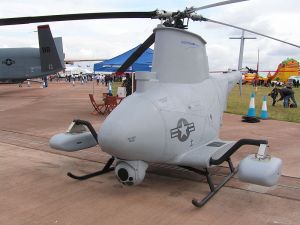
Drones over Des Moines: or, UAV’s in the Heartland

Source: Wikipedia; User: Dammit

Source: Wikipedia; User: Dammit

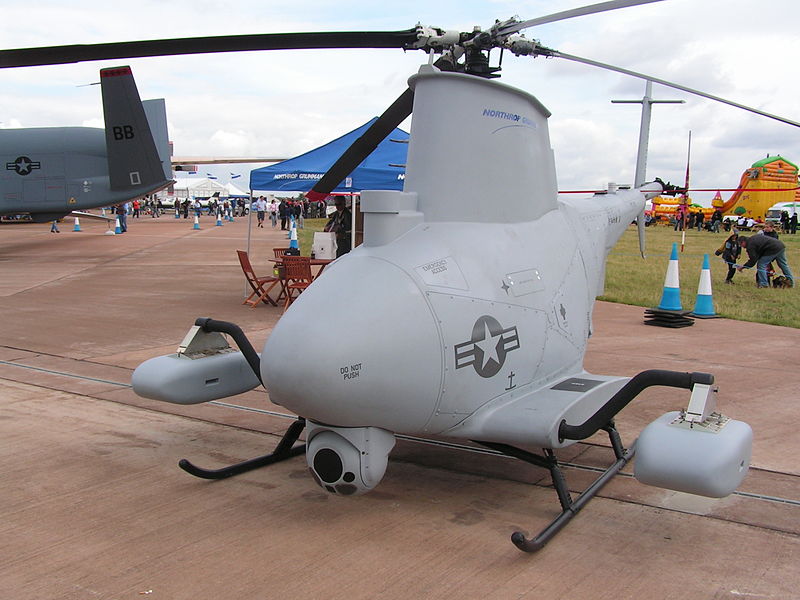
National Geographic has an interesting and well-timed article in this month’s issue called The Drones Come Home. I say well-timed because of all of the attention that Senator Rand Paul’s recent filibuster received. Senator Paul was filibustering the nomination of John Brennan as CIA Director, but his true purpose was to bring attention to the lack of transparency on policy regarding the use of drone strikes on U.S. soil. You’ll recall from your Civics classes that the 5th and 6th amendments (supported by other laws) require legal due process be conducted before anyone gets, to use the mafia-esque term, “whacked.”

The impetus for all this discussion of drones is the Obama Administration’s 2012 direction to the Federal Aviation Administration (FAA) to open the skies to Unmanned Aerial Vehicles (UAV’s) by September 30, 2015.

It should be noted that the use of armed drones for execution missions is only the most dramatic of many legal issues that will arise with the proliferation of this technology. The National Geographic article devotes more space to the use of drones by state and local law enforcement than they do to that of the Federal government.

Some other new legal considerations will include:

Searches:  I suspect that well before any government is terminating U.S. citizens at home with such devices, they will be using them for surveillance and investigation (i.e. spying.)  The Constitutional standard is that law enforcement can act on any evidence that can be seen from a place they legally have a right to be. So if you’ve got a stolen car in your front yard, they can arrest you.  However,  if the police get an anonymous tip that there is a stolen car in your backyard under your deck, things are trickier. They can ask you to see your backyard, but you can say no. They can ask a neighbor if the neighbor will allow them to look from the neighbor’s property onto yours, but, if that’s unsuccessful, they’d better be able to impress a judge sufficiently to obtain a warrant.

However, what  happens with UAV’s? Now the law enforcement officer can be parked perfectly legally on the street while his “eyes” are hovering over your backyard.  Your property rights overhead are not established (unless you are getting a check every time Delta flies over your house–I’m not.)

Extensions: What about peaking in through your window with an aerial telephoto lens? What if it’s not law enforcement, but rather the Neighborhood Watch? What if it’s not even the Neighborhood Watch, but rather the crotchety retiree at the end of the block who has self-appointed himself neighborhood watchman because he’s bored to tears… and more than a little bitter?

Sovereign Immunity: Many governments have laws that prevent you from suing them. So what happens given a scenario suggested in the National Geographic article, the government’s UAV falls out of the sky and it’s rotor-blade slices open the jugular of your four-year old daughter as she is innocently playing in the sandbox in your back yard?

There are many who are concerned that this technology is not perfected. The military is having its share of problems, and they are spending billions on UAV’s. Imagine what will happen when local governments, corporations, and other cash-strapped entities begin flying more low-budget versions?

Personal No Fly Zones: Despite the tenuous legal situation regarding the “airspace” over one’s head. You know that, sooner or later, someone will try to enforce a no-fly zone over their property. So what happens when a person sees that Sheriff’s department UAV peeping through their window, and they blast it out of the sky with a 12-gauge shotgun?

Of course, there will be a whole new wave of issues that will arise as the autonomous UAV’s are perfected. By “autonomous” I mean ones that don’t need a remote pilot, but are more “fire-off and forget.”

Was the Fukushima-Daiichi Incident the Final Nail in Nuclear Energy’s Coffin?

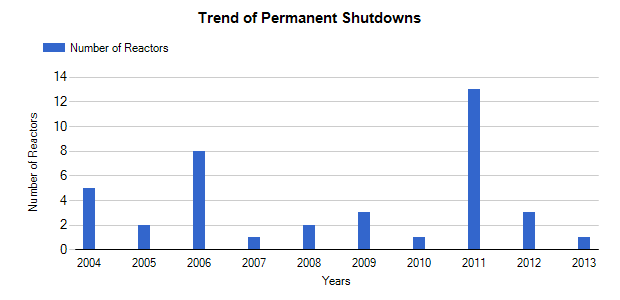
Today is the two-year anniversary of the tsunami that swamped parts of eastern Japan. Among the ongoing effects of this event was a re-chilling of attitudes toward nuclear energy–undoing a thaw that some swore was imminent. The tsunami hit the Fukushima-Daiichi plants and knocked out generators that were needed to run the coolant pumps with the power lines down. In the days after the disaster, the release of radioactivity and explosions of built up hydrogen presented some of the most prominent news stories.

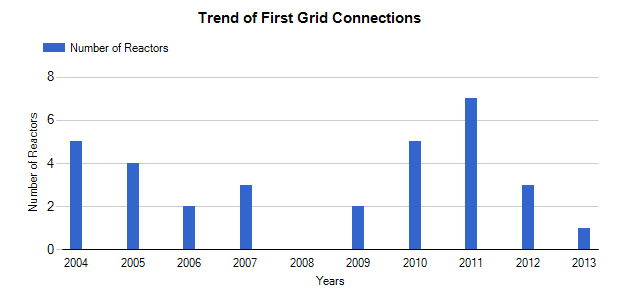
Japan obtained about a third of its energy from nuclear prior to the event. All reactors were shut down in subsequent months, at no small cost to their economy. Eventually, a couple of plants were brought back on-line, providing only a fraction of the electricity of the country’s full fleet of 50+ nuclear plants.The Japanese had plans to add another 15 plants to their reactor fleet at that time, plans that have since vanished.

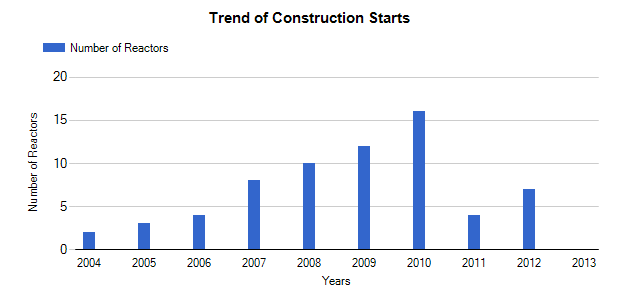
Even China, the world’s most prolific builder of nuclear plants as of late, had a brief moratorium on nuclear power plant (NPP) construction. However, China seems to have regained its ardor for nuclear power. France, of course, won’t be dissuaded either. However, for much of the rest of the world, doubts remain.

Pictures may be worth a thousand words.

Source: International Atomic Energy Agency (IAEA) Power Reactor Information System (PRIS)

Source: International Atomic Energy Agency (IAEA) Power Reactor Information System (PRIS)

Source: IAEA PRIS

Source: IAEA PRIS

Source: IAEA PRIS

Source: IAEA PRIS


The Nuclear Renaissance and International Security

Edited by Adam N. Stulberg and Matthew Fuhrmann

2013, Available Now

Buy this book

ONLINE RESOURCES
Contents

Contributors

Introduction