Five Wise Lines from Macbeth

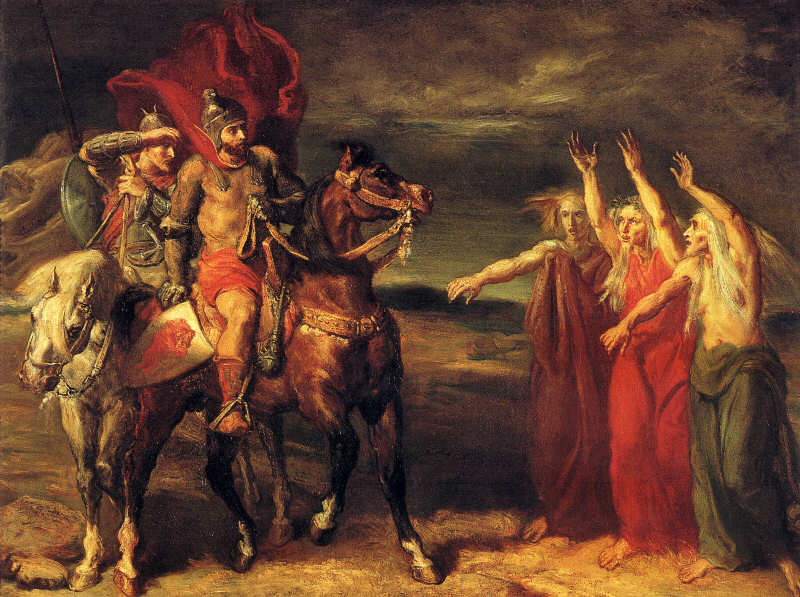
Macbeth & Banquo Encounter the Witches
by Theodore Chasseriau

“There’s no art to find the mind’s construction in the face.”

Duncan in Act I, Scene 4

“Bloody instructions, which, being taught, return to plague the inventor.”

Macbeth in Act I, Scene 7

“when our actions do not, our fears do make us traitors”

Wife of Macduff in Act IV, Scene 2

“Then the liars and swearers are fools, for there are liars and swearers enough to beat up the honest men and hang them up.”

Son of Macduff in Act IV, Scene 2

“Life ‘s but a walking shadow, a poor player, that struts and frets his hour upon the stage and then is heard no more. It is a tale told by an idiot, full of sound and fury signifying nothing.

Macbeth in Act V, Scene 5

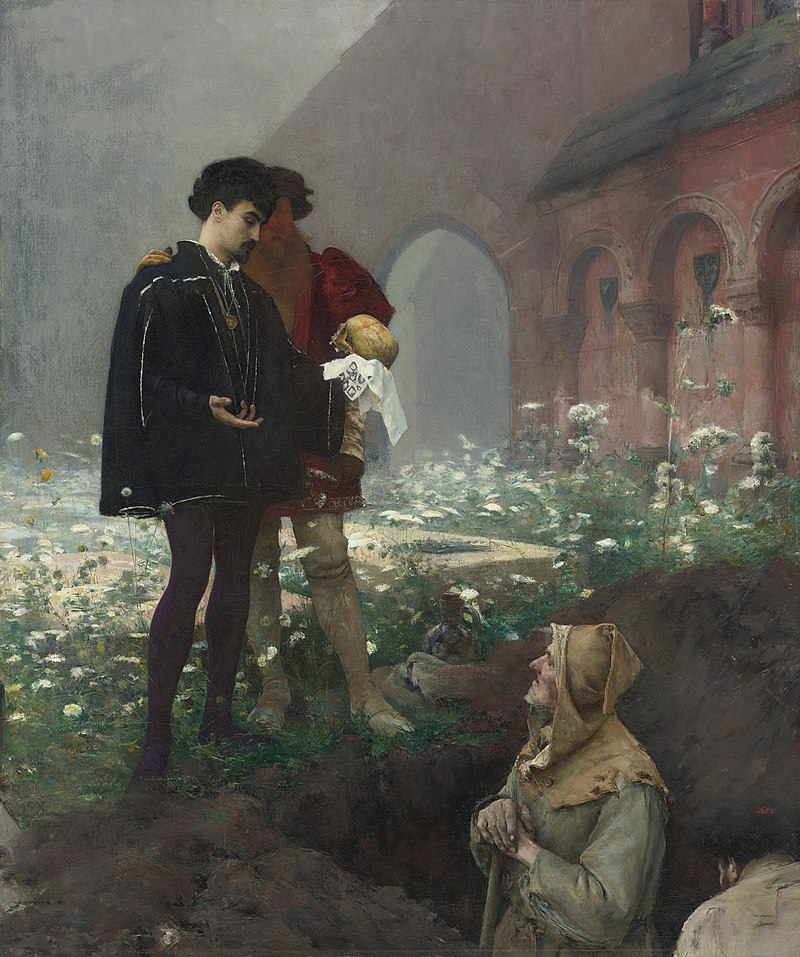
Five Wise Lines from Shakespeare’s Hamlet

We fat all creatures else to fat us and we fat ourselves for maggots… a king may go a progress through the guts of a beggar.”

HamLet to Claudius in Act IV, Sc. 3

One may smile, and smile, and be a villain.

Hamlet to Queen Gertrude in Act I, Sc. 5

I could be bounded in a nutshell and count myself a king of infinite space, were it not that I have bad dreams.

Hamlet to rosencrantz & Guildenstern in Act I, sc. 2

Brevity is the soul of wit.

Polonius to claudius & gertrude in act II, sc. 2

A knavish speech sleeps in a foolish ear.

hamlet to rosencrantz in act IV, Sc. 2

BOOK REVIEW: Supernatural Shakespeare by J. Snodgrass

Supernatural Shakespeare: Magic and Ritual in Merry Old EnglandSupernatural Shakespeare: Magic and Ritual in Merry Old England by J. Snodgrass
My rating: 4 of 5 stars

Amazon.in Page

Like – I suspect – most of humanity, I’m a big fan of Shakespeare’s work, but I’m also not alone in feeling that I’ve missed a some of the depth and texture of his plays. Both language and the body of common / popular knowledge have evolved and migrated tremendously since the Elizabethan era. This makes a market for books that offer insight into the age and the role that the beliefs, norms, and daily life played in Shakespeare’s theatrical works. This book is one such work. It focuses on the role supernatural beings and various festivals play in the Shakespearean canon and why they do so.

Conceptions of the supernatural may be one of the areas in which human beliefs have changed most severely since Shakespeare’s day. The book has chapters on witches, ghosts, fairies, and enchanted forests that are interspersed among chapters that deal with various seasonal festivals of Pagan origin. I did find this leapfrogging around a bit odd, but I would speculate two possible reasons for it. First, the author may have wanted to build cyclicality into the overall organization, and thus put beings and creatures that seemed thematically related to a season near its festivals. Second, it may have seemed like a good idea to break up the festivals because that discussion could have felt tedious to a general reader if it’d been clumped together (as opposed to the “sexier” topics of witches and ghosts and the like.) This organization didn’t bother me; it just seemed a bit strange, but I could imagine it being for the best.

I learned a great deal from this book, and my newly gained knowledge wasn’t all about the supernatural elements of Shakespeare. The author dropped some fascinating facts regarding other domains as well – such as Elizabethan sexuality and lifestyles as well as biographical facts about Shakespeare. If you’re looking to expand your understanding of background information relevant to Shakespeare’s plays, this book is worth looking into.

View all my reviews

BOOK REVIEW: The Medea by Euripides [Trans. Gilbert Murray]

The Medea of EuripidesThe Medea of Euripides by Gilbert Murray
My rating: 5 of 5 stars

Amazon.in Page

Project Gutenberg

This tragedy follows up the myth of “The Golden Fleece.” That hero’s journey culminated in three trials which Jason (of Jason and the Argonauts) must complete in order to acquire the golden MacGuffin. Jason succeeds in large part because (arguably, entirely because) Medea, daughter of the fleece’s owner, i.e. King Aeetes, gives Jason some potions to make the trials a cinch. She does this in exchange for Jason’s everlasting love.

And, herein, lies the heart of this play’s conflict. Jason – like many heroes of Greek Mythology – is kind of a jerk. In flashing forward to the beginning of this play, we find Jason has traded Medea in for a younger and higher stature wife (i.e. a princess whose father doesn’t despise and disown her). [Note: Technically, Medea may not be married to Jason because of legalities, but she did bear him two boys.] To add insult to injury, Jason’s new father-in-law (King Creon) insists that Medea and her two boys be exiled, effective immediately.

What makes this play so fascinating is that we have sympathy for Medea’s plight, but then her inner monologue turns to the nuclear option she will employ – killing Jason’s new princess-wife and, more disconcertingly, her own children. Medea goes back and forth about her plan, showing reluctance to kill her boys, at least. So, the reader (viewer) ends up finding Jason loathsome because he steadfastly refuses to accept any blame for how poorly things have gone, but – on the other hand – he’s being more reasonable. (i.e. He talks kindly and isn’t murdering anyone.) It’s a fascinating reflection on the battle between rationality and passion.

I’d highly recommend this play. It’s a short and straightforward story, but it does present a great deal of food-for-thought.


View all my reviews

BOOK REVIEW: Henry VIII by William Shakespeare

King Henry VIIIKing Henry VIII by William Shakespeare
My rating: 5 of 5 stars

Amazon.in Page

This play takes place over a period of time, for want of a better measure, straddling the first two [of six] marriages of Henry VIII. It doesn’t reach the ill-fated end of Anne Boleyn, but rather finishes with the baptism of the girl child she birthed [Elizabeth, who will later be Queen.] [Of course, the failure to produce a male child was the downfall of Katherine of Aragon’s Queenship, so the birth of Elizabeth doesn’t bode well.]

In as much as a history has a theme, this one would be the conflict between the aristocracy and the clergy. This is first, and most extensively, seen through the rise and fall of Cardinal Wolsey, who wins the favor of the King in the Cardinal’s conflict with the Duke of Buckingham, but later Wolsey gets ousted after an aristocratic cabal diverts the Cardinal’s mail to the King. Henry discovers that Wolsey has recommended denial of an annulment of Henry’s marriage to Katherine, despite the fact that Wolsey was telling the King to his face that the marriage’s end had his endorsement. Later, we find aristocrats (the King’s Council) taking on the Archbishop of Canterbury, Cranmer, but Henry sides with the Archbishop as he once had with Wolsey.

The play’s major events are the execution of Buckingham, the divorce from Katherine, the marriage to Anne Boleyn, and the birth of Elizabeth.

This isn’t the most compelling of the Shakespearean histories, but it does have its intrigues. No doubt it would be a bolder play in the absence of the authoritarian nature of monarchy, but it’s still worth reading.

View all my reviews

BOOK REVIEW: The Clouds by Aristophanes

The CloudsThe Clouds by Aristophanes
My rating: 5 of 5 stars

Amazon.in Page

This play scoffs at philosophers and sophists (in general) and Socrates, in particular. An old man, Strepsiades, is beleaguered by creditors, having purchased a horse and chariot for his son, Pheidippides. Strepsiades tries to get Pheidippides to study philosophy because the old man believes it will allow his son to argue away the debt. Pheidippides refuses, and so Strepsiades takes it upon himself to enroll as Socrates’ student. After some strained conversations and ill-timed masturbation, all parties conclude that the old dog can’t learn new tricks, and so Stresiades again tries to recruit his son. This time Pheidippides does join Socrates’ “think-shop” (called “the Thinkery” in some translations.)

Socrates’ characterization isn’t fair to the philosopher in some regards. If the works of Plato and Xenophon hold water, Socrates was neither a know-it-all nor was he obsessed with grandiose topics – rather, he claimed to know little and was said to have been only concerned with questions of how to live a better life (as opposed to lordly enigmas like the origin of the universe or the nature of reality.) However, this isn’t to say that Aristophanes has no valid point. That intense and abstract philosophical debate doesn’t change the hard facts of the world is a legitimate point. Debts aren’t erased by the creditor’s inability to successfully argue niggling points of grammar. Being stabbed by a jilted lover is no less painful if love is an illusion than if it equates to beauty or is a fundamental truth.
Much of the play’s humor is weakened (if not killed) by a lack of common context, but that’s not to say there aren’t jokes that still fly in the 21st century.

This short play is worth reading, as it presents a beneficial counterpoint to the Socratic dialogues.

View all my reviews

BOOK REVIEW: Henry VI, Part 2 by William Shakespeare

Henry VI, Part 2Henry VI, Part 2 by William Shakespeare
My rating: 5 of 5 stars

Amazon.in Page

Project Gutenberg

Whereas the previous part of this trilogy was a war story largely set in France, this middle section is much about courtly intrigues and more local threats to the Crown. It does see the “War of the Roses” infighting between York and Somerset come to a head, as well as a successful plot by the new Queen and Suffolk (who might be making the beast with two backs) to get rid of the much beloved Gloucester (the King’s protector / advisor.) And there’s a brief but tumultuous rebellion led by a commoner who thinks himself kingly material, Jack Cade.

Despite the fact that the historical events of this play are among the latter half of those covered in Shakespeare’s histories – chronologically — it is believed that this is one of Shakespeare’s first (and, quite possibly, THE first.) Like other early Shakespearean works (e.g. “Titus Andronicus,”) it doesn’t have all the bells and whistles by way of beautiful language. That said, it’s loaded with tension and has elements one might recognize from latter works, such as the comedically capricious nature of crowds. (Shown when the people yo-yo between Cade’s rebellion and the aristocrats who argue for loyalty to the Crown.)

The possibility that this might be Shakespeare’s first may seem unlikely because it turned out to be “Part II.” However, one piece of supporting evidence is the play’s intense cliff-hanger. [Henry VI, Part 1 is comparatively self-contained, but this this part ends with the King being pursued by York’s forces — who’ve dominated in a skirmish against loyalist forces.]

This may be an early play, and – thus — not one of the Shakespeare’s most mellifluous works, but it’s engaging and definitely worth a read.

View all my reviews

BOOK REVIEW: Henry VI, Part 1 by William Shakespeare

King Henry VI, Part 1King Henry VI, Part 1 by William Shakespeare
My rating: 5 of 5 stars

Amazon.in Page

Like some of the other histories, this one is not so much about the titular character (Henry VI) as it takes place during his reign, and, in this case, it’s the very beginning of young Henry VI’s rule. In fact, this play begins with Henry V’s funeral. Henry VI does play a role as the naïve, new ruler who has the childlike wisdom of one who can’t see why everybody is getting so upset about what seem like trifling matters (e.g. infighting) when more crucial problems are at hand (e.g. France in revolt.) This is best seen in the young King’s gentle rebuke of the aristocrats for the big deal they are making about the color of rose being worn – which includes Henry’s innocent wearing of a white rose to make a point. (The events leading up to the War of the Roses feature prominently in the story, i.e. the civil war between the House Plantagenet and the House York.)

All that being said, if one were to pick a protagonist for this play it would have to be the great military commander, Talbot (pitted against his French counterpart, Joan of Arc — referred to as Pucelle throughout the play.) Early in the play, Talbot is captured, and this throws the English into a panic because he’s considered the linchpin of their forces in France (and because England is in a fragile state with Henry VI being young and inexperienced.) Talbot’s release is negotiated (the French, perhaps, being dismissive of how crucial the English see Talbot as being.) This dismissiveness is later seen in an episode with the Countess of Auvergne. The Countess, surprised to find Talbot is not a giant – given his reputation, thinks she is about have him arrested. When asked how he obtained such an outsized reputation, Talbot calls for his men, who promptly make an overwhelming show of force, clarifying wherein his power lies and putting to rest the idea that her men can take him. Act IV sees the tragic end of Talbot and his son, who each try to get the other to leave a battlefield dominated by the French, but neither will do so and so they die together.

The reason the great Talbot gets outplayed is two-fold. First, Joan (Pucelle) convinces the Duke of Burgundy to change sides, which significantly changes the balance of forces. Second, the English infighting between Somerset and York plays out in Talbot being denied reinforcements. The tragedy of this being that Talbot is universally-beloved, and it’s through no fault of his own that he can’t get the backup he needs. He is lost due to the pissing contest of lesser men.

Act V shows us how a peace is brokered that hinges on an arranged marriage for the young Henry. This provides us a [kind of] story wrap-up, i.e. a moment of stability. However, it’s no surprise that there are more parts to come, because there is a tremendous amount of divisiveness yet to play out. There is the embryonic War of the Roses, and a related great deal of contention over the deal that was brokered to end the war in France. For one thing, at one point Henry was doubly betrothed, and there was dissention about which fiancé he should pursue. But even if there hadn’t been a second choice, there was still room for conflict over what was seen as a bad deal (no dowry to be paid from the Princess’s side and – in fact – the relinquishment of territories – a reverse dowry if you will.)

A lot of people consider this to be one of Shakespeare’s worst plays. (The insult is often not against Shakespeare as many also believe he only partially penned this play, as well as some of the other lesser-loved plays.) I must say, as Histories go, I found this one to be quite readable. (Of course, I didn’t despise “Titus Andronicus” either – though it is mega-bloody and perhaps not as nuanced a story as the later tragedies.) I think the Act IV tragedy and the political infighting made for some intense emotional resonance. In general, the histories are constrained by how interesting the events are rather than how creative the playwright can order them (though a number of the tragedies follow events – as they were known — fairly closely.)

Part of the complaint may have to do more with language than story, and from this perspective, I must say there are not a lot lines that leap out at one in the manner typical of Shakespeare.

At any rate, I wouldn’t necessarily dismiss this play based on its (relatively) diminished stature, lest one make the same mistake as the Countess.


View all my reviews

BOOK REVIEW: Henry IV, Part 2 William Shakespeare

Henry IV, Part 2Henry IV, Part 2 by William Shakespeare
My rating: 5 of 5 stars

Amazon.in Page

This continuation of the story of the reign of Henry IV, like the preceding part, is really the story of Prince Hal, the rapscallion who will be transformed into King Henry V. And transformation is the central theme of the play [as it often is in great stories.] In the previous part, we saw that Hal pulled it together to do what needed to be done while the rebellion raged, but here we see a bit of a relapse at the beginning as he returns to Eastcheap to hang out with friends. The Lord Chief Justice has a stern talking to Falstaff to discourage the incorrigible rascal from leading Hal down a destructive path, a talk that fails, causing a defensive Falstaff to take umbrage at the official’s words. However, by the end of the play we see how the weight of the crown forces Hal into what feels like a more permanent changing of ways. To borrow and misapply a Biblical quote: When he became a king, he put the ways of debauchery behind himself.

Prince Hal isn’t the only one who’s changing, Falstaff is also experiencing a transformation, but not so much one of growing up or growing more virtuous, but rather one of getting old. This is seen most vividly when Hal and his past conspirator, Poins, spy on Falstaff and Doll Tearsheet, a tavern girl. Hal breaks the espionage off, realizing there is no adventure to be had in the endeavor.

While Henry IV’s forces (including, prominently, Hal) won the day in the previous play, a peace settlement hasn’t been reached. With Hal out gallivanting and Henry IV having fallen ill, the task of concluding a peace agreement falls to Hal’s brother, Prince John. No-nonsense John receives the rebels’ grievances and says he will see to it that they are all rectified, and then (when their guard has fallen,) he tells them that there is still the matter of the rebellion for which they will have to be put to death. Which they are.

The play climaxes with Henry IV on his deathbed. Hal goes in to visit him, and mistakes the King’s feeble vital signs for death. Overwhelmed not only with grief, but also with an anger at the very crown for subjecting his father to more stress than the old man could bear, Hal takes the crown and walks off in dread contemplation. When the King revives and sees the crown is gone, he questions his men as to where it’s gone, and they say Hal must have it as he was sitting with Henry IV the last any of them knew. Henry IV is outraged that his son should care so much for the crown and so little for father that he’s not willing to wait until the old man’s death to abscond with the crown. When Hal is summoned, Henry IV tells his son as much via more extensive and eloquent comments. When the King completes his rebuke of Hal, Hal responds by saying that it’s not the case at all. Hal refutes that he is eager to be the King, and instead sees the crown as a kind of enemy that he is nonetheless fated to confront. The King is happy with Hal’s articulate explanation, and father and son are on good terms when Henry IV dies – this time for real.

The play reaches resolution when Henry V’s state of mind is revealed. This can be seen vis-à-vis two characters. First, the Lord Chief Justice is afraid Henry V may have an axe to grind about the senior official’s attempts, on behalf of Henry IV, to rein in Hal (including pressuring Falstaff.) Second, Falstaff takes it as a given that his position will be vastly elevated by his old drinking buddy’s rise to King. It turns out that both men are wrong in their assumptions. The newly matured Henry V is gracious to the Lord Chief Justice, and makes a show of turning Falstaff away.

This play is sometimes considered the penultimate of what has been called the Henriad, and so the story bleeds into the next, “Henry V.” It’s definitely a work that should be read by those interested in Shakespeare’s histories.


View all my reviews

BOOK REVIEW: King Edward III by William Shakespeare

King Edward IIIKing Edward III by William Shakespeare
My rating: 5 of 5 stars

Amazon.in page


This play, one of the histories attributed to Shakespeare, is among those that have only in recent decades come to be included in The Bard’s canon. While the current consensus among Shakespeare experts seems to be that this play was authored or co-authored by Shakespeare, it remains possible that it wasn’t or that it was only partially written by him. [Fun fact: Shakespeare was known to collaborate, even though only experts know anything about any of his collaborators — and even then it largely seems to be educated guesswork.]

This is not among the most narratively satisfying of Shakespeare’s plays, but histories inherently face the issue of following the events as they happened – at least in some degree. Even kings don’t necessarily live drama-shaped lives. The play addresses two major events in Edward’s life. The first is his unsuccessful wooing of a beautiful Countess after the King’s forces drive back a Scottish attack on the Earl of Salisbury’s castle. This part follows the common dramatic theme of the mere presence of a beautiful woman draining men of both virtue and smarts. For a time, the Countess simply rebuffs Edward’s advances, but when that doesn’t work, she tells him that the only way they can be together is if each one murders their current spouse. The Countess only says this to snap Edward out of it, but when he agrees to take her up on the bargain, she changes tack. She tells Edward that if he doesn’t quit his pursuit of her, she will end her own life. This does snap Edward out of his horn-dog induced insanity.

The second story line involves King Edward’s fight to claim the crown in France. While many will find this the more gripping part of the play, it’s not King Edward III, but rather his son Prince Edward, who is really the hero of this fight. It’s Prince Edward who is engaged in the most savage fighting and who narrowly ekes out a victory.

While this may not be as engaging and gripping as Shakespeare’s tragedies or comedies, it is an interesting way to glimpse history. I have little knowledge of British history, and can’t really say how accurate the depiction of events is, but Shakespeare generally follows the basic contours of events as accurately as was probably known at the time. I highly recommend all of Shakespeare’s works, but if you don’t have time for them all, this is probably one you’ll set aside for the time being.

View all my reviews