PROMPT: Technology

What technology would you be better off without, why?

That’s a tough question. While not a Luddite, I do think there are a number of technologies that are out of control, figuratively (or may – literally – become so.) But that doesn’t mean I think they should be gone altogether (it just makes me wishful that people can find a way to moderate their use.)

I’ll go with nuclear weapons, the one technology whose only use lies in not being used. I choose them because they result in low-level existential dread and inflated tax bills. [There is the argument that they may have staved off a colossal Third World War, but one can also argue that two really shitty wars in rapid succession led to institutions (e.g. UN agencies & permanent alliances) and approaches (e.g. low-intensity proxy wars) to avert such a war as well (Those things also being extremely expensive, but not so much with the existential dread.)]

To What Degree Can Yoga Be Whatever One Needs It to Be?

Chennakesava Temple, Somanathapura


To what degree can yoga practice be whatever one needs it to be?


If one is expecting the definitive answer to this question, one won’t find it here. While I’ll share my views, I’d love to get some comments, because shared wisdom may help myself and others to hone in on a more coherent answer.


There is a continuum of views on this question.  On one hand, there are people who have very rigid notions of what a yoga practice can (or should) consist of. “Everyday, one should do precisely x repetitions of Surya Namaskara (Sun Salutations), y repetitions of nadi shodhana (alternate nostril breathing), z repetitions …, and every full moon one should do…, and every six months one should do… shatkarma, etc.” In some circles, this rigidity may extend to what deity one worships, the nature of one’s personal philosophy, what one should eat, how one should dress, and how vigorous one’s practice should or shouldn’t be.


Near the rigid end of the spectrum are those who rail against drawing secular and / or culturally-neutral elements from yoga, and / or engaging in a revision of yogic culture. [Cultural revision, in this case, referring to a shift from the traditional culture which is Indo-centric to a more Westernized approach (e.g. this may be seen in different modes of teaching and / or in interaction between students and teachers.) I’m afraid this may remain unclear to anyone who hasn’t spent time in both: a. a traditional yoga ashram / shala; and b. a Western-style yoga studio. To those who have, it’s likely apparent that these two places each have a culture that may share elements (especially superficial one’s like symbology, etc.), but which aren’t identical.] The recent controversy generated by a paper by a Michigan State University professor, Shreena Gandhi, who suggested that Americans practicing yoga were engaging in a kind of white supremacy is a case in point.


I find myself rejecting the aforementioned extreme for a number of reasons. First, if yoga practice should be one thing, how come there are so many different “one things” that it should be? If one set was objectively superior, one would expect it to come to dominate, but we don’t see that. Secondly, it fails to acknowledge the wide variety of varied needs. There can even be logical inconsistencies embedded in these rigidities. For example, if one says that a practitioner should do 15 rounds of Surya Namaskara per day, and, also, that they shouldn’t increase the rapidity of breathing by much, then one is limiting the base of students. Some students simply can’t do 15 rounds in a session, while for others it’s an inadequate warm-up because it doesn’t tax their system in the slightest. Thirdly, while I’m not a Sanskrit scholar, from what I’ve been taught, the early writings don’t suggest the kind of doctrinaire approaches to yoga one sees today. One can see in Patanjali’s Yoga Sutras a sparse and vague set of dictums that aren’t consistent with the idea that one needs to accept and embrace any and all of the trappings that have come along in the past few thousand years.


Now it might seem that I’m at the footloose and fancy free end of the spectrum. But  I’m afraid that I cringe too hard every time I see a story about “ice cream yoga.” (Or fill in the quote marks with whatever the mashup-du-jour consisting of an activity that some individual finds nifty, and, therefore, assumes will pair excellently with yoga.) At the far end of the spectrum are people who think one can engage in any activity (or set of activities) and label it yoga, and it is yoga. I don’t think I can quite get on that bandwagon either. While I don’t offer my support to the people who have very fixed and limited views of what yoga is, I can empathize with them at times. These include: 1. the person who has the Om symbol emblazoned over 80% of their wardrobe [or — more astoundingly — has it tattooed on his body] but who thinks it translates to “namaste,” “yoga,” or to any other mistranslation. 2. the practitioner who believes the ultimate question of the universe is which print of Lululemon captures her spirit animal, or, 3. the individual who thinks the sports bra and yoga pants she wears for practice seems like reasonable attire in which to visit a Hindu (or virtually  any other) temple.

“Om,” not “namaste” etc,


This leaves me somewhere in the middle on the issue. The single question I would ask to determine whether something is a yoga practice or not, is:

Is one working towards quelling the turbulence in one’s mind by dispassionately observing one’s body, breath, and / or mind?


This probably seems like an insane criteria because if one is doing the Gerbil Yoga version of setu bandasana (back bridge while devoting one’s attention to petting a rodent) then one isn’t actually doing yoga. However, if one is sitting at a bus stop watching the air go in and out of one’s nose and adjusting the pace of said flow, then one is doing yoga. Crazy, right? A back bridge is much more yoga-esque than sitting at a bus stop apparently doing nothing. Don’t even get me started on how one could be in a yoga studio doing a perfectly traditional yogasana like ardha chandrasana while your mind is in an internal monologue — i.e.  rant — about how miserable one is in the and how one can’t wait to hit the bar after class, and you’re not really doing yoga. On the other hand, one could be being screamed at by one’s boss in the office while watching the emotional turmoil bubble up, and one would be doing yoga. Crazy as it may sound, it’s the best I’ve been able to figure.


Let me know where you fall on the question.

5 Reasons to Read Outside Your Comfort Zone

5.) Nothing, and I mean nothing, gets stronger in the absence of adversity. If I told you that I had a strength building regime that would double your strength and you’d never be sore, you’d call bullshit. [I’m presuming that you’re not the proud owner of a Shake Weight.] Yet, somehow, people think they can build a stronger mind while consuming only information that confirms their existing worldview just because it, at best, offers a few additional scraps of information.

4.) Get a journey on the cheap.
 Reading outside your comfort zone not only exposes you to an unfamiliar world, it’s good preparation for traveling and the mental gymnastics that will be required of you. If you cannot handle the cognitive dissonance of reading something that challenges your existing worldview, you aren’t ready for traveling — stick with your AC bus tour group, or stay at home. [Yes, I’m distinguishing between being a tourist and a traveler. If you’re a traveler, you know exactly what I mean. If you don’t know the difference, you — my friend — are either a tourist or a homebody. Yes, furthermore, I’m aware of the irony of making a distinction between travelers and tourists in a post that is — in part — a critique of the proclivity to create separations between oneself and large portions of the rest of humanity.]

3.) Master your mind. If you get queasy reading a character perspective that is remote from your experience, or if you get livid reading views that radically depart from your own, that’s a good opportunity to step in and rewire your mind to be more agile and empathetic. A good place to start is by trying to adopt another’s perspective as a dispassionate observer.

2.) Tear down some of the things you “know.”  I use the word “know” [in quote marks] to describe those beliefs you ascribe to with iron-clad certainty for no reason that would survive, say… lunch with Socrates. I’m not suggesting one should obliterate all of one’s beliefs, I’m just saying one should become aware of which articles of belief serve you and which do not.

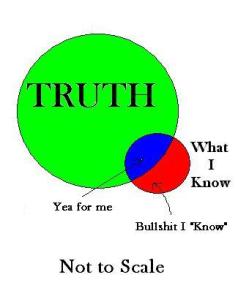
For a few decades, I thought the path to a truer picture of the world involved adding to my stockpile of knowledge. However, I realized that some of what I knew was bullshit, and just adding to a stockpile of knowledge ballooned up the bullshit as well as the understanding of truth. So I needed away to tear down illusions. But how to do it? Turns out that beating one’s head with a frying pan destroys what one knows as well as what one “knows.” Furthermore, it turns out that reading outside my comfort zone has been key to helping separate the wheat of knowledge from the chaff.

1.) Be less predictable. Emerson said, “If I know your sect, I anticipate your argument.” He was a smart guy, and thought for himself.

Sharknado: or, the Rock Band or Cheesy Movie Game

Somebody on Facebook made an offhand reference to Sharknado the other day.  I had no idea what a “Sharknado” could be, except the mind-numbingly stupid idea suggested by the phonetics of the “word.” It turns out that is exactly what it was. Despite the fact that sharks exist in places like Florida and tornadoes exist in places like Oklahoma (not a lot of overlap there), the movie is about tornadoes that pick up sharks and throw them through the air at unsuspecting people. (The sharks are, of course, still alive and hungry contrary to everything we know about biological entities that get picked up in twisters.)

I once wondered why the “Sci-fi” channel changed its name to the “Syfy channel.” I now know that it must have been the threat of false advertising lawsuits that spurred this change. (Of course, this doesn’t explain why the “History channel” isn’t the Sasquatch Alien channel.) Sci-fi is short for science fiction. Let’s break that down. First, the reference to “science” means one would expect some speculative universe which is constrained by scientific laws–either the laws of physics as we know them or some reasonable set of scientific principles by which a universe could be held together. It is not a magic universe, as required by Sharknado. The target demo for science-fiction is geeks and nerds (said in the most complimentary sense of those words)–in other words, people who overthink (or, at least, think.) The target demo for Sharknado seems to be pubescent boys failing science and in need of an opportunity to masturbate to Tara Reid.

Second, fiction is a creatively-engineered story, and I’m not even sure Sharknado qualifies on this front either. The creative component seems to be limited to cramming two things that terrify people together into one word or phrase. This may work in some cases, such as with the term “divorce lawyer.” However, the two concepts that one smashes together have to have some credulity as a unified threat. The fact that motherf#$%ing Samuel L. Jackson couldn’t save Snakes on a Plane, should have made this apparent to all.

As a thought exercise, let’s try some examples:

1.) Which of the following terror-inspiring dualities are devices around which a movie plot could be built, and which are just awesome rock band names?

a.) Clown-Pirates

b.) Hobo-Scorpions

c.) Black Mamba-Teen Driver

d.) Bear-Proctologist

e.) Spiders in a Tuk-tuk

f.) Karaoke-Mugger

g.) Robo-gynecologist

h.) Newborn-Arsonist

i.) Mother-in-Law / Attorney-at-Law

j.) Anthrax-blizzard

By the way, if the Syfy channel comes out with any of the above movies or series, please shoot me an email so I can claim my Executive Producer credit. It’s more likely this will be the starting line up for Lollapalooza 2025.

Bear with bubbles

The IT Revolution & Crises of Self-Importance

Source: Ed Poor at Wikipedia.en

Source: Ed Poor at Wikipedia.en

If you’re as old as I (no, I’m not Wilford Brimley old by any stretch), you remember the days when you couldn’t count on getting a hold of another person instantaneously. Incidentally, the phrase “get a hold of” is apropos. Think of other times one might use those words. If one were a practitioner of judō (i.e. a judōka), one might use that phrase when talking about seizing an opponent in anticipation of throwing them.

Herein lies an intriguing irony. The person calling is dominating the called. That is, they are writing a check on one’s time that they believe to be cashable whenever the hell they please. Therefore, one might expect the person receiving random calls at random times to suffer a diminution of self-esteem. They are, after all, at the beck-and-call of some localized bit of humanity. However, on the contrary, the perfection of the electronic-leash has spawned a growing field of narcissists.

The reasoning that drives this plague of narcissism is as follows, “I am so important that some–albeit tiny–part of the universe is at risk of collapse if I’m not ready to spring into action at a moment’s notice. In other words, I am a localized superman[/superwoman.]”

The thing is, you’re really not. The deflating truth is that none of us is so important that any portion of the universe will collapse if we are unplugged from the hive for a few hours– try it.

Now, you may be saying, “Look, I have my phone on all the time, and I talk on it much of the day, but I’m not one of those loud people whose conversation lays waste  to the solitude of people around me everywhere I go.”

The thing is, you really are. Those annoying bastards that you “hurrumph” at when you’re not on the phone–that’s you when you are on it. You make a connection at a distance and, like all others, become oblivious to your immediate environment. At best you are a destroyer of solitude; at worst you are a danger to yourself and others.

There’s No Such Thing as a Silly Question? LIAR!

I’m shocked by how easily a piece of “common wisdom” can become accepted despite being patently and demonstrably wrong. The best example may be, “There’s no such thing as a silly question.”

Oh, yeah:

“Do you wear spurs when you ride ostrich in the avian rodeo?”

“If you had to wear shoes made of cheese, of which cheese would you want them made?”

“Do you have purple-glazed doughnuts in honor of the St. Crispin’s Day unicycle rally?”

“May I twirl my way into an eternity of dandelion lunacy?”

I can do this all day.

Are you seriously going to tell me that none of the above questions is at least a little bit silly. As a person of silliness, it enrages me… well maybe not so much “enrages” as has no discernible effect… when people deny the potential for silliness. Folks, it’s all around us. So, the next time you say that there is no such thing as a silly question, my response is, “Do you really think you can make that stick like the Archbishop’s bugger to the side of an albino wino?”

My Humble Narcissistic Opinion on Organizations

Whenever an organization is built around an idea or set of values, that idea or set of values shrinks dwarf-like into the background. What looms large is the imperative to protect and expand the organization.

The organization is an organism, but one whose only growth governor is the attractiveness of its ideas. You think those ideas are the organization’s genes, but they aren’t. They aren’t the codes by which the organization lives. They aren’t its DNA. They are its skin. But even the loveliest beauty queen can be a gloppy, cancerous mess on the inside. No, the code that your organization lives by is the same viral code by which all organizations live.

Step 1: Preserve the organization.

Step 2: Grow the organization.

Step 3: Annihilate competitors.

Step 4: Repeat steps 1 through 3 until you’ve consumed the world.

You say that I’m not a loyal Party man. Guilty. I cannot be loyal to Party without being disloyal to my own mind. If one’s views mirror those of the Party, how likely is it that one didn’t twist one’s ledger into line? Not likely, I’d say. My thoughts are not static. They evolve. I learn. I will no more subordinate my belief s to a Party then I will chain my neck to a rock.

Your Company doesn’t make widgets, it makes Company.

You say I don’t believe in God. I see God in every leaf. I see him in the new fallen snow. I see him in the confident aerial leap of a nervous squirrel. I feel the pulse of him in my hand when it holds another hand. No, what I don’t believe in is religion. They say the problems of religion are the fault of flawed individuals. I say they have it exactly backwards. There wasn’t an evil cell in Hitler’s body, but together they formed an evil seed. Yet, one man cannot make a holocaust. Ever increasing numbers had to fall in love with a skin-deep mirage of an idea, and ignore the ugliness inside.  A man can only be as evil as the world lets him, but a government? a church? Those, my friend, can consume worlds.