“Down to Jiangling” [下江陵] by Li Bai [李 白]

I left Baidi amid ochre clouds --
Crossed a thousand li by day's end.
Monkeys howled and chased along each bank;
My skiff slipped past ten thousand mountains.

The original in Simplified Chinese:

朝辞白帝彩云间
千里江陵一日还
两岸猿声啼不住
轻舟已过万重山

Note: this is poem #269 of the 300 Tang Poems [唐詩三百首.]

“Spring Thoughts” by Li Bai [w/ Audio]

Yan grass shimmers like silken jade.
Qin mulberry trees' green leaves droop.
Your homecoming is now at hand
As heartbreak has me thin and stooped.
Spring Winds and I are strangers --
Why, past my curtains, the inward swoop?

Chinese Title: 春思; Original poem in Simplified Chinese:

燕草如碧丝, 秦桑低绿枝;
当君怀归日, 是妾断肠时。
春风不相识, 何事入罗帏?

Note: this is poem #7 in “300 Tang Poems” [唐诗三百首]

“Sitting Alone on Jing Ting Mountain” by Li Bai [w/ Audio]

The flock flies high and vanishes.
The sole cloud drifts to oblivion.
Mountain and I exchange a gaze,
Until only Jing Ting remains.

Drinking Alone by Moonlight by Li Bai [w/ Audio]

A pot of wine, under blossoms.
   I drink alone, no friends in sight.
 I raise a cup to lustrous Moon:
   Me, Moon, and Shadow will make three.
 But Moon is a teetotaler.
   And Shadow just skulks at my feet.
 Still, Moon & Shadow are my chums.
   We need a bash before Spring's end.
 But my singing makes Moon recoil.
   And Shadow flops hard when I dance.
 At first, we have a grand old time,
   But we part ways when I drift off.
 We should keep this epic friendship rolling,
   and meet again in the River of Stars.

NOTE: I produced this “translation” / arrangement, using translations by Arthur Waley, Ezra Pound, and that of “The Anchor Book of Chinese Poetry” [ed. by Tony Barnstone and Chou Ping] to get varied takes on the source poem.

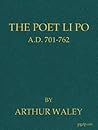
BOOKS: The Poet Li Po AD 701-762 Trans. & Ed. by Arthur Waley

The Poet Li Po       A.D. 701-762The Poet Li Po A.D. 701-762 by Arthur Waley
My rating: 5 of 5 stars

Available online at: Project Gutenberg – The Poet Li Po

Li Po, also Romanized “Li Bai,” is one of China’s most famous poets, the prolific Tang Dynasty poet wrote extensively at the nexus of intoxication and the beauty of the natural world. His well-loved and evocative poem, “Drinking Alone by Moonlight,” is a prime example [and is included in this selection.]

The selection consists of a small number of translations by [20th-century Orientalist] Arthur Waley. It’s only 20-some of the 1,000-ish extant poems of Li Bai, but it does offer variety in form and subject matter. It doesn’t include all of Li Bai’s most anthologized poems, which I consider a plus — i.e. Waley didn’t just assemble a greatest hits album.

The Waley translations aren’t as sparse as many that one will read. That offers the advantage of being clearer in meaning while losing some of the feel of the original. That said, I enjoyed this group of translations and didn’t feel they were too verbose – for the most part. It’s a selection well worth reading for those who enjoy poetry.

View all my reviews

Li Bai [Lyric Poem]

Li Bai fills his cup;
 Li Bai loves his wine;
  Li Bai sits in moonlight,
 staring at the sky. 

BOOK REVIEW: Three Tang Dynasty Poets by Wang Wei, Li Po, and Tu Fu

Three Tang Dynasty PoetsThree Tang Dynasty Poets by Wang Wei
My rating: 5 of 5 stars

Amazon page


This book is in a series put out by Penguin Books entitled “Little Black Classics.” As the series name implies, these are booklets featuring classic works (or fragments, thereof.) This book features a combined 33 poems by three Chinese poets who lived in the eight century.

In the 14 poems by Wang Wei (a.k.a. Wang Youcheng) we see his famed mastery of landscape and nature poems, and we feel the effect of his Cha’an (Zen) Buddhist mindset.

Among the ten poems by Li Po (a.k.a. Li Bai) we are introduced from the beginning to the poet’s legendary proclivity for drink. While it’s not all carousing, human characters do play a more central role in Li Po’s work.
There are nine poems by Tu Fu (or, Du Fu), which share Li Po’s inclination to feature humanity at the heart of each poem, if in a more straight-laced way.

I enjoyed the poems in both their imagery and sound quality. I can’t really speak to how skilled the translation was, i.e. how much better or worse they could have been. The translators were G.W. Robinson and Arthur Cooper, who I know nothing of, but who apparently both translated a considerable amount of classic Chinese literature.

The poems are almost all short form works, so – with one exception – the poems are included in their entirety (i.e. not excerpted.)

The booklet has an appendix that features a two-page prose story entitled “The Story of the Peach Blossom Spring” by Tao Yuanming. The reason for including the story is that it’s the inspiration for the Wang Wei poem that opens the volume.

I enjoyed reading this little booklet of poetry. The translations are easy to follow, and the imagery is appealing. The Zen / Taoist feel that is widespread in these works is pleasant.

View all my reviews