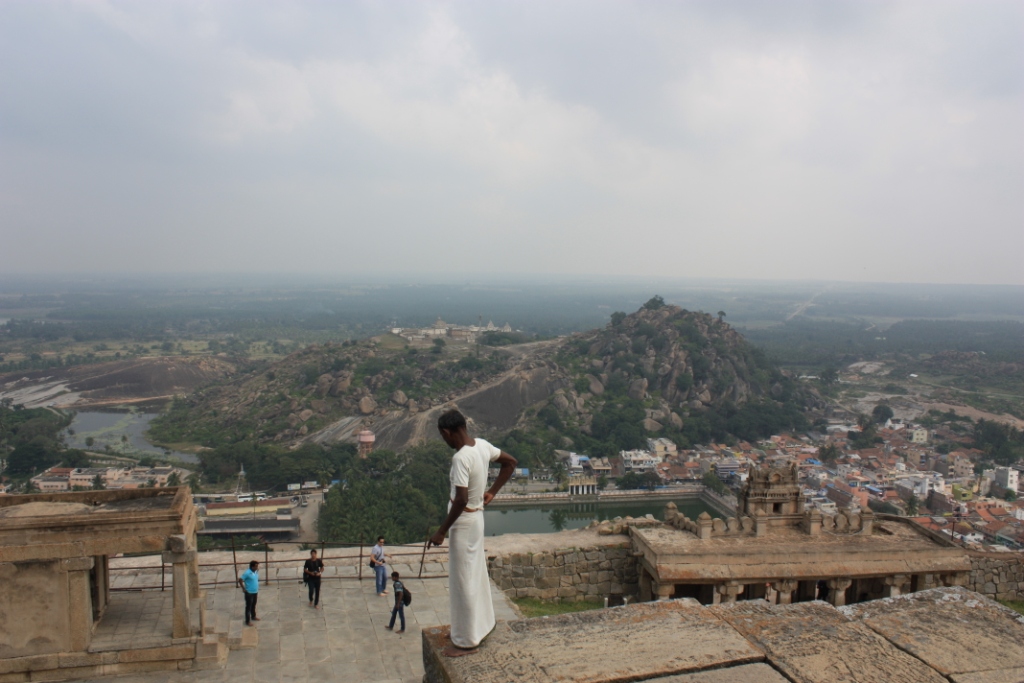
The other day I posted a pic of the gigantic statue of Bahubali that’s located on Shravanabelagoli Hill. This is the view from the hill looking down toward the village. A Jain adherent was standing on the edge of the temple base looking down at path up to the temple.
Tag Archives: Karnataka
DAILY PHOTO: Shiva Dancing in an Elephantine Demon
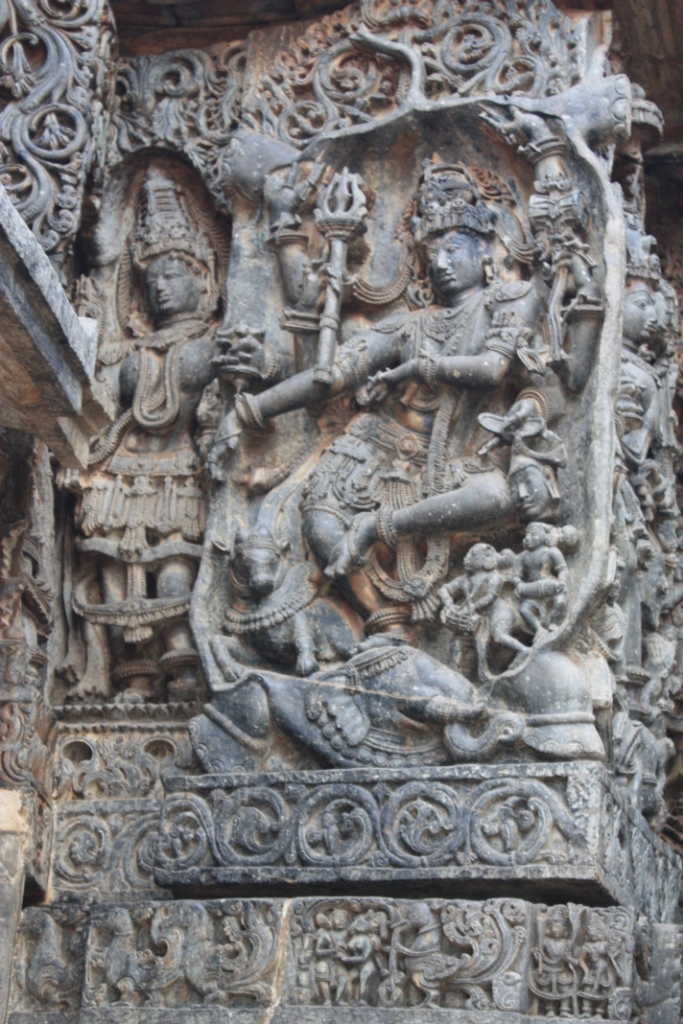
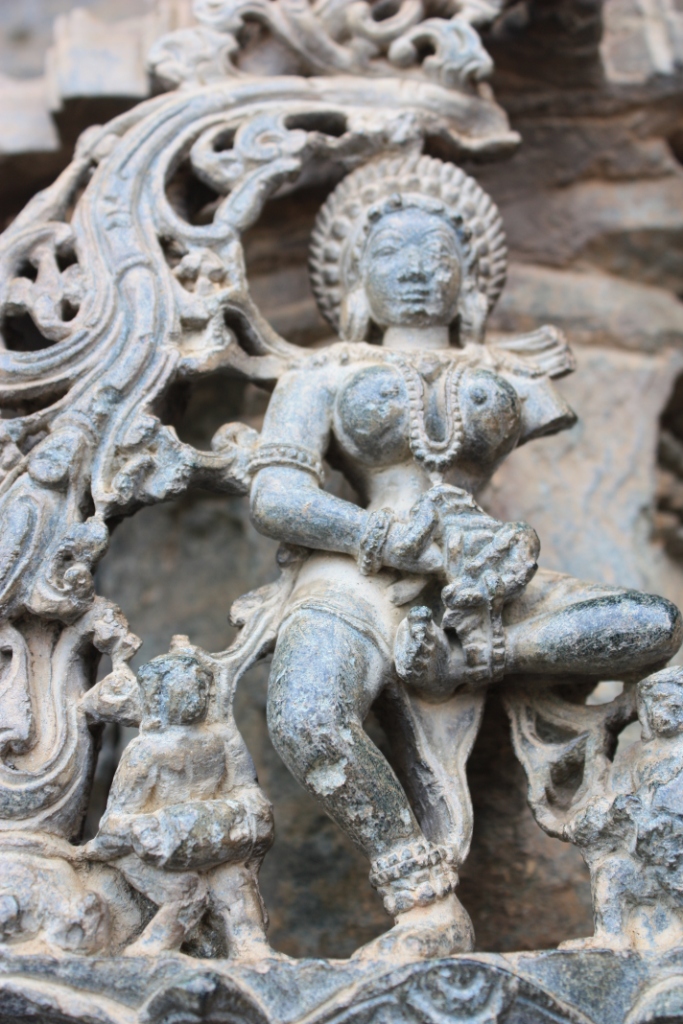
This frieze is located at Hoysaleshwara temple in Halebidu. Hoysaleshwara is dedicated to Shiva, and was finished in 1121AD–though many believe it was not actually finished. It’s one of the largest temples to Shiva in southern India and is actually a double temple–the inside being split between the king’s temple and the queen’s temple.
This is a depiction of Shiva dancing inside a vanquished elephant. It may seem mean to kill an elephant and dance inside it, but this particular elephant was a demon or possessed by a demon. Of course, the question remains as to why one would dance inside a slain enemy. I guess it’s a little like dancing on your enemy’s grave, but a lot stinkier and messier. It’s just weird no matter how you slice it.
DAILY PHOTO: Chennakeshava Temple at Belur
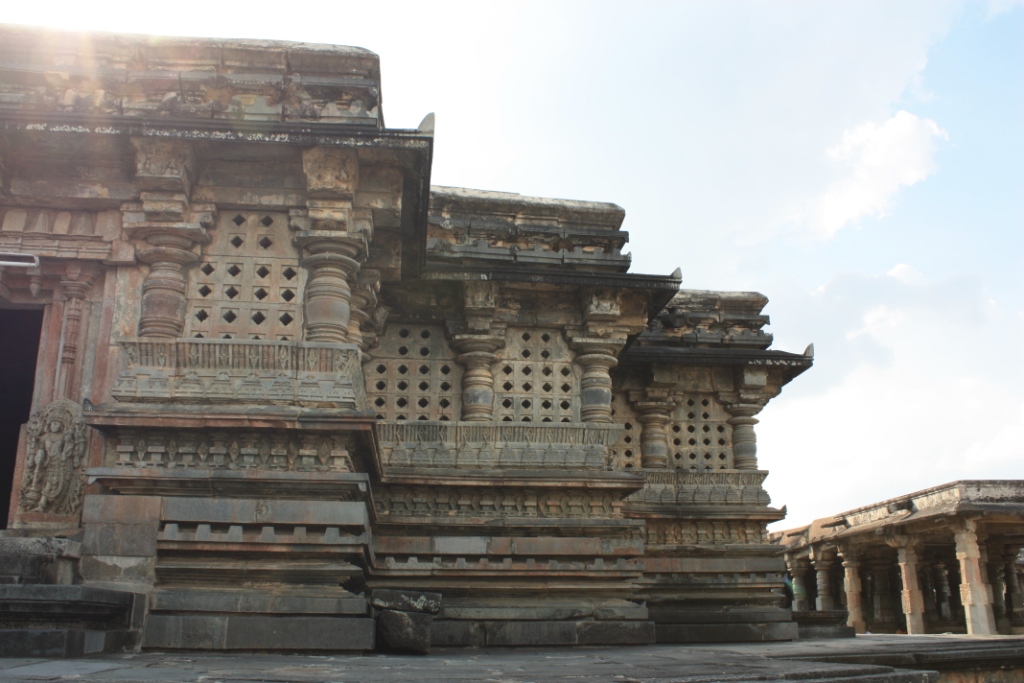
Chennakeshava temple at Belur is a Hoysala era temple to Vishnu–the deity of the Hindu trilogy responsible for processes of sustenance and evolution (as opposed to creation or destruction, which are the bailiwicks of Brahma and Shiva, respectively.)
This temple and its sister temple at Halebidu, Hoysaleshwara temple, are probably the most ornate structures I’ve seen anywhere in the world. They are covered with soapstone carvings arranged in several tiers. For example, the bottom layer is a series of elephants, each one unique. There is a layer that tells tales from the Mahabharata in pictures.
Soapstone is soft and easily worked when quarried, but it becomes hard enough to survive everything but looters as it’s exposed to the elements. You’ll note the “windows” carved in the rock to allow in light and breezes.
DAILY PHOTO: Gomateshwara of Shravanabelagola

Taken on November 23, 2013 on Shravanabelagola Hill
[As I was on the road yesterday and missed my Daily Photo post, I’ll double up today—if I can. I’m iffy because Bangalore got 2” of rain in an hour last night (which we arrived home in; I saw a city bus literally—no hyperbole here whatsoever—half underwater in an underpass.) Anyway, my internet connection is spotty at the moment, and could go out permanently at any moment.]
The Gomateshwara (a.k.a. Bahubali) sculpture at Shravanabelagola is the world’s largest monolithic stone sculpture. Gomateshwara was a Jain Arihant, and was said to be the second of 100 sons of the first Tirthankara.
An Arihant–literally a “vanquisher of enemies” (a rather bellicose title for a sect that won’t eat onions because the plant must be killed to harvest them), is one who has defeated anger, ego, deception, and greed. (Oh, THOSE enemies. you say.) A Tirthankara is a special kind of Arihant that appears every so often to revitalize the Jain community.
Shravanabelagola is not a well-known site. Being in rural Karnataka, and not on the regular tourist loops, it’s easy to miss. However it can be grouped nicely with trips to the temples at Halebidu and Belur.
Tip 1: You’ll have to walk to the top of a rather large hill in bare feet, so be prepared. On the bright side, the steps are quite clean and devoid of the usual multi-species feces common to footpaths in India.
Tip 2: Jains, like Hindus and some Buddhist sects, utilize the swastik emblem heavily. Despite the ubiquity of what some call the “twisted cross” or “swastika,” you are not in a den of neo-Nazis. That emblem, and its mirror-image, was used for thousands of years in South Asia before Hitler co-opted the symbol—presumably misinterpreting its meaning (as he misinterpreted so many things.) Ironically, it means a wish for good fortune.
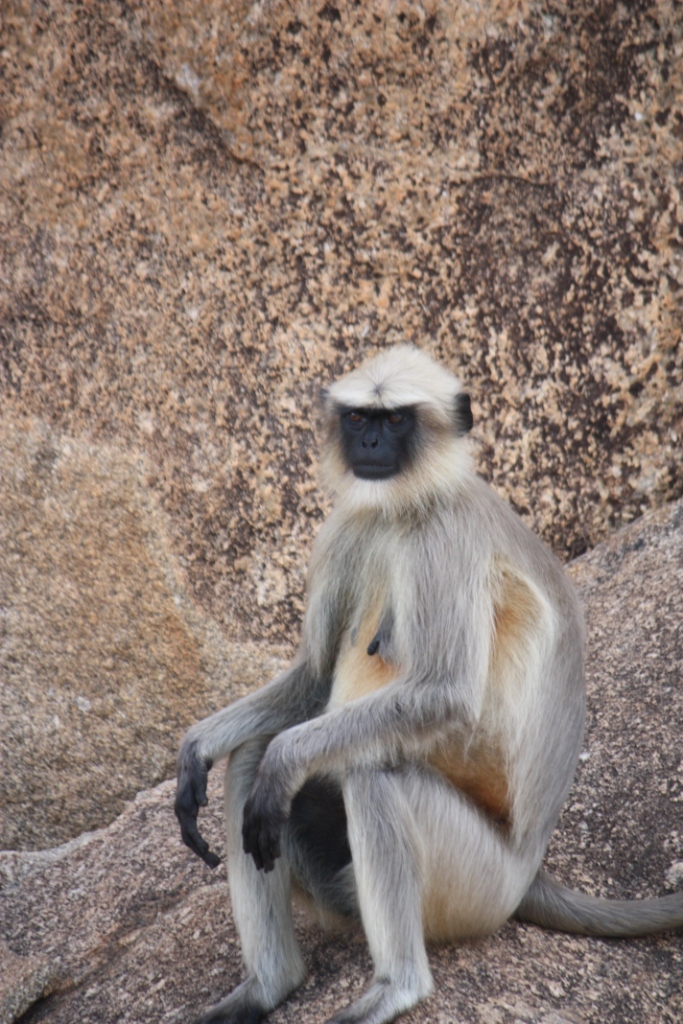
DAILY PHOTO: Gray Langur Watchmonkey
Gazing into the distance
he renders his assistance
to the mischievous monkeys–
making him a monkey flunky
A watchman of the langur pranks
yet not a part of their prankish ranks
He screeches warnings now and then
on sight of broom-wielding women
He neither seeks nor needs praise
just the occasional banana raise
He does it not for power or glory
just the occasional funny story
DAILY PHOTO: Yellow Blossoms
The Hampi area is painted from a different palette than most of Karnataka. Instead of uniform green, the brownish-red of the boulders dominates, and, while green lines the spaces between the rock, the vivid yellow of these flowers decorate the base of many hills. Of course, there remain islands of green, in the form of corn fields, banana plantations, and palm groves.
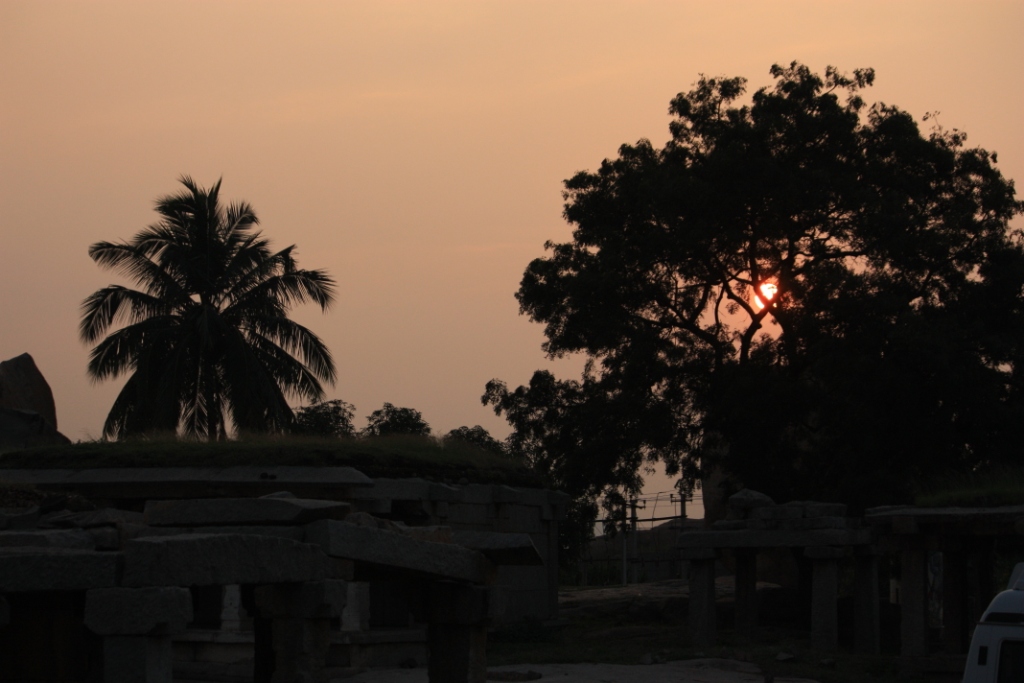
DAILY PHOTO: Sunset Over Hampi
In the tropics the summer days seem so short and the winter days seem so long–at least if you grew up at 42°N (northern Indiana) and now you’re living at 13°N (Bangalore, India.) There’s no discernible adjustment in the length of days here. Maybe, if you’re a local. But it always gets dark around 6 at night and becomes light around 6am the next morning.