5 Psychological Concepts Psychologists Disagree About [or Just Plain Get Wrong]

Every academic discipline has a concept or two that its scholars disagree upon. In the social sciences, these can even be the fundamentals of the subject, and, sadly, they aren’t always so much disagreements of definition as concepts the experts don’t grasp. In Economics [the discipline I was educated in], there is a famous war over whether economists understand “opportunity cost” — a concept that is raised not only in undergraduate texts but even in high school classes.

That said, Psychology appears to take the cake for being the most internally confused academic discipline. Ever. I first became aware of this problem with respect to a subject I have great personal experience with (by virtue of  being firmly lodged in said category), and that’s introversion.

Recently, this psycho-confusion has come up again as I’ve been reading two books that have major discussions around psychological definitions. One is Dean Haycock’s Murderous Minds, which devotes a whole chapter to the fight over how psychopathy is defined and differentiated from other conditions (in part, because another term — Sociopath — exists to spur confusion, but even without that term [which some psychologists think of as a synonym and others think of existing in another ballpark] there would be a huge gulf in expert opinion.)

The second book is Julia Shaw’s The Memory Illusion, which is a fascinating and generally thought-provoking book. In it, Shaw claims that hypnotism doesn’t exist.  I found this difficult to believe (both because I’ve been in a hypnotic trance state and because there is a well-established literature on the subject [i.e. it’s not like parapsychology concepts, e.g. clairvoyance, which are highly controversial]) until I realized that Shaw’s definition of hypnosis was filled with all the misconceptions that one would expect of an individual entirely unfamiliar with a hypnotic trance — except maybe having seen a stage hypnotist once or twice.

5.) Introversion: Introverts are often confused with those who have social anxiety disorder(severe shyness) — which an introvert may or may not have, but which an extrovert also may or may not have. (While it’s probably true that introverts experience social anxiety disorder at a higher rate than extroverts, there is a big problem with equating the two — not the least of which is that one can beat one’s social anxiety and still be an introvert.) It should be pointed out that Susan Cain’s excellent book Quiet (among others) has done a lot to bring a consensus view to the subject, but one still hears people — even experts — equating shyness and introversion.


4.) Psychopathy: Like many confused topics (including introversion and hypnosis), part of the problem is that everybody has a mental construct of what psychopathy is before they learn anything formally about it, and sometimes those preconceptions survive the presentation of formal knowledge — even, apparently, for the experts.  Maybe a person has read American Psycho or maybe they’ve seen Dexter or the movie Psycho, and so they know very well that a psychopath is a murderous maniac, and, therefore, they may not swallow the information that most psychopaths function just fine in society and aren’t even considered inherently mentally ill.


3.) Schizophrenia (v Split Personality): This is probably one of the most discussed of the confusions in the field. To be fair, this may be largely ironed out these days, but it certainly took long enough. Multiple Personality Disorder (commonly called Split Personality but today called Dissociated Identity Disorder [DID]) is usually a trauma-based disorder that results in schisming of personhood. Whereas, Schizophrenia is a genetically transmitted disorder that involves a disconnect with reality, but not necessarily a separation of personalities.

 

“Hypnotisk” by Richard Bergh (1887)

2.) Hypnosis: I mentioned Julia Shaw’s statement that hypnosis doesn’t exist. In her book, she mentions several preconceptions about hypnosis that are quite different from my limited (but existent) experience with hypnosis. To be fair, many hypnotists would tell you that the term hypnosis (coined by Scottish surgeon James Braid) is a confusing choice because “hypno” suggests the state is like sleep — which, not so much. First, Shaw calls the hypnotic trance state a non-attentive state. (This comes up because she is making the point that attention is critical to memory formation, which is probably entirely true and I don’t have any dog in the fight of whether hypnosis can help memory.) What I am arguing is that hypnosis is not a non-attentive state. It’s a highly relaxed state, but might be more accurately called a hyper-attentive state. Maybe the confusion is because stage hypnotists frequently successfully suggest participants temporarily forget things in deep trance, but keeping one’s attention focused  (on what may vary, though it’s usually voice) is critical to the hypnotic trance state. Second, she suggests that hypnosis is an act that must hinge on the activities of the hypnotist — i.e. the hypnotist as sine qua non.  I think many, if not all, hypnotists would admit (often begrudgingly) that the hypnotist is the most dispensable element of the process — or, as it’s more commonly phrased, “all hypnosis is self-hypnosis.” Third, she seems to have problem with hypnosis being considered an altered state of consciousness. To my mind, everything but ordinary waking consciousness is an altered state of consciousness. I don’t know of any way in which a hypnotic trance state could be confused with ordinary waking consciousness. (If you’re sure of it, go to a dentist who uses hypnotism for pain reduction and have them yank your tooth in a state of ordinary waking consciousness, and then compare your experience to the individuals who had it done under hypnosis. See here for a related BBC special on the Science of Hypnosis.)


1.) Delirium  (v. Dementia):  To be fair, by the time an individual is in a full-blown state of either, these conditions are nearly impossible to distinguish and have overlap. However, delirium has quick onset, involves severely impaired attention, and can fluctuate greatly from one day to the next. On the other hand, dementia often progresses slowly, begins with mild impairment of attention and focus, and is a far more consistent state.

5 Tips for Introverts

5.) Eye contact: Train yourself to be aware of eye contact. Eye contact doesn’t come naturally for an introvert. It’s common to not only avert one’s gaze, but to zone out in the process because one’s mind is trying to anticipate the direction of the conversation and formulate a replies. There’s not enough consciousness left for monitoring the visual stream. This has a number of side-effects such as:

-missing non-verbal cues

-appearing uninterested

-staring in the wrong direction (crotches, cleavage, Hells Angels, etc.)

Just don’t let the pendulum swing too far such that one stares like a homicidal maniac.


4.) Scheduling: Bracket social and /or noisy events with quiet time. It’s not just social activity that can be draining for the introvert, being in environments with high levels of sensory stimulation will run down one’s energy even if one isn’t interacting socially. Living in India, I find that sometimes just walking down the street and minding my own business wears fairly rapidly. In moderated doses, these sensory-intensive situations are enjoyable and beneficial, but the secret is to avoid redlining. Extended periods of high stimulation may result in you being grumpy and / or dull.


3.) Readings: Come on, you’re an introvert, you know you love reading. There are a number of books that have come out in recent years to help introverts both better understand introversion and to learn to arrange their lives in a manner optimized to it. I’ll mention two of the more well-known ones.

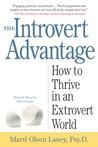
The first is The Introvert Advantage by Marti Olsen Laney. I mention this one first because it was the first book I read on the subject, and it transformed my thinking about what it meant to be introverted. Though I’m an introvert, I didn’t really understand introvertism until I read Laney’s work.

introvertadvantage_laney


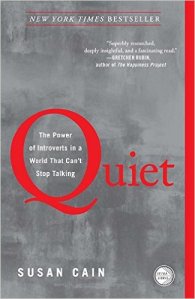
The more well-known and critically acclaimed book, however, is Quiet by Susan Cain.

quiet_cain


2.) Introversion ≠ Shyness: Know the difference between introversion and shyness (social anxiety.) Introversion has long been considered synonymous with shyness. Even many psychologists and mental health professionals seem to believe they are one in the same–or at least they did until the recent spate of books, TED Talks, etc. It’s true that many people are both shy and introverted, but it’s more complicated than that. One can be extroverted and shy. Talk about a raw deal. The shy introvert faces forces pulling them in one direction. The shy extrovert is being pulled in two different directions at once.


1.) Embrace it:  Accept your introverted nature. Given an extrovert bias, there’s a proclivity for introverts to wish they were extroverted or to even try to force themselves to be so. This is a recipe for disaster. I discussed the difference between introversion and shyness above, shyness is something that one can work on reducing through visualization, mindfulness, and–most importantly–practice interacting, but introversion is hardwired.

BOOK REVIEW: The Introvert Advantage by Marti Olsen Laney

The Introvert Advantage: How to Thrive in an Extrovert WorldThe Introvert Advantage: How to Thrive in an Extrovert World by Marti Olsen Laney

My rating: 4 of 5 stars

Amazon page

A number of books have come out about introversion in recent years. Most of these books seek to dispel common myths about being introverted, such as:

a.) Introverts can and should change teams to the extroverted
“light side” as soon as possible.

b.) There’s something psychologically wrong (re: neurotic or even psychotic) with being introverted.

c.) “Introverted” is synonymous with:

1.) Shy (i.e. having social anxiety disorder)
2.) Schizoid
3.) Anti-social
4.) Self-centered (in the pejorative sense–a more neutral meaning could be said to be true by definition.)

This isn’t to say that one can’t be both introverted and any of the above, but one can also be extroverted and any of the above (including, believe it or not, shy—i.e. it’s possible to be an extrovert with social anxiety disorder.)

Where Dr. Olsen Laney’s book tries to carve a niche is in teaching introverts how they can conduct their lives in an extrovert-centric world so as to maximize their effectiveness and minimize their exhaustion. One will note that her advice doesn’t advocate attempting to become extroverted. In fact, one of the most interesting and informative sections of the book is chapter 3, which explains the differences in brain chemistry that result in introversion or extroversion. While some of the conditions mistaken for introversion–such as shyness–can be overcome or trained away, introversion is hardwired into the brain.

The book’s ten chapters are organized into three parts. The first part explains just what defines an introvert, what traits commonly mistaken for introversion aren’t introversion, and the physiological roots of introversion. The second part consists of four chapters that delve into problems faced by introverts in four critical domains: relationships, parenting, socializing, and work. The final three chapters present the prescription for modifying one’s behavior to keep one’s energy up in the face of the demands of modern life. It’s really all about energy—how we use it and replenish it differently. The external world—most notably interaction with other people but also anything of a chaotic environment—drains the energy of introverts faster than that of extroverts.

As one reads through the book, there are many tips for mitigating the negative effects of common introvert characteristics seen as problematic in an extrovert’s world. It should be noted that some of these are genuine problems (i.e. how one metabolizes food) and others are a matter of perspective (i.e. lack of conviction v. open-mindedness.) These “problems” include: difficulty making quick decisions, difficulty with word retrieval, lack of investment in one’s own ideas (“wishy-washy” in extrovert lexicon, but arguably open-minded), tendency toward over-stimulation, lack of inclination to engage in [prolonged] eye contact, proclivity to metabolize food quickly with resultant blood sugar drops, proclivity towards sedentariness, and a tendency to fail to delegate work and reward job completion—if one happens to be the boss.

I found this book to be enlightening. There were many ideas I found myself agreeing with (e.g. using hobbies and activities as a means of controlled interaction.) There were only a few pieces of advice that I thought poor (i.e. picking a weekend day to lay in bed or on the couch all day—reading or otherwise.) While it may seem logical that movement would drain energy in contradiction of the goal of restoring energy, I find being sedentary beyond a certain number of hours to be a huge energy drainer and that periodic movement is necessary and restorative to keep my energy level robust. (And I’m about as introverted as one gets by the criteria established in the book, most of which apply to me.) Of course, there are variations among introverts–just as among extroverts—not only with respect to the degree of introversion but also with respect to specific characteristics experienced. (e.g. Some introverts may not find that all of the criteria in the preceding paragraph apply to them.)

I’d recommend this book not only for introverts, but for those who interact with introverts in key ways (e.g. familial relations, significant others, bosses, employees, etc.) Non-introverts may find some sections are more helpful and necessary than others, and may not find they need to read from cover to cover.

View all my reviews

Tulip 7

Night falls on Bangkok

Night falls on Bangkok

I’m speed-walking down the sidewalk off Sukhumvit Road like one of those elderly mall-walkers.  Like the mall-walkers, there’s an irony to my speedy step. I’m on vacation. I have no particular place to be, and no particular time by which I need to be there. Unlike the mall-walkers, my path is perilous. I have to weave around street-food vendors deepfrying springrolls or grilling satays (and fight my stomach’s urgings), evade the grasping taunts of idle tuk-tuk drivers, and wave off T-shirt vendors selling shirts featuring elephants, thaiboxers, and Singha beer.

I don’t know why I’m moving so quickly. It feels natural. It’s the pace of the city. To walk slow would be to swim against the current. If you want the truth, I walk fast because in the back of my mind, in the deep recesses of irrationality, I feel that if I slow down the city will collapse into me, forming a black-hole. It will start with a few tuk-tuk drivers, a beggar, a prostitute, and a few street vendors converging on me. They will create a gravity, attracting more vendors, beggars, drivers, and hookers. If I don’t walk fast, I fear that I will be crushed in the center of a dense mass of humanity.

Leaning against the marble wall of a bank façade, a master of timing, an Indian man blinks, touches his forehead, and grimaces–as if my approach causes him some sort of psychic pain. I brace myself for the scam. He steps away from the wall into my path, gently extending an arm.

He says, “Sometimes, you think too much.” He’s trying to convince me that he has insight into my soul by making a statement that, while perfectly correct, contains no information content whatsoever. He’s smooth in behavior and handsome of feature. I bet he makes a mint in his chosen profession.

An instantaneous battle rages inside of me. On the one hand, I’m an introvert– or perhaps a sociopath– something like that. Whatever my affliction, interacting with strangers is draining. On the other hand, I’m curious about everything. I know the man is a scam artist. It’s not that I was never on the turnip truck, but I fell off a couple of decades ago, and while it took me several bounces to come to a stop, I eventually became quasi-worldly. While I know he’s a scam artist, I don’t know what kind. I so desperately want to know that I stop.

After a greeting, he says, “I can tell your future. There are two women in your life, I can tell you how it will work out.” His speech is clear, and well-spoken, like he was born in Mumbai, but moved to Cincinnati when he was 15. He is, in all respects, a smooth operator.

However, he’s wrong already.  As I said, I’m not exactly a people person. It takes all my mental energy to even be monogamous, as opposed to nul-agamous. The idea that I’m maintaining two relationships would be a bit laughable to anyone who could really “see into my mind.” Whenever I hear about one of these guys who has two separate families, I always think, “How many hours a day did the good Lord grant you?” Because I can’t fathom living that way and not being in an utter state of exhaustion every minute of every day. I’d be a wreck.

However, I give him points for playing the odds. I’m a middle-aged man with a gray goatee walking down the street in Bangkok. I’m probably the only one fitting that description who hasn’t fallen desperately (and pathetically) in love with an “eighteen year old” bar girl who the man secretly thinks is 16, but who, in reality, is 29.

Incredulity must show in my face, because he changes tack. “Let me show you proof of my abilities.”

He extracts a flip-style pocket-notepad from the inner pocket of a tweed sport-coat that is grossly out-of-place in steamy Bangkok, but which lends credibility. He scribbles down something on a page so that I cannot see. He then tears off the strip of paper containing his writing. He wads the paper up.

“I want you to think of the English-language name of a flower. Have you got it?” he asks.

“Yeah,” I reply.

“Now think of a number between six and nine. Have you got it? Now think of them together.”

In my mind I see, Tulip 7.

He hands me the wadded up scrap. I unravel it. It reads, “Tulip 7.”

He then opens his day-planner and asks me to put in any amount that I feel is fair and he will tell me about my future.

What he doesn’t know is that I’m the exact wrong person to pitch his act to. As a skeptic, I make Descartes look like gullible. (After all, Descartes developed a “proof for the existence of God”–granted everyone deserves a nadir of thought, and that was clearly Descartes’.) The most fundamental thing that studying Economics and Political Science taught me was that humans are completely incapable of making meaningful predictions. I’d seen this guy’s act before from a guy named Professor Bruce Bueno de Mesquita, but instead of getting a few baht on the streets, the political scientist got millions of American tax dollars for convincing the CIA that he could tell the future.

As I walk away, he says, “You have an ailment. I can tell you about it.”

I think, Good one, that’s a true test of my powers of skepticism, and I continue to walk, thinking out how the mentalist scammer did his trick… and wondering if I have cancer.