BOOK REVIEW: The Way of the Iceman by Wim Hof and Koen De Jong

The Way of The Iceman: How The Wim Hof Method Creates Radiant Longterm Health--Using The Science and Secrets of Breath Control, Cold-Training and CommitmentThe Way of The Iceman: How The Wim Hof Method Creates Radiant Longterm Health–Using The Science and Secrets of Breath Control, Cold-Training and Commitment by Wim Hof
My rating: 5 of 5 stars

Amazon page


Wim Hof is often presented as a freak of nature. If you’re flipping through the science channels, you might see a segment that shows him subjecting himself to extremely cold temperatures with no ill effects. This book is an attempt by Hof, and co-author Koen De Jong, to counter the proposition that he’s some sort of mutant (or—worse–that his demonstrations are cons) by offering a method by which anyone can achieve the same feats. It should be noted that long before Hof and YouTube came on the scene, there were people [notably Taoist and Tibetan Buddhist monks] performing similar acts.

Hof’s method (called the “Wim Hof Method” or WHM herein and in this book) consists of three components: cold training, breath exercises, and commitment building. The book explores this three-legged stool from both the scientific and practical dimensions. There’s one chapter on each of these elements that describes what it does to the body and how it contributes to well-being, and later chapters both describe what scientific studies have found so far and outline the approach by which the reader can explore the WHM on their own.

There’s a lot of front matter in this book (two forwards, a prologue, and an introduction), but the book more-or-less consists of seven chapters. The first of these is a mini-bio of Hof. It describes a fascinating event in Hof’s youth in which he was exposed to cold, as well as his travels to India in an attempt to find a yoga teacher. [As is the case with most people who come to India seeking to find that quintessential guru—i.e. a half-naked, weather-beaten, and forehead paint-streaked classical guru—he found that he had to wade through a sea of charlatans and shysters while never finding the true masters who are likely hidden away in caves in the Himalayas. Note: this is not to say that one can’t find excellent yoga instruction in India but it’ll likely be by someone fully clothed and not someone smoking pot on a ghat in Varanasi.] This resulted in Hof taking an experimental approach in which he studied the effects of various activities on himself (and such experimentation is what he advocates for others as well.) It should be noted that Hof didn’t invent this method from scratch—e.g. the breath component is based on Tibetan Tummo meditation.

As mentioned, Chapters 2 through 4 explore the three components of the WHM, i.e. cold training, breath exercise, and commitment building, respectively. These chapters describe the science of how these three elements generally (as opposed to a later chapter that describes studies in more depth) act upon the body. The commitment section describes a number of arduous feats such as climbing Kilimanjaro in a T-shirt and shorts, but also describes the role of diet (with particular emphasis on the fast-5 diet which is similar to, but not precisely, what Hof came to practice organically.)

Chapter 5 dives more deeply into the science than does the preceding chapters, and focuses on the studies in which Hof has participated in his attempt to facilitate a better understanding of his method.

The penultimate chapter suggests what the WHM might do for people in various classes, including: healthy people, athletes, and people suffering from various physical and mental ailments. With respect to the latter, there is discussion of exemplary cases as well as the possible means by which the training might act.

The final chapter is a brief outline of how the WHM can be put into practice by readers. There is also a sample log by which practitioners can chart their experience.

There are a range of graphics including line diagrams and photographs. Most of the photographs are inspirational shots of Hof in action, but there are diagrams and other graphics used to convey scientific ideas. There’s a recommended reading page as well as a works cited page. Both lists are small and confined to a few key sources of information, with the latter being the more scholarly works. There is also a glossary that may prove handy for some readers.

This book is illuminating and many stand to benefit from it. I found the approach of the authors to be sound; it’s basically “see for yourself.” This book could easily have been a sales brochure, and in some ways it is, but the fact that it emphasizes the science and the suggestion that the reader try the practice lends credibility. I’d highly recommend this book for anyone who wants to expand and explore the limits of their capability.

View all my reviews

BOOK REVIEW: The Science of Breath by Swami Rama et. al.

Science of BreathScience of Breath by Swami Rama
My rating: 4 of 5 stars

Amazon page


This is an oldie, but a goody. The first edition came out in 1979, but as its intent is to provide an overview of the anatomy and physiology of breath for yoga practitioners, the fact that it doesn’t access the bleeding edge of respiratory science isn’t all that detrimental.

This short book consists of four chapters. Two chapters are by the famous yogi Swami Rama, and the other two are written by medical doctors. The first chapter is an introduction to breath from the yogic perspective. It both explains why it’s so important to understand and work with breath and introduces the mythic physiology (prana, nadi, chakra, etc.) that has historically been used to explain pranayama (breath exercises.)

The second chapter is written by Dr. Alan Hymes and it explains the mechanics of respiration. While Chapter 2 focuses on the anatomy of breathing, it begins with an explanation of cellular respiration to introduce the role of breath in powering muscles. There is a fine explanation of the operation of the diaphragm and the intercostal muscles in breathing.

Chapter 3 is written by Dr. Rudolph Ballentine, and it delves into the role of the nose and nasal cavities in respiration. Breathing through the nose is emphasized in both yoga and many other systems of breath training (e.g. the Buteyko and Wim Hof methods.) This is because the nasal cavities perform many useful functions such as moisturizing and warming air, capturing pollutants, and extract heating and moisture from exhaled breath. Besides exploring nasal anatomy and physiology, Dr. Ballentine describes jala neti shatkarma (nasal cleansing with salt water) and nadi shoudhana (alternate nostril breathing.)

The final chapter, written by Swami Rama, mostly describes various techniques of pranayama (breathing exercises) and related practices bandhas and mudras (locks and seals in which bodily parts are contracted or constricted.) However, the chapter begins with a mix of physiology and mythic physiology. That is, it explains some topics not addressed earlier–such as the interaction between the nervous and the cardiovascular systems as well as chakra.

My standing complaint about books that weave together science and pseudo-science is mitigated a bit herein. My problem with putting these ideas together is that it can be difficult for the reader to determine what concepts reflect reality and which offer models to help one visualize energy. However, except for the last chapter, this book does a good job of keeping these ideas separate. The chapters by the medical doctors present the science with minimal intrusion of unscientific concepts. Swami Rama does present science and mythology together, but not so much scrambled together in a confusing mish-mash.

Chapters 2 through 4 use a number of graphics to help present the material. In the middle chapters these largely consist of line drawings to convey the relevant anatomical features or physical actions. The last chapter adds photographs to demonstrate relevant postures. There is a page of recommended readings, but it’s more of an advertisement for other books put out by the Himalayan Institute than the recommendation of books on the science of breath.

I found this book to be educational. It packs a lot of useful information into a concise package and is readable to a layman. I’d recommend it for yoga practitioners and others who are engaged in breath work.

View all my reviews

BOOK REVIEW: Greatest Ever Boxing Workouts by Gary Todd

Greatest Ever Boxing Workouts - including Mike Tyson, Manny Pacquiao, Floyd Mayweather, Roberto DuranGreatest Ever Boxing Workouts – including Mike Tyson, Manny Pacquiao, Floyd Mayweather, Roberto Duran by Gary Todd
My rating: 3 of 5 stars

Amazon page


This will be a quick review as the book is simple and straightforward in its approach. The author interviewed 30+ boxers, and each chapter corresponds to a boxer. A few of these boxers are household names, e.g. Tyson, Duran, Pacquiao, and Mayweather, but others may or may not be known to those who aren’t fight fanatics.

Each chapter consists of three sections. The first and longest of each is an overview of that boxer’s career, but it’s the other two sections that are most relevant to the book’s title and theme. One of these sections is an interview that asks a series of 14 questions about how the respective boxer organized his training day, and the other is a description of the boxer’s workouts (typically there was more than one workout—i.e. sparring v non-sparring days.)

If you’re a big boxing fan, this book will be interesting to you particularly for some of the insights about the boxers. The author is clearly knowledgeable in that regard. If you are mostly interested in the book from a fitness perspective, and seek to learn about working out for combative sports, it’s of decidedly less value. It still has some fascinating information, but you’ll probably find it tedious and of limited usefulness. The question and answer section elicits answers from one word to a couple of sentences and the workouts are a page each. What is fascinating is how similar the day in the life of a boxer is, and, specifically, how standardized workouts are. What I mostly found intriguing was when someone stuck out as having a different mode of operating. For example, most started their days very early (often going back to sleep after road-work) but a few were clearly night owls. One can also see a little of how approaches have shifted between the earliest fighters and the ones active until recently.

There are plenty of photographs in the book, but they are the only graphics. There isn’t much else by way of ancillary matter. (i.e. there is a section of pictures of the author with various boxers, but that—of course—is primarily of interest to the author.)

In one sense the book is quite limited and tedious, but it’s also interesting to see how thirty different fighters answered the exact same pallet of questions. There is some insight into nutrition, sleep schedules, optimal time for workouts, etc. However, the book doesn’t drill deep.

If you’re a fight fan, fascinated by boxers and their careers, I’d recommend this book. For those who are buying it thinking they’ll get some insight into how to prepare as a boxer, I’d say said insight will be extremely limited. That said, the book isn’t much of a time investment, and so if you can get it cheap you may find it of some benefit.

View all my reviews

5 Hyphenated Yogas That Miss the Point of Yoga

The laissez-faire and easy-going yoga community has spawned some phenomenally ridiculous mergers. I have “yoga” as a term on Google News, and almost every week I get fed a new example. I’m not saying every new approach to yoga is bad, but there’s one disturbing trend–i.e. the distraction yoga.


In the title, I refer to “hyphenated yogas,” but what I’m really ranting about is “distraction yogas.” A distraction yoga is one in which an element is brought into the practice so that one doesn’t have to keep one’s mind on one’s breath, alignment, and / or mental state. (Because who wants to think about that shit when one can be thinking “Wow, that kitten sure is cute.” or–believe it or not–“This beer has hoppy undertones.”)


Now before I get accused of hating puppies or beer, let me point out that nothing could be further from the truth. What I’m ranting against is the notion that you can marry any two good things and make a great thing. If you don’t believe me, please allow me to dip my nachos in your banana split. See, there are plenty of things that are awesome independently that make abominations when forced together.


I’ll include links as I go, lest you think I made this stuff up for hilarity’s sake.


5.) Beer Yoga: This is one of the most recent and intriguing distraction yogas. I’m not saying that one needs to follow a strict Vedic approach to life to practice yoga, but–come on–could you stop drinking for a couple hours to pretend your body is a temple (or at least that it’s not sitting in a trailer park with the windows busted out.) Unless “calf slaughter-yoga” catches on, it’s hard to imagine a less yoga-like practice than consuming intoxicants during the practice of yoga. By the way, there’s also a marijuana yoga, but I’ll lump these together as intoxicant yogas.

beermug


4.) Goat Yoga: This is one of many “animal yogas.” Like the others, the point is to have cute creatures around. How it’s supposed to help one’s yoga, I can’t fathom. Actually, I can fathom the suggested logic, probably something to do with calming and engendering feelings of compassion and well-being. But, ultimately it’s distraction by cuteness. Note: you can also do yoga with cats, dogs, horses, and probably river otters.

goatyoga-461x346


3.) Karaoke Yoga: Talk about distraction–nothing better than pounding music and reading a prompter to keep one’s mind off that ache in one’s hamstring.

karaoke_yoga


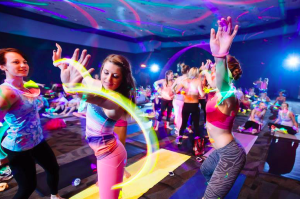
2.) Rave Yoga / Club Yoga: This might be a cheat because it’s similar to the previous one on the list, and I’m trying to lump these together so as to not be too repetitive. However, it’s not exactly the same, and is the perfect example of a distraction yoga. (There’s also Harmonica yoga and other musical yogas, but I won’t double-dip anymore.)

bombay_yoga-2e16d0ba-fill-735x490


1.) Tantrum Yoga: It wasn’t easy to determine whether I’d include this one or not. On the one hand, it’s not a distraction yoga in the sense that the others are. On the other hand, it takes the award for being least yoga like on the grounds that it’s not about dispassionately witnessing one’s emotional state but rather feeding one’s negative emotions. Note that I don’t group laughter yoga into the same class. I’m not sure whether laughter yoga is beneficial (or to what degree it’s a yoga), but I know that many people benefit from it because it bolsters positive emotional states.

tantrum


Now, one may have noticed that there are many seemingly strange (hyphenated) yogas that I haven’t mentioned. I haven’t said a thing about surf board-yoga, stripper pole-yoga, or acro-yoga–and I specifically excluded Laughter Yoga from the wrath of my rant. That’s because this isn’t a rant about people being innovative or non-traditional, it’s about people missing the point of what yoga is supposed to be (i.e. a means to quiet the mind.) I don’t know whether I can see myself doing yoga on a surf board or a stripper pole, but I’m certain that one has to give it one’s full attention–it’s not about finding a distraction to make yoga more palatable to hipsters.

BOOK REVIEW: Light on Pranayama by B.K.S. Iyengar

Light on Pranayama: The Definitive Guide to the Art of BreathingLight on Pranayama: The Definitive Guide to the Art of Breathing by B.K.S. Iyengar
My rating: 4 of 5 stars

Amazon page


This is B.K.S. Iyengar’s A-Z guide to breath and breathing exercises (pranayama.) It’s meant to do for pranayama practice what “Light on Yoga” did for asana (postural) practice. That is, it presents all the classic techniques, offers variants to meet individual needs, and provides the background necessary to put pranayama into the context of a balanced yoga practice.

Let me begin by discussing the book’s organization, and this book is organized to the n-th degree. There are parts, sections, chapters, and even the paragraphs are numbered (though–near as I can tell–the latter serves no purpose for a typical reader and may be more for the help of the writer and his assistants. It does create a somewhat biblical scheme, so maybe it was assumed there would be a need to quote this guide “chapter and verse,” as they say in Bible study.)

The bulk of the book consists of the first of two parts, and Part I is divided into three sections. The first of those sections is “The Theory of Pranayama,” and it puts pranayama in the context of yoga’s entirety. If you’ve read other B.K.S. Iyengar titles, much in these nine chapters will be familiar (e.g. discussion of the eight limbs.) However, chapter 4 offers a nice description of the anatomy and physiology of respiration. There are many anatomical drawings and diagrams in it to help convey the complex information. There’s also additional information about the traditional Indian notions of breath encapsulated in the concepts of prana, nadis, and chakras.

Section II is entitled “The Art of Pranayama” and it covers those topics necessary regardless of what technique of breath exercise one is practicing. It includes seated postures, mudras, bandhas, inhalation, exhalation, retention, etc. This section, too, has nine chapters. The final section of Part I describes the various techniques of pranayama. The chapters of this section are arrayed in lists, and they systematically build from the basic technique towards more advanced variations (e.g. by inserting retentions.)

Part II covers meditation (dhyana) and the corpse pose (savasana.) With respect to the former, it suggests how one’s body, mind, and sense organs should be conducted in the act of meditation. In the case of the chapter on corpse pose (after cross-legged seating position, this being the most common position for practice) there’s an extensive look at the details of that pose.

There are a number of helpful features incorporated into the book. In addition to the drawings mentioned in Chapter 4, there are black-and-white photos throughout to clarify the textual instructions. There is also a glossary of Sanskrit terms and an Appendix of courses of pranayama (i.e. recommendations as to how to sequence breathing techniques for optimal results with guidance as to how many sets or repetitions of each to use.)

My major criticism is one I’ve offered about previous books from this author and others. There’s a muddle of science and mythology that makes it hard to know how much weight to give particular instructions. It may be that a given piece of advice (e.g. a contraindication) is based on repeated observations of the physical or mental effects, or on a sound understanding of anatomy & physiology. In which case, it makes sense to heed such advice. However, advice can also be based on myths and the desire to preserve a way of thinking about the human body which is wholly unsupported by evidence. In which case, if one has no dog in the fight to preserve egos, it makes sense to disregard said advice. I suspect the vast majority of statements of what to do (or not to) fall into the first category, but some may fall in the latter, and it’s not easy to tell which is which.

I would recommend this book for students and teachers of yoga. It’s a good reference for one’s pranayama practice.

View all my reviews

5 Courage Building Yoga Practices

Learning to manage and moderate one’s fears and anxieties needn’t involve strapping on a parachute, cold quitting a job, or bare-knuckle boxing in a back alley. In fact, it may be best to begin by quietly watching those anxieties at the other end of the spectrum, the one’s so subtle that conscious awareness of them can be blotted out by the noise of living–but which nevertheless have a physiological impact.


The ability to quietly and non-judgmentally witness one’s emotional state–as is taught in yoga and related practices such as Buddhist meditation–is crucial (and, in my opinion, is one of the most valuable lessons that these systems have to teach.) Crushing or repressing emotions is a demonstrably losing strategy. At best these feelings are tamped into one’s subconscious mind, still adversely affecting one’s outlook and, therefore, indirectly casting a pall over one’s life.


You’ll note that I’ve mentioned courage and moderating fear, but have not mentioned defeating emotions or quelling fear. Wrongly, our archetypes of fearlessness are characters like John McClane (i.e. the “Die Hard” movies), Katniss Everdeen (i.e.”The Hunger Games” trilogy),  or Yoda (i.e. the “Star Wars” movies.)  But neurologists who study patients whose brains have been damaged such that they are literally fearless tell us that the defining characteristic of such individuals is “paralysis by analysis.” In other words, Sheldon Cooper (i.e. “Big-Bang Theory”) is a more apt model. Also, the fearless tend to live short lives because they eventually do something fatally inadvisable.


We need our fear. However, while fear can keep us from doing stupid things, it can also turn us into the worst version of ourselves. Therefore, our fear needs to be moderated with courage and reason (to these, some would add “faith.”)


You may note that I tend toward the intermediate / advanced with the practices I mention. This is, in part, because that’s probably more likely the point at which one is ready to take this on. In beginning a practice, one may have one’s hands full to grasp the basics of alignment and breath.


Without further ado, here are a few yoga practices that I’ve used to help me witness my anxieties and learn to moderate them:


1.) Nauli (and other external breath retention [i.e. bāhya kumbhaka] techniques.): Breath retention can produce a subtle anxiety, even when one has full control of the timing of release and the next breath. In fact, subtle anxiety may cause one to have a less robust retention than one might otherwise. Truth be told, this practice has probably been more fundamental than any of the āsana practices that will follow, for me personally.  

Note: external retentions are relatively advanced practice and should only be added to one’s sadhana after one has been taught by an experienced teacher and is somewhat experienced with pranayama.

practicing nauli

practicing nauli


2.) Eyes closed: This is particularly effective with Surya Namaskara (Sun salutations), standing poses, and–at an advanced level–balancing poses. One should make sure that ones balance is solid throughout before attempting with one’s eyes closed. We have redundant systems to help achieve balance (i.e. inner ear, proprioceptive, and visual), but–for the sighted–going without vision can be nerve wracking.

ashwa sanchalanasana in Surya Namaskara

ashwa sanchalanasana in Surya Namaskara


3.) Inversions: Inversions are meant to be calming because when the blood pressure to the head increases, it triggers reactions in the body to reduce it. However, it may take some time before that promised is reached. I’ve done a more extensive post on inversions that can be read here.

shirshasana (headstand)

shirshasana (headstand)


4.) Standing Back-bends: (Ardha Chakrasana / Urdhva Triangmuktasana / full Urdhva Dhanurasana) Simple back-bending can create the feeling that one is about to fall back onto one’s head. One may want to begin with a simple back-bend as one might do in Surya Namaskara before advancing to the complete Urdhva Dhanurasana in which one moves into a wheel pose (Chakrasana) from a standing position. (Urdhva Triangmuktasana is an intermediary in which one’s knees are more deeply bent, and one reaches back towards one’s Achilles tendon.)

ardha chakrasana

ardha chakrasana


5.) Standing Balances: Depending on one’s level, anything from tree pose (vrksasana) to bound twisted half-moon pose (baddha parivrtta ardha chandrasana) may be applicable. I’ve shown the unbound version of the latter (parivrtta ardha chandrasana.) Twisting and balancing at the same time provides a great challenge, if one is already confident with balances generally.

parivrtta ardha chandrasana

parivrtta ardha chandrasana


Happy practice.

5 Books to Improve Mind-Body Performance

It’s the time of year when people think about how to be better, fitter, and smarter; so I thought I’d drop a list of books that I found helpful and thought-provoking.


If you’re interested in learning more about any of these books, the hyperlinks take you to my review in GoodReads, and from GoodReads you can get to Amazon page.


1.) THE RISE OF SUPERMAN by Steven Kotler: How do extreme athletes achieve Flow when one false move will kill them?

RiseOfSuperman


2.) FASTER, HIGHER, STRONGER by Mark McClusky: How do elite athletes squeeze the most out of the potential of the human body?

FasterHigherStronger


3.) BECOMING BATMAN by E. Paul Zehr: What would it take, physically and mentally, to become the Caped Crusader?

Becomingbatman


4.) FLOW by Mihaly Csikszentmihalyi: How does one achieve that state of relaxed and confident concentration in which we perform our best called Flow?

flow


5.) Extreme Fear by Jeff Wise: How does one overcome anxiety and fear to perform one’s best?

ExtremeFear

BOOK REVIEW: Yoga Assists by Sharon Gannon and David Life

Yoga Assists: A Complete Visual and Inspirational Guide to Yoga Asana AssistsYoga Assists: A Complete Visual and Inspirational Guide to Yoga Asana Assists by Sharon Gannon
My rating: 4 of 5 stars

This is an illustrated guide to making yoga assists, or what are often called corrections or adjustments. The style is Jivamukti Yoga, and the book is written by its founders. The postures will be familiar to practitioners of any form of Hatha Yoga, but the action of the teacher (or assistee) may be quite unlike what one is used to.

This book offers some valuable information for any teacher of yoga, though many—probably most—will find the overall approach unsuitable. (If it is suitable, more power to you; you’ll want to read and re-read this book.) However, even if you’re not likely to use this style of teaching, there’s worthwhile technical information to be gained.

I’ll explain why this won’t be everybody’s cup of tea. First, many of the assists are highly invasive, by that I mean they involve being at an intimate distance with the student for an extended period of time. If you primarily teach experienced students who know and trust you, these invasive assists may be helpful. However, if you’re teaching beginners in studio sessions, one may need to be selective about what one uses and what one doesn’t. The ultimate goal is “chitta vritti nirodhah” (calming mental turbulence) and not to contort the student’s body into a perfect version of the posture. If, instead of facilitating the student’s look inward, you make them feel awkward and self-conscious, you’ve missed the mark. If everybody in question has achieved a monkish state of mind, this won’t be an issue, but history (and many a lawsuit) suggests that this is often not the case.

The second issue follows from the discussion above. By manipulating the student toward some objectively perfect version of the posture, you may encourage them to think that is important—that it’s important to you and that it should be important to them. This may have adverse ramifications such as driving away students who are far from the perfect expression of the pose or making it difficult for them to internalize santosha (contentment with where one is presently.) Being so hands-on may be at odds with one’s philosophy. Not only does it discourage contentment and gradually advancement toward better form, it also detracts from the notion that it’s about the student looking inward. (In other words, so much hands-on assistance thrusts the teacher onto the spotlight of what should as much as possible be the student’s private time and space.) Corrections are needed to avert injuries and to help the student improve, but this level of contact is more intense than required for those goals.

Still, I found this to be an informative and worthwhile read. It’s not every assist in the book that is invasive, and the ones that are still have their use with students with whom one has built trust and rapport, and particularly in workshop settings. The assists are optimized to be stable and safe, which is why they are often close and handsy—at least for those of us who were taught to start with verbal instruction, move to non-touching gestural instruction, and—only when necessary–put hands on the student (and then with care to be at an angle so as to not make the student uncomfortable.) Overall, the book does a fine job of presenting the necessary information.

The authors use both photographs and line drawn diagrams to convey the details of the assists. The organization is logical. After a section of general background, the book proceeds through poses using the standard groupings with which Hatha teachers will be acquainted (standing, forward bends, twists, back bends, inversions, and relaxation poses.) There is textual explanation in a form consistent from one asana (posture) to the next to support the graphics. The poses are the most common of the classic asana, and they cover a good number of the basics that one will teach in classes. They also provide some insight into how to apply the same principles to intermediate and advanced poses that aren’t included.

The book does have its faults. One of them is to wedge in irrelevant information. This can be seen from the get-go with an introductory “Go Vegan” rant. There’s also a bit of a tendency to muddle science with pseudo-science, but all that matters for the most part is basic anatomy–and that’s handled well enough. This isn’t so much criticism as forewarning, but you may find some of the commentary to be like those YouTube parodies of yoga classes—you know the ones that are hilariously far out. But just occasionally.

I’d recommend this book for yoga teachers or intermediate / advanced students who want to increase their understanding of alignment.

View all my reviews

BOOK REVIEW: Kokoro Yoga by Mark Divine

Kokoro Yoga: Maximize Your Human Potential and Develop the Spirit of a Warrior--the SEALfit WayKokoro Yoga: Maximize Your Human Potential and Develop the Spirit of a Warrior–the SEALfit Way by Mark Divine
My rating: 4 of 5 stars

Amazon page

Like many yoga practitioners, I’m never sure whether to be dismayed, amused, or pleased by the explosion of new styles of yoga. It’s nothing new. Yoga has been branching out since its early days. But today’s flavors tend toward the frivolous, usually involve shoving yoga together with something else generally likable, and said two things are in some cases largely inconsistent. There’s marijuana yoga, dog yoga, karaoke yoga, and tantrum yoga. I wouldn’t be surprised if there was a Häagen-Dazs Yoga. Hell, if I was a bit less lazy and more unscrupulous I’d have made a mint from my patented SELFIE YOGA (™ -pending), which involves modifying impressive looking poses so that an individual can take their own pics for FaceBook. (You’re welcome; to whomever the driven sleeze-bag is that turns that idea into a thing.)

I, therefore, tend to approach books like Mark Divine’s “Kokoro Yoga” with a measure of skepticism. That said, I found that this book offered a respectable vision of yoga that might even succeed in bringing a new demographic into the fold. Divine is a former Navy SEAL who developed a fitness empire called SEALFIT, a system that combines fitness ideas from the famous Special Operations unit with ideas from civilian sports and exercise science, such as high intensity interval training (HIIT.)

Incidentally, “kokoro” is the Japanese word for heart / mind (heart and mind were inexorably entwined for Japanese in the era in which the term came into being.) Divine mentions that “Warrior Yoga” would have been his first choice, but that was already taken. The author appeals to warriors with this approach to yoga. He does this in several ways. Firstly, and encouragingly, he doesn’t neglect the mind, but rather puts it front and center by emphasizing the need for mental strength and clarity. My biggest problem with the plethora of new yogas is that they usually forget that it’s ultimately about calming the mind, and instead of providing an environment conducive to looking inward, they embrace or create all sorts of distractions (loud pop music, mirrors everywhere, nudity, animals, ice cream, circus clowns, etc.) Divine doesn’t just make a new fitness fad, he argues for the need for all of the eight limbs of yoga—not neglecting yama and niyama—and emphasizes how yoga served as a calming and clarifying tool for him and not just as a means to be more bendy.

Second, he adds components to balance out the dimensions of fitness. If you are a yogi / yogini, and you want a yoga body; yoga is all you need. However, if you are a martial artist, cop, or soldier, you also need strength, speed (then, by definition, power), and cardiovascular endurance, as well as those aspects yoga offers (e.g. breath control, flexibility, core strength, posture, and mental clarity.) Again, I’m often dismayed by attempts to round out yoga with functional strength building and cardiovascular endurance. I understand the desire to combine them into one workout. Besides the fact that some people need a more balanced approach to fitness, not everybody has time to do multiple workouts multiple times a day. Still, one can’t just ram these components together willy-nilly because if one needs to be in a space to observe one’s breath while being still and one is coming out of having done 100 burpees, it’s probably not going to work so well. I haven’t yet done any of the sequences from the book, but it looks like this shouldn’t a problem, at least not for individuals who are moderately fit. I’m less confident about the value of mixing in elements of chi gong and “cardio kickboxing,” which is suggested by the system. It’s certainly not that I’m opposed to either chi gong or functional martial arts training, but there’s a lot of important detail in those activities and this format risks some horrible half-assery. (Yes, sometimes you get chocolate in peanut butter and get a Reese’s cup, but more often you get sausage in the pudding. Two things being great, by no means ensures they will be great together.)

Finally, Divine puts his approach in the language of soldiers, using concepts like “strategy” and “tactics” and eschewing Sanskrit terminology. The book begins with an anecdote about going into a combat zone as a Reserve officer, which describes his use of yoga to help him get his mind in the right place. He also talks extensively about his practice of martial arts.

There are eight chapters and three appendices to the book. They proceed from the aforementioned story through a look at the general approach, looking at the eight limbs of yoga, before getting into the details. The penultimate chapter sums up research on some of the benefits of yoga, and the last chapter offers advice about how to set up one’s sadhana (personal practice) with the Kokoro Yoga approach in mind. The appendices offer information about functional conditioning exercises, combat conditioning, and module building.

Overall, I think this is a useful book that provides some interesting thoughts on yoga. You may or may not find that it’s the approach for you, but it’s worth checking out. The photos are well-done—though some readers may wish there were more related to the functional conditioning exercises (but he’s got other books for that, it seems.)

I’d recommend this book for those interested in how a yoga practice might be integrated with other aspects of fitness without losing track of the core yogic objectives.

View all my reviews

BOOK REVIEW: Running with the Mind of Meditation by Sakyong Mipham

Running with the Mind of Meditation: Lessons for Training Body and MindRunning with the Mind of Meditation: Lessons for Training Body and Mind by Sakyong Mipham
My rating: 4 of 5 stars

Amazon page

Tibetan Buddhists believe Sakyong Mipham is the reincarnation of a great teacher from late 19th century Tibet. He’s also completed many marathons—nine at the time of this book’s publication. He’s certainly qualified to comment on meditation, running, and the nexus of the two–if there is such a thing. However, it may not be clear that the topics are particularly connected. Readers may have an intuitive sense that they are closely connected, but without sufficient understanding of both elements to draw sound conclusions.

The author, himself, proposes that one should recognize the points of contrast as well as comparisons between the two activities. A couple quotes make this clear:
“People sometimes say, ‘Running is my meditation’… in reality, running is running and meditation is meditation… It would be just as inaccurate to say, ‘Meditation is my exercise.’”
“The body benefits from movement, and the mind benefits from stillness.”
Later in the book, the author suggests that the apparent clarity after running usually has more to do with the “wild horse” of the mind being tired, rather than it being tamed. (Taming the mind being the objective of meditation.) That said, Mipham Rinpoche clearly believes that there are benefits to be had from an interaction between these two activities.

The book is divided into six parts. The first part gives background on basics like base-building, breath, what meditation is, and the challenge of starting to build a regime (either of running, meditation, or both.) The rest of the book is organized by way of a Tibetan Buddhist conception about how new skills are learned. This schema relies on animal symbolism. The first level is that of the tiger, and this is when one works on attentively and conscientiously building one’s technique. The lion level follows the tiger. The lion phase is a joyful one because a base capacity and fundamentals have been built and the initial struggle is in the past. The next phase is represented by the Garuda (a mythical eagle-like creature that features in Hindu as well as Buddhist mythology), and it’s expressed by challenging oneself to more demanding practice. The final phase is the dragon, and it involves moving beyond doing the activity for oneself to doing it for others. There’s a final part, entitled the windhorse, that is based on the notion of an energy that Tibetan Buddhists believe accumulates when one follows the aforementioned 4 phase path. This last part is a description of events that might be seen as the culmination of the author’s running career.

Within the aforementioned six parts, there are 40 chapters—most of which are only a few pages and deal with a specific aspect (or pitfall) of that phase of training.

I found this book interesting. Learning about the four phases (tiger, lion, garuda, and dragon) of skill development was illuminating, and I found myself thinking about how this idea could be more widely applied. It’s a handy conception with broad utility. The author uses stories from his own experience to add credibility as well as light-heartedness to the philosophy lessons being taught. While the book may seem ethereal, much of the discussion is on down-to-earth subjects like dealing with pain and injury. It should be noted that the introductory and tiger parts make up a little more than half the book—suggesting the importance of fundamentals. There’s a lot of valuable information on fear, confidence, and how to view pain.

I’d recommend this book, especially for runners and meditators—but not exclusively so. Many people who are interested in mind / body interaction will be able to draw useful lessons from the book, even if running isn’t your thing.

View all my reviews