BOOK REVIEW: Lila Says by Anonymous

Lila SaysLila Says by Chimo
My rating: 5 of 5 stars

Amazon page


Lila Says is the tale of a star-crossed odd couple. The lead, Chimo, is an unemployed, 19-year-old, Arab man living in a Parisian government housing complex. Chimo’s life revolves around writing stories and getting by however he can. A fair amount of the book is about living a life of poverty in the ghettos of one of the world’s most expensive cities, but the core of it is about Chimo’s relationship with Lila.

While Chimo is awkward with girls and uncomfortable in sexual matters, Lila is an exhibitionist and – it seems at first – a nymphomaniac. She is a pretty blonde girl being raised by a Catholic aunt. Over the course of the novel, it becomes less clear that Lila is a nymphomaniac, and it’s possible that she just gets excited by causing arousal in others – particularly Chimo. In other words, it’s not so clear to what degree she is having sex, versus telling erotic tall tales. At any rate, the interplay between Chimo’s repressed nature and Lila’s unrestrained nature is at the center of the story. It soon becomes clear that part of the reason Lila has chosen Chimo is because he’s simultaneously safe and interested. That is, he can control his libido but doesn’t reject Lila’s flirtations. Chimo is surprised to find that Lila doesn’t talk to any of his friends the way she does to him, and – in fact – she doesn’t talk to them much at all.

This book is hard to rate. It’s definitely rough around the edges. However, as it’s presented as the journal of a young, unemployed man with minimal education that roughness contributes to an authentic feel. I have no idea whether it’s really a case like Go Ask Alice. (Go Ask Alice was presented as an anonymous manuscript written by a teen-aged girl whose life fell apart due to drug use, but it turned out to be written by a middle-aged woman whose life experience was nothing akin to Alice’s – though she was a therapist and youth counselor and thus had access to stories of those like Alice.) However, the text feels like it could have been hand-scrawled in the ruins of an abandoned building by candle light as described. (That is, if one discounts the British slang which takes one away from the “Arab man in a Parisian housing project,” but the book was originally published in French and so the English edition translation was made to invoke the same class level in its readership.) There are even a few footnotes about the state of the pre-edited manuscript that sell the meta-story of the book.

It’s also a great oversimplification to classify the book as erotica. It’s true that there is a great deal of sexual content in the book, and most of what Lila says, except toward the book’s end, is intended to be titillating. However, the book is also about living in poverty, selling blood to get grocery money and such. Furthermore, the book’s end ventures away from eroticism and into the realm of tragedy.

I found this book to be incredibly and surprisingly engaging. I might say I liked it warts and all, but I think it’s truer to say its warts contributed to making it more engrossing. I would highly recommend it for readers who don’t mind adult themes and who aren’t attached to happy endings (no pun intended.) I don’t mean to give anything away or to beat a dead horse. It’s just that if one picks the book up thinking of it as romance or erotica, one might feel betrayed. Better to think of it as a gritty work of fiction.

View all my reviews

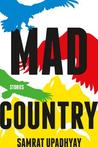
BOOK REVIEW: Mad Country by Samrat Upadhyay

Mad CountryMad Country by Samrat Upadhyay
My rating: 5 of 5 stars

Amazon page


I’ve recently started reading at least one work of literature from each country I visit, and I picked this book up in Nepal as a first take on that country through the lens of literature. I couldn’t be happier with my selection. This book provided exactly what I was looking for in such a book, and more. What I want from such a book is insight into culture, lifestyle, and politico-historical context that can be difficult to witness through travel. Traveling a new country is like dating a new person; one doesn’t see the rough edges for some time. (Usually the relationship – in either case — is over before one sees into the murky depths.)

Over the course of eight stories, Upadhyay not only gives one insight into the nature of life for a variety of Nepalis (e.g. rich, poor, and middle class as well as young / progressive v.) older / conservative), he also shows the life of a hippie ex-pat gone native as well as presenting the worldview of a Nepali abroad (i.e. in America for college.) Where this book exceeded my expectations was in the skilfulness of tension-building employed in the stories. Often a book that achieves the aforementioned objectives does so in a way that is flat on story because it takes the character-centric orientation common in literary fiction. These stories are gripping as well as insightful, and don’t abandon story for character. It dances a beautiful line in that regard.

The first of eight stories tells of the trials and tribulations of an editor of a hard-hitting journalistic magazine, and the dual challenges she faces in taking on a corrupt regime while at the same time she has a friend who is going through a messy breakup. However the editor juggles these competing demands, we know she won’t escape some guilt of failing someone important to her.

The second story is about a rich boy whose life is tormented by the fact that his mother abandoned him and his father and moved on to form a new family. The boy takes to impersonating a beggar, secretly hoping his mother will see him and will be shocked into change. The story is also about the young man’s wake up call to the fact that he’ll never have the killer instincts bred by necessity into those less fortunate that are arrayed against him.

The third story is about “the Sharmas,” a dysfunctional Nepali nuclear family in which the mother is pure shrew, the father is trying fumblingly to have an affair, the son is a dim-wit, and the daughter is dating a young man who everybody seems to think is out of her league.

The fourth story is about a girl in the early 1980’s Kathmandu who goes from the drug-addled life of a Freak Street hippie to going full native. Here we see what draws the foreigner to Nepal and to Nepalese people, as well as how attempts to escape into another culture can be as troubled as attempts to escape into drug-induced euphoria.

The fifth story is by far the longest and might be classed as a novella. It’s about a young man who becomes obsessed with an African girl that he rescues in Kathmandu. The piece has a very dream-like quality to it, and through much of the story one is left unclear as to what is real and what is the product of the lead’s mind. In fact, the title “Dreaming of Ghana” suggests this imagined state of affairs.

The sixth story is the shortest, and – as its title suggests – it’s about an “Affair before the Earthquake.” The story evokes the emotion of world events that cleanly bisect our lives.

The eponymously titled penultimate chapter follows a wealthy and powerful woman who is “disappeared” by a corrupt authoritarian regime when she tries to look into the similar disappearance of her son. It’s a fascinating tale about a prominent real estate developer who is disabused of the notion that she is too powerful to be man-handled by the State. We see her transformation as a prisoner as the wind is taken out of her sails until one wonders whether she would ever be able to cope in her old life after being cowed by prison life.

The last story, like the fourth, turns things upside-down a bit. In it we find a Nepali student abroad who finds himself out in the cold because of his strong views on race. He discovers he’s at odds with the other foreign students because he thinks they should be more outraged about the bias displayed against them. He identifies with the plight of blacks, but they don’t see him as one of them.

This is an intense little collection of stories and I’d highly recommend it. The stories are well-crafted and keep the reader intrigued.

View all my reviews

BOOK REVIEW: Hard-Boiled Wonderland and the End of the World by Haruki Murakami

Hard-Boiled Wonderland and the End of the WorldHard-Boiled Wonderland and the End of the World by Haruki Murakami
My rating: 5 of 5 stars

Amazon page


This novel intersperses two story lines, the connection between which only becomes clear near the book’s end. The first story arc is set in a realistic world in which a few futuristic and bizarre science fiction elements intrude on an otherwise ordinary Tokyo scenescape. Let’s face it, Tokyo is one of those cities that it’s easy to believe hides some unexpected truths inside its gargantuan sprawl.

In the first story (i.e. the odd-numbered chapters), a Calcutec (i.e. the narrator) is hired by a mysterious elderly scientist who’s running an independent laboratory. Calcutecs are individuals who’ve been trained to use their subconscious for data encryption and storage. As the offense / defense of data encryption has become a contact sport in this world, the narrator isn’t initially surprised when he gains some unwanted attention from nefarious types, but gradually he comes to discover that nothing is as it seems.

The second story arc plays out in a surreal dream world. In this world, the lead (also a “narrator”) is a dream reader who spends his nights taking in old dreams from the skulls of the beasts who reside in the countryside nearby and which die off in massive numbers each winter. All and all, this narrators life is relatively calm and tranquil, though he does suffer some anxiety over the fact that he’s been separated from his shadow, and that said shadow seems to be dying off.

For a story that plays out in the surreal imagery of the subconscious mind and which hinges on the esoteric world of the brain, it’s incredibly readable and easily followed. This is trippy reading, but it’s not difficult to follow. If you enjoy movies like “Inception,” “Source Code,” “Memento,” or “The Machinist,” this book will be right up your alley.

I’d highly recommend this book for those who enjoy mind-bending fiction.

View all my reviews

BOOK REVIEW: The Graveyard Book by Neil Gaiman

The Graveyard BookThe Graveyard Book by Neil Gaiman
My rating: 5 of 5 stars

This book begins with a family being murdered by Jack, a cold-hearted killer – a family all save the infant. It’s readily apparent that this isn’t a random violent crime. For one thing, the fiend is far more concerned with finding the baby so as to complete his treacherous task than he is with absconding with loot or reveling in carnage. We don’t know why the family is killed or how a baby could possibly be a worthy target for an assassin, but it’s a mystery that will play out over the course of the book. What we do know is that the boy, Bod – short for Nobody [Owens] – crawled from his crib, out of the house, and into a graveyard that night and that he was taken in by the dead [and a vampiric guardian named Silas] and granted free access to the graveyard.

While the plot is about a killer on the loose intent on murdering Bod, a lot of the book deals with the boy’s challenges as the one living human among a community of the dead. Silas and his adoptive – if deceased – parents, the Owenses, are reluctant to let the boy out of the graveyard because they know he is in danger and they can protect him there were a different set of rules apply, but he has a desire to experience the world. An abortive experiment with going to school fails because Bod sticks up for bullied kids and can’t help but employ some of the skills he’s acquired as a denizen of the graveyard. In the graveyard, he is a living person among the dead, but he is no less the outsider among the living.

This is written for a young audience, and is therefore highly readable while avoiding all the gore that one might expect of a book that begins in murder. Gaiman masterfully creates the ghoulishness and suspense without being horror, per se. I’d recommend this book for readers of low (intrusion) fantasy works.

View all my reviews

BOOK REVIEW: The Journey to the East by Hermann Hesse

The Journey to the EastThe Journey to the East by Hermann Hesse
My rating: 5 of 5 stars

Amazon page


This lesser-known Hesse work adopts a theme common throughout the author’s books in that it’s philosophical man-versus-himself fiction. The book’s protagonist, H.H., is a member of a secretive league [called “The League”] with whom he is undertaking a journey of self-discovery. H.H. fails to complete the expedition, and that fact haunts him into old age. Ultimately, H.H. finds Leo, a servant who’d been on the journey with him, with whom H.H. had a great affinity, and whose disappearance (along with some loot) led to H.H.’s abandonment of the trip. In the process, the lead discovers that nothing was what it seemed.The book examines how vulnerable people are to disillusionment and how quickly they can lose their passion, and it urges the reader to consider from what source one draws one’s strength.

This novella is a little under a hundred pages, and is told in five chapters. The first couple of chapters describe the ill-fated journey. The third chapter is a pivot in which H.H. is considering his inadequate attempt to chronicle events, and is advised to get closure by tracking down Leo. In the last two chapters, H.H. does find Leo, receives the man’s wisdom, and ultimately finds out what really happened.

I enjoyed this book. It’s a quick and simple read, but is extremely thought-provoking. I’d recommend this book for anyone who likes to think about life’s big questions.

View all my reviews

BOOK REVIEW: The Finger by William S Burroughs

The FingerThe Finger by William S Burroughs
My rating: 4 of 5 stars

Amazon page


This is book #25 in Penguin’s “Modern” series. These short books (less than 100 pages) feature short works (poems, short stories, essays, speeches, and even a novella or two) from 20th century luminaries. In this case, the book consists of six short stories by the Beat Generation writer William S. Burroughs, who’s most famous for his novel “Naked Lunch” and for his affinity for heroin. I mention the latter not to besmirch Burroughs’ character, but because drug use (and the vices that sometimes travel hand-in-hand) is a fixture in Burroughs’ writing, and this collection is no exception.

Many, if not all, of these stories are in the same fictional universe, as suggested by repeated characters and locations — most notably the junky William Lee of “Naked Lunch” fame. [These stories were previously published in a collection entitled, “Interzone,” and the titular piece had an even earlier first publication in the book, “Early Routines.”] However, the stories are all stand-alone pieces and a couple of them show no evidence of being related. The one’s that do share common features don’t tell an overarching tale.

The six stories are:

1.) “The Finger”: An addict, Lee, cuts off his own finger (just the top joint) and is surprised by the reaction it incurs.

2.) “Driving Lesson”: An individual with no experience driving is asked to take the wheel, and given some bad advice to boot.

3.) “The Junky’s Christmas”: The spirit of Christmas overcomes an addict’s yearnings.

4.) “Lee and the Boys”: Lee and his various [non-sexual] interactions with young male prostitutes.

5.) “In the Café Central”: This isn’t so much a story as sketches of the various meetups simultaneously transpiring at a café. There is a table with: a.) a guide and a tourist, b.) a German expat and the annoying gossip who he uniquely tolerates, c.) a beautiful woman with bad teeth who is a wee bit sensitive about them.

6.) “Dream of the Penal Colony”: This hazy, little story is part a dream of being in a penal colony and part slurry of reality and the hallucinations of drug-addled drifter.

I enjoyed this little collection and would recommend it for someone who wants to sample Burroughs before diving into one of his novels. While the first story may have gotten the title role by virtue of its bizarre subject matter, I’d argue that “The Junky’s Christmas” is narratively the strongest. It’s not too hard to follow these pieces despite the fact that the stories virtually all feature unreliable narration by virtue of being told through the eyes of someone in the grips of substance abuse. Burroughs presents that mix of reality and drug-distorted world-view vividly and intelligibly. That said, if you’re expecting the world through sober eyes, you’re in the wrong place.

View all my reviews

BOOK REVIEW: Only the Impassioned by H. C. Turk

Only The ImpassionedOnly The Impassioned by H.C. Turk
My rating: 4 of 5 stars

Amazon page


The blurb offers readers the gist of the story. In a nutshell: an American soldier, Andrew Bower, experiences some horrific happenings during the Second World War and the subsequent liberation of a Nazi concentration camp. Nearing being sent home at the end of the European campaign, he’s severely wounded. In his wound- and drug-induced stupor, a dream world story unfolds. He imagines he’s fled to a tiny, neutral country that’s been unaffected by the war. Bowers’s deathbed dream mixes insights into the absurdity and insecurity of war with a fantasy about the adult family life it looks as though he will be denied.

The dream world story explores an interesting theme, particularly involving the notion that to be human means to be a mixed bag of drives and desires and not a mechanistic unified actor. Andrew wants to flee to a place untouched by the war, but even there he (and the people who populate his mind space) finds he can’t escape the anxiety. To be in an unaffected country means only to be in the looming shadow of war. It doesn’t mean one will feel safe. Bowers thus faces the dilemma of whether to go back to war or to stay in war’s shadow. This split is commonly seen in the real world. Soldiers despise being in a war, but are often drawn to it in part because they feel they owe it to their peers, in part because of guilt, and in part because acting is better than sitting around stewing in one’s fear and torment.

The surrealism of the dream sequence gradually unfolded. By this I mean one doesn’t sense an immediate shift in tone and imagery from the real to the metaphysical. This may have been on purpose, and some portion of readers will like it that way, but I suspect another portion of readership would like a clearer / cleaner shift in the feel. There does come a point at which there is a weirdness going on that one can’t reconcile with the real world, but that comes fairly well into the part of the story that isn’t rooted in the real world. It’s a hard line to capture that mental world surrealism without becoming distracting. Adding to the challenge in this case, there’s meant to be a haziness in which real world elements intrude into the mental world.

I found this book to be entertaining and insightful, and would recommend it for readers of war fiction.

View all my reviews

BOOK REVIEW: Up the Down Staircase by Bel Kaufman

Up the Down StaircaseUp the Down Staircase by Bel Kaufman
My rating: 5 of 5 stars

Amazon page


This is a humorous novel about a rookie teacher’s first year in a New York City public school with all the frustrations and victories that experience entails. It’s an epistolary novel – meaning it’s conveyed through a series of documents. Some of the humor is of a “kids say the darndest things” nature – though these are high school students, so the humor isn’t so much born of naiveté as it is a combination of teenage snarkiness and a maddening ignorance of concepts that students should have grasped by that age (i.e. laugh so you don’t cry style humor.) The humor from kids is largely conveyed by students’ comments in the teacher’s comment box as well as via homework assignments.

There’s a second kind of humor in the form of bureaucratic absurdism. Bureaucratic wrangling and lack of resources cause most of the protagonist’s frustrations. This humor is largely conveyed through memos – some school-wide and some specifically to the protagonist, Sylvia Barrett. Barrett also commiserates with her co-workers, and we see some of her frustration playing out through the post-it note equivalent of water-cooler conversations.

The epistolary form offers a challenging format for both character development and story presentation. However, the novel is strong on character development. It achieves this in large part by mixing long-form letters to a close friend with the short memos and comment box entries. The reader gets to see events unfold and responses by way of different documents. The longer letters give us some depth of feeling. There is even a point where Barrett is being swamped by correspondence and we hear nothing back from her, and in this we can feel the degree to which she is overwhelmed.

The book isn’t story-centric. However, there is a narrative arc that revolves around the question of whether Barrett will stay on at the public high school or move on to teach at a liberal arts college. She is torn because she feels she can do good at the public high school and that would be satisfying, but at the same time she is bureaucratically frustrated and demoralized by perceived failures. There are dramatic events here and there to elevate the tension from the run-of-the-mill school events, but not so much that the book ever moves away from feeling like the real experience of a rookie teacher.

The book uses drawings here and there, usually presented as student doodles, to add to the humor.

I enjoyed this book, finding it to be both humorous and illuminating. I would highly recommend it for those interested in the challenges of secondary education or who can appreciate the [bittersweet] humor of it.

View all my reviews

5 of my Favorite Books on Yoga

5.) Sure Ways to Self-Realization by Swami Satyananda Saraswati: All you need to know about meditation and more. The first half of this book examines various yogic approaches to meditation and offers in-depth explanation of said techniques. The second half puts yogic meditation into a larger context by providing a survey of meditative approaches from around the world. It’s as close to one-stop shopping for the yogic meditator as one is likely to find, and the presentation of material on topics such as Jnana Yoga and Tantra is much more balanced and illuminating than many books.


4.) Your Brain on Yoga by Sat Bir Singh Khalsa: This Harvard Medical School Guide provides an overview of the scientific evidence for the benefits of yoga practice.


3.) A Search in Secret India by Paul Brunton: Brunton traveled India looking for the needles of yogic sagacity amid a haystack of charlatans and posers, and he found a few.


2.) Warrior Pose by Brad Willis: As the sub-title suggests, this book is about how yoga saved the life of a war correspondent who suffered from a severe spinal injury that had repercussions beyond his back — re: his state of mind.


1.) The Heart of Yoga by T.K.V. Desikachar: This book provides one-stop shopping for building one’s yoga practice, and it does so in a very down-to-earth, secular, and non-doctrinaire way. It also includes a translation and brief commentary of Patanjali’s Yoga Sutras — hence, the reason I didn’t need to include that work on this list.

BOOK REVIEW: Gagamba by F. Sionil José

Gagamba The Spider ManGagamba The Spider Man by F. Sionil José
My rating: 5 of 5 stars

Amazon page


This short novel revolves around a real world event, the devastating earthquake that struck Luzon, wreaking havoc on Manila, in July of 1990. The novel is written in an unusual format. The chapters could be described as character sketches offering insight into various people who were in (or next to) the Camarin building when it collapses in the earthquake. Rather than the usual narrative approach, F. Sionil José offers captivating slices of the lives of these individuals that include insight into what brought each of them into the doomed building.

In the book, the Camarin Building houses a popular Spanish food restaurant called “the Ermita” that attracts wealthy movers and shakers both for its cuisine and for the ladies-of-the-evening who ply their trade there. The book presents an interesting contrast between the powerful military officers, businessmen, politicians, and expats who came there to dine and the common folk who work or live in the shadow of the building. The latter includes the character for which the book is named. Gagamba means spider in Tagalog, and it’s the nickname of a beloved man who sells lottery tickets outside the Ermita (because his deformity gives him an appearance reminiscent of a spider.) We see how all become equal in the cross-hairs of Death.

What makes these stories about the victims all the more intriguing is that we know from the book blurb that two of the characters (in addition to Gagamba) will survive the building collapse. The author does a good job of creating characters who are intriguing and who we want to know more about. There is the military officer who is aide to a high-ranking General but who is made a lucrative proposal from a superior officer to mule drugs (this being pre-911 days in which VIPs and their assistants might plausibly be exposed to little to no screening.) There’s a Filipino-American who is taking a priest and family friend out for a fancy dinner. The priest’s ominous discomfort with the setting of the meal – a feeling that we can’t tell is (as he says) because he’s uncomfortable with the cost or because he has an unspoken discomfort with the vice know to occur there – makes one wonder. There’s a homeless couple who lived in the alley beside the Camarin with their infant child.

I enjoyed this book. I think it offers some insight into Filipino culture and the chaotic nature of disaster. I’d highly recommend the book for readers of literary fiction, particularly if one also has an interest in foreign literature.

View all my reviews