BOOK REVIEW: Notes from Underground by Fyodor Dostoevsky

Notes from UndergroundNotes from Underground by Fyodor Dostoyevsky
My rating: 4 of 5 stars

Amazon page


This novella is divided into two uneven parts. The first part consists of eleven chapters of floating head philosophizing by an old man about all manner of topics loosely connected by a cynical outlook. The most prominent topic is consciousness and how it’s a curse upon mankind – for the more one has of it the more one is trapped in a dead-end life. (Presumably what Dostoevsky meant by “the underground.”) One really has to be interested in philosophy to get through the first part, which is about 1/3rd of the book, because there is no story and nothing in particular to make one interested in the monologuing old man’s life or thoughts. However, it’s considered the first existentialist novel, and is considered important on that grounds, and the philosophy is thought-provoking now and again.

It’s in the second part that the book gets interesting. In this part, we get a flashback to the narrator’s life as a young man and the events that presumably shaped the cynical philosophy that he’d rambled on about in the first part.

One can subdivide the second part into three subsections that each get more extensive and more interesting in turn. In the first section, the narrator tells about how he became irritated that there was an alpha male military officer who would walk boldly down the sidewalk and everyone would get out of his way. The narrator is ashamed that he consistently got out of the man’s way, himself. Since there was no rule that this man was owed the right-of-way, the narrator devises a plan to play chicken with the man. This may seem like a silly and sad little story, but it gives insight into the man’s state of mind. There are shades of “Fight Club” in this book, as the narrator feels emasculated by society and modernity. He’s a coward, but a proud coward who believes the world is ruled by fools, while men of intellect – such as himself – are trapped in the underground. He also has a masochistic ambivalence about pain and suffering.

The second and third sections flow together from a solitary event. The narrator runs into an old acquaintance from school, Zverkov, and invites himself to Zverkov’s going-away party dinner. However, neither Zverkov nor his chums particularly care for the narrator. There is a tension not only because they are of a higher status, but because the narrator has a chip on his shoulder about it. The narrator feels himself the superior man, and his self-invitation to the party is in a way another act of playing a game of chicken with those who are de facto superiors. His low-income post, combined with his feelings of superiority, compels him to assert himself to no good end.

When Zverkov and his pals slip away, in part to continue their festivities and in part to get away from the narrator, the narrator pursues them to the brothel they’ve taken their boy’s-night-out to. This is where the third part begins when the narrator ends up sleeping with Liza, a young prostitute. After the deed, the narrator rambles on about how she should get out while the getting is good, engaging in moralistic diatribe. Before leaving, he gives her his address card. Over the next several days, he swings between fears that she’ll actually show up to his shabby abode and fears that she won’t. His feelings for Liza bounce between whipping post and object of affection. And, being a classic unreliable narrator, the reader is left to guess as to the weight of those competing feelings.

Once one gets into the second part, this book becomes intriguing. The lead character would, at best, be classified and anti-hero. There’s nothing likable about him, but still one wonders how events will unfold. The first part offers the occasional bit of food-for-thought, but isn’t a compelling read for those who didn’t major in Philosophy. Even most Philosophy majors will find it needlessly cynical – if interesting. Still, it’s worth reading, and, hey, it’s really short.

View all my reviews

5 of my Favorite Banned / Challenged Classics

Banned Books Week runs from September 23 to 29 in 2018, offering a nice reminder about all of the books that are so awesome that some doofus doesn’t want you to read them.

Here are five of my favorites:

5.) One Flew Over the Cuckoo’s Nest by Ken Kesey: Randle McMurphy conducts a con to convince authorities that he’s insane and belongs in an asylum rather than doing hard time in a prison. It’s a commentary on how free-spirits are viewed by society and the pressures put upon them to conform. It’s been challenged many times on the usual grounds of sex and language, as well as for the “glorification of criminal activity.”

4.) A Clockwork Orange by Anthony Burgess: In a dystopian England, the head of a small band of thuggish teenagers is imprisoned and convinced to undergo operant conditioning that will make any future attempts to engage in violent behavior personally painful. The book is a critique on social engineering, though it should be pointed out that there are two different versions of the book in circulation, one with the final chapter written by the author and one without it, and the inclusion or deletion of that chapter has serious implications for the book’s message. Instances of sex and violence are the usual basis for challenges to this novel.


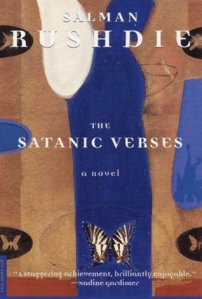
3.) The Satanic Verses by Salman Rushdie: Two men fall from a plane and survive, one archangel and one demon. The title of the book, and much of its controversy, is owed to a plot point about the Islamic prophet Muhammad (Mahound, in the book) receiving both angelic and demonic guidance and prophecy. This is the most explicitly banned book on the list with at least a dozen countries explicitly banning it — most of them were Islamic countries offended by the portrayal of events when Islam was first coming into existence, but a few banned it out of public safety fears over extremist activity. The author is under Fatwa, religious approval of Rushie’s execution, by Iranian authorities.

2.) Brave New World by Aldous Huxley: In this soft dystopia, people are kept in line by readily available drugs and promiscuous sex. Among the American Library Association (ALA) list of challenges to this book was one suggesting the book be banned because it: “makes [promiscuous] sex look like fun.” Which made me laugh a little.

1.) The Grapes of Wrath by John Steinbeck: A family, bankrupted by the one-two punch of the Dust Bowl and Great Depression, packs up and heads out to the promised land of California, only to discover that it wasn’t all that it promised. Objection to language is the most prevalent cause for challenges to this book.

BOOK REVIEW: The Yellow Wallpaper by Charlotte Perkins Gilman

The Yellow WallpaperThe Yellow Wallpaper by Charlotte Perkins Gilman
My rating: 5 of 5 stars

Amazon page


This short story, written in the last decade of the 19th century, tells the story of a sad woman’s descent into madness. The lead is an upper-class lady, wife of a doctor, and is staying in a rented mansion with her husband and her husband’s sister (who acts as their housekeeper) through the summer. The protagonist has been diagnosed with a depressive disorder with hysterical tendencies, and the story serves as an indictment of the way in which mental illness was treated.

It’s not clear what the true nature of the protagonist’s mental or emotional infirmity was at the beginning of her move to the summer-house, but it’s clear that the treatment makes her state of mind much worse. That treatment was a so-called “rest-cure,” and it prohibited her from working, writing (which is now known to be quite therapeutic), or doing much else, save for staring at the walls – hence the title. As happens when the mind is shut-off from external stimuli, it starts to form its own stories that become projected into the individual’s world in the form of hallucinations. In the protagonist’s case, these hallucinations play out in (and behind) the irregular wallpaper pattern.

The fact that the woman’s husband is a doctor, ironically, contributes to her worsening condition because she accepts his “treatment” as being formulated by a great authority. As much as it is an indictment of the specific treatment offered (i.e. “rest-cures”), it may be even more of an indictment of the belief that there exists an infallible authority on the mind. A humbler doctor might have listened to his patient, and adjusted course when it became clear the patient was getting worse under the existing treatment.

This is a very quick read. It may be slow in places, as one might expect of a story that involves a substantial amount of staring at, and contemplation of, wallpaper, but as her condition becomes more serious the story becomes gripping and the nature of reality more in question. The edition that I read contained drawings.

I found this story both intriguing and thought-provoking, and would recommend it for all readers.

View all my reviews

BOOK REVIEW: Exit West by Mohsin Hamid

Exit WestExit West by Mohsin Hamid
My rating: 5 of 5 stars

Amazon page


A young couple falls in love in an undesignated Middle Eastern country, but when violence flares out of control they are forced to flee. The novel follows this couple as they cross through various “doorways,” moving from one country to the next, trying to find someplace where they can settle into a peaceful life.

What makes this love story so intriguing is its exploration of the varied ways in which individuals cope with the challenges of refugee life. The male lead, Saeed, is close to his parents, who are professionals, at the beginning of the story. He’s been raised in a middle-class devout but moderate Muslim household. Saeed seeks out his own people and takes solace not only in Islam, but in the culture of his countrymen more generally. His girlfriend, Nadia, is on the outs with her family because she moved out on her own and she was too modern and progressive for the tastes of her traditional family. She’s a non-believer, and the religion and culture with which she was raised are objects she is more than willing to put in her rearview mirror. (To make it interesting, Nadia wears the burka, not because she is devout, but because it’s somewhat successful at keeping the guys from pawing her. This makes her appear devout, when she is anything but.) Nadia tries to assimilate into whatever community she finds herself. What begins as a comfortable “opposites attract” set of differences becomes an ever-widening chasm as the two are exposed to the stresses of refugee life.

This book is written in a sparse style. It does a lot of telling versus showing. However, that seems to work because some of what it does show the reader is so visceral that some straight-forward exposition of the character’s feelings forms a palate cleanser. The story is specifically vague about how the characters move from place to place. This is clearly on purpose to capture the nature of refugee travel, which is so different from the looking out windows and snapping photos that ordinary travelers do. It also allows the author to portray the refugee routes as portals that open and close on different locales as authorities on either end shut them down. They aren’t the firmly established transportation corridors ordinary travelers move through, but rather ephemeral windows of opportunity.

There are little vignettes about individuals apparently unrelated to the story in each chapter. Through them, I think the author just wishes to convey the global nature of this phenomenon. I didn’t find these bits added much, but the also didn’t take up much space or time, and so didn’t detract from the story.

I enjoyed this story. It reads clearly and quickly, and has a nice tight theme and story arc. I’d recommend it for fiction reads, particularly those interested in a story about being a refugee in the modern world.

View all my reviews

BOOK REVIEW: Circe by Madeline Miller

CirceCirce by Madeline Miller
My rating: 5 of 5 stars

Amazon page


Circe is a minor goddess / sea-nymph in Greek mythology. While her father is the powerful Titan sun-god, Helios, she is the runt of the litter. She has a weak voice by godly standards, has few and limited powers, and is sympathetic to the fates of humans in a way that is considered ungodly. (The latter was strengthened by her affinity for Prometheus, the god who introduced fire to humanity and was subsequently punished by having his liver eaten each day by an eagle.) Circe’s underdog status would only go so far in producing an interesting story, but things become more intriguing when she begins to develop her skill as a witch. This makes her more powerful, and the increasing power of a minor deity threatens greater gods. Some of her abilities as a witch may result from her divinity, but it’s made clear that even mortals can practice witchcraft. Her gift for witchcraft is especially prominent in her abilities of transformation.

Circe’s adverse reaction to the Cinderella treatment she gets at home in addition to the increasing and unexpected threat she presents as a witch – seen when she turns a mortal into a god and another nymph into a monster — gets her exiled to an island. While it would seem that her story would get uninteresting while she’s exiled to a remote island, she’s visited by a number of mythic figures – mortal and god alike – who keep her tale fascinating, these include: the master craftsman Daedalus, the messenger deity / trickster god Hermes, and – most crucially to her story – the heroic king of Ithaca, Odysseus. She also makes a couple of trips off the island, such as when her sister, Pasiphaë, gets a special dispensation to temporarily break the exile in order for Circe to attend to the birth of Pasiphaë’s child. (This might make it seem that the siblings were close, or at least liked each other, but that’s not the case at all. The only family member she has a decent relationship with is her younger brother, Aeëtes, but he is not so much warm to her as he is tolerating of her affections, and even that alliance of convenience is doomed.)

Miller presents readers with a Circe who is both sympathetic and intriguing because she’s no match for the forces arrayed against her and can only survive by her wits and self-knowledge. Circe’s diligence in practicing her craft and her knowledge of her strengths and limitations allows her to persevere in the face of great dangers. She faces hordes of horny sailors, familial dysfunction, and, most crucially, a dire threat to the child who results from her dalliances with one of her most prominent visitors. The story features the many twists, common in Greek Mythology, resulting from gods and men trying to outwit the Fates, but it’s also the straightforward story of a mother who’ll do anything to keep her child safe against a hostile world.

I’d highly recommend this book for all readers of fiction, regardless of whether they have a specific interest in Greek Mythology. It’s a great story, well written, readable, and featuring characters who one can love and others who one can loathe.

View all my reviews

BOOK REVIEW: The Man Who Spoke Snakish by Andrus Kivirähk

The Man Who Spoke SnakishThe Man Who Spoke Snakish by Andrus Kivirähk
My rating: 5 of 5 stars

Amazon page


I read this book as part of my continuing effort to read at least one book from every country to which I’ve traveled. Kivirähk’s book came highly recommended for Estonia on a list by diplomats who were asked to provide a book that offers insight into the country where they served. At first blush, this book seems like an odd selection for such a purpose because it’s a fantasy novel (rather than the character-centric literary fiction that typically offers deep insight about the culture from which the book’s characters reside.) However, I came away from this book feeling that I had learned something about the Estonian national character, if while immersed in a question which has much broader applicability.

The book revolves around the tension between the forest people and the those who’ve moved to the villages. The main character is among the last of the people who live in the forest. Among the traditional skills he learns is how to speak a language called “Snakish,” which is not only the language of snakes, but which also serves as a kind of lingua franca (common language) among many of the species of the forest. A central question of the book is whether this man will be the last to speak Snakish – representing mankind’s expulsion from the natural realm. He is a boy at the beginning of the book, and as he’s learning Snakish, the only other speakers are advanced in age. In essence, the book explores whether the old ways will survive, and – in particular – the ways of humans living in nature instead of thinking themselves above it.

The villagers are enamored with all things foreign. They are passionate converts to Christianity. They gaze admiringly upon knights and monks. They take up any new technology that is introduced. (Needless to say, the time of the story is ambiguously pre-Industrial revolution, when agriculture and feudalism prevailed.) While the villagers look upon the forest people as backwards, just as people today might assume the forest-dwellers to be more superstitious and simpler, what we read is a twist in which the forest people find the villagers to be superstitious and woefully out-of-touch with the ways of nature. The villagers live in fear of nature because they have separated themselves from it, and – following the newly introduced Christian beliefs – they believe they are above nature and that all other creatures are under their dominion to do as they see fit. Of course, nature doesn’t yield easily to the desires of man, and the villagers are forced into the contradiction of thinking themselves superior to nature while at the same time being terrified of the creatures who live in the forest and – for that matter – the forest itself. The simple dichotomy of good and evil that foreigners have introduced is also in contrast with the more nuanced and, arguably, more sophisticated views of the forest-dwellers.

What the reader sees in this story mirrors what we have seen in our world, which is that mankind’s culture continues to leave a progressively bigger mark on the natural world – but not without a cost. On the other side of the coin, aboriginal ways are dying out. In a way, it’s the story of human development shrunk down to the scale of a few characters.

This is an excellent book, and I would highly recommend it for all readers. The story is intense and keeps one reading, but it’s thought-provoking at the same time as it entertains.

View all my reviews

BOOK REVIEW: Marvel’s Avengers: Infinity War Prelude by Will Corona Pilgrim

Marvel's Avengers: Infinity War PreludeMarvel’s Avengers: Infinity War Prelude by Will Corona Pilgrim
My rating: 4 of 5 stars

Amazon page


This two issue comic book was released in advance of “Avengers: Infinity War.” It revisits the events of previous movies adding a few snippets of new material here and there. Of the new material, much of it elaborates upon events that are known to have happened behind the scenes of earlier movies. Not surprisingly, given Marvel’s penchant for secrecy, there are only a few frames that offer insight into activities that a fan who’d seen all the preceding films would be in the dark about.

I’m assuming that anyone considering reading a prelude to “Infinity War,” by this point, has already seen that movie and relevant preceding films such as “Captain America: Civil War,” the first two “Avengers” movies, “Guardians of the Galaxy 1,” and “Doctor Strange.” If that’s not the case, and you want to avoid potential spoilers, stop now.

The first issue recaps “Captain America: Civil War” while providing insight into what happens with Captain America’s team in the wake of that film, at the end of which they find themselves on the wrong side of the law. Much of the issue is verbatim repetition of the events of that movie. There’s also elaboration about the Black Panther’s assistance to Winter Soldier (Sgt. Barnes) via his genius sister Shuri, as well as a scene showing what Captain America, Black Widow, and other team members are up to in the aftermath of the breakup of the Avengers.

The second issue consists largely of Wong schooling Doctor Strange on the powers of the infinity stones and their current whereabouts. Those who’ve seen all the films know that five of the six stones were accounted for before the third Avengers movie. Only the whereabouts of the soul stone remains in doubt. This book doesn’t solve that mystery and merely offers a cryptic comment about the soul stone’s power. As Wong is describing events, the reader is shown flashback scenes from the movies and post-credit scenes that explain where each stone is and how they were used in “Guardians of the Galaxy Vol. 1,” “Thor: The Dark World,” “Avengers 1 & 2,” “Doctor Strange,” etc.

If you are an intense fan who craves every new bit of information, you may enjoy combing through this comic book. Otherwise, it’s mostly of use for those who are planning on seeing “Infinity War” but who haven’t seen “Captain America: Civil War,” “Guardians of the Galaxy 1” (which contains a brief piece of exposition that clarifies the nature of the stones), or the previous “Avengers” films. I don’t know how big that demographic is, but I suppose new fans are coming along all the time. I wouldn’t recommend you purchase the prelude expecting anything new and earth-shattering. The art and dialogue are all well done and inline with the Marvel Cinematic Universe (MCU) films.

View all my reviews

BOOK REVIEW: Inheritance by Balli Kaur Jaswal

InheritanceInheritance by Balli Kaur Jaswal
My rating: 5 of 5 stars

Amazon page


I read at least one piece of literature from every country I visit, and I picked this book for Singapore. In a way, it’s an odd choice because – while the book is set in Singapore over a two decade period — the story revolves around a Punjabi Sikh family. The family consists of single-parent father, two sons, and a daughter who is the youngest child. The father is a police officer who’d been posted to Singapore before it became an independent country. (Singapore is a small [in size, not necessarily in population] island nation that was a British colony, was under Japanese occupation during the Second World War, and then was briefly part of Malaysia — before gaining its independence in 1965.) Given the facts that: a.) Singapore is so fundamentally multi-cultural; b.) the setting substantially influences the nature of the story; and c.) the author lived in Singapore long enough to convey its feel, I stand by my choice.

The story revolves around the damage that can be done by shame and the dark side of traditional values – especially when transplanted into a society that is highly competitive, orderly, but also indulgent. That’s where the importance of the Singaporean setting comes into play. While it’s a strict society that prides itself on order, Singapore is also a mega-Asia metropolis where anyone can find a dim recess to do whatever he or she wants.

Amrit, the young woman in the family, is the single biggest point of shame for the father – and, to varying degrees, the rest of the family. She drinks to excess, is promiscuous, is generally dismissive of traditional values, and all of this ultimately results in her being unmarriageable [at least not in a traditional wedding to a family of equal or greater status as is so coveted in Indian culture.] Early in the book, she disappears for several days and throws the family into a lurch. One would think that concern for Amrit’s well-being would be the over-riding emotion during her absence, but it’s tainted by fear that she’ll make the family look bad. The problem is that Amrit is bipolar but no one recognizes this because all the family can accept is that she is misbehaving – perhaps because she never got to know her mother. Because of this, she doesn’t get treatment for her condition until long after she should have. The fear of her being seen as “mad” and the effect that would have on her ability to be wed keeps the family from helping Amrit get the medicine that would allow her manage her impulses and make better decisions.

The middle son, Narain, is a quieter embarrassment to his father. While Narain is not the kind to go on benders or to draw attention to himself, he is gay – in both a culture and a country that are intolerant of homosexuality. At the beginning of the book we see him being sent away to America to college after being prematurely discharged from military service. His father thinks college in America will make a man out of Narain, but what it does is expose him to an environment which is more permissive but at the same time which drives him away from the Sikh values with which he was raised. In short, it does exactly the opposite of what the father hoped for, and we can imagine Narain would have gone through life playing a part as dictated by traditional norms (getting married, having children, and either repressing his sexuality or leading a secret double-life) had he not spent time abroad.

Even the eldest son, Gurdev, is a disappointment to the father despite the fact that he lives life by the traditional script, marrying a wife who has traditional Punjabi values, and having three children who are successful in school. (Though the fact that they are all girls may be an unstated element of the father’s disappointment, it seems to have more to do with the fact that a cousin who was orphaned and spent time with the family is progressing more quickly in his occupation than Gurdev.)

I enjoyed this book and found it quite illuminating. One sees how tradition and modernity come to loggerheads, and how the outcome is influenced by taking place in a setting that is still trying to get a footing on how to be a country – as Singapore was at the time. It seems fascinating how culture and traditional values form – for good or for bad – blinders. The father can’t fathom that Amrit has a mental condition, not just because he’s in denial, but because it’s not a construct that’s part of his world. Narain, at the start of the book, is extremely aware of cultural norms (e.g. in the opening, we see that he won’t step on so much as a brochure because it’s a violation of the tradition he was raised in to step on the written word.)

I’d highly recommend this book. It’s especially good for those who are seeking to gain insight into Singapore, Punjabi culture, or who want to see how mental illness is swept under the rug to the detriment of all involved.

View all my reviews

BOOK REVIEW: A Spy in the House of Love by Anaïs Nin

A Spy in the House of Love (Cities of the Interior #4)A Spy in the House of Love by Anaïs Nin
My rating: 4 of 5 stars

Amazon page


The novel’s lead character, Sabina, is an actress who has a series of extra-marital affairs over the short period covered by the novel. Intrigue is generated at the book’s beginning when Sabina contacts a character that we know only as the “lie detector” and petitions him to watch her. The lie detector follows Sabina throughout the course of her sexual dalliances with four men other than her husband, but the reader is only made explicitly aware of his presence during Sabina’s conversations with him, which bookend the events of the novel.

One might presume this novel would be categorized as erotica or romance, but it’s not so graphic as to be typical of the former, nor so much of a celebration of romance to count as the latter. I’d place this work simply as literary fiction. It focuses on the character of Sabina and the conflict that resides within her – on the on hand, she craves the attention of multiple men; but on the other hand, she is in turmoil about this need. The lie detector serves as a confessor, and by having her activities known to someone she hopes to be unburdened. The language is often verges on the poetic.

I enjoyed this novel both for its language and its reflection on the inner conflict of the human condition. I’d recommend this work for readers of literary fiction.

View all my reviews

5 Characteristics I Look for in Travel Literature (w/ My List to Date)

Recently, I’ve begun to read at least one piece of literature from each of the countries I visit. While I’ve done this for the last several countries I’ve been to, now I’m going back to fill in the gaps from past travel.


I don’t want to be doctrinaire about the books I choose, but I’ve learned a little about what I find the most beneficial. While some people who do this insist on reading a novel from each country, I’ve been much more open to a range of forms, including: poetry, short stories, and — in a case or two — creative non-fiction. One reason I’m flexible this way is that the novel isn’t the basic unit of literature everywhere in the world. I don’t want to read a pop crime novel published by an expat that offers zero insight into culture just because that’s the only novel I can get my hands on in English. Short story collections have proven at least as insightful as novels because one sees more lead characters put into more diverse situations, and poetry can be as well — as long as it gives a sense of place and people.


I should also point out that I’ve violated almost all of these suggestions when something caught my eye — often to great effect. #5 and #1 are really the only ones upon which I insist.


5.) Offers insight into the culture of the country at hand. I don’t want to sound like a literary fiction snob. I read a lot of genre fiction and the occasional commercial fiction, but this is one area where I find literary fiction is best. In large part this is because literary fiction tends to be character-driven and that depth of character usually transmits some insight into culture. When I went to Nepal I read Samrat Upadhyay’s Mad Country [short stories] and learned a great deal about the people of Nepal from various walks of life.


4.) Authored by a national of said country and set there as well.  The second part (set in the country) seems like it would be non-negotiable, but I’ve certainly violated the first part  (local author) and can imagine violating the second (local setting) as well. The key is that it must do #5 (cultural insight, that’s the point after all.) To give an example of a violation of the local author proviso, for the time being at least, I’m going with George Orwell’s Burmese Days as my pick for Myanmar (Burma.) I may change that at some point, but it definitely offered insight about more than one of the items on this list.


To give an example of how one might violate the setting clause and still benefit, I’ve had Michael Ondaatje’s The Cat’s Table, recommended to me for a Sri Lankan book. It features a Sri Lankan boy on a ship headed from Colombo to England and thus (as I understand it) is only briefly set in Sri Lanka. Sometimes, when a national is abroad, one gains even more cultural insight — i.e. it becomes easier to see culture through the state of contrast. (It turns out that I’m reading another novel set in Sri Lanka entitled Chinaman by Shehan Karunatilaka, which promises to offer me insight into not only Sri Lanka, but also into the craziness that is the sport of cricket.


3.) Teaches me about some historical happenings of the country in question. In some sense this is always true because even a contemporary novel deals in history by the time it’s published. However, I tend to prefer a time-frame during which something interesting was going on in the country, but not so far into the past that there is disconnect with the people I interact with in my travels. For example, for Vietnam, I recently read Novel Without A Name, which features a North Vietnamese soldier as a protagonist, and it’s set during the last days of the war with America.


2.) Exposes me to a diverse set of characters. It’s a definite plus if the book shows how more than one element of society lives. A great example of this is Gagamba, a book by F. Sionil Jose, that I read in conjunction with my trip to the Philippines. In it, one peeks into the lives of rich and poor alike, as well as seeing Filipinos who’ve been living abroad and expats living in the Philippines, all this contrast makes the shadowy shapes of culture clearer.


1.) It’s a good read. It’s as simple as that. It must be a book I’d want to read regardless of whether I was trying to check off a box on travel literature.


Here’s a list of countries I’ve been to with my selections for that country — if I have one. There are some countries (e.g. USA, Hungary, India, China, Japan, and the United Kingdom) from which I’ve read a lot, but I’ll stick to presenting one that is an exemplar vis-a-vis the criteria above.


I’d love to receive recommendations, particularly for those countries I don’t have anything for yet.


Austria: The Tobacconist (recommended to me, not yet read.)

Belize:

Botswana:

Cambodia: First They Killed My Father  (I’ve read some fiction set here, but this non-fiction is the best.)

Canada: Surfacing (not yet read)

China: Life and Death Are Wearing Me Out

Czech Republic: The Good Soldier Svejk

Estonia: The Man Who Spoke Snakish (In progress. An unconventional choice as it’s genre fiction, but it came highly recommended and has not disappointed.)

Finland: The Year of the Hare (not yet read)

Guatemala: The President  (not yet read)

Hungary: Cold Days

India: The Guide

Japan: Narrow Road to the Interior

Kenya: A Grain of Wheat

Malaysia:

Mexico: Selected Poems of Octavio Paz

Mongolia: The Blue Sky

Myanmar (Burma): Burmese Days

Nepal: Mad Country

Netherlands:
Peru: Death in the Andes

Philippines: Gagamba

Singapore: Inheritance (in progress; another odd choice as the family that this novel presents is Punjabi, though they live in Singapore. and their lives are shaped by that locale. Some places, like Singapore and the UAE, have a lot of immigrants and it’s only fair to consider them through that lens.)

Slovakia:

Slovenia: I Saw Her That Night (not yet read)

Sri Lanka: Chinaman (in progress)

Thailand:

UAE: Temporary People (not yet read)

United Kingdom: A Christmas Carol

United States: Blood Meridian

Vietnam: Novel Without a Name

Zambia: