BOOK REVIEW: Escape from Kathmandu by Kim Stanley Robinson

Escape From KathmanduEscape From Kathmandu by Kim Stanley Robinson
My rating: 5 of 5 stars

Amazon page


This is an oldy-but-a-goody. It was originally published in 1989, though I read a 2000 edition that I bought in Pokhara. Nepal is probably the only place one is likely to find this book on the shelves of a bookstore (other than used book sellers.) If you didn’t get your copy in Nepal (or haven’t been to the Himalaya) the one thing you need to know to admire the quirkiness of this book is that the grandiosity of what you experience in the Himalaya makes lost cities (ala, Shangri-La) or lost species (ala, the Yeti) seem less unlikely than you would ordinarily think them.

This isn’t so much a novel in the sense of a work with a single narrative arc as it is a novel-in-stories that consists of four adventure stories featuring the same lead characters — George Fergusson and George “Freds” Fredricks — some overlapping minor characters, and all of them set somewhere within Nepal. The cross-cutting theme of these stories is that of trying to rescue the magic of Nepal (dusty and dilapidated as it can sometimes be) from modernity and the grasping hands thereof. The point-of-view character varies from one story to the next (though not within stories.) The setting criss-crosses Nepal from Everest to Chitwan forest to ill-defined border areas, but always going back to — or cutting through — Kathmandu.

The titular first story of the book is about an attempt to rescue a Yeti that has been captured and taken King Kong style back to civilization by way of Kathmandu. The second adventure presents a race to hide the body of a famous deceased climber before it can be found and plundered by individuals who would like to take it from Nepal to make their names from the investigation of it (or, possibly, the novelty of it.) [You may or may not be aware that the bodies of most of the people who’ve died climbing Everest remain up there – often buried in snow and ice but, occasionally, exposed.] The penultimate story is about trying to save Shangri-La by stopping a road that is to be built too close to it for comfort. The final adventure imagines that there are ancient of tunnels under Nepal and centered in Kathmandu. In this story, the conflict between the old and modernity is brought to a head is a most challenging way by the fact that the threat to the secret, ancient tunnels is a badly needed sewer system for Kathmandu. While in the first three stories, the reader readily knows who to root for, in this last story, he or she is hung on the horns of a dilemma.

I enjoyed this book tremendously. It’s humorous. The two Georges (though one conveniently goes by the name “Freds”) offer a classic odd couple dynamic. The stories and characters are quirky, but the book still manages to hang on to its theme and lessons. I’d highly recommend this book for those who like humorous adventure stories.

View all my reviews

BOOK REVIEW: Much Ado About Nothing by William Shakespeare

Much Ado About NothingMuch Ado About Nothing by William Shakespeare
My rating: 5 of 5 stars

Amazon page


[Spoiler-laden summary: To be fair, you’ve had almost 400 years to read it or watch it.] The “nothing” that there is much ado about in this play is the [non-existent] hanky-panky of Hero, daughter of Leonato and the female lead. As it happens, a couple young and studly bachelors (Claudio and Benedick) roll into town after valorous service in the war. This causes some angst in Don John, bastard (Shakespeare’s word, not mine) brother to the Prince of Arragon, because his stock just plummeted. Don John, thus, devises a plot exploiting one of his minions and one of Hero’s attendants to make it look like Hero is flirting about with a strange man. This is a problem because it’s 1623 and Claudio wants his bride to be able to wear white.

When Hero is accused by some credible [but misled] witnesses including her fiancé, Claudio, she passes out from incredulity. Claudio takes off without knowing her condition. A Friar with a devil on his shoulder suggests Leonato tell everyone that Hero’s heart gave out and she died. Friar Francis is one of a handful of steadfast fans of Hero (as well as her cousin and best-friend Beatrice and – by extension – the man courting Beatrice, Benedick – who’s not so much sure of Hero’s virtue as he is sure that Don John is a jerk.) Sad as it is, Hero’s father and her fiancé are ready to relegate her to skanks-town, but her smart-aleck bestie / cousin Beatrice and the priest each have her / his own idea of how things can be set straight. As mentioned, the friar thinks that if Claudio believes Hero died, the better angels of his nature will make him come and atone for his accusations. Beatrice’s approach is to whip Benedick into challenging Claudio to a dual. (Which Benedick is not keen on because he’s war buddies with Claudio, but he plays it strategically by giving Claudio an opportunity to do the right thing while still challenging him.)

This is one of Shakespeare’s comedies, and so in the end everything works out after the twists and turns. Unfortunately, things even work out for Don John – for the time being, at least. The bastard (Shakespeare’s word) goes on the lam knowing the jig is up on his plot. His man, Borachio, rolls on him, and with Hero “dead” things are about to get serious. So, if you were expecting the villain to get it Shylock-style, you’ll be sadly disappointed.

Of course, it’s brilliant; it’s William -frickin- Shakespeare.

View all my reviews

BOOK REVIEW: The Gothamites by Eno Raud

The GothamitesThe Gothamites by Eno Raud
My rating: 5 of 5 stars

Amazon page


While the English translation of this children’s book just came out this summer, the original book (in Estonian) dates to 1962. I don’t point that out because it’s incomprehensibly dated, but because some readers may find the basis of the story to be misogynistic by today’s standards. There is a nation of people (the Gothamites) that is so known for their great wisdom and erudition that all of its men are hired abroad as counselors and advisers. The women find it untenable to have their men gone all the time, as well as finding their own nation is falling into shambles, and so they call all the men back home for a pow-wow. It’s decided that as long as their reputation for wisdom precedes them, the Gothamite men will always be called away to serve other nations, and so the only solution is to immediately give up their clever ways. Which they do.

The opening chapter lays out the backstory I discuss in the previous paragraph. Each chapter thereafter shows the Gothamites bumbling through a simple problem for which they are now unable to find solutions because they’ve given up being contemplative. It’s a bit like the movie “Idiocracy” but set in an ill-defined past instead of in the future, and geared toward children rather than adults. If it was meant as a jab at the Soviets for the bumbling ineptitude in which their system of governance resulted, it seems to have escaped the wrath of the USSR and – in fact – the author seems have done well for himself.

This is one of those children’s books, where I believe the age of the child matters greatly. Let’s consider just one of the stories from the book. Facing a salt shortage, the foolish Gothamites plant a field with little crystals of salt. When weeds begin to sprout, as will happen in a fallow field, the Gothamites are sure they are on the right track. There is an age at which this story is humorous and / or provides a teachable moment, but an older age at which the recipient of the story finds it boring and cringe-worthy. I think at the sweet-spot, the stories are funny and may offer ways to encourage judicious thinking. It’s certainly not laugh-out-loud funny for an adult reader, but it’s all about finding the right audience.

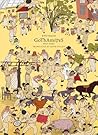
There are whimsical artworks throughout, depicting scenes from the various misadventures of the Gothamites. As far as how individuals are drawn, it reminded me of the old Popeye cartoons, but most of the plates show a chaotic scene with many silly things going on at once.

As l said, I think one has a limited window for an ideal readership, but within that window I think children will find the stories amusing and playful, and parents will find it to be wholesome humor. For that readership, I’d highly recommend this book.

View all my reviews

BOOK REVIEW: Dream Story by Arthur Schnitzler

Dream StoryDream Story by Arthur Schnitzler
My rating: 5 of 5 stars

Amazon page


Suffering one-two blows to his masculinity, the lead – a doctor named Fridolin – engages in a risky chain of events that culminates in sneaking into the orgiastic masquerade ball of a secret society. The major drivers of this behavior seem to be his wife’s admission of a fantasy she had about another man and Fridolin’s embarrassment over a subdued response upon being run into by another man on the sidewalk. The former is the more important event, but it amplifies the effect of the latter event, and together they result in Fridolin goading himself to do something dangerous. It also drives him to ignore warnings and show undue bravado, which results in his being discovered as an impostor at the masquerade event.

If this sounds familiar in broad brush-strokes (but not necessarily in details,) it’s because the 1999 Kubrick film, starring Tom Cruise and Nicole Kidman, “Eyes Wide Shut” is loosely-based on this story. The movie was set in modern-day New York, and the novella is set in Vienna contemporary to its composition (i.e. circa 1926.) The book was originally released in German under the title “Traumnovelle.“

I enjoyed this novella. There is excitement and tension throughout the work that varies from a bit of marital friction to life-and-death fear that the protagonist’s desire to redeem himself will get him killed. There’s also a fascinating instance in which Fridolin’s wife, Albertine, recounts a dream she had that has faint echoes of what actually happened to Fridolin in it. This leads the reader to wonder whether she knows more than she lets on, or whether her subconscious just made some lucky guesses based on their earlier interactions. The reader is shown the seedy side of early twentieth century Vienna. Certainly, what was going on there with regards to the fields of psychology and psychiatry play into the story.

If you’re looking for a short work of intrigue, I’d highly recommend this book.

View all my reviews

BOOK REVIEW: Surfacing by Margaret Atwood

SurfacingSurfacing by Margaret Atwood
My rating: 5 of 5 stars

Amazon page


A young woman takes a double-date to her childhood home in rural Canada after her father goes missing. [OK, “double-date” sounds a bit trivial for the tone of the novel, but it’s the quickest way to say that she goes with her boyfriend, Joe, and a married couple, David and Anna.] At first all is well, and the four are enjoying time away from the city, living in a cabin on an island in beautiful lake country. In fact, the group decides to extend their stay, and — intriguingly — this decision isn’t advanced by the protagonist, who’s father remains missing, but one of the others who is enjoying the novelty of back-country living. During this extension, tensions rise within the group, both within each couple and between the couples.

In the third part of this three-part book, the protagonist descends into a feral madness. Her father’s disappearance, which the protagonist addresses with the stoicism of one accustomed to living in remote territory, is only one of several triggers. We discover that she was divorced, she’d been on the outs with her parents in relation to that marriage, and that her current relationship is falling apart because Joe wants to get serious but the protagonist wants to keep things casual – presumably because of the trauma of her last marriage.

As the novel progresses, we get little indications of what might have been responsible for her father’s disappearance, though the reader doesn’t have a good grasp on whether there is merit to the speculated motives, or whether they are just indication that the protagonist is beginning to lose a grip. We discover that there are parties interested in purchasing the property. Some vitriol is spoken over the fact that the prospective buyers are American, but we don’t know whether that reflects a reasonable curiosity about why foreigners would be interested in such a remote property or whether it’s the madness or whether it’s just a visceral dislike of Americans. It also seems like the protagonist may be on the trail of some sort of artifact and that her father may have left her clues about it. However, again, we don’t know whether this is all the crazed imagings of a person descending into madness.

This is a short, quiet novel, but it was nevertheless engrossing. A lot of the intrigue is packed into the very end of the novel, but as it’s a short novel that doesn’t mean that there’s and excessively long build. The protagonist’s madness offers nice opportunities for strategic ambiguity – i.e. the reader has some freedom to determine what is true and what is paranoia.

I read this as part of a personal project to read a piece of literature that offers insight into a country for every country that I’ve visited. I think it fits the bill nicely. The reader sees a little bit of what life in rural Canada is like. The reader also witnesses some of the conflict over language and nationalism as this takes place in predominantly French-speaking territory, and the protagonist has been living away long enough that her language marks her as an outsider — even though this is where she’s from. We also see how Canadians can feel an intense difference between themselves and people from the United States, even though much of the world sees Canadians as “the polite Americans.”

I’d highly recommend this book for fiction readers.

View all my reviews

BOOK REVIEW: Thirteen Steps Towards the Fare of Erika Klaus by Kazat Akmatov

Thirteen steps towards the fate of Erika KlausThirteen steps towards the fate of Erika Klaus by Kazat Akmatov
My rating: 4 of 5 stars

Amazon page


This book is set in Kyrgyzstan shortly after the breakup of the Soviet Union in a border region that has become the fiefdom of the head of the border patrol force, Colonel Bronza. This condition exists because Bronza had always reported to Moscow, which is no longer concerned with borders beyond those of Russia, and because the Kyrgyz government has been so busy getting its feet under it that it neglected its far reaches.

Into this fiefdom, comes a Norwegian volunteer, Erika Klaus, to teach English. Klaus’s naivete keeps her from grasping the dire nature of the situation and so her fate becomes worse and worse. She fails to realize that she isn’t in democratic and progressive Scandinavia anymore, but rather is in a place that is governed in part by the old Soviet KGB playbooks and in part by a man who is essentially a warlord. Even the reason she is in Kyrgyzstan shows her lack of sophistication. A childhood ailment resulting from lack of sun exposure (a not uncommon factor in Scandinavia) had a profound effect on her psyche and she chooses this location because she read that the locals were “sun-worshipers.” What she didn’t realize is that the reason they have so much affinity for the sun is that they live in a valley where they, at most, get two hours of non-shadow existence per day. But, worse, her naive ways keep her from playing the game that the locals are playing to get along. The story is supposedly based on a true story. However, I don’t know how much dramatic license Akmatov took with the narrative.

I picked up this book in Bishkek as part of my continuing effort to read a work indigenous literature from each country to which I travel – particularly a work that sheds some insight into the culture of that particular country. As I couldn’t find any translated books by Chingiz Aitmatov, I ended up with this book because – for some reason – a few books by this author, Kazat Akmatov, were all that were available in English translation. (This is a little surprising as Chingiz Aitmatov is a much more globally recognized Kyrgyz author.) All that being said, I think this was a good book for my purposes. The fact that it features a Westerner trying to get by in a rural region puts culture and history front and center. The reader learns both about life in Kyrgyz village household as well as how the locals got through this sad time as the protagonist is exposed to these lessons.

I should point out that this isn’t a happy tale. The story has a grim feel throughout, and gets progressively more so. It does have some happy moments in which we see how kind and hospitable the Kyrgyz people are, but they are sparse contrast to the tale of woe playing out. The story is particularly dark when one considers that some version of these events actually happened. That said, it’s a very readable book. The story is engaging and it’s hard to put down.

The book is factually confusing at times. In places it suggests this is the border with Afghanistan (which is relevant to the story because of the past history – i.e. the Soviet-Afghan War), but Tajikistan lies between Kyrgyzstan and Afghanistan and the two post-Soviet countries gained independence within a few days of each other. In other places it reads like the border is with China (which Kyrgyzstan does border.)

The book has a few plates of black-and-white artwork to accentuate certain scenes.

If you’re looking for a book to offer you some insight into Kyrgyzstan, I’d recommend this book. It’s also an interesting, if sad, story for more general readership.

View all my reviews

BOOK REVIEW: Under the Frog by Tibor Fischer

Under the FrogUnder the Frog by Tibor Fischer
My rating: 5 of 5 stars

Amazon page


This book’s strange title derives from an old Hungarian saying of “under a frog’s arse [and down a coal mine.]” That’s the position the protagonist, Gyuri Fischer, feels himself to be in during the course of the book, running from end of the Second World War through the Hungarian Uprising of 1956. Not many can see, let alone convey, the great absurdist comedy of life under a totalitarian regime, but Tibor Fischer manages to do so. Of course, no tale of life under a Communist regime is without a share of tragedy as well, and that plays out to make a gripping finale.

The book is a mostly chronological telling of the life story of a blue-collar worker who plays basketball well enough to be on the team of the factory he works for (and then, when he switches jobs, the railway.) Throughout the book, Gyuri wants nothing more than to leave Hungary behind. His lonely bachelor’s life and the grim nature of life in a Soviet satellite is too much to bear. One sees his fraying sanity as well as that of some of the other key characters. The sole bright-spot in Gyuri’s life is a love affair that plays out during the second half of the book.

I researched the events of the 1956 Uprising for my Master’s thesis, and Fischer’s book was quite accurate in the portion of the book that covers that time period. In places, I suspect the author favors exaggeration for comedic effect (such as in a hilarious segment that explains the origins of Budapest’s “White House” – a hideous piece of Stalinist architecture if ever there was one,) but he weaves real-world happenings into the stories of his book’s characters.

I’d highly recommend this book. If you’re interested in life under a Communist regime, but can’t take the grim and dreary way these stories are usually conveyed, you’ll find this book a refreshing change. (It’s not that the dreariness is absent, but the absurdity blunts the demoralization.) Alternatively, if you just like humor in your novels, this book will serve one well.

View all my reviews

BOOK REVIEW: Batman: A Death in the Family by Jim Starlin, et. al.

Batman: A Death in the FamilyBatman: A Death in the Family by Jim Starlin
My rating: 5 of 5 stars

Amazon page


This collection gathers comic books first published in the late 80’s, telling the story of the demise of Jason Todd (the second Robin) and the rise of the third Robin, Tim Drake. There is an intriguing interactive element to the story of Todd’s death as readers were allowed to vote on whether the character would be killed off or not by way of a phone hotline. The challenge for DC was that when readers did decide to ax Todd the publisher couldn’t tell whether the decision reflected a preference for a lone-wolf Batman, or whether they just didn’t like Todd.

The reason it might have been the latter is that Jason Todd was written as a much more sassy, impudent, and disobedient Robin than his predecessor, Dick Grayson (i.e. who’d shed sidekick status to become Nightwing.) Todd’s teenage insolence can be seen in this story when Batman puts him on probation after some rash action while crime-fighting. Having found a clue that puts him on the trail of his birth mother, Todd goes on a global walkabout searching for her. With comic book convenience, Todd’s pursuit of meeting his mother brings him back across the path of a Batman who is out to stop the Joker. When Robin is asked to maintain surveillance on the Joker while Batman sets off to interrupt a convoy of poisonous gas, the seeds of self-destruction are sown.

This isn’t a Gotham-centric Batman story, but reflects the geopolitics of the 1980’s. Batman and Robin reunite in the Middle East, and the story proceeds to the United Nations as the Dark Knight attempts to end the Joker’s reign of madness. When the Iranians make the Joker their Ambassador to the United Nations, Superman is brought in to make sure an enraged Batman doesn’t do something that will cause an international incident. Superman’s role is neither extensive nor, given his vast powers, particularly interesting.

When DC was putting together this collection, they apparently thought that leaving the story with a bitter, despondent, and angry Batman wasn’t the way forward, and so they include the story of how Tim Drake becomes the third Robin. (Even though it makes for an odd narrative kink and tone shift.) Drake is a boy Sherlock Holmes. Having deduced that Batman is Bruce Wayne and noticing that Batman has become more reckless in the wake of Todd’s / Robin’s death, Drake stalks Dick Grayson in an attempt to get him to return to being Batman’s sidekick. Grayson isn’t interested in the demotion, and the guilt-ridden Batman has no desire to partner up again, feeling that he got the last one killed.

I enjoyed this collection. The fact that it includes powerful consequences gives it some emotional resonance and narrative tension. (Of course, in comic book fashion, Todd doesn’t stay dead, but that doesn’t happen until long after this run.) I found the shift to the “Teen Titans” books (i.e. the part involving Drake and Dick Grayson) makes for an odd turn-about in the story. But it’s understandable as it’s a dark story line otherwise. (I would have preferred more on the front end to show why I should care that a rash and disrespectful twit got killed doing what he was told not to. Long time readers will have some sympathies for Todd [his execution by readers was of a narrow margin, after all], but just based on this book one may feel Todd got what was coming.)

This book presents a crucial moment in the Batman canon, and should be read by any one interested in the Dark Knight’s story.

View all my reviews

BOOK REVIEW: The Book Thief by Markus Zusak

The Book ThiefThe Book Thief by Markus Zusak
My rating: 5 of 5 stars

Amazon page


One might think that a book narrated by Death and set in Nazi Germany during the Second World War would be bleak from cover to cover. But one would be wrong. “The Book Thief” heaps hope and humor upon the reader, saving tragedy for the final course – besides a few sprinkles throughout. It’s not that the story lacks a tension born of many close calls and morally compromised situations, but it’s a very human story – with the appropriate mix of blemishes and beauty.

The protagonist is a girl named Liesel who is sent to live with foster parents during the first year of World War II. Traveling to meet her new family, her brother dies, leaving her alone with new parents in a new city on the doorstep of the most lethal war in human history. In the cemetery, after her brother’s impromptu funeral, Liesel finds a fallen book and keeps it. It’s the first of several books she will “steal,” acts that will define her but which are comic sins in the shadow of the mass murder in progress. Fortunately, Liesel’s foster parents are salt of the earth folk. They aren’t wealthy or erudite, but they offer Liesel a loving home. It’s a little harder to see this affection in her foster-mother, who has a stern and gruff exterior — in contrast to her papa who is endearingly sympathetic.

The story is about this family, and others in the neighborhood, trying to get through life under a regime they recognize as tragically absurd, but which is terrifying none-the-less. Besides surviving, characters like Liesel’s papa try to do the right thing whenever they can, in whatever way won’t get them killed. Life gets harder as the war wears on. Liesel’s papa is a house painter, an occupation that is not a year-round occupation in Germany. Liesel’s mother does laundry, a luxury that most can’t afford as the war rages. On the other hand, this doesn’t make them worse off than most of the others on Himmel Street, which is – figuratively speaking – on the wrong side of the tracks.

While this is an engaging story, Death as narrator is the feature that really makes this book exceptional to me. Much of the lightness and humor comes from the fact that the narrator is not grim, but rather has humor and a stilted form of humanity about him. From a narrative perspective, Death offers a unique point of view, but it’s the circumvention of expectations that comes from the fact that Death can recognize the tragedy of what is unfolding before him. He’s not emotional about it in the way a human would be, but neither does he ignore the brutality and absurdity of it. The other factor that catapults this book beyond the realm of run-of-mill war story, is how the desire for literature and learning — which would usually be lost in a war story’s struggle for survival – is given a prominent role.

I enjoyed this book immensely. It’s an intensely human story, neither saturated in sorrow nor ignoring the horrors of war and genocide. I highly recommend it for fiction readers.

View all my reviews

BOOK REVIEW: The Merchant of Venice by William Shakespeare

The Merchant of VeniceThe Merchant of Venice by William Shakespeare
My rating: 5 of 5 stars

Amazon page

Get Speechify to make any book an Audiobook


This story hinges on the (now proverbial) pound of flesh. Bassanio is a poor gentleman in love with a rich lady, Portia. While Bassanio is upfront with Portia about his poverty — and she could care less — he can’t bring himself to propose to her without a few coins to his name. So, he goes to Antonio, the titular merchant of Venice and a close friend, and asks for a loan. Antonio is free and easy about making loans without requiring interest payments. Antonio says he’d gladly hand over the money to Bassanio, but all his money is tied up in his ships at sea. He, furthermore, tells Bassanio that if anyone will make him loan, the merchant can easily cover it. Antonio has tons of merchandise arriving in the next couple months from all around the world. The loan amount is small compared to what Antonio intends to earn from selling his goods.

The problem is that the only other game in town for loans is a Scrooge-esque lender named Shylock. Shylock is hard enough to deal with as it is, but he has it in for Antonio, in particular. Besides the fact that Antonio frequently offers interest-free loans — cutting into Shylock’s business — Antonio has also kept Shylock from collecting collateral by paying off other people’s loans before said loans went into default. (Maybe that’s why there were no other lenders in all of Venice?) To be fair, Shylock claims that his gripe with Antonio is that the latter is always leveling antisemitic slurs and other insults at the lender. At any rate, Shylock says he’ll make the loan of 3,000 Ducats, but, instead of ship or merchandise, he requires a pound of flesh as bond. Antonio, for reasons of friendship and the fact that he believes he will have a windfall by then, agrees to Shylock’s terms. If he doesn’t repay the 3,000 ducats in three months, Antonio will have a pound of flesh cut from his chest.

[Spoilers follow.] Bassanio takes the cash and goes traveling to make his proposal. First, he is required to play a “Let’s Make a Deal” game in order to earn the opportunity to wed Portia. The game involves three boxes (i.e. caskets): one of gold, one of silver, and one of lead. Inside one of them is a portrait of Portia, but the others are losers. All a prospective suitor has to go by is a brief inscription. By the time Bassanio arrives the reader has seen two Princes’s failed attempts at this courtship game. The inscriptions with the gold and silver boxes flatter Portia and the suitor, respectively. The inscription on the leaden box acknowledges that the marriage will not be all sunshine and roses, and that is the box Bassanio has the wisdom to choose. Unfortunately, shortly after he does so, he learns that a couple of Antonio’s ships wrecked at sea and the others haven’t been heard from, and – by now – the loan is in default.

Bassanio heads out to Venice with triple the Shylock’s money from his generous and wealthy new wife, planning to dispose of the situation. However, Shylock won’t budge on the terms of the bond. A drama plays out in the courtroom. Portia, anticipating the Shylock might not take the lucrative offer, has her butler take a letter to a legal expert and has said servant return with the lawyer’s reply posthaste. Portia and her handmaid disguise themselves as men – a lawyer and legal clerk, respectively – and catch up with the legal proceedings in Venice. After no one (i.e. the Duke, Bassanio, nor Portia-in-disguise as lawyer) is able to reason with the Shylock, Portia-as-lawyer tells him that he may proceed with cutting away the pound of flesh. However, the bond document says nothing about blood. So, if Shylock spills any of Antonio’s blood, he will be guilty of assault (at the least) and murder in the likely event that Antonio dies. Not to mention, going an ounce over a pound would be a breach of contract to be severely countered. This turns the tables, and Antonio and friends end up exploiting the situation to force the Shylock to convert religion as well as dictating the disposition of the lender’s estate (not to mention he’s still out his 3,000 ducats.)

[Spoiler end.] This play has a tense story line, particularly for a comedy, and is a gripping read. However, it’s also one of the most controversial Shakespearean works for its antisemitic and racist comments. On the other hand, there are reasons to believe that Shakespeare might have been engaging in satire. First, I mentioned that Shylock doesn’t cite loss of business as his quarrel with Antonio, but rather that the merchant has repeatedly insulted and slandered him. While we don’t see direct evidence of this behavior, the fact that Antonio rapes Shylock with his religion (by that I mean forcing a conversion using the threat of State force,) makes it ring true. Second, but continuing on this theme, there are a number of points during which the Shylock is sympathetic, most notably the famous “If you prick us, do we not bleed?…” monologue. Third, we learn that Shylock has a delightful daughter named Jessica, leading the reader to the conclusion that perhaps Shylock isn’t a jerk because he’s a Jew, but is a jerk who happens to be a Jew. Finally, the degree to which Antonio and his friends rake Shylock over the coals at the end of the court scene tarnishes Antonio’s virtue and makes Shylock sympathetic once again. The “turn the other cheek” approach of Christianity gives way to Old Testament vengefulness.

Like many of Shakespeare’s plays (notably “The Taming of the Shrew”,) accusations of sexism are also common, but if there were an award for BOSS of this play it would go to Portia, hands down. True, she has to pretend to be a man to get it all done, but those were those the times. The need for disguise also facilitates a prank that she and her handmaid play on their new husbands, regarding their wedding rings. While they are forced to comply with the dictates of the age, the women in this play certainly hold their own as strong characters. Still, I can’t say the degree to which Shakespeare was a satirist versus an anti-Semite / racist / sexist, but it’s a testament to the richness of his stories and the depth of his characters that his works can be interpreted so diversely.

It’s a masterpiece. Read it.

View all my reviews