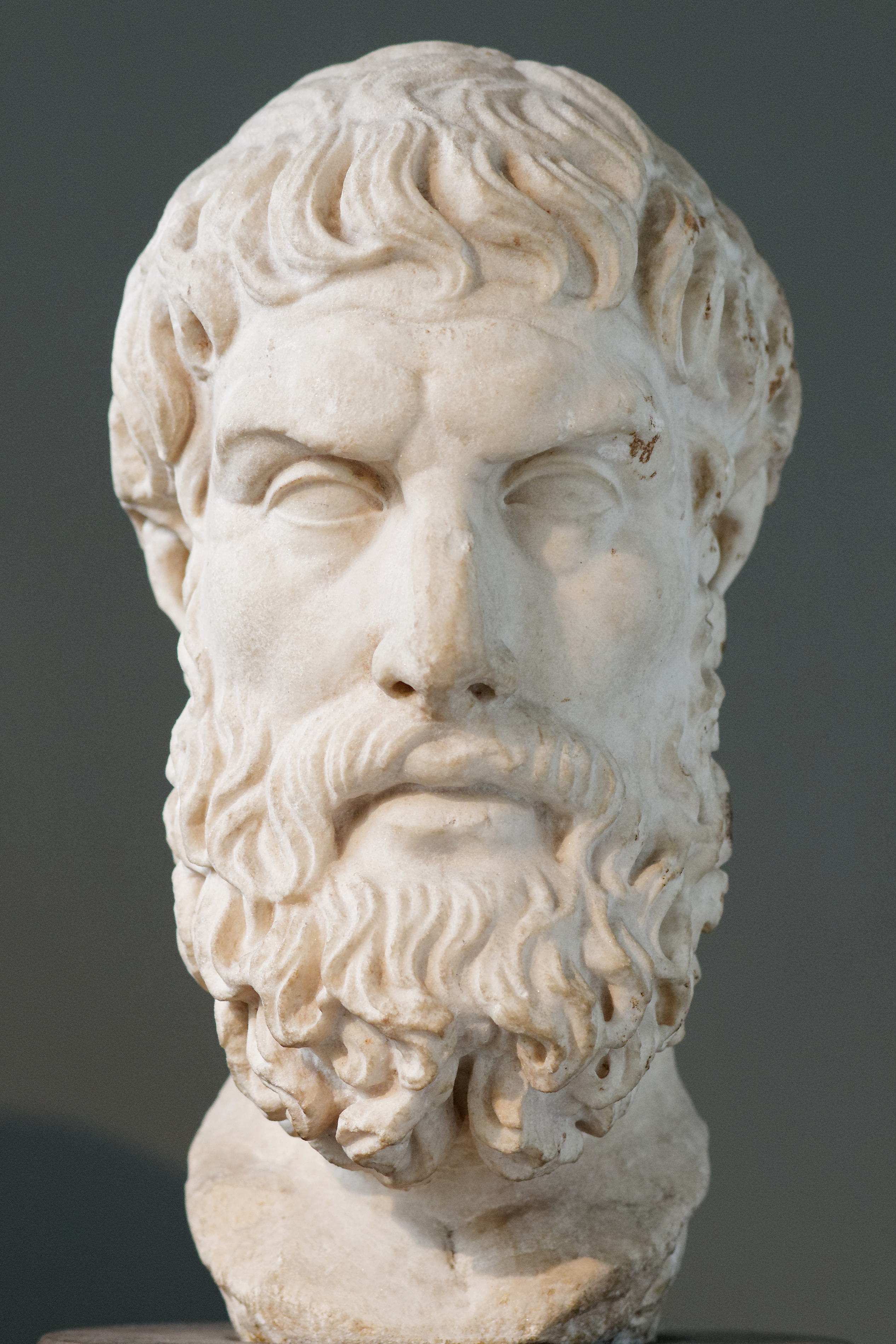
PROMPT: Lesson

Daily writing prompt
Share a lesson you wish you had learned earlier in life.

Few things in life matter as much as they feel they do. Almost nothing is perilous, while many things feel as though they are. Don’t let illusory feelings keep one from living boldly.

Or, as the Epicureans liked to say, “What is painful is easy to endure.”

FIVE WISE LINES [June 2025]

…we should not be too confident in our belief of anything.

cicero; tusculan disputations

No matter what plans you make,
no matter what you acquire,
the thief will enter from the unguarded side.
Be occupied, then, with what you really value
and let the thief take something less.

Rumi; Mathnawi II

Very little is needed to make a happy life;
it is all within yourself, in your way of thinking.

Marcus aurelius; Meditations

I possess, but I am not possessed by her;
since the best thing is to possess pleasures
without being their slave,
not to be devoid of pleasures.

aristippus [according to Diogenes laertius in
lives of the eminent philosophers]

Do not fear the gods.
Do not fear death.
What is good is easy to attain.
What is painful is easy to endure
.

philodemus; Herculaneum papyrus
[Often referred to as the four cures of epicurus]

Five Wise Lines from Epicurus

Death is nothing to us, because a body that has been dispersed into elements experiences no sensations, and the absence of sensation is nothing to us.

principal doctrines – No. 2

Nothing is enough to someone for whom what is enough is too little.

Vatican Sayings – No. 68

Of all the means which are procured by wisdom to ensure happiness throughout the whole of life, by far the most important is the acquisition of friends.

Principal Doctrines – No. 27

Don’t spoil what you have by desiring what you don’t have; but remember that what you now have was once among the things only hoped for.

vatican sayings – No. 35

No pleasure is a bad thing in itself, but some pleasures are only obtainable at the cost of excessive troubles.

Principal doctrines – No. 8

And Five Honorable Mentions:

[T]here are an infinite number of worlds, some like this world, others unlike it.

Letter to Herodotus

Dreams have neither a divine nature nor a prophetic power, but they are the result of images that impact upon us.

vatican sayings – No. 24

It is pointless for a person to pray to the gods for that which he has the power to obtain by himself.

vatican sayings – No. 65

But one must not be so much in love with the explanation by a single way as wrongly to reject all others…

Letter to pythocles

Let no one be slow to seek wisdom when he is young nor weary in the search thereof when he is grown old. For no age is too early or too late for the health of the soul.

Letter to Menoeceus

SOURCE: Epicurus. 2021. The Fundamental Books of Epicurus: Principal Doctrines, Vatican Sayings, and Letters. Trans. by: Robert Drew Hicks & R. Medeiros. Independently published on Amazon. 45pp.

BOOKS: Travels with Epicurus by Daniel Klein

Travels with Epicurus: A Journey to a Greek Island in Search of a Fulfilled LifeTravels with Epicurus: A Journey to a Greek Island in Search of a Fulfilled Life by Daniel Klein
My rating: 5 of 5 stars

Amazon.in Page

With the wave of renewed interest in Philosophies of Life lately, it’s nice to see a book that puts Epicurus at the fore. In a number of ways, I believe Epicurus was the most advanced of Ancient Greek philosophers, and yet he doesn’t get much attention compared to Plato, Aristotle, and the Stoics. (In part this is because the vast majority of Epicurus’s writings were lost, and in part it’s because little-“e” epicureanism [i.e. being culinarily hedonistic] has become much more familiar to people than big-“E” Epicureanism [i.e. a materialist philosophy that values pleasure, but not in so hedonistic way as to lose sight of virtue and the countervailing costs of pursing pleasure.] While adjectival forms have done a number on Cynicism and Stoicism as well, the former is – for all intents and purposes – dead and the latter has become much more well-known to present-day people from a pile of podcasts, books, and vlogs.)

I should point out that Klein doesn’t solely focus on the philosophy of Epicurus, he also tells readers what other schools of philosophy teach us about how to age well (and to not turn into a curmudgeon) — most notably: Buddhism, Stoicism, and Existentialism. That said, it’s fair to call Epicureanism the backbone of this book.

One who reads the title might wonder whether this is a pop philosophy book on aging or a travelogue. It’s definitely both, but the philosophy part dominates. I would call it 70/30 pop philosophy to travelogue (maybe 65/35.) The book uses the individuals Klein interacts with on Hydra (and elsewhere in Greece) as examples of how people age well, and in the process shows the reader [textually] a beautiful part of the world. But the core of the book is about philosophy as it pertains to such topics as play, perception of time, idleness, and changing views of spirituality.

I will warn the reader that, while the book offers many great thoughts for a philosophy of aging well, I didn’t agree with everything in the book. Klein contrasts his philosophy for living well into old age and for adapting one’s life to changing roles to the people he calls the “forever young” crowd. I wouldn’t put myself in the “forever young” category as I don’t believe I’m grasping at youth and all its blessings and pains. However, I suspect Klein would put me in that group because I work out intensely, watch what I eat / manage my vices, and am trying to work things so that my heart explodes while I’m still physically and mentally capable — i.e. before I become decrepit or senile. My point is, I’m not sure Klein’s dichotomy is that useful or reflective of reality, and that being health-conscious should necessarily be contrasted with enjoying the pleasures of age. [Truth be told, I’d say the biggest driver for people being more health-conscious into old age is seeing earlier generations live longer, but with a decreased quality of life through that period of increased longevity — See: Being Mortal by Atul Gawande.]

Still, overall, the book is quite readable and offers much excellent food for thought, and I’d recommend it for anyone who is interested in moving into advanced age in a way that isn’t misery filled.

View all my reviews

BOOK REVIEW: Ancient Philosophy: A Very Short Introduction by Julia Annas

Ancient Philosophy: A Very Short IntroductionAncient Philosophy: A Very Short Introduction by Julia Annas
My rating: 4 of 5 stars

Amazon.in Page

Annas’s task of creating a concise guide for such a broad topic is a daunting one. For perspective, I’ve read books in this series [AVSI] on Stoicism, Epicureanism, and Socrates – each of which is a slim subset of the material called “Ancient Philosophy.” Furthermore, it’s not as though there was great homogeneity of ideas among the ancients. And, adding to the challenge, the author attempts to address the full scope of ancient philosophy: i.e. ethics, epistemology, logic, and metaphysics.

The book is forced to both restrict itself to an inch deep (because the subject is a mile wide,) but also to make choices about what schools, philosophers, and sub-topics it will address. History did part of the work – e.g. for many ancients, only fragmentary or secondhand evidence of their positions survived. So, we see a lot about Plato and Aristotle because their words remain. The book also devotes a disproportionate emphasis to what some call “philosophy of life,” i.e. ethics and how / whether to pursue a happy and meaningful life – i.e. how to live. This emphasis is both because that’s what many ancients focused upon, but also because it’s what people find relevant when looking back to them. [As opposed to ancient metaphysics, which science has largely made obsolete, ancient ethics and thoughts on happiness aren’t necessarily outmoded.] The first chapter sets up this focus on philosophy of life in an interesting way by discussing humanity’s mixed motivational system — reason v. emotion.

One question that the book robustly considers is the degree to which ancient philosophy is still relevant. This is taken up most directly in chapter two, but the final chapter (on what constitutes ancient philosophy) also has germane things to say on the subject.

I found in this book a quick guide to comparing schools of the ancient world across the breadth of philosophy, and would recommend the volume – particularly as a starting point prior to delving deeper into sub-topics.


View all my reviews

BOOK REVIEW: Epicureanism: A Very Short Introduction by Catherine Wilson

Epicureanism: A Very Short IntroductionEpicureanism: A Very Short Introduction by Catherine Wilson
My rating: 5 of 5 stars

Amazon.in Page

Like all ancient schools of philosophy, Epicureanism birthed an adjectival oversimplification that has eclipsed the word’s original meaning and obscured the full story of this philosophical system. Platonic refers to the teachings of Plato, but platonic is a friends-without-benefits scenario. A Cynic is a minimalist who eschews comfort and rejects social norms, but to be cynical is to think the worst. A Stoic believes that there are things one can control and things one can’t and that one should act virtuously in the former case and indifferently in the latter, but a stoic is an emotionless automaton. Epicureans developed a comprehensive system of philosophy that included metaphysics, epistemology, ethics, and political philosophy, but an epicurean is a hedonist, probably dripping butter from his chin. The tenet that there is nothing wrong with seeking pleasure became the whole picture, and lost was the understanding that moderation is a virtue.

Being unacquainted with Epicureanism, I was surprised to learn that it was the least superstitious, as well as the most compassionate, of all the ancient Greek philosophies. Like most people studying ancient philosophies, I’m most interested in those aspects that might be called “philosophy of life” – i.e. ethics, politics, and other aspects that deal in how one should live. [As opposed to the more arcane questions of metaphysics and epistemology.] The reason is simple; the former ideas have aged better, while ancient metaphysics, for example, appears ridiculous in light of all the science that has come along. For this reason, I tend to overlook the long-discredited ideas of ancient philosophers. However, I’ve come to see that these ideas informed the life philosophy of each school (and, also, that there are degrees of wrong.) For example, the Epicureans, being atomists, were correct to a point, and in rooting their entire system in nature (rather than gods and the supernatural) they avoided preoccupation with pleasing the gods and developed an acceptance of the fact that sh!% happens (and it’s not due to angry gods.) So, while many of the details of Epicurean atomism were far from the mark, it did yield a less superstitious outlook (and was less wrong than most ancients.) My point is that I ended up benefiting from this guide’s comprehensive approach.

If you’re looking for an overview of Epicureanism, or you think the defining characteristic of an Epicurean is a love of heavy sauces, you should definitely check this book out.


View all my reviews