The Mythical High Performance Sock

All my socks do is sit and plot their escape.

All my socks do is sit and plot their escape.

The day before I flew to India, a guy in the hotel’s guest laundry room told me that he’d almost gotten in a fight once when a pair of socks turned up missing. We all know that socks are the great self-emancipators of the garment world; they go Steve McQueen from the dryer all the time. Begging the question, why would anyone get so upset over the disappearance of them.

He must have seen the incredulity in my face, as he went on to tell me these were “high performance” socks.

I don’t know if got my second level incredulity as I thought, High… Performance… Socks? The things you wear on your feet to mop up sweat?

A sock is essentially a foot-shaped bag for your feet. As near as I can tell, the acts it “performs” are: 1.) warming the foot a little, 2.) drying the foot a little (theoretically)–though it can also keep the foot wet longer than it otherwise would be, and 3.) producing stink.

In the military we were instructed to wear two pairs of socks. The sock closest to the skin was a cotton sock, and the outer sock was wool. This rationale for this foot sauna was that the cotton sock would wick moisture away from one’s skin, and the wool sock would keep one’s foot warm even when wet. Incidentally, this works great if you are in a cold environment–unfortunately, we haven’t fought a war in a cold environment since 1953.

So when I thought about the “performance” at which these socks excelled, I assumed they must keep one’s feet toasty. Wrong! The material seems extra thin. So, they must keep the foot extra dry, perhaps they are embedded with talc or something like that. Wrong again.

Surely these socks aren’t better than average at producing foot stench?  No. That’s not it.

Then I realized there was an other factor on which a sock might be judged: its ability to get people to hand over money in exchange for it. An average pair of socks can garner $3 or $4, but high performance socks can get people to shell over $17 or more. That’s some high performance.

Now, I know someone out there will be wanting to tell me about the orthopedic benefits of said sock in supporting one’s arch. This sounds like sock oil salesmen shtick. Is there any fabric known to man that can support your body weight so as overcome in adequate arch support in your shoes? Unless you are Tinkerbell, I doubt it. Perhaps, these socks do have physics-defying properties; maybe we should use them to mend bridges.

The Force of Nature

This video begins on the peaceful banks of a river in a nondescript Japanese town. The first minutes of footage is unremarkable except that the water level is quite low, but as it might be in dry season or low tide. Then there is a shrill siren and an urgent warning by loudspeaker–events that will replay periodically throughout the video. Twenty-five minutes later, the camera is fixed on throngs of people trapped on a rooftop across the river. Dawn slinked in and it would be too dark to see these rooftop refugees, but they are silhouetted by the glow of the fires that rage in the background. In the footage in between, one sees houses and ships being carried by the water as if they were a child’s toys washed away by an overturned bucket of water–but brown, debris-laden water that is roiling and churning. Eventually, we see the river reverse its flow.

Someone posted this on Facebook yesterday. I watched all 25 minutes of it. Who watches 25 minutes of shaky, hand-shot home movie? Not me, normally, but I was compelled by the force of nature. They say that one of the things that differentiates humans from even our closest primate brethren is that humans routinely achieve the identical physiological state emotionally from remembering tragedy as from experiencing it first hand–or sometimes even through being exposed to them remotely.

I thought about this force of nature, at first in the literal sense–a pedestrian bridge swept away and freighters swept up a normally unnavigable river. Then I wrote the first 1,000 words or so on a short story entitled The Ghost Ship Onryō that was inspired by watching the tsunami and remembering the news stories it triggered. The story is quite dark, as matched my mood for much of yesterday. Such is the force of nature, to compel me to change my plans and to morph my emotional state through ripples that continue to expand years after the event.

Sharknado: or, the Rock Band or Cheesy Movie Game

Somebody on Facebook made an offhand reference to Sharknado the other day.  I had no idea what a “Sharknado” could be, except the mind-numbingly stupid idea suggested by the phonetics of the “word.” It turns out that is exactly what it was. Despite the fact that sharks exist in places like Florida and tornadoes exist in places like Oklahoma (not a lot of overlap there), the movie is about tornadoes that pick up sharks and throw them through the air at unsuspecting people. (The sharks are, of course, still alive and hungry contrary to everything we know about biological entities that get picked up in twisters.)

I once wondered why the “Sci-fi” channel changed its name to the “Syfy channel.” I now know that it must have been the threat of false advertising lawsuits that spurred this change. (Of course, this doesn’t explain why the “History channel” isn’t the Sasquatch Alien channel.) Sci-fi is short for science fiction. Let’s break that down. First, the reference to “science” means one would expect some speculative universe which is constrained by scientific laws–either the laws of physics as we know them or some reasonable set of scientific principles by which a universe could be held together. It is not a magic universe, as required by Sharknado. The target demo for science-fiction is geeks and nerds (said in the most complimentary sense of those words)–in other words, people who overthink (or, at least, think.) The target demo for Sharknado seems to be pubescent boys failing science and in need of an opportunity to masturbate to Tara Reid.

Second, fiction is a creatively-engineered story, and I’m not even sure Sharknado qualifies on this front either. The creative component seems to be limited to cramming two things that terrify people together into one word or phrase. This may work in some cases, such as with the term “divorce lawyer.” However, the two concepts that one smashes together have to have some credulity as a unified threat. The fact that motherf#$%ing Samuel L. Jackson couldn’t save Snakes on a Plane, should have made this apparent to all.

As a thought exercise, let’s try some examples:

1.) Which of the following terror-inspiring dualities are devices around which a movie plot could be built, and which are just awesome rock band names?

a.) Clown-Pirates

b.) Hobo-Scorpions

c.) Black Mamba-Teen Driver

d.) Bear-Proctologist

e.) Spiders in a Tuk-tuk

f.) Karaoke-Mugger

g.) Robo-gynecologist

h.) Newborn-Arsonist

i.) Mother-in-Law / Attorney-at-Law

j.) Anthrax-blizzard

By the way, if the Syfy channel comes out with any of the above movies or series, please shoot me an email so I can claim my Executive Producer credit. It’s more likely this will be the starting line up for Lollapalooza 2025.

Bear with bubbles

RANT ROOM: Robots Calling

698px-Alt_TelefonThe phone rings. I pick it up. A robot starts talking in my ear. Well, not a robot, but an electronically recorded voice. I hang up. This happens about seven times a day.

I’m on a no-call list, but there’re so many loopholes so as to make its value questionable. First of all,  the politicians exempt themselves–of course. Only a politician could be so megalomaniacal as to think that a person who expressly requests not to be bothered by anyone by phone is secretly awaiting his robo-call.  Second, charities are exempt, whether it’s the March of Dimes or the Irritable Bowel Syndrome Defense Fund.  There seem to be more charities calling than ever. Or, perhaps, they’re like Phnom Penh urchins– if you give one of them money it induces a swarm. (Or, more likely, they make all the big money by selling contact lists to other charities.) Finally, any business that you’ve ever done business with is exempt  (even monopoly phone companies and utilities, for which you had no choice but a third world existence), as well as the parent companies that bought a company that you did business with once 20 years ago.

People who know me will tell you that I don’t even like to talk on the phone with human beings that I like, what hope would a machine have? Answer: “None.”

Now, let it be known that I’m not anti-machine. In 200 years, when they unfreeze my brain after the Terminator Wars, I’m not going to be one of the douche-bags standing on a picket like to prevent little T8-Y0 from going to school with the human kids and super-intelligent dolphins. I just resent someone calling me, intent on taking up my time, without even having the common courtesy to be intelligent–artificially or otherwise.

Some will say, “But, Bernie, you’ve called me and said not a word that was remotely intelligent.”

To that I say, “Nuh-uh, stop being a jerk-head.”

I almost always meet the technical definition of “intelligent” (self-aware? I’m self-obsessed!) when I call someone on the phone, and that’s all I expect of others.  I would pass a Turing test because the evaluator would say, “Any machine would maintain a train of thought better than this guy. He’s all over the place. He must be human. Plus, he can’t do math for shit.” [If you want to weed the androids out of your life, ask them to divide 49  by 18. If they answer automatically and correctly to two decimal points, stake them through the oil pump. If they are one of those “Human Calculators,” they deserve it for betraying their kind–but I’m not speciesist.]

Still, this brings one question to mind, how lonely do you have to be to listen to a machine blather on? Obviously the companies using robo-calls have sufficient success to keep paying their phone bills. That means that some people have to hear the robot voice and say, “What the heck? Let me hear what R2-D2 has to say.”

Who does this? I’ve heard that some people have guilt issues with hanging up on people because they were “raised right.” I can’t claim to understand this. It’s not an affliction that burdens me. I will hang up on anyone who assumes they can make demands on my time without compensation in about two microseconds. Yes, I said it, Mom. (Just kidding, I’m really talking to cable companies, natural gas providers, credit card companies, etc.)

Still, even if one feels guilty about hurting the feelings of a person, why would the same guilt apply to machines–which do not have feelings to hurt.

I mean, does this person think the caller might be a T-101 calling from the future to warn him that a mean T-1000 is on its way to poke him to death with a memory metal finger? I guess that sounds reasonable… no, no it doesn’t.

Alternatively, do people sit around thinking, I wish someone would call me up and tell me what I want, because I have no idea.

Maybe I just don’t understand this mindset. No person has ever convinced me to make an impulse buy by yapping. I’ve never said, “Gee-whiz, you’re right, I definitely need this product or plan that I didn’t know existed five minutes ago.”

It has occurred to me that I might be taking the wrong tack by hanging up on these calls instantaneously. By doing that, I am helping them weed out an unlikely sale in as inexpensive a manner as possible. The next time a robot calls me, I think I’ll put the phone down next to the radio–playing easy listening, of course–and then walk off. I encourage you all to do the same.

Snowden’s Muddled Message

Also posted in my blog, Strategic Ramblings.

Edward Snowden is once again the headline leader. The man some consider a whistle-blower and others think a traitor is trying to gain temporary asylum in Russia. His U.S. passport having been suspended, Russian asylum seems to be his only immediate path out of the transit lounge of Sheremetyevo International Airport in Moscow. A few countries in Latin America have agreed to offer Snowden asylum and he has expressed interest in taking Venezuela up on the offer, but without a passport he is stuck like Tom Hanks’ character in Terminal Man.

The request for Russian asylum is problematic in that Russian President Vladimir Putin has said that asylum wouldn’t be considered as long as Snowden was still leaking. While Snowden said he has no interest in hurting the U.S., he is still talking about U.S. intelligence activities and seems unlikely to give up giving up information.

When the revelations of this story initially broke in the Guardian, I was outraged by the allegations being put forth by Snowden. In essence, Snowden suggested that Americans’ electronic communications were being spied on without warrants and without specificity. While lawyers and politicians love to play word games, the Fourth Amendment is clear and concise. Where there is a reasonable expectation of privacy, searches require a warrant that says who is involved and what’s being sought. In short, the Constitution doesn’t allow fishing expeditions.

The damage control by the Administration and the Intelligence Community in subsequent days was even more infuriating. The message seemed to be, “We want to have an open debate about all these nifty protections that are in place to make this all legal, but, alas, that’s all classified.I’m not saying you should just trust us, but–yeah–just trust us, ya-da-ya-da-ya-da.” I’m suspicious of a government attempting to expand its power; I abhor a government that tries to do it under the cover of darkness.

Director of National Intelligence, James Clapper, had been asked the following question by a Senator during his testimony, “Does the NSA collect any type of data at all on millions or hundreds of millions of Americans?”

Clearly the answer to this question, in light of the Verizon revelation was, “yes.” However, Clapper answered in the negative, and then added a qualifier “not wittingly” that didn’t help improve the truthfulness of statement, but should have been a red flag that the Director was trying to play some type of semantic game. Clapper later went on a Nixon-esque / Clinton-esque defensive about how his answer was the “least untruthful.” Of course, to suggest that the Verizon data was “unwittingly collected” strains credulity.

When General Keith Alexander of the NSA (among others) testified, he said that he had three points. First, that the programs had yielded positive results, or–in other words–the ends justified the means. Second, that the programs in question were “limited, focused, and subject to rigorous oversight.” Third, privacy and civil liberties are protected by the programs. However, he seemed to only want to talk substance about the first point–that is, what ends justified these means. I found it disconcerting that Gen. Alexander could tell us something about which cases had positive outcomes as a result of these programs, but not about the processes and protections required to draw specific information from the vast pools of data being collected on Americans. The former being the kind of information that could have negative security ramifications, the latter could only embarrass politicians. Secrecy is needed to protect assets and methods, but shouldn’t be a tool of protecting dubious legal practices. Al Qaeda doesn’t get a leg up by knowing the legal process required to access data generically.

The testimony was full of what would be objected to as “leading questions” in a court of law. For example, Alexander was asked if there was “any switch that could be flipped to allow analysts to eavesdrop on communications.” This makes for nice ass-covering when it turns out that they, in fact, have to type a command into a command line. “No, we never lied. We were as truthy as can be, there is no switch– we had the switches replaced with buttons decades ago.” Alexander repeated the “flip a switch” phrase back in his reply so that they were all on the same page.

As sad as any comment made was when Alexander said, “Further, as the Deputy Attorney General noted, virtually all countries have lawful intercept programs under which they compel communications providers to share information about individuals they believe represent a threat to their societies.” At the risk of sounding nostalgic, I remember when America prided itself in being a leader in liberty rather than saying, “look we aren’t doing anything that Russia and China aren’t!”

Telling me that you had success due to these programs isn’t enough for me. If you said, “hey, we put everyone of a particular religious persuasion in jail, and we foiled x-number of plots,” should I be reassured or outraged. I would argue the latter.

Telling me that other countries have such programs doesn’t satisfy me. I think the U.S. should seek to be on the leading edge of freedom and not happy slouching around the middle of the pack.

Telling me that a given database has only phone numbers and metadata and no identifying information doesn’t really inspire confidence. It turns out that there’s this nifty thing called “the internet” that allows one to look up people’s names from a phone number. You’re going to tell me that no one is going to google the number they’re looking for information about?

If the government wants to reassure the public, they need to have transparency in legal processes and not hide behind a veil of classified information.

Of course, part of the disagreement is that the law as it now stands only suggests only the content of messages incurs a reasonable expectation of privacy. That Mr. A talked to his therapist for two hours one Sunday evening as (according to cell tower triangulation data) he was sitting in the parking lot of a hospital is–in the eyes of many–completely unprotected information that no one could reasonably expect to be their own damn business.

I’m not comfortable with the collection of vast stores of information on citizens. Even if there are some protections that are working for the moment, all that information will just be waiting for some moment of weakness, some rally-around-the-flag moment, during which people are willing to flush all they hold dear down the crapper in exchange for a promise of security.

Having said all this, I’ve had a bit of trouble retaining sympathy towards Snowden as he’s muddled his initial message about unconstitutional actions. When he started releasing information about how the U.S. was spying on China, his message became lost. Of course the U.S. is spying on China, and they upon us. That’s the nature of the game in an anarchic international system. Yes, it’s a political embarrassment; coming as it did when the President was attempting to give China “the old what for” over the issue, but spying on other countries in order to keep one safe is part of what is expected of a government. (Yes, even on allies. You can be certain Israel, Japan, and the United Kingdom are spying on the U.S.) I take as a given that other countries might try to read my email if they think it has any potential benefit to them. However, they haven’t been granted a monopoly on the legitimate use of force against me. I expect my government to serve to protect me from any dire consequences of other country’s snooping. In fact, I have held jobs where other countries may have eavesdropped on me (not because of the work I did, but because of with whom I was in contact.) The potential for nefarious activities by a foreign country are just not the same as they are for domestic shenanigans–for most of us at least. There is less incentive to try to manipulate a random Joe for political or material gain across borders than there is within.

If Snowden is driven by his love of freedom, why has he headed in the direction that he has. Even if everything he says is absolutely true, the U.S. is still vastly more free than either Russia or Venezuela (e.g.Freedom House ranks the former as “not free” and the latter as “partially free.”) (There is some doubt about whether what Snowden says is true, but as the government hasn’t really delved into details or engaged in any contradiction that is not riddled with carefully censored qualifying words, one cannot tell.)

Happy 237th, America

IMG_9111America is the product of a set of exceptional human beings. Some may wish to humanize the founding fathers and to deflate the mythology that has grown up around them, but deflate the myth and one still has impressive facts. Who turns down a salary for the most sleepless and thankless job in the universe? George Washington, that’s who. Who writes a political document so artfully that its turns of phrase still chime poetically  in the ear 237 years after the fact? Thomas Jefferson, that’s who? Who can invent the lightening rod and bifocals, convince the French to move toward the sound of the guns (just kidding, France), and get the chicks despite the most hideous comb-over ever? Benjamin Franklin, that’s who.

Now this may be Golden Age fallacy talking, but today’s ruling elite seem a bit… well let’s just say “pathetic” by comparison. Sure modern-day rulers still have charisma out the wazoo, but Franklin had charisma plus a world-class intellect. Jefferson had charisma, and he didn’t need a speech-writing team and focus groups to craft his words for him. Washington had charisma, and–quite frankly–he could scare the shit out of a grizzly bear. It’s the rare modern-day leader who is  qualified for any alternative career besides ambulance chasing.

Still, I will remain optimistic about the fate of the nation as long as great ideas prevail. Checks and balances is a great idea. The compromise to appease both populous and small states is a great idea. The Bill of Rights is a set of great ideas. I’m a little amused whenever I hear people say that America needs to revise its Constitution if it wants to keep up in the modern world. I heard this most recently from a scholar who said that because it was relatively difficult to make laws and spend money, America was going to fall ever behind the likes of Scandinavian countries? What? Really? Seriously?

Is India More Rape-prone Than Other Countries?

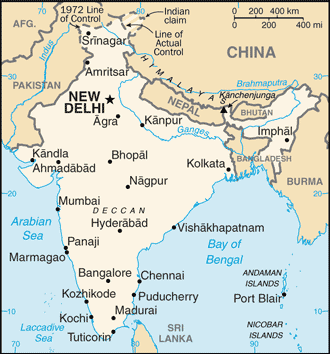
india_sm_2012As I prepare to move to India with my wife, the string of high-profile rapes that have taken place in recent months in India have not gone unnoticed. This past week two such cases were in the news. An American tourist was gang-raped in Himachal Pradesh, and a businessman in West Bengal was charged with the rape of an Irish NGO worker. Other recent cases include a Swiss cyclist in the countryside south of New Delhi and that of a British woman who jumped out of her hotel window because a group of men were trying to force entry into her room in the middle of the night.  While one might argue whether these cases should be given particular prominence just because their victims were foreign, they do speak to a certain level of boldness. In these cases, the criminals didn’t know anything about their victims, and while this makes the act no more or less reprehensible, it does suggest the attackers were particularly audacious.

Of course, the case that has garnered the most attention and outrage was the brutal gang-rape and beating of a young Indian physical therapy intern and the thrashing of her male friend last December. This case gained particular attention both because the victim later died, but probably also because the circumstances seemed like those that anybody could fall into. This wasn’t a drunk girl hitchhiking through the countryside at witching hour. The girl and her friend were going home from a movie at 9:30pm and were lured aboard a bus that was said to be going their way. In some sense, the victim was doing most things right. She was not traveling alone. It was not particularly late. She was not in an isolated area.

However, it turned out that the private bus was under the control of six joyriders. All six men, including the driver, participated in the violence. It may seem odd that the victims would get on this bus that was not  a normal city bus. However, for those used to traveling in the developing world, private buses and collectivos are not that out of the norm–and sometimes are the only way to get the place you’re going.

So the question remains, is rape more common in India than elsewhere? It turns out that this question is hard–if not impossible–to answer. If one takes the statistics at face value, then one should be more worried living in America. The U.S. had almost four times as many police-reported rapes in 2010 as India. When one normalizes this for population (accounting for the fact that India’s population is over 1 billion and America’s is only 300 million), this disparity becomes even more exacerbated.

However, it’s impossible to know what these numbers really tell one. While it is a sad fact that many rapes go unreported in the U.S., there is reason to believe that unreported rapes are even more prevalent in India. In absolute  terms, India has one of the highest numbers of police-reported rapes, but it also has one of the biggest populations in the world–and the biggest for a democracy. When one normalizes for population, India drops way down the list. However, up toward the top of the population-normalized list is Sweden, which would seem to speak to how important the incidence of reporting is. (I don’t imagine Sweden to be home of a disproportionate hostility toward women, but I could be wrong.)

I would also say that India is likely not as bad as many countries which institutionalize misogyny, e.g. theocracies. However, one of the breaks of being a democracy is that one gets held to a higher standard. Yes, there is a lunatic fringe in India. This was most vocally personified by Asaram Bapu, a Hindu guru who shifted blame to the victim by saying that she should have fallen to her knees, held her tormentors hands, and invoked their common religion; and, in doing so, she could have prevented the attack. Another break of democracy is having to accept that you’ll have ass-clown douche-bags with the power of the microphone. As much as most Indians might like to ship Asaram Bapu off to an island with the likes of Todd Akin (the Missouri candidate for Senate who said that women don’t get pregnant if they are really raped [presumably because, “it’s devastating to my case, Your Honor”]), that’s part of liberty–the freedom to say really stupid stuff.

As I’ve been reading about these cases, there are a number of explanations that I’ve heard that hold varying degrees of sway. Some have suggested that alcohol is the culprit. Wrong! Yes, alcohol makes one stupid, but this stupidity is usually restricted to the making and accepting of ill-considered marriage proposals. Millions of people get drunk every week without perpetrating violence other than badly sung karaoke.

There are a few cultural arguments. One is that there’s a bodice-ripping theme in Indian entertainment. This sounds like the alcohol argument and a few other arguments that shift blame away from the attackers–in this case by suggesting that they were just confused about what women want by pop culture depictions.  Speaking as a man, we are all perpetually confused about women want, but knowing that a person doesn’t want to be beaten up or lose control of her body is a no-brainer.

Another argument is that Indian tendencies towards rape reflects the vestiges of ingrained power dynamics. While India may have abandoned the caste system, the idea that some class of people have the right to exert power over others may not be entirely dead.

I don’t know if India has a more extreme problem than other countries in this domain, but I’ll take the recent outrage as a good sign. If there is some societal proclivity that contributes to the problem, perhaps it is about to go down.

Most importantly, be careful out there.

The IT Revolution & Crises of Self-Importance

Source: Ed Poor at Wikipedia.en

Source: Ed Poor at Wikipedia.en

If you’re as old as I (no, I’m not Wilford Brimley old by any stretch), you remember the days when you couldn’t count on getting a hold of another person instantaneously. Incidentally, the phrase “get a hold of” is apropos. Think of other times one might use those words. If one were a practitioner of judō (i.e. a judōka), one might use that phrase when talking about seizing an opponent in anticipation of throwing them.

Herein lies an intriguing irony. The person calling is dominating the called. That is, they are writing a check on one’s time that they believe to be cashable whenever the hell they please. Therefore, one might expect the person receiving random calls at random times to suffer a diminution of self-esteem. They are, after all, at the beck-and-call of some localized bit of humanity. However, on the contrary, the perfection of the electronic-leash has spawned a growing field of narcissists.

The reasoning that drives this plague of narcissism is as follows, “I am so important that some–albeit tiny–part of the universe is at risk of collapse if I’m not ready to spring into action at a moment’s notice. In other words, I am a localized superman[/superwoman.]”

The thing is, you’re really not. The deflating truth is that none of us is so important that any portion of the universe will collapse if we are unplugged from the hive for a few hours– try it.

Now, you may be saying, “Look, I have my phone on all the time, and I talk on it much of the day, but I’m not one of those loud people whose conversation lays waste  to the solitude of people around me everywhere I go.”

The thing is, you really are. Those annoying bastards that you “hurrumph” at when you’re not on the phone–that’s you when you are on it. You make a connection at a distance and, like all others, become oblivious to your immediate environment. At best you are a destroyer of solitude; at worst you are a danger to yourself and others.

There’s No Such Thing as a Silly Question? LIAR!

I’m shocked by how easily a piece of “common wisdom” can become accepted despite being patently and demonstrably wrong. The best example may be, “There’s no such thing as a silly question.”

Oh, yeah:

“Do you wear spurs when you ride ostrich in the avian rodeo?”

“If you had to wear shoes made of cheese, of which cheese would you want them made?”

“Do you have purple-glazed doughnuts in honor of the St. Crispin’s Day unicycle rally?”

“May I twirl my way into an eternity of dandelion lunacy?”

I can do this all day.

Are you seriously going to tell me that none of the above questions is at least a little bit silly. As a person of silliness, it enrages me… well maybe not so much “enrages” as has no discernible effect… when people deny the potential for silliness. Folks, it’s all around us. So, the next time you say that there is no such thing as a silly question, my response is, “Do you really think you can make that stick like the Archbishop’s bugger to the side of an albino wino?”

TODAY’S RANT: Crossing False Alarm

Source: roadtrafficsigns.com

Source: roadtrafficsigns.com

If you’re like me, when you see the above sign, you say to yourself, “That is all well and good, but what if I get a non-conformist deer, or one of those illegals who can’t read English?”  Now, I know what you’re thinking, usually they put a little leaping deer silhouette on the sign so the deer knows the sign is addressed to it, even if reading is not its strong suit. (Let’s face it, if reading were essential to life on this planet, most of humanity would die out.) At any rate, for any number of reasons I might collide with a deer in a completely inappropriate zone.

Now imagine my confusion, and then excitement, when I came across this sign on a recent walk.

IMG_5309This was a flat piece of land, and rocks are generally believed to be inanimate.  So–at first blush–this doesn’t seem to make a lick of sense. However, then I began to think, “What if they mean ‘Rock’ as in ‘rock-n-roll’?”  So I staked it out for an entire day, hoping to get an autograph–maybe Clapton or REO Speedwagon. Who did I get? No one. Not even Donnie Osmond, because–you know–he’s a little bit rock and roll (a very little bit, an infinitesimally small part nano-rock-n-roll.) There weren’t even local bands.

What’s more, no actual rocks tried to cross all day. No igneous, no sedimentary, no basalt, no granite, no shale, no pyrite, no agate, no jasper, no oolite, no amber, no opalite, no Icelandite, no norite, no obsidian, no quartz, no chert, no flint, no gneiss, no marble, no schist, no slate… are you getting my point here? There wasn’t a single rock crossing event all day. Furthermore, how would a rock even know where to cross the trail? They aren’t as smart as deer.