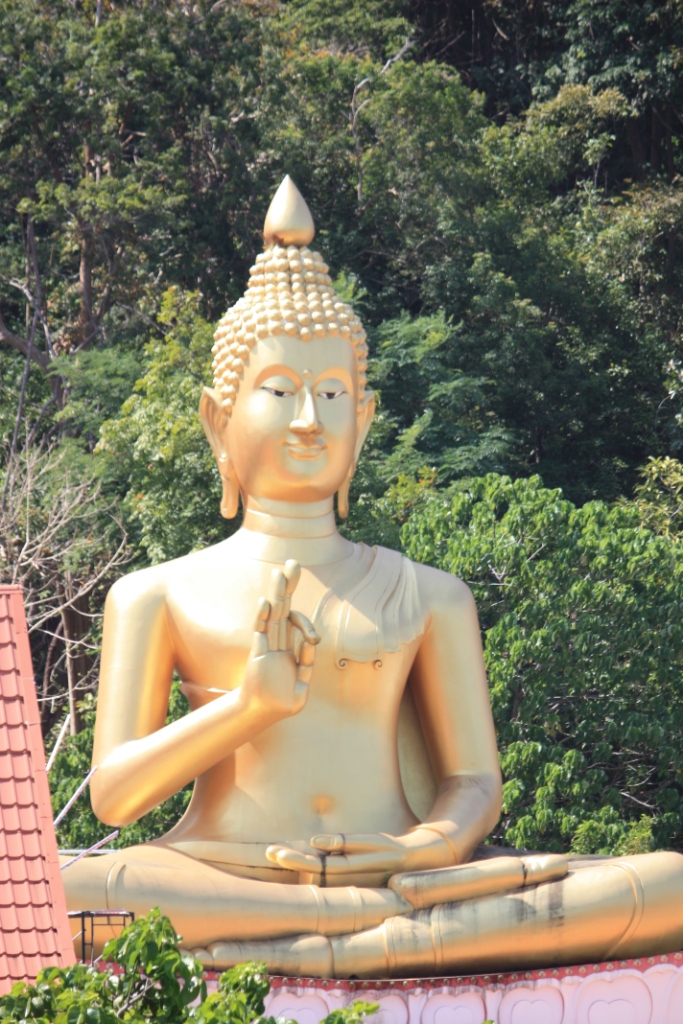
Taken in January of 2013
This Buddha is located at Wat Khao Rang on Rang Hill, overlooking Phuket Town. His right hand mudra conveys that the spice is just right–but you may want to verify that with a Buddhist.

Taken in January of 2013
This Buddha is located at Wat Khao Rang on Rang Hill, overlooking Phuket Town. His right hand mudra conveys that the spice is just right–but you may want to verify that with a Buddhist.
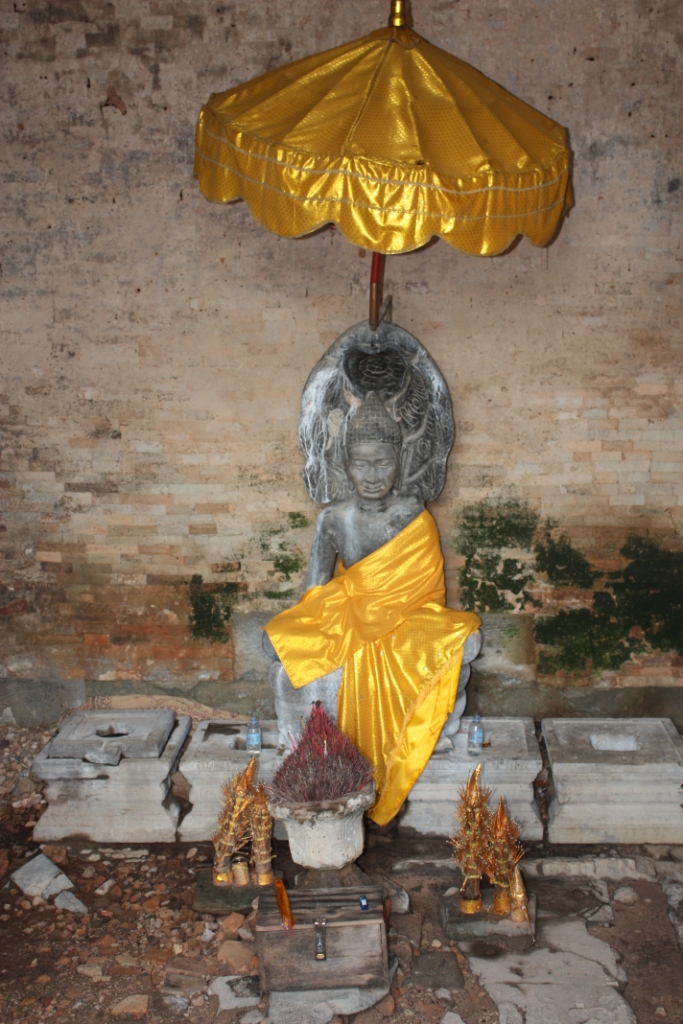
Taken in October of 2012 at Angkor, Cambodia.
I was just doing some research on 13th century Angkor, and so I figured I’d dig back to 2012 for a photo from my visit there.
 I read a story in The Guardian the other day entitled “What drives writers to drink?” It was actually an edited excerpt from a book by Olivia Laing entitled The Trip to Echo Spring: Why Writers Drink.
I found this piece fascinating despite the fact that the title question seemed readily answered with another question, “In what other occupation must one regularly, repeatedly, and thoroughly get punched in the soul in order to succeed?” Writing is a personal act, and no piece of writing that is read escapes the assault of criticism, invited and uninvited, which ranges from sagacious to ridiculous.
One somehow has to find the courage to wade through what feels a lot like attacks on one’s intellectual self in order to discover what is useful and what is not. If one summarily rejects all criticism and advice, one will neither grow nor is one likely to be published. If one accepts all criticism as having merit, one may find a psychiatric ward in one’s future–and one is likely to remain unpublished. So the trick is to be able to answer the question, “What within this writing is genuinely bad?”
The problem is that it feels like the question is, “What about me is flawed?” It’s like holding a mirror up to the core of one’s being and noticing that you have some rot.
How do writers do this? There are probably innumerable approaches, but three common ones come to mind. The first is the one thoroughly addressed in Laing’s book; that is, some writers self-medicate. The article references a quote by Tennessee Williams, “…you felt as if a new kind of blood had been transfused into your arteries, a blood that swept away all anxiety and all tension for a while, and for a while is the stuff that dreams are made of.”
A second unhealthy approach is to reject any assertion that contradicts one’s perfection. In other words, be a narcissist. These are the writers who meet each and every piece of criticism with statements like, “you just don’t understand what I was trying to do there, my misspelling was actually a clever commentary on the zeitgeist of 20th century Armenia.”
The narcissists have the advantage not becoming clinically depressed by the constant rejection and criticism that is a life of writing. The downside is that they have to live in a world in which everyone else on the planet is ignorant and incapable of recognizing brilliance when it’s shining in their faces, and that is depressing in its own way. Only a few in this group manage to get published, and they do so through a combination of being truly great and, at least early on, being willing to tarnish their awesomeness by accepting some editorial suggestions.
The third approach is the one that we should all aspire to, but it’s a bitch getting there. In the title I used “Buddha” as a code word for the enlightened approach. What is the enlightened approach to dealing with rejection and criticism? First, one must realize that equating one’s writing and one’s self is illusory, and that criticism of one’s work isn’t criticism of self. Before any writer gets to the point of submitting works to agents, editors, or publishers someone along the line has told one that one’s writing is good. This fatal compliment causes one’s self-worth to become entangled in one’s writing.
Second, one must develop a confidence that isn’t rooted in external validation. In less pretentious words, one mustn’t feel it necessary to be loved by everyone with whom one comes into contact. This is hell if one’s entire life is writing. The value of published writing is inseparable from how it’s received. My only suggestion on this point is to find something else in one’s life that allows one to build self-confidence. For me, this has been martial arts. Sure there are usually rank tests, which are about validation from one’s teacher. However, what it really comes down is whether one experiences success in training and sparring. If one sees some success, the rank starts to be irrelevant to one’s confidence. I think outdoorsmanship is another such skill– for those less scared of bears than being beaten ugly with a stick. There are few activities in which other’s evaluation of one is ultimately irrelevant, but those are the activities with which one should seek to balance one’s writing.
If anyone needs me I’ll be guzzling Bourbon and contemplating how the publishing industry is run by poop-weasels.
My rating: 4 of 5 stars
Karen Armstrong’s book is a biography of Siddhatta Gotama (a.k.a. Siddhartha Gautama), the man who became the Buddha. However, in the process of telling this man’s life story, she introduces the reader to the basic tenets of the religion he inspired.
Siddhatta’s story is an interesting one that many non-Buddhists know the gist of from the Herman Hesse novel entitled Siddhartha. As a boy, the Buddha-to-be was the son of a wealthy, high-caste man who attempted to shelter his child from all the ugliness of the world, e.g. poverty, disease, and death. Despite these attempts, the young man eventually sees the true world and realizes that he has been living an illusory life. Ultimately, the young man abandons his comfortable life in search of an enlightened view-point.
The Buddha’s life is what one might call “novel-shaped.” That is, the arc of Siddhatta’s life as we know it is ideally suited to being conveyed as a story. It’s a warrior’s quest tale, but one of the mind rather than physical adventure. Armstrong’s book takes advantage of this arc and is arranged accordingly. The six chapters of the book are:1.) Renunciation; 2.) Quest; 3.) Enlightenment; 4.) Dhamma (the doctrines or teachings); 5.) Mission; 6.) Parinibbana (the final rest.)
Renunciation refers to Siddhatta’s abandonment of the world he knew. The quest describes his life as he strikes out in an attempt to become enlightened. The third chapter outlines how he came upon enlightenment. This might have been the conclusion of the story of the man, but that’s when the story of the Buddhist religion becomes entwined with the story of the Buddha. Chapters 4 and 5 deal largely with how the religion spread.
If one is looking for a good overview of Buddhism, Armstrong’s book is a good place to start. It’s readable, and, by tying teaching into the Buddha’s life story, interesting as well.
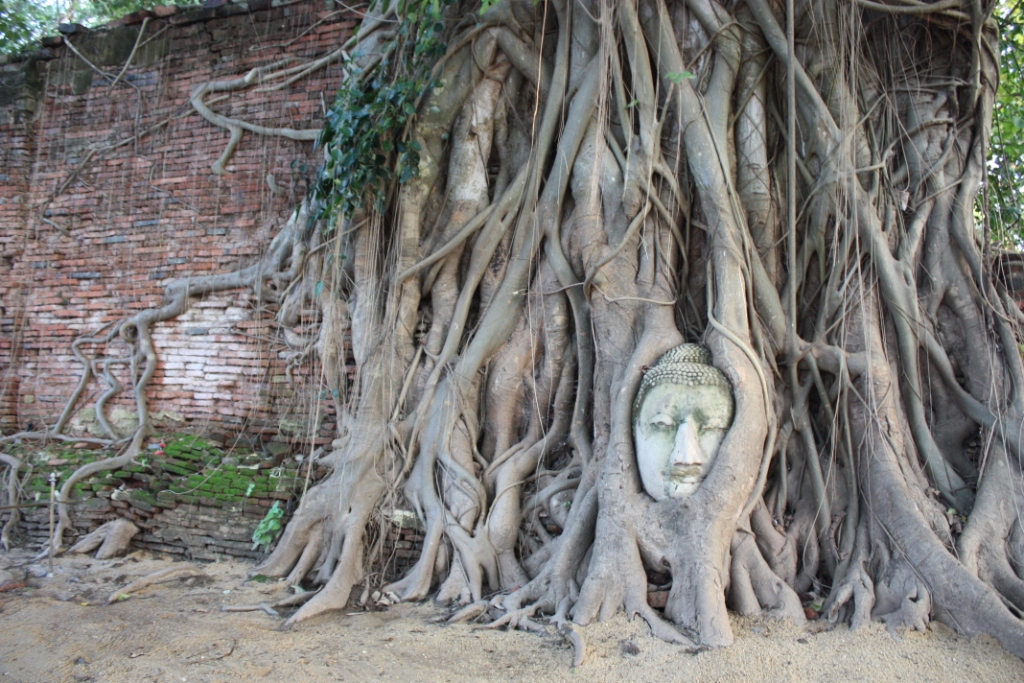
Strangler fig chokes the Buddha

Taken on the grounds of the Royal Palace in October 2012

In the courtyard of the National Museum of Cambodia
The National Museum of Cambodia is picturesque. The collection is small and simple, but impressive in quality. For those of us who run out of “ooh” and “ahh” stamina after a few hundred artifacts, it’s just the right size. It’s also not stuffy in the usual way of museums– large barred windows are unshuttered while the museum is open. (This is probably less than ideal from both the perspective of security and artifact preservation, but it gives the place a certain ambiance, and maybe helped the exodus of the bats that took up residence during the museum’s dormant period)
It’s great to see what they’ve done with the place considering the state of disrepair it was said to be in after the Khmer Rouge period. With respect to my comment about it not being a large collection, it’s a wonder that any collection exists at all after the wave of lootings from the French through Vietnamese soldiers that took place in the country.
Be forewarned, once one is inside, one will be confronted by Buddhists from a monument preservation society seeking donations at about half a dozen different Buddhas around the museum. If you aren’t a Buddhist, this can be a bit of an annoyance. If you are a Buddhist, you may find their approach disconcertingly unBuddhist. They will try to press incense into one’s palm in order to corner one into paying homage to the Buddha so they can make some dough for their cause. However, they don’t follow one around once refused (as similar individuals have been known to do at Angkor.) It may be a great cause, but they’d probably do better if they restricted it to one per museum and not one per gallery, and just let people drop cash rather than insisting on the idol worship first. I’m nondenominationally happy-go-lucky myself, but I can imagine this being troublesome for some visitors. At any rate, it’s symptomatic of the country’s poverty and their inability to support their deity at the level to which he has apparently become accustomed.


 Tiger Riding for Beginners