Tag Archives: Bengaluru
DAILY PHOTO: Gandhi Bazaar
Does That Mean What I Think It Does? No, No It Does Not

Would you like a kick in the crotch with your cupcake? (The name reads a bit hostile for an American.)
Cultural idiosyncrasies of language matter. In India on a daily basis I find myself asking, “They don’t mean what I think they mean, do they?” Here’s a few examples.

You mean you’re selling clothes, just clothes? (The “Happy Ending” sale just seems a little risqué to me. If the smiley face was winking it would really be suggestive.)

No, Sir, I will not loofah you just because you ordered the rice bath! (FYI: rice bath is a Karnataka rice dish with lentils.)

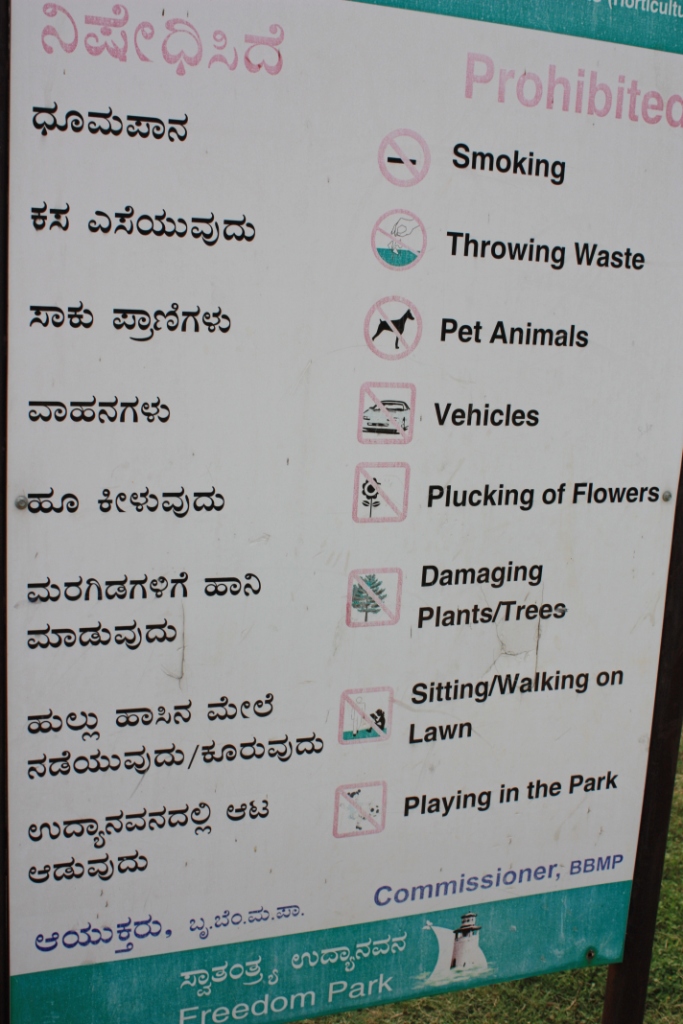
“Playing in the Park” is prohibited. Dear Park, What the hell are you good for? Signed Concerned Resident
DAILY PHOTO: Bangalorean Winter Flowers
The other day I posted a winter photo from Budapest to psyche myself up to experience winter for the first time in a while. Now I’m going the other route. As I pack to travel to a place with winter, I’m posting some of the flowers currently blooming in Cubbon Park.
LSNED: The Many Faces of Gypsy Dance
FYI: LSNED = Learn Something New EveryDay
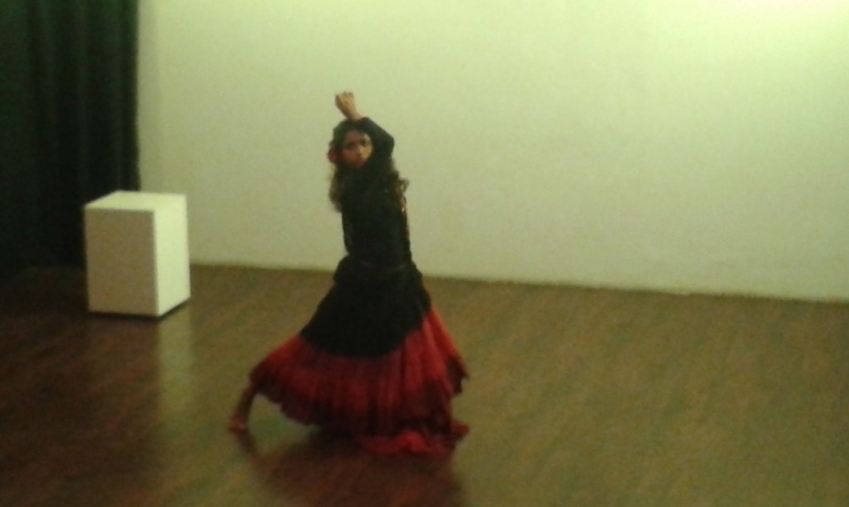
My wife, some friends, and I went to a dance performance at the KalaRasa Art House in Jayanagar last night. The dance was performed by a duo (made trio for the evening) called The SaraLuna Project, who demonstrated three dance forms with Gypsy roots: Kalbeliya Dance of Rajasthan, Egypt’s Belly Dance, and the Spanish Flamenco. I had no idea that these dance forms were connected (hence the Learn-Something-New-EveryDay [LSNED] segment,) and that they are but three styles along the long trail of Gypsy migration–though I have seen other Gypsy dance forms in Hungary.
This promises to be the first installment of a series that will cover other dance forms in this long and rich cultural heritage. The dance was sensational and it was a learning experience (complete with slides and graphics) as well as an entertaining evening. So if you’re in Bangalore and enjoy dance you should follow The SaraLuna Project.
Seeking Expert Answers About A Possible Bengaluru Ratzilla

This fake rat is kind of big, but if you asked me how it differed from real Indian rats, I’d have to say the bling. Real Bengaluru rats aren’t ostentatious, and rarely wear jewelry.
Occasionally, I will see a rat–usually the carcass thereof–that makes me exclaim… Duh-uh-AAAaaammmmm! They often look like beavers, sans the distinctive paddle-tail, but with a whip-like, hairless rat tail in its place.
These sightings have raised some intriguing questions:
The first question is for any biologists or geneticists who–quite improbably–might read this post. Is it possible for the offspring of an English Bulldog and a Norwegian Rat to survive? If so, I’m pretty sure that I’ve seen one. If I find out where it lives, will they name it after me? Can I pay them not to?
The second question is for statisticians–particularly bio-statisticians. Let’s say that 95 percent of rats successfully live their lives underground, in walls, and out of sight. Let’s further say that I’ve seen a rat that was 1.5 feet long and 0.75 feet wide. Is it possible to calculate how large the biggest statistically likely rat would be. I’m thinking, lurking somewhere in the sewers, there is a three-foot long and foot-and-a-half wide ratzilla–probably chomping on a cigar and belching occasionally.
The third question is for an ecologist. I know that cats and other predators will attack–often successfully–prey that are larger than they are. However, given the freakish disparity in sizes that we are seeing, will the existing ecological order be overturned, and to what effect? Bangalorean cats are about the same size as American cats, but Bangalorean rats are about the size of American pigs–not the cute little pot-bellied variety but rather the kind that take a blue ribbon at a 4H County Fair. I know humans were once primarily prey, and only quite recently became dominant predators. This worries me because I know that humanity’s prey-like predilection to be scared of everything, combined with its unprecedented predatory weapon set, has fucked up the world but good. I can only image what a rat would do with a hydrogen bomb.
The fourth question for a rat neurologist. Are rats really that much smarter than turtles? I know the Teenage Mutant Ninja Turtles follow their Rat Sensei unquestioningly. I googled it. Rats live about 1 year and turtles can live to be about 40. So Splinter must have learned much faster in addition to being much smarter.
OK, the last one was not a serious question (but it’s a serious plot-hole for TMNT), but I do have one last question for the general public.
Which do you find more disturbing: a.) when you see a single mammoth rat? or b.) when you see an elaborate Vietcong-style series of tunnel openings and you know there is a billion rat army wriggling all over each other just centimeters below your feet?
Please don’t think I’m anti-rat. I know that, while we fear the plague-infested rats, it was really the fleas that gave us the Black Plague. I also know there are places like Karni Mata Temple in Rajasthan where rats are treated deferentially. There are an estimate 20,000 rats living on the temple grounds.
I guess this raises one more question for a rat nutritionist. How come these rats, which are fed and cared for, don’t get huge like the one’s lurking in the back alleys of Bengaluru.
9 Self-Defence Tips for Women
Today is a day of protest in Bangalore to decry sexual assaults on women and children. It seems like an apropos time to offer some advice on self-defense.
1.) NEVER GET INTO A VEHICLE or allow yourself to be taken to another location:
This is line in the sand #1. He’s telling you to get in the vehicle because he wants to do something that he’s scared to do at the present location. That means your chances if you scream, run, fight, or some combination of the above are better than if you get in the car. A thief wants your money/possessions and then wants to put as much distance between you and he as possible. Don’t believe anything a thug tells you about why he wants to take you somewhere–no matter what kind of soothing tone he may use. He means to do you harm at the end of that ride.
2.) Never allow your freedom of movement to be restrained:
Line in the sand #2. The same logic applies. He wants to bind or handcuff you because he’s scared to do what he wants to do with an unrestrained victim. Your chances are better if you scream, run, fight, or all of the above than if you allow yourself to be hogtied.
3.) If you remember nothing else from this post, remember points 1 and 2.
4.) 2 ways a cluttered purse can be perilous:
First, if you decide to carry some form of weapon (e.g. pepper-spay or a stun-gun) or the ineloquently named “rape-whistle”, it will do you less than no good if you can’t put your hand on it instantaneously. (Why less than no good? Because your eyes will be on your bag, instead of on the threat.)
Second, see point 5, below.
5.) How to be robbed, a primer:
You’ve probably heard the mantra, “Never fight over money or possessions, they can be replaced, you can’t!” That’s sound advice. However, you must keep in mind that violent criminals use “gimme your money” as a ploy. They wait until your eyes go down and then they pounce with much more ominous intent. This is the second way a cluttered purse can be perilous. If you start looking through your purse, you’re at risk. Pitch the whole purse, let them find it. If they don’t go for it, then it’s time to flee or fight.
What’s the “proper way” to be robbed? You throw the money in the robber’s direction (preferably between his feet and behind him) and then you run the other direction. If he’s a robber, he’ll grab the money and hightail it in the opposite direction from you. If he chases you, then it’s time to be ready to fight for your life.
There are a lot of offerings of self-defense and martial arts classes. The first thing to know is the difference between self-defense and martial arts classes. Self-defense classes will teach you a few basic, easily remembered techniques to get out of the grasp of an unsophisticated attacker so that you can run. If you know that you don’t have a lot of time and energy to devote to learning to protect yourself, this is the type of class you should pursue. You probably won’t learn what you need to get safely away from an athletic psychopath, but–fortunately–such individuals are rather rare. I’d recommend this type of training periodically even for women with no interest in martial arts.
There are many different primary objectives one may see in various martial arts, including: sport, entertainment, sustaining a historical lineage, or preserving historical / cultural events and ways. While self-defense is one of several objectives of almost all martial arts, it’s the primary objective that will shape the martial art and its relevance to you. Sporting martial arts will get you in fighting shape and teach you to take a hit and keep moving, but may leave you with systematic vulnerabilities around the rules of the game.
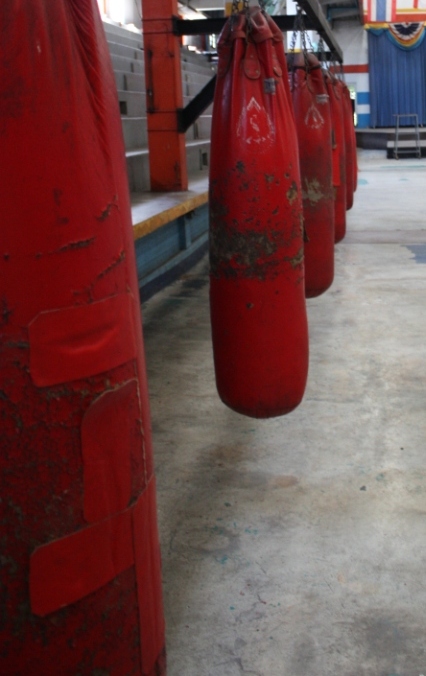
For example, if punches to the head aren’t allowed, you won’t learn to defend yourself from the head punches that a real world attacker won’t hesitate to employ. If fighting on the ground isn’t allowed, then you’ll miss out on some beneficial training. Also, in a sport you may spend a lot of time punching with a closed fist. This is great if: a.) you’ve built up bone density with bag work and exercises, b.) your hand is wrapped tightly, and c.) you have a padded glove on. If not, there’s a good chance you’ll break one of the tiny bones in your hand on the attacker’s thick, bony skull–and it may distract you enough to lose advantage. This isn’t to imply such a martial won’t prepare you better than the next woman (and better than an attacker, for that matter), but you should only do it if you’re interested in the sport as well as in defending yourself.
Martial arts for entertainment may have you spending a lot of time practicing complex, spinning, aerial maneuvers that you cannot count on being useful against an attacker on the street. Again, if you enjoy this kind of martial art for its own sake, I’m not suggesting you should abandon it or that it isn’t benefiting you at all from a defensive standpoint.
Historical martial arts often offer the advantages of being combat-oriented and not rule constrained, but you may spend a lot of time working with archaic weapons and may not practice sparring or free-form fighting–which, I would argue, is essential to being ready to defend yourself. Again, these arts are awesome, but you need to be aware of what you are studying and what it’s value is to you.
Questions to ask:
a.) Can I watch a class? I’ve heard clever explanations for why this isn’t necessary for such-and-such martial art, but if they won’t let you watch a class, I’d move on to the next place. The observation class allows you to see whether that art is right for you and whether the teacher is skilled and professional. Now, don’t expect a school to keep allowing you to show up and watch, but one class should give you enough idea. You may want to ask ahead to make sure it’s a fairly typical class. Some martial art schools occasionally have atypical classes to communicate some ancillary information to students which isn’t at all that useful in a day-to-day sense. (Alternatively, some schools have classes that are rigidly identical from one session to the next.)
b and c.) Will you teach me how to stay on my feet? and Will you teach me how to fight on the ground? The ideal answers to both is “yes.” If they answer the first question by saying, “All fights go to the ground, we teach you how to get down and control the situation.” You have some sort of submission sport school that would likely make you tough as nails. However, there’s a reason there are weight classes in those sports. You don’t want to default to the ground voluntarily with someone who outweighs you by 60 pounds and who can bench press your body weight two or three times over.
That being said, if the answer to the second question is, “No. Going to the ground is ridiculous,” you might want to move on to the next school. To summarize, you want a school that will teach you how to stay on your feet so you can get away, but, also, you want a school that’ll prepare you for the worst case scenarios.
d.) Do you do sparring, randori, rolling (as in ground-fighting free-form training), or other free-form training? Note: In most martial arts, you’ll need to spend some time learning basics before you get into sparring (and that’s a good thing, in my view.) However, if the school doesn’t do any of that type of training at any level, it probably won’t prepare you for what you are likely to face. There are some old school martial arts that only do form and technique training, but with no “unstructured” training.
My final word on looking for a school: Don’t be scared off by the students looking haggard, sweaty, and mildly gimpy by the end of class. Such a school will prepare you much better than one in which the students look pristine going home.
7.) Drill with any weapon you carry:
Believe it or not, I once saw a professional law enforcement officer who accidentally sprayed himself full in the face with pepper-spray. (Among my varied and sundry past occupations was a stint in law enforcement.) No weapon is a magic talisman that you can put in your bag and expect to have it ward off evil.
8.) Don’t expect the Hollywood plop:
Squirting an attacker with pepper-spray, shocking them with a stun gun, or even shooting them with a handgun will not necessarily immediately and definitively incapacitate them. They may keep coming, hopefully impaired, but possibly just angered. There is an old samurai saying that goes, “Even in victory, cinch tight your helmet cords.” This means, even when it looks like your attacker is down for the count, maintain caution.
9.) Remember items 1 and 2, NEVER GET IN THE CAR and NEVER LET YOURSELF BE TIED UP.
DAILY PHOTO: Republic Day Flower Show
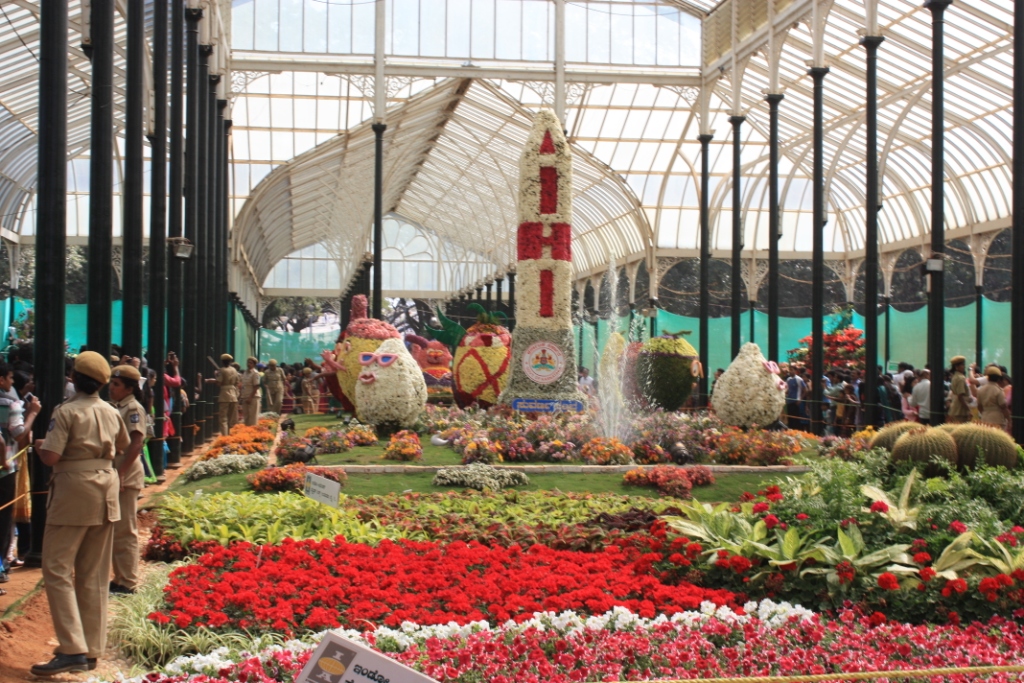
The Crystal Palace at Lal Bagh gardens, which is normally roped off and empty, has been packed brimming with flowers for the annual Republic Day Flower Show that ends today.
It would be slightly more enjoyable if security wasn’t threatening to wallop one with a stick if one loiters for a second. You can see it as many times as you can fit in a day, but you must keep moving along. It’s a one way flow, so if you don’t have the desire to go through twice (once on either side) I’d recommend going on the south side (farthest from the main entrance.) For some reason the crowd was about half on that side (probably because no one anticipated the layout would make you do two half loops instead of one full loop.) Why they did it, I have no idea, but the flowers were pretty.
DAILY PHOTO: Bull Temple
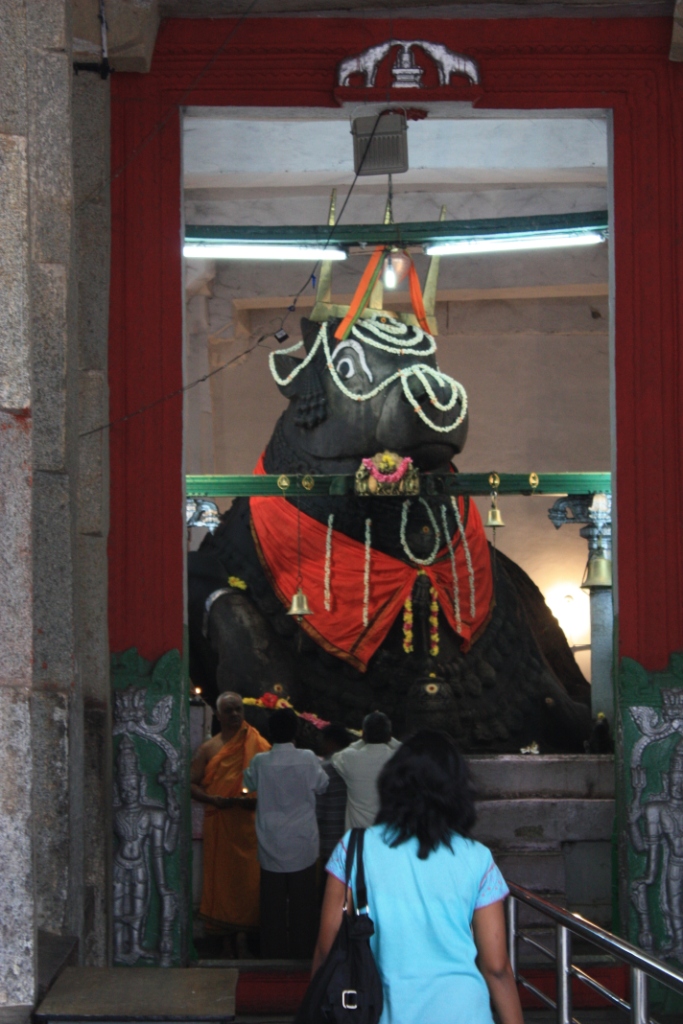
This was my first experience inside a Hindu Temple, so I was completely out of my element. Fortunately, it was easy enough to follow the crowd through the procedure. (As opposed to the multi-deity temples where many disparate and complex practices may be being carried out at once.) First, one leaves one’s shoes outside, as one would at a Buddhist temple. One then walks down a corridor toward the bull. When one gets to the front of the bull, one turns to one’s left and circles the bull in a clockwise fashion, passing by a Hindu priest. There is a Hindu priest at both the head and the tail end of the idol. There’s an opportunity to make a monetary offering at both. When one gets back around to the front, the priest puts a tilaka mark on one’s forehead with bright red tikka powder. This is made in the same place one sees Hindu women wearing bindi ornamentation.
DAILY PHOTO: Vidhana Soudha
Bangalore hasn’t learned to do tourism. Perhaps this shouldn’t be a surprise as the city’s population has doubled from five million to almost ten million in the last dozen years. So, Bangalore’s government has a lot on its plate. However, because of this deficiency, the city is largely seen as a jumping off point for people wanting to go to places like Mysore, Hampi, or Kerala that are not so well-endowed of international flights but which are vastly more scenic.
I mention this because some of the most impressive sights in Bangalore are not very photogenic. First and foremost among these is the palatial Vidhana Soudha, which is the seat of the Karnataka State Legislature. It’s perfectly reasonable that it be closed to the public as serious work is done there, but it’s a little surprising not to be able to get a decent picture of it because of the ugly chainlink fence that surrounds much of it and dense clusters of trees that surround other parts of it. They are doing some work on the High Court side, so maybe they aim to throw tourists the bone of a little more picturesque view.
This isn’t the only bit of tourism unfriendliness. At Bangalore Fort we had a security guard attempt to extort money from us–and I’ve experienced similar things at smaller city parks with random cops. At least I think that’s what the guard was doing; there was neither signage to indicate we needed to pay a fee nor a ticket office. It may have just been that they didn’t put up the right signage. At any rate, we left without any pictures but without paying, and so one way or another this was just bad tourism. Many people probably don’t even know about the little section of fort that remains, but it is easily combined with a trip to the Tipu Sultan’s Palace and the City Market.
While Bangalore doesn’t have a lot of sights for a city of its size (because it hasn’t been a city on this scale for long–compared to places like Delhi, Mumbai, or Kolkata), it could do a lot better to build its tourism revenue, and doesn’t have the history. It’s not quite like Belize City, where the general advice is, “Yeah, you have to fly in there, but get the hell out as soon as you can.” However, it’s not a pleasant place to sight-see either.