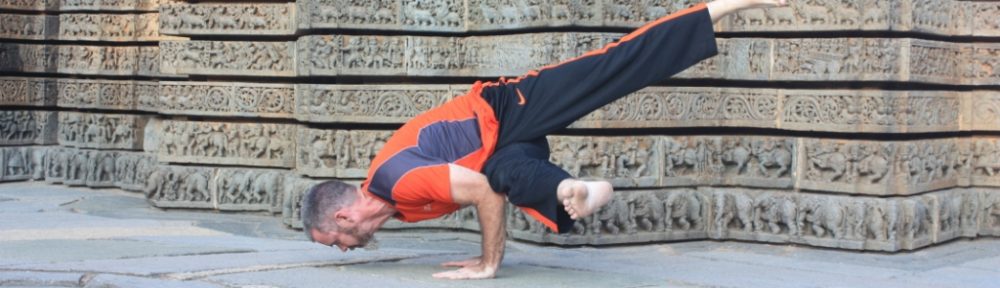
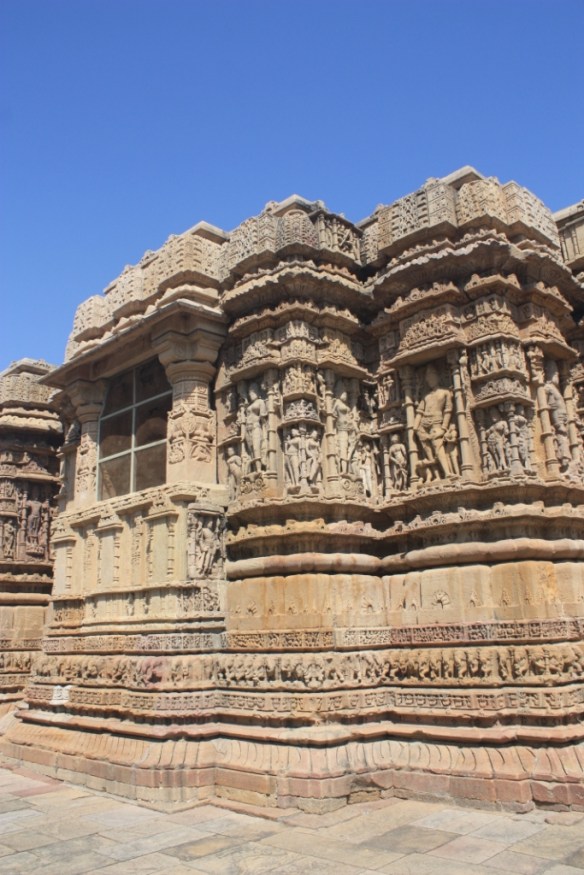
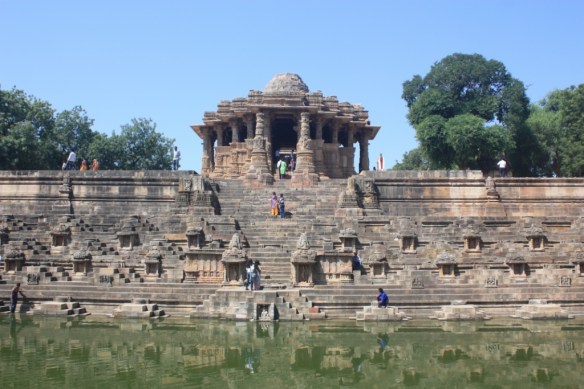
Taken on September 30, 2017 in Ahmedabad from the Swami Vivekananda Bridge toward the Riverfront Flower Park
![]()
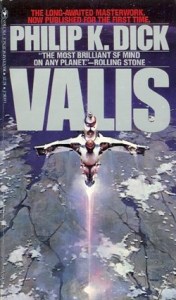
It is sometimes an appropriate response to reality to go insane.
Philip K. Dick in VALIS
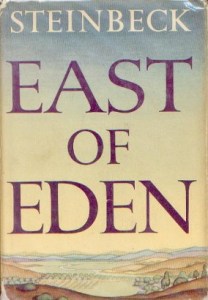
And now that you don’t have to be perfect, you can be good.
John Steinbeck in East of Eden
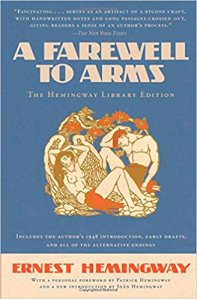
Anger was washed away in the river along with any obligation.
Ernest Hemingway in A Farewell to Arms
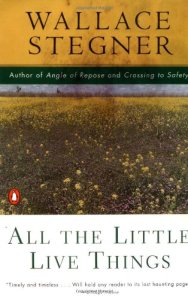
There is a sense in which we are all each other’s consequences.
Wallace Stegner in All the Little Live Things
There are some things that are so unforgivable they make other things easily forgivable.
Chimamanda Ngozi Adichie in Half a Yellow Sun
Complete Calisthenics – The Ultimate Guide To Bodyweight Exercise by Ashley Kalym
My rating: 4 of 5 stars
“Complete Calisthenics” delivers an overview of body-weight exercises, as well as the information needed to begin a calisthenic workout program. It covers advanced exercises such as planches, levers, and flags, but it also provides simplified modifications and progressions for said advanced exercises for those who aren’t ready to leap into gymnast level practice. I’d say this book is ideal for an intermediate level practitioner or, at least, someone in sound physical shape who can knock out several push-ups and at least a few pull-ups. It offers one the information necessary to gradually progress toward the most advanced levels. While there are simplified modifications, a beginner who is out of shape may need more content on capacity-building and simplified modifications to get started.
The first six chapters form an introduction and give essential background information on equipment, nutrition, rest / recovery, warming up / mobility, and flexibility. The warming up and stretching sections provide many photos and explanations of key points, just as the latter exercise sections do.
Chapters seven through twenty describe and demonstrate the various exercises. These chapters can be divided into the first five chapters (ch. 7 through 11) that cover upper-body push and pull exercises (i.e. push-ups, pull-ups, dips, muscle-ups, and handstands.) Each of the aforementioned exercises has a range of variations offered–some easier and many harder than the basic. Chapters 12 through 16 explore levers (planche, front lever, back lever, half lever, and human flag) and these offer progressions, variations, and various approaches to entering the pose—since most practitioners will not be able to proceed straight to the full expression of the technique. Chapters 17 through 20 delve into the core, lower body, and full-body exercises. These are: floor core exercises (17), leg raises (18), lower body / leg exercises (19), and conditioning exercises–i.e. the full-body exercises that get the heart pumping (20.)
The last two chapters suggest an approach to building a training program and offer an FAQ, respectively. The approach suggested involves four levels. The first is called “the fundamental five” and it is built around push-ups, pull-ups, dips, hanging knee raises, and squats. The next builds upon the first and prepares one to transition to the third, which focuses on learning to do the levers. The final is called “complete calisthenics” and it incorporates all the advanced. The author also describes how one might approach optimizing one’s program to one’s needs and abilities.
The one thing that I missed is a discussion of intervals. Even if the author doesn’t use or recommend such an approach (timed work/rest), I expected he would discuss his rationale. In the FAQ, he does mention that the reason that he doesn’t discuss periodization (having occasional light spells for long-term recovery) is because they must be tailored to the needs / fitness level of the individual. At any rate, the role of time in workouts was conspicuously absent.
That said, I found this book to be quite well done overall. The pictures are explicit. The write-ups mention important points of consideration—e.g. safety challenges. There’s a thorough coverage of progressions and modifications. I’d recommend this book for anyone who practices calisthenics. Again, it’s probably a little more suitable for someone who either has an existing practice that they’d like to ramp up, or at least someone who has a reasonable level of fitness starting out.
The Way of the Bodhisattva: A Translation of the Bodhicharyavatara by Śāntideva
My rating: 4 of 5 stars
A bodhisattva is one who achieves enlightenment but sticks around to help others pursue the path. Shantideva was a Buddhist monk who lived [mostly] in the 8th century in the part of India that is today in the state of Bihar. Shantideva’s lesson on how to be a good bodhisattva is delivered via 10 chapters of verse, mostly in four-line stanzas. This instructional poem makes up almost 240 pages of the edition of the book put out by Shambhala as translated by the Padmakara Translation Group, and the rest is front matter, appendices, notes, and a bibliography.
The chapters of Shantideva’s poem are: 1.) The Excellence of Bodhichitta (lit. “enlightened mind”); 2.) Confession (fear is a major theme in this statement of modesty); 3.) Taking Hold of Bodhichitta; 4.) Carefulness (discussion of what to avoid.); 5.) Vigilant Introspection (on the need to keep one’s attention concentrated, and to not let the mind roam.); 6.) Patience (on not being focused on self, but on all those suffering.); 7.) Diligence (on avoiding hedonism and being industrious.); 8.) Meditative Concentration (avoidance of getting caught up in the material / physical world.); 9.) Wisdom (karma, illusion, and, particularly, the illusion of self.); 10.) Dedication.
As mentioned, there’s a lot of ancillary matter in this edition of the book. There’s a forward by the Dalai Lama, an extensive introduction (which is helpful as even a modern translation requires background), three appendices (a brief biography, a discussion of equalizing self and other, and a meditation on exchanging self and other), notes (which are also necessary give the nature of a 21st century global reader spoken to by an 8th century Indian monk), and a bibliography. There are no graphics (except a single line-drawn panel) but none are needed.
I had mixed feelings about this work. There was a great bit of wisdom, and the meditation described in the final appendix (based on Shantideva’s discussion) seems to be tremendously valuable. One the other hand, there was a lot of degradation and abasement of the physical body. Granted, I know that Shantideva is talking to an audience of primarily monks and he’s trying to keep them from being horn-dogs or otherwise being distracted by physicality. However, I’m always turned off by those who fail to recognize the tremendous awesomeness and beauty of the human body. There’s also the pessimism. Buddhists are often accused of being pessimistic. Starting with an opening statement of “life is suffering,” this might not be a surprise. Of course, Buddhists counter by saying that they aren’t pessimistic because they are offering a solution to the fact that life is misery, to which non-Buddhists tend to say, “Yes, but the defining characteristic of life need not be agony in the first place.” I won’t weight in on that debate, but the reader should be prepared for a certain dismal tone here and there.
I found this book to be loaded with food for thought. The introduction and notes are extremely beneficial, and this is one of those few cases in which they don’t just feel like padding to hit a desired page count. The verse is readable, and can be understood by a general audience.
I’d recommend this for those interested in Buddhist philosophy.
Modern Buddhism: The Path of Compassion and Wisdom – Volume 1 Sutra by Geshe Kelsang Gyatso
My rating: 4 of 5 stars
This is the first book in a three-volume overview of Buddhism that is available for free (or for the minimum Kindle book price on Amazon.) The book is written by a Tibetan Buddhist scholar-monk, and, therefore, emphasizes the Mahayana approach and specifically that of the Gelug school. (I’m a neophyte, but I don’t think this book goes into so much detail as to be controversial among Tibetan Mahayana Buddhists, but if you are thinking you’ll learn about, say, Zen or Theravadan Vipassana, not so much.) The theme of this volume is an overview of the Limram, which is a sutra describing the path to enlightenment.
The book is divided into four sections. The first offers a broad overview of Buddhism with particular discussion of the Kadam Lamrim (the specific sutra discussed) and Kadampas (which is the name for an individual who pursues practice of the Kadam Lamrim.) The other three sections describe the information needed by an initiate, middling practitioners, and advanced practitioners, respectively.
The section on persons of initial scope (i.e. initiates) emphasizes the need to recognize the limited scope of a human life, to reflect upon one’s imminent death, and to consider the importance of avoiding lower rebirth.
The section on persons of middling scope echoes the four noble truths. They are discussed by way of the four questions: 1.) What one should know? 2.) What one should abandon? 3.) What one should practice? And 4.) What one should attain? In essence, it suggests one understand suffering, the path to is cessation, and that one follow that path.
The largest section, by far, is the portion on individuals of great scope. It is divided into four parts. The first part describes the need to revise one’s approach to love by taking oneself out of the center and practicing loving-compassion for those that one doesn’t know. The second subsection outlines the six perfections (giving, moral discipline, patience, effort, concentration, and wisdom) and the importance of each. The third section is about emptiness and truth. The final section is a brief description of the Lamrim practice.
There are a small number of line drawn illustrations of important figures in the tradition. There are no notations, citations, or ancillary material.
I found this book to offer a concise overview of the subject of Buddhism—specifically from the perspective of the Gelug tradition of Tibetan Buddhism. While there are some historical stories, such as those drawn from the life of Milarepa, the book is not designed to be entertaining reading. It’s a straightforward transmission of knowledge. In that regard it does a fine job, it’s clear and concise.
I’d recommend this book for one who’s interested Tibetan Buddhism, but one should be aware that it’s not a nonsectarian overview of Buddhism as the title might suggest to a reader.