DAILY PHOTO: Sunset Over Hampi

Taken on November 1, 2013

Taken on November 1, 2013

In the tropics the summer days seem so short and the winter days seem so long–at least if you grew up at 42°N (northern Indiana) and now you’re living at 13°N (Bangalore, India.) There’s no discernible adjustment in the length of days here. Maybe, if you’re a local. But it always gets dark around 6 at night and becomes light around 6am the next morning.

DAILY PHOTO: 1008 Linga on the Tungabhadra Bank

Taken November 1, 2013 near the Tungabhadra river at Hampi.

Taken November 1, 2013 near the Tungabhadra river at Hampi.

I read the Wikipedia article on Shiva linga, which said that it was a grave error to think of a lingam as a phallus. However, the article went on to say that the union of the lingam and the yoni represents the inseparability of male and female and the act of creation. Therefore, I’m sticking with the neophyte view that this symbolically represents the male organ of amour.  [Note: the terms linga and yoni are used in the Kama Sutra to describe the male and female organs, respectively. The terms may have been euphemisms that distorted the true initial meaning, or this might be taken as evidence of the correctness of the neophyte view. I’m not qualified to comment.]

Shiva is one of the top-tier aspects of God in Hinduism. He’s one aspect of the Hindu trilogy. Brahma is the creator. Vishnu is the operator. And, Shiva is the destroyer. This may seem a little ominous, but it’s obvious that something must be destroyed to make way for new things to come into existence. In a more modern interpretation, matter cannot be created or destroyed but can only change forms. These two ideas may seem very different, but when one considers that there is a finite amount of matter, if you want to make something new, then something else has to give up its matter to build it.

So while Shiva’s hallmark quote is, “I am become death, destroyer of worlds,” [reiterated by Robert Oppenheimer in referring to his role in the Manhattan Project] he’s really not so bad a deity.

DAILY PHOTO: Hampi Boulders

Taken on November 1, 2013 on the Tungabhadra  River

Taken on November 1, 2013 on the Tungabhadra River.

I just got back from a trip to Hampi, India. My wife and I agreed that it’s the most spectacular Indian historic site we’ve seen to date. The reason why it edges out the–awe-inspiring–Taj Mahal for us is that even if man had never touched this land it would be a spectacle to behold due to the unique geological processes that have taken place there. (The Taj Mahal is impressive, but once you leave its gates, the glory shrivels. In Hampi, leave the ruins and the awe has just begun.)

The rocks in that region are some of the planet’s oldest, and while much of the softer rock has been entirely washed away, the harder marble remains, but has been eroded over time. It creates an otherworldly appearance that is suitable for the set of a sci-fi film. Some formations seem to defy gravity, with boulders stacked on boulders in impossible ways.

I highly recommend a trip to Hampi. It’s about 7 hours by car from Bangalore (if your driver knows where he’s going–ours was a bit longer.)

A couple of points to keep in mind.

-There’s no alcohol allowed in Hampi village.

-There’s little non-vegetarian food in Hampi (Even if you’re vegetarian, you may be a little underwhelmed. It’s bland by Indian standards, and almost every guesthouse / restaurant tries to sell every ethnic food imaginable resulting in a “jack-of-all-trades-master-of-none” warmed-over mediocrity. The one exception that we found was the Mango Tree restaurant, which is generally packed. Eat at off hours if you can.)

-If you stay across the river, the ferry only runs until 6pm. We stayed in one of the many basic guesthouses in Hampi proper. Staying in a nicer hotel incurs a trade-off that one will have to travel quite a while to get to the site. (As my wife said, “30 kilometers is too far in India.”) If you miss the ferry, the trip by car is a long way around.


DAILY PHOTO: Fatehpur Sikri

Taken October 13, 2013

Taken October 13, 2013

Fatehpur Sikri is a historic site not far from Agra (home of the Taj Mahal.) It’s almost entirely red sandstone, and is impressive site and well-maintained– including ornate carvings inside many of the structures.

This will be my last post for a few days as I will be traveling to Hampi, another set of famous Indian ruins of once great states.  I’ll be back after Diwali with photos and experience from that visit.


9 Nights at an Ashram

Taken October 20, 2013 at Fireflies Ashram.

Taken October 20, 2013 at Fireflies Ashram.

Indian cities don’t whisper. They are often lovely, always lively, but offer little relief from bombardment of the senses. Horns are relentless. Bus and truck air-horns can make a person jump from one’s skin. The smells may be pleasing or putrid, but they’re never faint. There is sign pollution, wherein it’s often impossible to find what one is looking for in the sea of signage–even when it lies right in front of one’s face. Colors pop and glow, not smooth pastels, but oranges and purples that you can practically taste.

It shouldn’t have surprised me when I got to the southern edge of the city to find one of the major land uses was Ashrams. Ashrams in all shapes and sizes, from the small but authentic Narayana Gurukula (mentioned a few DAILY PHOTO installments back) to the massive Art of Living International Center–headed by Bangalore’s most famous guru, Sri Sri Ravi Shankar. Out Kanakapura Road, where monkeys sling through trees and fields of corn remind me of my own Hoosier upbringing, lies a diverse collection of houses of spirituality and reflection. They offer a much-needed island of tranquility amid a sea of chaos.

I stayed for nine nights at one of the most singular of these ashrams, Fireflies. One way in which it’s unique is that it’s a “guruless” ashram. That may seem oxymoronic. The terms “guru” and “ashram” seem to go hand in hand. Guru means teacher. My dictionary defines ashram as, “the home of a small community of Hindus.” [I think this definition could be challenged both on the necessity of “smallness” and “Hindu-ness.” As indicated, there are some pretty massive ashrams and there are ones that are associated with non-aligned spiritual groups.] It’s true that the typical ashram has a spiritual leader or yogi as its head. At Fireflies the gurus come and go with the groups that visit. While I was there, besides our group of Thai Yoga Bodywork practitioners, there was a group of psychotherapists and an organization of past life regressionists. Rather than housing a single unified set of beliefs, at this ashram a diverse and sometimes conflicting set of beliefs are harmoniously housed.

As I have little experience with ashrams, I can’t speak authoritatively about other differences. However, it’s my understanding that one other difference between Fireflies and many–more typical–ashrams is that the latter often have limited or non-existent staff. This means that the visitors may do much, if not the bulk, of the work. Fireflies has a staff that does the cooking and takes care of many needs of the visitors. This isn’t to suggest that it’s like a hotel stay. There’s somewhat of an expectation that visitors will take care of the things that they can do for themselves, and the accommodations are basic.

I found the experience of my stay to be beneficial, if not always stress-free. The main source of my stress had little to do with the Ashram. I received my phone sim card right before I left. After a couple of days I got my phone working for a day or two only to have the phone company turn it off because no one was home when they randomly dropped by to verify my address. [Showing up unannounced in the middle of the day and then treating you as non-existent if no one is home is one of the annoying little hallmarks of Indian institutions (corporate and government) that I’ve experienced on more than one occasion.] I will admit that it is a mark of both society’s and my own wussification that we can’t go a few days without being in contact with home and news of the world. Twenty years ago no one would have expected to have such constant verification that all was well in the world. People could go days back then without worrying that the sky was falling. While it wasn’t pleasant to be cut off, it was an eye-opening experience. [I will note that the Ashram property is on a slope and at the low end I got no reception at all, but on the high end I’d get a bar or two–enough to do the job if the phone company wasn’t screwing me over.]

It was also useful to go without brain candy for a while–that is without television and related entertainment. Part of what I hoped to learn from my stay was whether I was prepared to take the 10-day Vipassana meditation course in the spring. The Vipassana course is considerably more spartan level of existence than that of Fireflies.

On some levels, I proved ready, and on others I have yet to do so. I did just fine eating two vegetarian meals and a snack for dinner each day. (I could have had three full meals per day, but I wanted to make sure I was ready to cut my intake adequately. Therefore, I stuck with a snack in the evening and ate reasonable portions for breakfast and lunch.) I found the meals at Fireflies to be quite good, and I had no complaints in that regard. It should be noted that the ashram is not an easy walk to any restaurants or substantial stores (there are a couple small shops up on the corner, but they’re geared toward locals and don’t necessarily have what a traveler needs) so it’s not easy to go out for something–though I did see one auto-rickshaw around the premises at times.

The true test of preparation for the Vipassana course is that there are no books or notebooks allowed. This will be my greatest challenge. I finished two novels and two nonfiction books on Kindle during my stay, plus probably another 100 pages of other books, and I filled 2/3rds of a journal–mostly with notes from the TYB workshop.

Also, at the Vipassana meditation course one is not allowed to speak to anyone but the instructor at a specific time when they take questions about the course. I wasn’t nearly so cut off from humanity at Fireflies. The workshop participants and teachers were around all day and I had occasional conversations in the evening with others at the ashram. Furthermore, I’m a fairly solitary creature.

It was interesting that during the weekends there were so many people around, but during the middle of the week there were few. For a while I thought I was the only non-staff member person at the ashram—though I later found that to be incorrect.

So my time at the ashram was Spartan, but that’s part of the beauty of it.

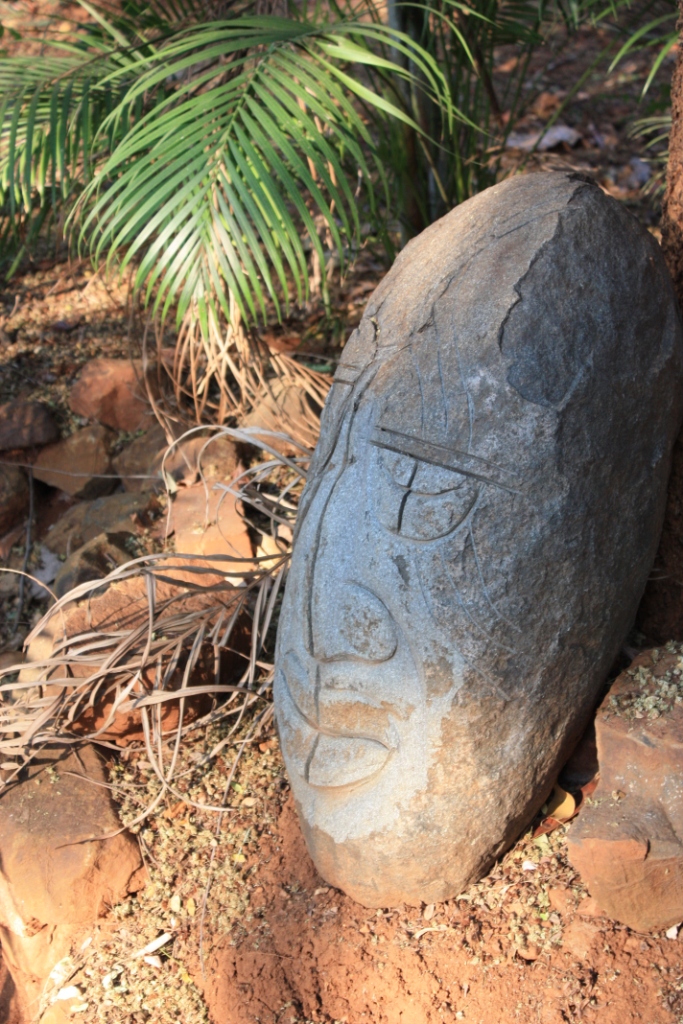
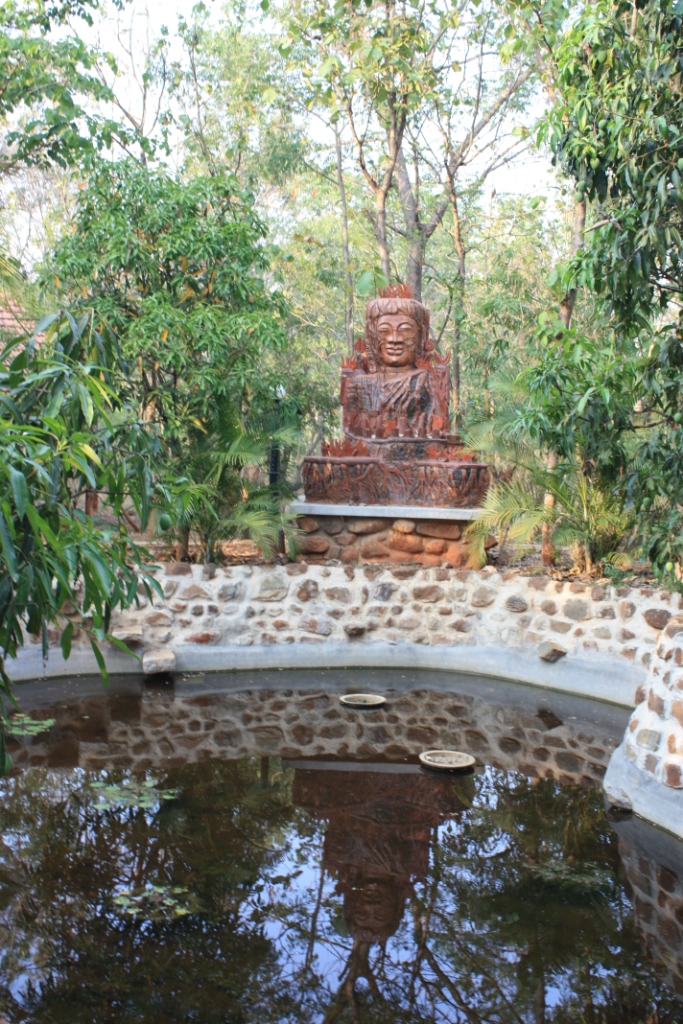
I should point out that there are some impressive stone carvings located throughout the property. The artists are international in scope. Each of these carvings or sculptures offers its own story. I’ll attach a few pics for your edification.

20120101_16151920120101_16142320120101_155241

DAILY PHOTO: Red Fort

Taken on October 16, 2013

Taken on October 16, 2013

This white marble palace constructed in the Indo-Islamic style is one of the more impressive structures in Old Delhi’s Red Fort.

The Red Fort should be visited before visiting Agra Fort, because it should be seen but it’s not as impressive as its Agra kin. I did it the other way around, and the Red Fort was a disappointment by comparison. The grounds aren’t kept up, most of the semi-precious gemstone inlays are missing from the ornately carved marble, and the fort houses an architectural hodgepodge. That being said, the red sandstone walls are imposing and magnificent and the few historic structures are quite impressive–if not as much so as in Agra.

Close up of the same structure.

Close up of the same structure.

DAILY PHOTO: Chandni Chowk Street Food

Taken October 15, 2013 in Old Delhi.

Taken October 15, 2013 in Old Delhi.

Ummm! Fried breads.

Chandni Chowk is a major bazaar street that runs west from the Red Fort in Old Delhi. It’s a solid traffic jam from about 8:30am to 10:30pm. Bicycle rickshaws, auto-rickshaws, oxcarts, and automobiles can all be seen inching down the boulevard.

One can get cloth, sweets, suits, or glasses on the cheap.

7:00am gives one an entirely different perspective. There are people bathing in the streets from communal spigots. There are long lines of individuals, mostly men waiting to see the street doctor, who–right on the sidewalk–is bandaging up a badly swollen foot. There are worshipers entering the Sikh temple.  There is little traffic, but pallets of materials piled in the street outside some businesses.

DAILY PHOTO: Narayana Gurukula Bangalore

Taken on October 25, 2013.

Taken on October 25, 2013.

Well I’m back from my 10-day Thai Yoga Bodywork course, and will resume a normal posting schedule.

While I was gone I visited a couple  interesting places. One of which was the Narayana Gurukula Bangalore location. This small and simple ashram is watched over by a sweet lady known to visitors as “Ma”… and some really menacing looking dogs. Above is the interior of what might be called the main hall. There are some interesting stone carvings and artworks across the property as well as a little stone temple and a lilliputian book house.

I wasn’t familiar with Narayana Guru before my visit. There have been so many gurus in India, and it’s hard to know of them all. However, this particular guru and his disciples (one of whom, Nataraja Guru, started the Gurukulam) held forward-thinking views on society and spirituality. A Hindu, Narayana guru advocated unity between traditions and a focus on introspection as the route to betterment.

DAILY PHOTO: Taj Mahal

Taken October 13, 2013 in Agra, India.

Taken October 13, 2013 in Agra, India.

My last Daily Photo for 10-days. I tried to make it a good one.

DAILY PHOTO: Jama Masjid

Taken October 14, 2013 in Old Delhi.

Taken October 14, 2013 in Old Delhi.

This is India’s largest mosque. It is capable of holding 25,000 worshipers–mostly in that open courtyard that can apparently be covered as needed.)  It dates back to the rule of Mughal Emperor Shah Jahan–who you may know of from his requisitioning of the Taj Mahal.

It’s located in Old Delhi and is usually matched with trips to the Red Fort and Chandni Chowk (a huge bazaar street), which are both nearby.

It’s mostly Red sandstone with white marble, as was common of Shah Jahan’s other monumental structures.

[I realize it’s a cheat that I’ve posted two “Daily Photos” in a couple of hours of one another, but it’s a new day in the States–and I’ve got a ton of photos from my recent trip.]