POEM: Dark City Sonnet


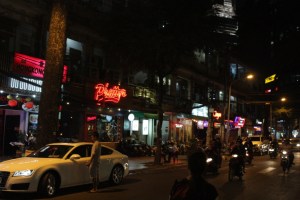
any city you enter after dark
will not reveal itself until the morn
you’ll see it like a scrawny sheep unshorn
vague blankness punctuated by landmarks
you’ll see nothing in the darkness of parks
not junkies sprawled out in clothes, rank and torn
though you see neon twenty-four hour porn
you’ll know not the dogs by their noisy barks

light makes it more pretty and more ugly
you’ll see it pick itself up and brush off
like shame walkers concoct a makeshift coif
turning focus from the bloody and stubbly

to see a city at its worst and best
catch it when it’s wearing last night’s dress.

POEM: Tripless Trip

In the outlands lives a shaman,
an unkempt medicine man of some renown.

He grinds some roots with a wooden pestle,
black and shiny on its business end.

His apprentice sits drumming —
soft and offbeat.
You listen deeply,
dead-eyed tranquil,
but can’t wear that wild rhythm
“like a bear skin,”
whatever that means.

The medicine will be bitter, but no matter.
It’s not for you.
Your cure will be sought on a tripless trip.

When the shaman re-inhabits
his sweat-soaked body,
he says only,

“Beware the Jackdaw!”

You say, “What’s that mean?”

He says, “That’s for you to know,
and for me… not to know.”

You say, “OK, what’s a jackdaw?”

With an intense wild-eyed stare,

he says,
“Google it.”

You say, “Seriously?”

Then he shrugs and he nods off.

POEM: The Silent Wild

Looking through a window
at the falling snow flakes.
Silent is the snow fall
that piles upon my sill.

And though it weighs limbs down,
it doesn’t break the branches.
If there were a slight breeze,
it’d dust it all away.

Out beyond the farm land,
in the distant forest,
lies the kind of wildness
that’s silent at the bone.

POEM: Virus

Oh little spikey spinning sphere,
drifting across the fresh clear air,
you think you’ll hijack my machine
for replication of your genes.


Something inside does multiply;
so small I can’t fathom its size,
but still it squeezes out the me
any would know from memory.


Your song and dance are done to Death,
making Crazy like Lady Macbeth.
But do not forget that last Act;
in ambition is writ the wrack.

Desert Haiku

offset prints
bisected by tail drag
lizard sign


gnarled driftwood,
snake skin, rusty barbed wire
in red sand


cold morning,
the rising fire ball,
a silent knell


red sandstone
warmed by the rising sun
gorge aglow


yon mirage
mirror-clear blue,
chase the lie

BOOK REVIEW: Letters Written and Not Sent by William Louis-Dreyfus

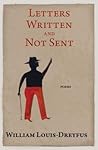
Letters Written and Not SentLetters Written and Not Sent by William Louis-Dreyfus
My rating: 5 of 5 stars

Amazon page


This collection consists of about 55 poems, mostly of the short-form free verse variety. The author passed away between completion and publication of the volume. He was that rarest of creatures, a rich poet. (Though he was not an impossible creature – i.e. he didn’t become a billionaire by writing poetry. It was his side gig between trading in commodities.)

One of the poems toward the end of the book, “How to keep from being devoured,” changed my attitude toward the book. Up until that poem, I found the collection to be just okay. It was alright, but didn’t feel like anything special. However, that one poem made its mark on me, and I suspect other readers will find their own favorites among the collection. The poems are finely crafted. The fact that this one short volume is billed as the man’s “lifetime work” suggests that he focused on quality rather than quantity of verse.

I found a gem among a body well-composed poetic works, and I’m pleased I took the time to read this collection.

View all my reviews

BOOK REVIEW: Why Dylan Matters by Richard F. Thomas

Why Dylan MattersWhy Dylan Matters by Richard F Thomas
My rating: 4 of 5 stars

Amazon page


Obviously, in the annals of popular music, the work of Bob Dylan matters. To make sense of the title and related objective of this book (which might otherwise seem presumptuous and demeaning) one has to know a little about some recent history of the politics of the Nobel Prize for Literature. (No, not the internal scandal that delayed the issuance of the 2018 Prize to 2019.) In 2016, an American hadn’t won since 1993 (Toni Morrison,) and given the relative volume of publications from America this was coming to be seen as a major “screw you” to the nation’s literary community. The Nobel committee claimed it was because American authors didn’t get their works translated and were too insular with respect to the global literary community. Still, the disparity was on the minds of many. Then, Bob Dylan was issued the Prize. While some who were offended by this disparity were placated, many thought it was an even bigger “screw you” than if the Committee again hadn’t issued it to an American – like it was a “you asked for it, you got it; now shut up for at least the next 15 years!” kind of award. I doubt anyone would deny that, as a pop music lyricist, Bob Dylan is brilliant – if not the best — but for many that still just made him a middling poet. (Dylan wrote one piece of prose poetry, “Tarantula” as well as “memoirs” [that were apparently largely an act of creative writing,] but only his lyrics could feasibly merit issue of the award.)

It was with that mess in mind that Thomas delivers this book. It seems to be his objective to not just prove that Dylan matters — generally speaking — but that Dylan’s work matters as literature – presumably, such that he’s at least as deserving of the Nobel Prize as any living American poet, story-writer, or novelist. The thrust of Thomas’s approach is in showing that Dylan’s work is dialed into the global literary canon. As a classicist, Thomas puts particular emphasis on Dylan’s stealing from, and referencing of, Greek and Roman figures like Homer and Ovid. (I mean “stealing” only in the sense that word used by artists, and there is considerable discussion of that subject, herein.) However, he does also show how Dylan uses and references other poets from Shakespeare to an obscure Confederate poet.

So, the logical question is whether Thomas answers his book’s titular question with enough authority to convince the reader that Dylan does matter. Thomas certainly convinces us why Dylan matters enough to have classes taught about him, like the one Thomas teaches a Harvard. However, I can’t say that I was convinced that Dylan is on-par with… for instance, Cormac McCarthy or Salman Rushdie (who resides in the US, as I understand it) as a major literary figure. While Thomas does show that Dylan’s work is literature because Dylan’s work is wrapped up in literature, the only real argument he offers for whether Dylan is at the highest echelon of literature is his intense fan-boy devotion. We see a lot of comments like: “He had all that he needed to write ‘Masters of War,’ the greatest anti-war song ever written.” Not “one of the best,” not “the best, in my opinion,” not “the best rock-n-roll anti-war song,” but a gratuitous presumption that nothing else could be considered in the running enough for there to be a debate. Thomas’s enthusiasm that Dylan is among the biggest artistic geniuses of our time – if not all time – is certainly potent, but not necessarily compelling.

The book is annotated, has a bibliography and a graphic discography.

I enjoyed this book. I learned a lot about the works of Bob Dylan and I found the author’s fervor for Dylan’s songs contagious — if not altogether convincing that it merits Dylan’s inclusion with Hemingway and Faulkner as an American literary icon. [Though I would not in the least challenge his inclusion as an icon of folk, rock, or pop music.] If you’re interested in Dylan, or this question of whether he’s the best American for the job of Literary Nobel Laureate, this book is worth a read.

View all my reviews

POEM: Morpheus’ Shroud

Last night the drape was thin and billowy.
Dreams seen through the weep of a willow tree.
Shapes without texture, beings without plights.
A curtain of fog, turning days into nights.

I stood on a corner in the land of nod.
One not crossed in maps of men or gods.
And wondered whether I was found or lost.
Waiting in calm for a morrow tempest-tossed.

But morning light brought me no clarity.

BOOK REVIEW: Three Tang Dynasty Poets by Wang Wei, Li Po, and Tu Fu

Three Tang Dynasty PoetsThree Tang Dynasty Poets by Wang Wei
My rating: 5 of 5 stars

Amazon page


This book is in a series put out by Penguin Books entitled “Little Black Classics.” As the series name implies, these are booklets featuring classic works (or fragments, thereof.) This book features a combined 33 poems by three Chinese poets who lived in the eight century.

In the 14 poems by Wang Wei (a.k.a. Wang Youcheng) we see his famed mastery of landscape and nature poems, and we feel the effect of his Cha’an (Zen) Buddhist mindset.

Among the ten poems by Li Po (a.k.a. Li Bai) we are introduced from the beginning to the poet’s legendary proclivity for drink. While it’s not all carousing, human characters do play a more central role in Li Po’s work.
There are nine poems by Tu Fu (or, Du Fu), which share Li Po’s inclination to feature humanity at the heart of each poem, if in a more straight-laced way.

I enjoyed the poems in both their imagery and sound quality. I can’t really speak to how skilled the translation was, i.e. how much better or worse they could have been. The translators were G.W. Robinson and Arthur Cooper, who I know nothing of, but who apparently both translated a considerable amount of classic Chinese literature.

The poems are almost all short form works, so – with one exception – the poems are included in their entirety (i.e. not excerpted.)

The booklet has an appendix that features a two-page prose story entitled “The Story of the Peach Blossom Spring” by Tao Yuanming. The reason for including the story is that it’s the inspiration for the Wang Wei poem that opens the volume.

I enjoyed reading this little booklet of poetry. The translations are easy to follow, and the imagery is appealing. The Zen / Taoist feel that is widespread in these works is pleasant.

View all my reviews

Haiku of Trees

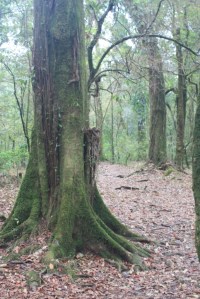
mossy trees
in a foggy forest
eery squared


split oak tree
hollowed by water
chimnified


a lone tree
sits atop a green hill,
solemnly


distant trees
resemble a painting
not a true grove