BOOK REVIEW: Sour Grapes by William Carlos Williams

Sour Grapes: A Book of PoemsSour Grapes: A Book of Poems by William Carlos Williams
My rating: 5 of 5 stars

Amazon.in page


This 1921 poetry collection is Williams’ fourth, coming out early in his career — shortly before his most well-known poem (“The Red Wheelbarrow” (1923)) and long before his most acclaimed collections — Paterson [National Book Award in 1949] and Pictures from Brueghel (1962) [Pulitzer, 1963.] Williams was a full-time physician, and in this part of his career composing poems would have been a secondary pursuit. The 50-some poems of the collection are mostly free-verse imagist poems. The experimental and improvisational nature of the included poems has been both criticized and lauded.

As I mentioned, imagism is the primary approach in this collection, focusing on vivid descriptiveness — particularly in the visual sense. The subject matter is largely natural, but it does include a not inconsequential venture into human activity. A recurring theme in the collection is seasonality. [While these poems aren’t haiku, haiku readers will recognize the importance of seasons in that form.] That’s not the only connection to the Japanese style. Much of William’s work features economy, a fundamental trait in haiku. Few of these poems have the verbal terseness of haiku (i.e. that few words) but they share that form’s austerity of meaning (i.e. sticking to description and not getting involved in analysis or judgement.)

I enjoyed this collection. It might not be William’s most polished work, but that doesn’t necessarily make it undeserving of reflection.

View all my reviews

Five City Limericks


There was a buxom lass of London
who was perpetually undone —
her plotting, it flopped —
her buttons, they popped.
She was undone in more ways than one.


There once was a man from New York
who would only eat using a fork.
You’d think soup his ruin,
but ’twasn’t his undoin’ —
he starved over a giant slab of pork.


There was a young gal from Tokyo
who used her umbrella in the snow.
‘Twas structurally sound,
and held eighty pounds.
huge biceps had that buff girl of Tokyo.


There was a young man of New Delhi
who thought himself the new Machiavelli.
He said, “Make them fear,
or you’ll see them sneer!”
…’twere not for his knees made of jelly.


There was a salesman from Nairobi
whose mind trick was like Ben Kenobi’s —
or so he did think,
but — despite psychic link —
he couldn’t sell even one Flowbee.

POEM: Ubiquitous Bird’s Eye

On my street, not a thing happens
uncaptured in birds’ eyes.
Hawks sit on streetlamps or corners —
swivel-cowled remote spies.

And the crows lurk by the murder,
swooping to the sidewalk.
Pigeons strut and flap-glide down low —
masters of the sly gawk.

Add myriad flitters and sitters —
high-speed reconnaissance
and those who seem occupied by
a playful mating dance.

They’re squatters, stalkers, and spotters —
but who watches the watchers?

POEM: On the Way to Chennagiri, or: A Silly Line of Thought

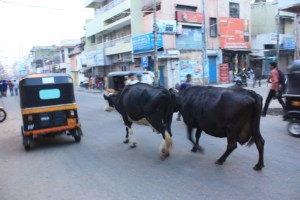
On the way to Chennagiri, I passed the military dairy farm, and wondered if they also grew blackberries and raspberries. Or, on the contrary, was it strictly a dairy — that would be so like the military. Stick with the primary, don’t distract with a secondary. But then — for the military — milking cows would already have to be tertiary, and, so, growing wild cherries would be quaternary, or — more likely — quinary [because, of course, they’d also need skills, veterinary.] But maybe the veterinary clinic is a subsidiary, or maybe they hire labor, temporary — maybe former service members volunteer — veteran veterinarians, so to speak.

Then I had a thought that was very scary, what if armed revolutionaries or radical reactionaries made a play for that dairy. The military would have to call on the constabulary, because the cows would be no help at all.

POEM: Moments Lost in the Monsoon

In monsoon moments, all falls still —
sounds of curb flow and gutter spill.
A restful ease from the patter
as raindrops fall, hit, and splatter.
Of lost minutes, I take my fill.

By the window, chin on the sill,
I watch water far below rill.
A car passes, no birds scatter.

-In monsoon moments…

In dim mid-day, I feel a chill,
though Tropics, says the Barbet’s trill.
I’m free — the Madness of the Hatter,
drowned out is the useless natter.
Though tempests may rage; all is still.

-In monsoon moments…

POEM: Windless Waving of the Mind

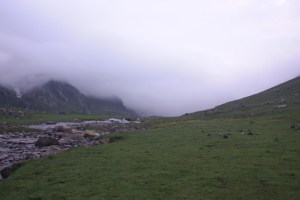
While walking down a verdant valley trail,
I saw the fog that gathered ’round the town.
And remembered an old, eerie folktale

about a village settled in a vale,
and felt my breath catch like I would now drown
while walking down that verdant valley trail.

In the tale, travelers heard a steady wail,
but found town ancient, empty, and run down.
Why remember that old, eerie folktale?

The sound I heard was like a flapping sail.
They must have set the flag and hunkered down,
while I was walking that green valley trail.

But snapping flags require some kind of gale.
This air was too still to rustle a nightgown
as I remembered that spooky folktale.

“Is that a boiling kettle or a wail?”
I ask as I have my nervous breakdown,
while walking down that verdant valley trail,
remembering that old, eerie folktale.

POEM: Dark Attractor

 See that vine crawl toward the darkness?

It’s nyctophilic as a Rave-addled youth.

“Maybe some genes got crossed — roots to leaves?”

Maybe, but how is it alive?

What winds it up enough to chase shadows to boarded mineshafts?

It might love darkness, but it’s not fed by darkness.

Some strange man called it “a canary in our coal mine.”

And that gave me a vague sense of foreboding.

POEM: King of Infinite Space

I have room to breath —

my ribs can’t catch the edge

of this expanding universe,

and, so, I suppose the cage is irrelevant.

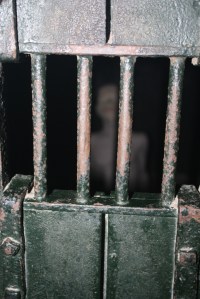
I can reach an arm as far as my shoulder allows —

as long as my hand slips through the slats.

With eyes shut, and cage in sway,

I’ve no reason to feel I’m in any particular place.

POEM: Disappearing Act

Some shake in fear that all will disappear —
from bone to soul — that all will disappear.


They hug it close, squeezing it so tightly
as to thwart the time when all disappears.


But that binding pressure only heightens
the dire urge to struggle to disappear.


Though nothing ever really vanishes,
but fades to the moment it disappears.


The secret is to be with each moment
in that slow fade, ’til it all disappears.

POEM: Mirror World

A mirrored world sprawls out beyond the glass.

I sit in reflection — a reflection

of a totem topped with an angry face —

a face so fierce its eyes will fry your mind.

The feeling fades, and I find I’ve crossed back.